What if a math sentence had a secret message? The symbol \(=\) has an important job. It tells us that the amount on one side is the same as the amount on the other side. When we understand this little sign, we can become math detectives and decide whether equations are true or false.
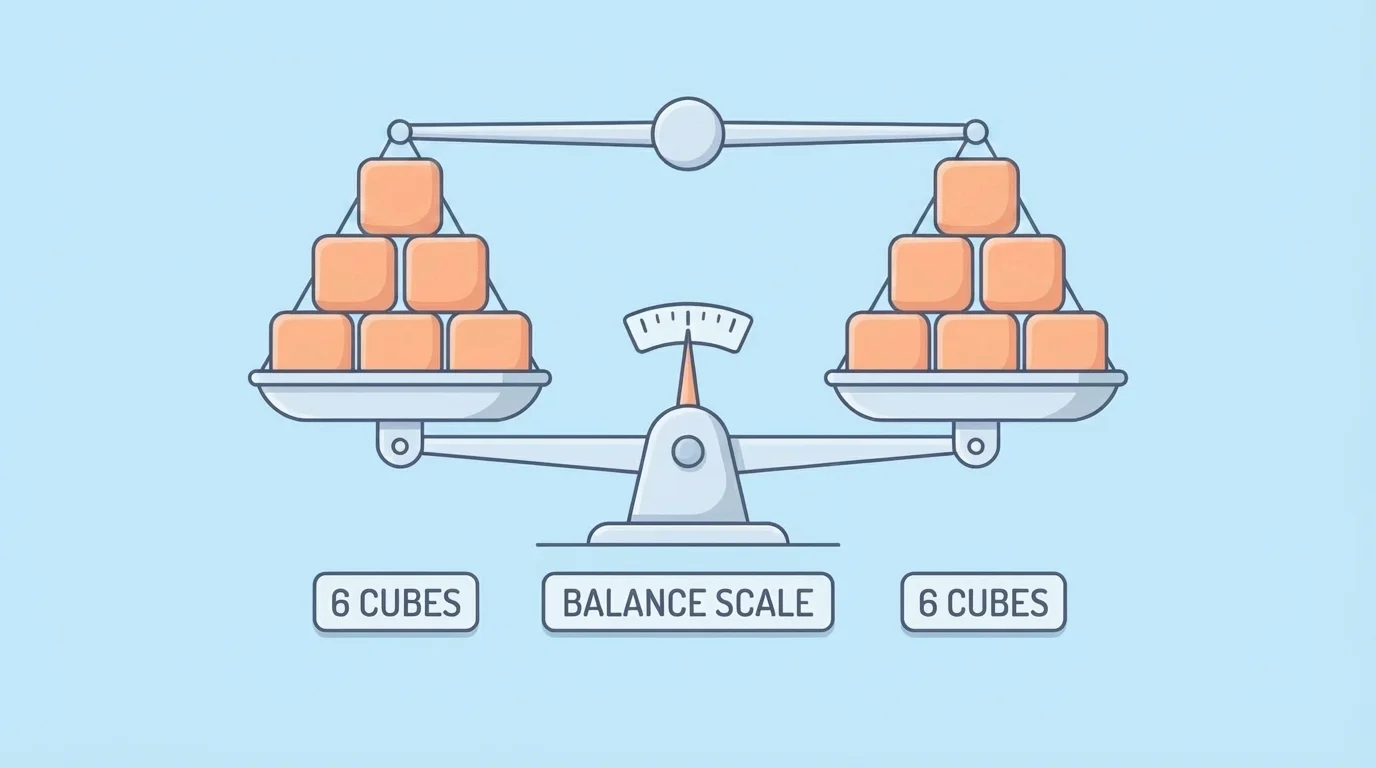
The equal sign, as [Figure 1] shows, means is the same as. It does not mean "put the answer here." It means the left side and the right side have equal value. If one side is \(6\), the other side must also be \(6\) for the equation to be true.
You can think about the equal sign like a balance. If both sides match, the balance is level. If the sides do not match, they are not equal. For example, in \(6 = 6\), both sides are the same, so the equation is true.
Sometimes one side has just one number, and the other side has an addition or subtraction expression. That is okay. We still check whether both sides are the same amount. In \(7 = 8 - 1\), the right side is \(7\) because \(8 - 1 = 7\). Since both sides are \(7\), the equation is true.
Equation is a math sentence with an equal sign. A true equation has the same value on both sides. A false equation does not have the same value on both sides.
When you read an equation, try saying, "This side is the same as that side." That helps you remember what the equal sign means.
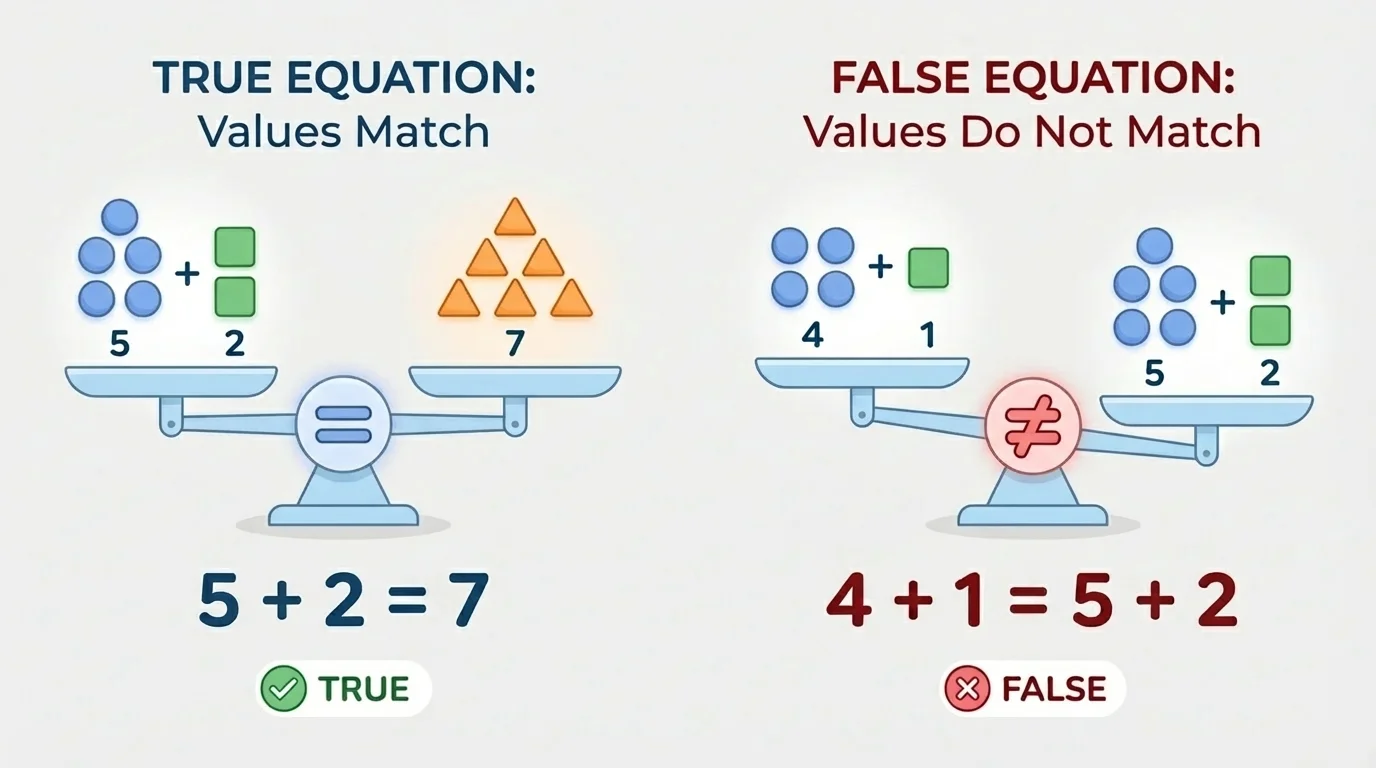
A equation can be checked by finding the value of each side. As [Figure 2] illustrates, if both sides match, the equation is true. If they do not match, it is false.
Let's look at some examples. In \(6 = 6\), the left side is \(6\) and the right side is \(6\). They match, so it is true. In \(4 + 1 = 5 + 2\), the left side is \(5\) and the right side is \(7\). Since \(5 \neq 7\), the equation is false.
It is important to check both sides. Some children look only at one side and stop. But the equal sign is about comparing two amounts.
You already know how to add and subtract small numbers. Now you are using those skills to compare two sides of a math sentence.
If you are unsure, solve the left side, solve the right side, and then ask: "Are they the same?"
Sometimes addition facts can switch places and still stay equal. As [Figure 3] shows, \(5 + 2\) and \(2 + 5\) both make \(7\). That means \(5 + 2 = 2 + 5\) is true.
This happens because with addition, changing the order does not change the total. If you have \(5\) blocks and then \(2\) more blocks, you have \(7\) blocks. If you have \(2\) blocks and then \(5\) more blocks, you still have \(7\) blocks.
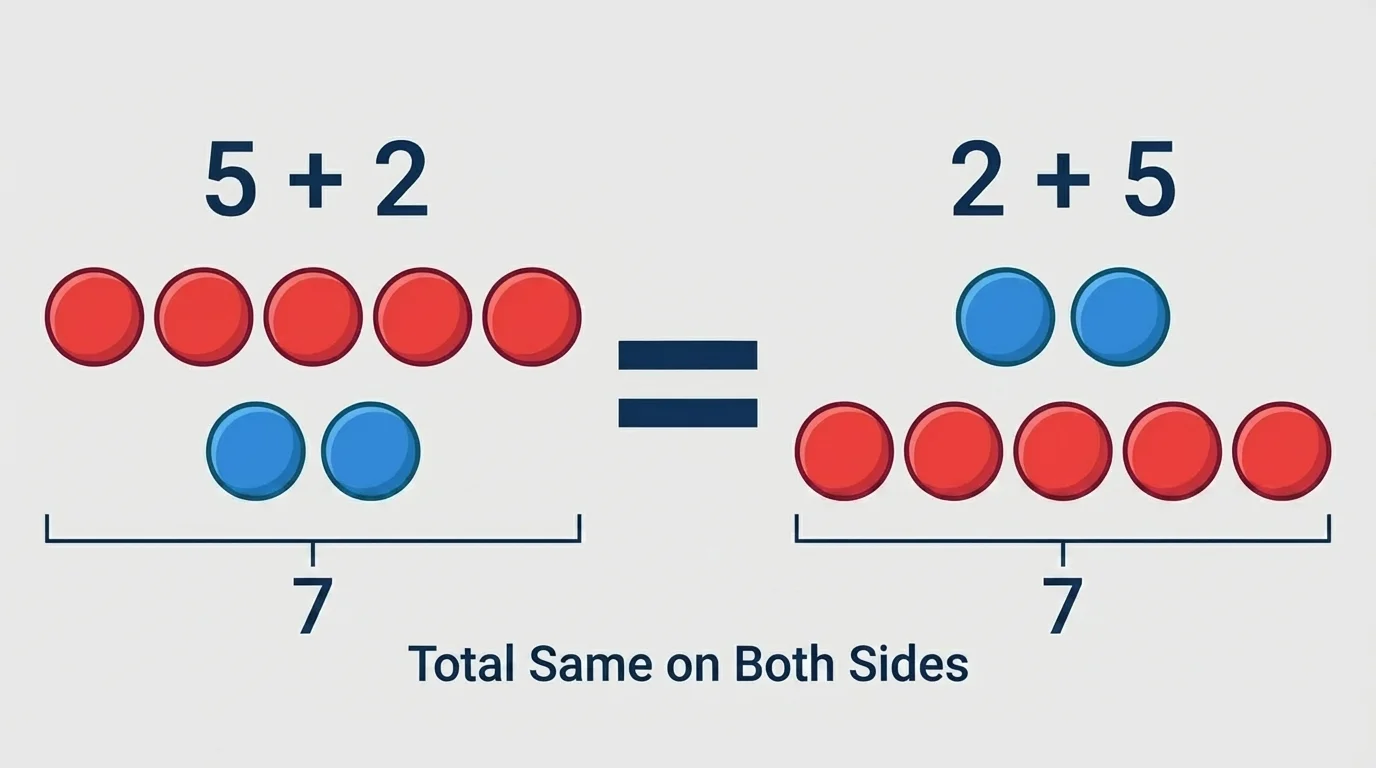
Later, when you see the same idea again in [Figure 3], it can help you remember that addition can be checked in different orders, but the equal sign still asks one question: do both sides have the same value?
Turning addends around keeps the total the same. That is why \(1 + 4\) and \(4 + 1\) both equal \(5\).
But be careful: not every equation with the same numbers is true. You must still check both sides.
Subtraction needs careful thinking. In \(7 = 8 - 1\), the right side is \(7\), so the equation is true. But if we had \(7 = 1 - 8\), that would not work for our grade-level subtraction, because \(1 - 8\) does not match \(7\).
Subtraction tells how many are left. So we cannot just switch numbers around and expect it to stay the same. For example, \(5 - 2 = 3\), but \(2 - 5\) is not the same as \(3\).
This is why checking each side matters so much. In [Figure 2], one equation matches and one does not. Math is not about guessing. It is about comparing carefully.
Now let's solve some true-or-false equations step by step.
Example 1
Is \(6 = 6\) true or false?
Step 1: Look at the left side.
The left side is \(6\).
Step 2: Look at the right side.
The right side is \(6\).
Step 3: Compare both sides.
Since \(6 = 6\), the equation is true.
Answer: \[\textrm{True}\]
That one is simple because both sides already show the same number.
Example 2
Is \(7 = 8 - 1\) true or false?
Step 1: Find the left side.
The left side is \(7\).
Step 2: Solve the right side.
\(8 - 1 = 7\).
Step 3: Compare.
Now we have \(7 = 7\).
Step 4: Decide.
Because both sides are the same, the equation is true.
Answer: \[\textrm{True}\]
Even though the sides look different at first, they have the same value.
Example 3
Is \(5 + 2 = 2 + 5\) true or false?
Step 1: Solve the left side.
\(5 + 2 = 7\).
Step 2: Solve the right side.
\(2 + 5 = 7\).
Step 3: Compare.
Now we have \(7 = 7\).
Answer: \[\textrm{True}\]
This is the same turn-around addition idea we saw earlier in [Figure 3].
Example 4
Is \(4 + 1 = 5 + 2\) true or false?
Step 1: Solve the left side.
\(4 + 1 = 5\).
Step 2: Solve the right side.
\(5 + 2 = 7\).
Step 3: Compare.
Now we have \(5 = 7\).
Step 4: Decide.
Because \(5 \neq 7\), the equation is false.
Answer: \[\textrm{False}\]
This example shows why we cannot assume an equation is true just because it has numbers and an equal sign.
The equal sign can describe real things around you. Suppose one plate has \(3\) crackers and another has \(2\) crackers. Together that makes \(3 + 2 = 5\) crackers. If another plate has \(5\) crackers, then \(3 + 2 = 5\) is a true equation.
Or think about toys. One shelf has \(4\) toy cars and you add \(1\) more. Now there are \(5\). If another shelf has \(7\) cars, then \(4 + 1 = 7\) is false because \(5 \neq 7\).
Math sentences help us compare amounts in the world around us. The equal sign tells us whether two amounts match.
A common mistake is thinking the equal sign only means "the answer is next." But in equations like \(5 + 2 = 2 + 5\), there is math on both sides. The equal sign still means both sides are the same.
Another mistake is checking only one side. For example, in \(4 + 1 = 5 + 2\), a child might see \(4 + 1 = 5\) and stop. But we must also check the right side. Since \(5 + 2 = 7\), the equation is false.
When you read any equation, ask: What is the value on the left? What is the value on the right? Are they equal?
"Equal means the same amount on both sides."
That idea helps with every true-or-false equation you see.
