A video game character flips, turns, slides, and zooms across a screen in a fraction of a second. Behind that motion is geometry. The same ideas are used in mapping applications, building plans, logo design, and animation. In coordinate geometry, these moves are called transformations, and they let us describe exactly what happens to a figure using points like \((2,3)\) and \((-4,1)\).
When a figure changes position, direction, or size on a coordinate plane, we can track every vertex using coordinates. That makes geometric descriptions precise. Instead of saying a triangle "moved over there," we can say that each point shifted \(4\) units right, reflected across the \(y\)-axis, rotated \(90^\circ\), or dilated by a scale factor of \(2\).
A transformation is a rule that moves or changes a figure. Some transformations keep the figure exactly the same size and shape. Others change the size but keep the shape proportional. Learning these moves helps explain two major geometry ideas: congruence and similarity.
In middle school geometry, the most important transformations are translations, reflections, rotations, and dilations. The first three are often called rigid transformations because they do not change the figure's size or shape. A dilation changes size, but with a positive scale factor, it keeps the figure similar to the original.
Preimage and image: The original figure before a transformation is the preimage. The new figure after the transformation is the image. If point \(A\) moves to a new location, the image is usually named \(A'\), read as "\(A\) prime."
Coordinate plane: A grid formed by the horizontal \(x\)-axis and the vertical \(y\)-axis. Their intersection is the origin, \((0,0)\).
Every transformation can be described by what happens to each point. If you know the coordinates of all vertices of a polygon, you can graph the image exactly. That is why coordinates are so useful: they turn geometric motion into clear mathematical rules.
An ordered pair \((x,y)\) tells the location of a point. The first number, \(x\), gives horizontal movement. The second number, \(y\), gives vertical movement. Positive \(x\)-values are to the right, negative \(x\)-values are to the left, positive \(y\)-values are up, and negative \(y\)-values are down.
When we describe a transformation, we compare each original point with its image. For example, if \(P(1,2)\) becomes \(P'(5,2)\), only the \(x\)-coordinate changed. That suggests the point moved horizontally. If \(Q(-3,4)\) becomes \(Q'(-3,-4)\), the \(x\)-coordinate stayed the same but the \(y\)-coordinate changed sign. That suggests a reflection across the \(x\)-axis.
Distance on the coordinate plane can be counted by units horizontally and vertically. Also remember that corresponding vertices are matched in order: \(A\) with \(A'\), \(B\) with \(B'\), and so on. This matching helps you describe exactly how a figure changed.
A useful question for every transformation is: What stays the same, and what changes? Some moves keep lengths, angle measures, and orientation. Others reverse orientation or change lengths by a scale factor. Paying attention to these effects makes each transformation easier to recognize.
A translation slides a figure without turning or flipping it. [Figure 1] shows that every point moves the same distance in the same direction. Because all points move together, the figure keeps its size, shape, and orientation.
If a point \((x,y)\) is translated \(a\) units horizontally and \(b\) units vertically, the new point is \((x+a,y+b)\). Moving right means adding to \(x\). Moving left means subtracting from \(x\). Moving up means adding to \(y\). Moving down means subtracting from \(y\).
For example, a translation right \(4\) and down \(2\) changes \((x,y)\) into \((x+4,y-2)\). If \(R(-1,5)\) is translated that way, then \(R'(3,3)\).
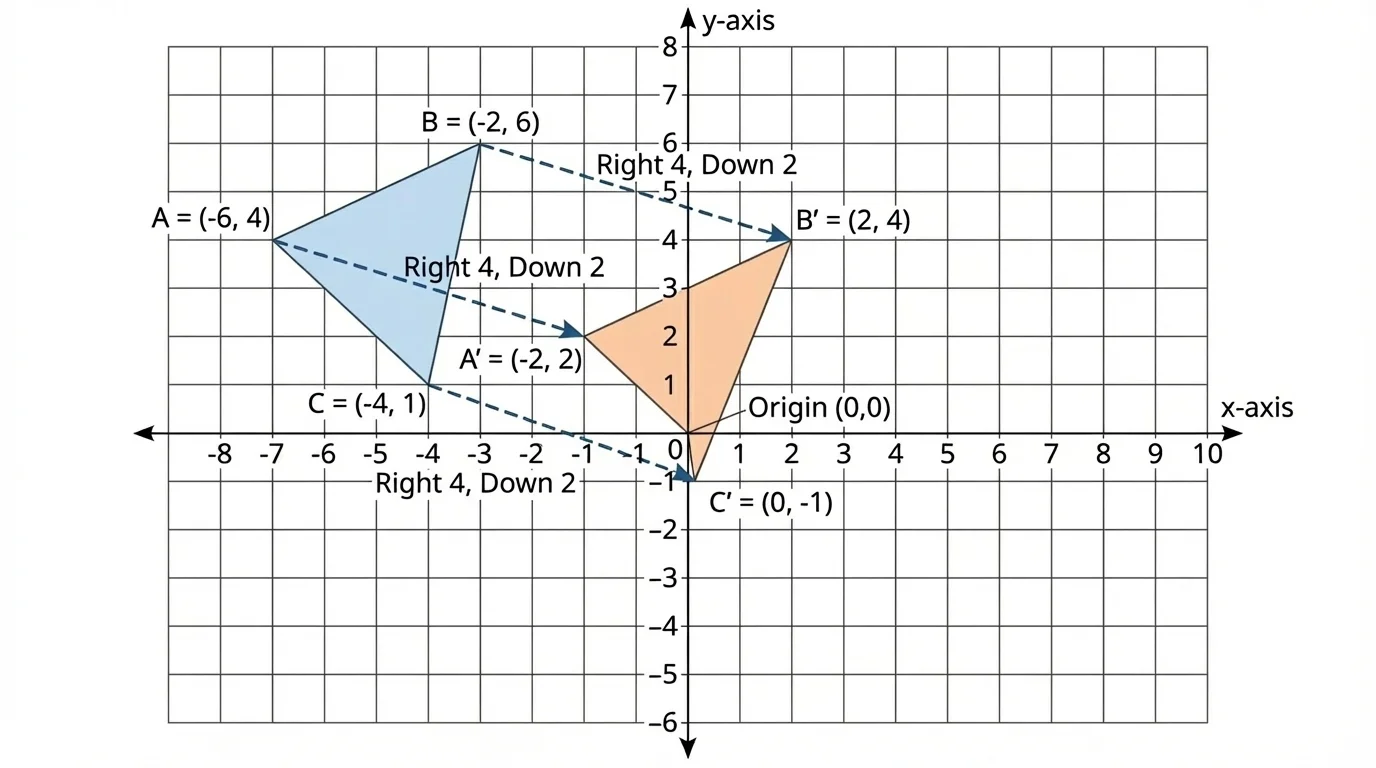
Translations are rigid transformations. That means corresponding side lengths stay equal and corresponding angles stay equal. A translated rectangle is still the same rectangle, just in a different place.
Later, when we compare congruent figures, we will return to [Figure 1]. It makes an important idea visible: a translation changes location, not size or shape.
A reflection flips a figure across a line. The line is called the line of reflection. [Figure 2] illustrates that a reflected figure looks like a mirror image. Points and their images are the same distance from the line of reflection, but on opposite sides.
Some coordinate rules for common reflections are very useful. Reflecting across the \(x\)-axis changes \((x,y)\) to \((x,-y)\). Reflecting across the \(y\)-axis changes \((x,y)\) to \((-x,y)\). Reflecting across the line \(y=x\) changes \((x,y)\) to \((y,x)\).
Suppose \(S(4,-2)\) is reflected across the \(y\)-axis. Its image is \(S'(-4,-2)\). Only the \(x\)-coordinate changes sign because the point moved to the opposite side of the vertical axis.
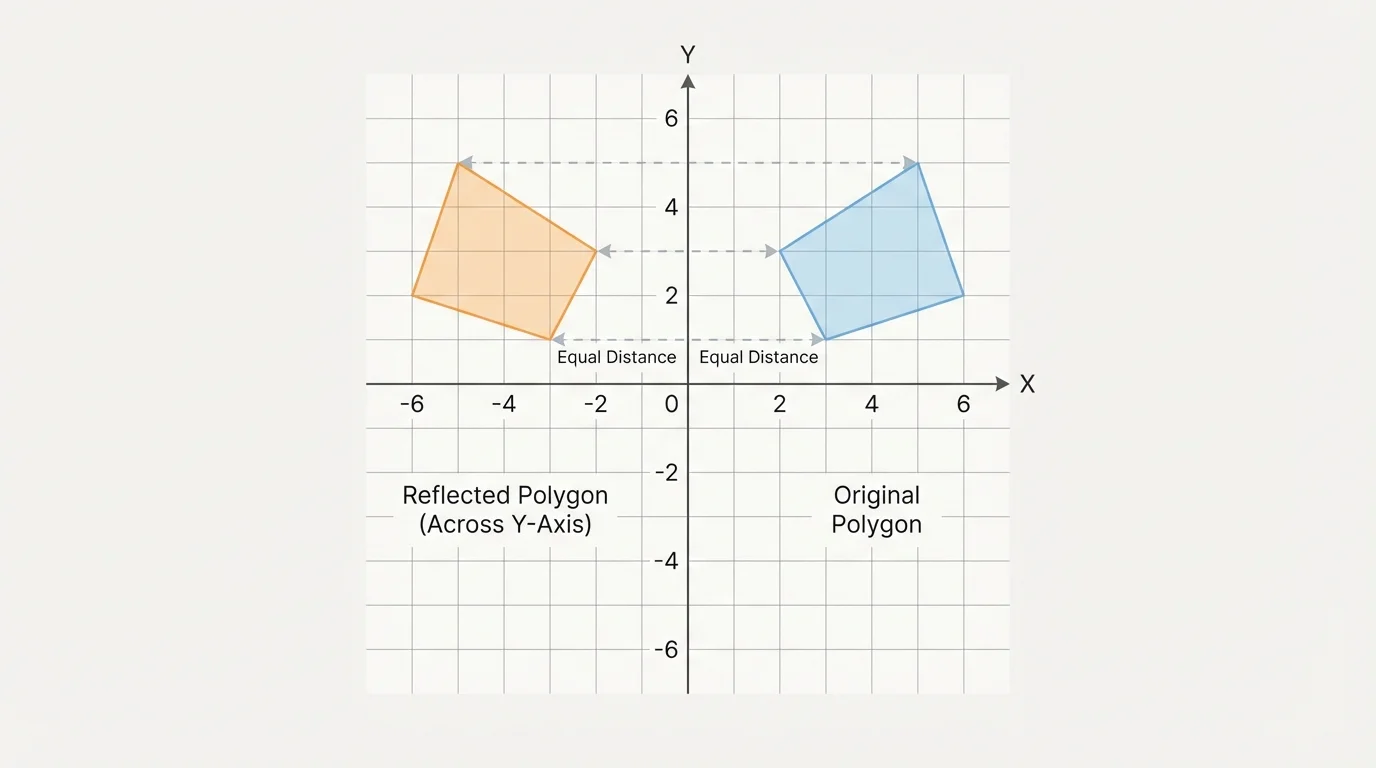
Reflections preserve lengths and angle measures, so they are rigid transformations. However, they reverse orientation. If the vertices of a polygon are named in clockwise order before the reflection, they appear in counterclockwise order after the reflection.
That reversal helps identify reflections. As we saw in [Figure 2], the figure is still the same size and shape, but its "handedness" changes, like a left glove compared with a right glove.
Mirror symmetry in nature often looks perfect, but living things are rarely exact reflections. Human faces, butterfly wings, and leaves may be close to symmetric, yet tiny coordinate differences would show they are not completely identical.
Reflections are especially useful in art, architecture, and logo design because symmetry often makes a design look balanced and intentional.
A rotation turns a figure around a fixed point called the center of rotation. On the coordinate plane, many problems use the origin as the center. [Figure 3] shows the figure turning by a certain angle, such as \(90^\circ\), \(180^\circ\), or \(270^\circ\).
Direction matters. A rotation can be clockwise or counterclockwise. Common rules for rotations about the origin are important to know:
For a \(90^\circ\) counterclockwise rotation, \((x,y)\rightarrow(-y,x)\).
For a \(180^\circ\) rotation, \((x,y)\rightarrow(-x,-y)\).
For a \(270^\circ\) counterclockwise rotation, \((x,y)\rightarrow(y,-x)\).
Because a \(90^\circ\) clockwise rotation is the same as a \(270^\circ\) counterclockwise rotation, its rule is also \((x,y)\rightarrow(y,-x)\).
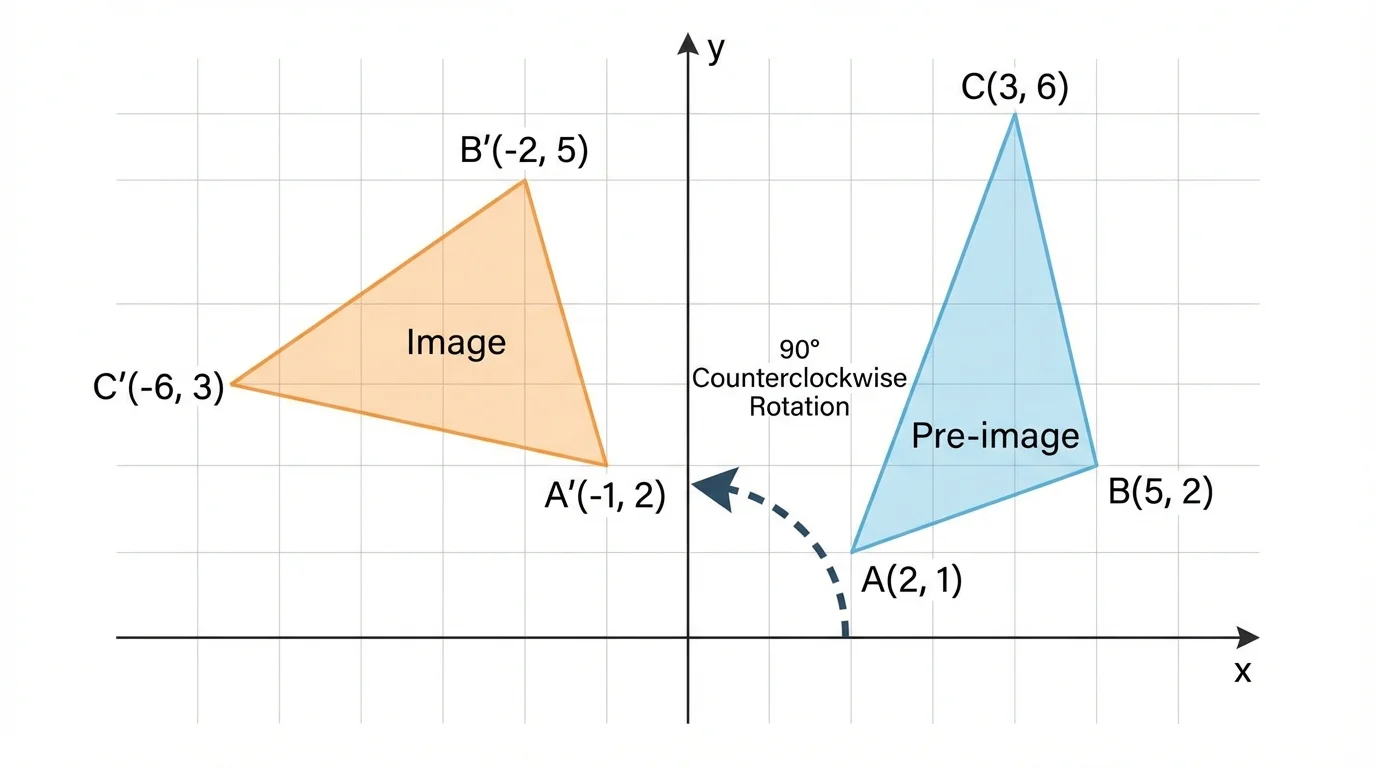
For example, if \(T(2,5)\) is rotated \(90^\circ\) counterclockwise about the origin, then \(T'(-5,2)\). The coordinates switch places, and the new \(x\)-value becomes negative.
Rotations are rigid transformations, so they preserve lengths and angle measures. Unlike reflections, rotations do not create a mirror image. The figure turns, but its orientation is preserved relative to the turn.
Looking back at [Figure 3], notice that each point travels around the center of rotation. That idea becomes important in robotics and computer animation, where objects often rotate around a fixed pivot point.
A dilation changes the size of a figure while keeping its shape. The amount of change is described by a scale factor. [Figure 4] shows that when the center of dilation is the origin, each point moves along a line from the origin through that point.
If the scale factor is \(k\), then the rule for a dilation centered at the origin is \((x,y)\rightarrow(kx,ky)\). If \(k>1\), the image is an enlargement. If \(0<k<1\), the image is a reduction.
For example, if \(U(3,-2)\) is dilated by a scale factor of \(2\), then \(U'(6,-4)\). If the same point is dilated by a scale factor of \(\dfrac{1}{2}\), then \(U'(\dfrac{3}{2},-1)\).
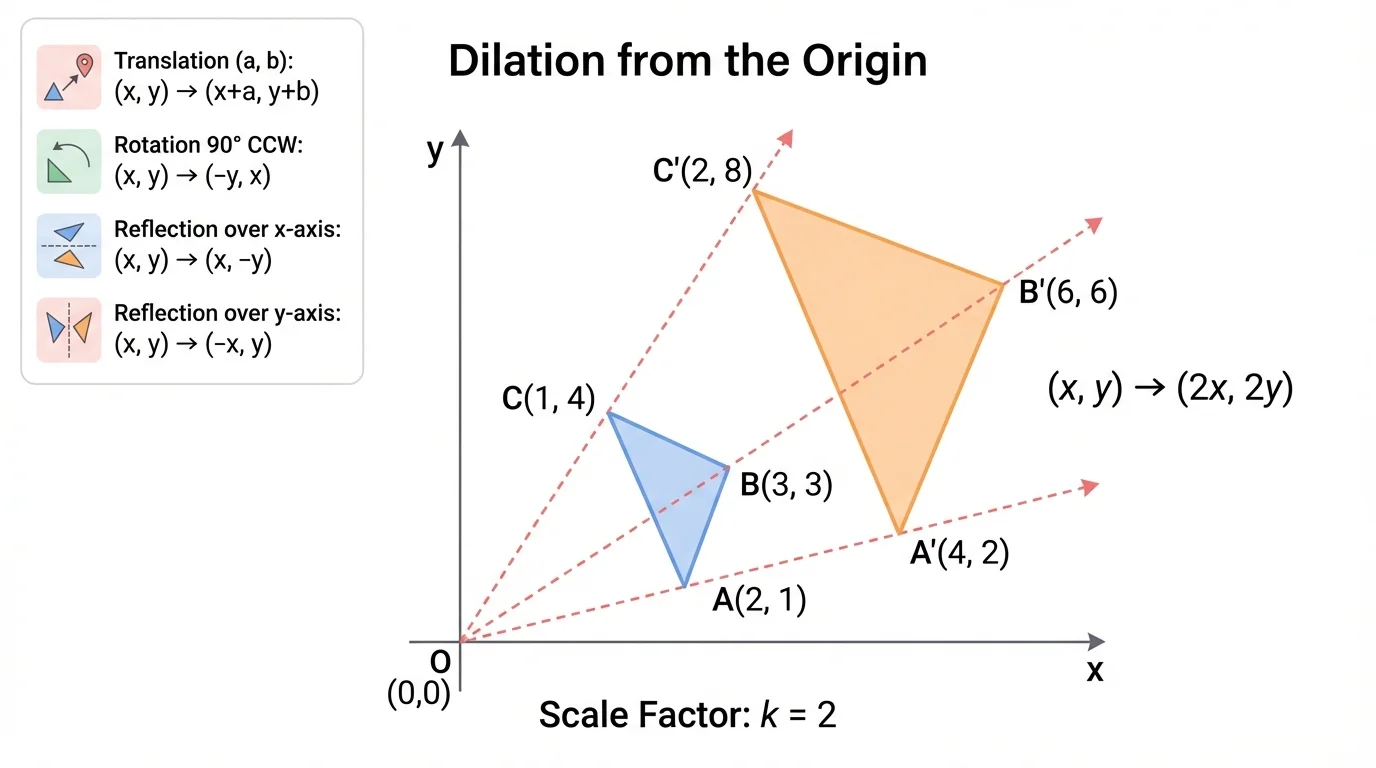
A dilation preserves angle measures, but it does not usually preserve side lengths. Instead, every length is multiplied by the same scale factor. If one side was \(5\) units long and the scale factor is \(3\), the image side is \(15\) units long.
The effect seen in [Figure 4] explains why dilations are connected to similar figures. The shape stays the same, but the size changes in a proportional way.
Rigid transformations and dilations
Translations, reflections, and rotations are rigid because they preserve distance and angle measure exactly. Dilations preserve angle measure and proportional shape, but they change distances by multiplying them by a scale factor. That is why rigid transformations are used to show congruence, while dilations are used to show similarity.
If the scale factor is \(1\), the dilation does not change the figure at all. If the scale factor is negative, the figure is also sent through the center to the opposite side, but at this level the main focus is on positive scale factors.
Two figures are congruent if one can be moved onto the other by a sequence of translations, rotations, and reflections. Because those moves preserve lengths and angles, congruent figures have the same size and shape.
Two figures are similar if one can be transformed into the other by a dilation, possibly combined with translations, rotations, or reflections. Similar figures have the same shape, but not necessarily the same size.
This idea connects physical models, transparencies, and geometry software with coordinates. If a shape on one transparency matches another after sliding or turning, the figures are congruent. If one transparency must also be enlarged or reduced, the figures are similar.
One of the most powerful habits in geometry is asking which transformation, or sequence of transformations, takes one figure to another. Sometimes the answer is just one move. Sometimes it takes two or three.
Now let's use coordinates to describe exact effects on figures.
Worked example 1: Translation of a triangle
Triangle \(ABC\) has vertices \(A(1,2)\), \(B(4,2)\), and \(C(2,5)\). Translate the triangle \(3\) units left and \(4\) units up.
Step 1: Write the translation rule.
Moving \(3\) units left means subtract \(3\) from each \(x\)-coordinate. Moving \(4\) units up means add \(4\) to each \(y\)-coordinate.
The rule is \((x,y)\rightarrow(x-3,y+4)\).
Step 2: Apply the rule to each vertex.
For \(A(1,2)\): \(A'(1-3,2+4)=(-2,6)\).
For \(B(4,2)\): \(B'(4-3,2+4)=(1,6)\).
For \(C(2,5)\): \(C'(2-3,5+4)=(-1,9)\).
Step 3: State the image coordinates.
The translated triangle has vertices \(A'(-2,6)\), \(B'(1,6)\), and \(C'(-1,9)\).
The triangle keeps the same side lengths and angle measures because a translation is rigid.
Notice that the coordinates changed in a very consistent pattern. That is the signature of a translation: every point follows the same rule.
Worked example 2: Reflection across the \(x\)-axis
A rectangle has vertices \(P(-5,1)\), \(Q(-1,1)\), \(R(-1,4)\), and \(S(-5,4)\). Reflect it across the \(x\)-axis.
Step 1: Use the reflection rule.
Reflection across the \(x\)-axis uses \((x,y)\rightarrow(x,-y)\).
Step 2: Find each image point.
\(P'(-5,-1)\), \(Q'(-1,-1)\), \(R'(-1,-4)\), and \(S'(-5,-4)\).
Step 3: Describe the effect.
The rectangle moves to the opposite side of the \(x\)-axis. Its size and shape stay the same, but its orientation is reversed.
The reflected image is congruent to the original rectangle.
Reflections are often identified by opposite signs in one coordinate but not the other. That quick pattern recognition saves time.
Worked example 3: Rotation about the origin
Point \(M(6,-2)\) and point \(N(3,1)\) are rotated \(90^\circ\) counterclockwise about the origin. Find \(M'\) and \(N'\).
Step 1: Recall the rule.
For \(90^\circ\) counterclockwise, \((x,y)\rightarrow(-y,x)\).
Step 2: Rotate point \(M\).
\(M(6,-2)\rightarrow M'(2,6)\) because \(-(-2)=2\) and the new \(y\)-coordinate is \(6\).
Step 3: Rotate point \(N\).
\(N(3,1)\rightarrow N'(-1,3)\).
The image points are \(M'(2,6)\) and \(N'(-1,3)\).
Notice that the coordinates switch places in a predictable way. Rotations may look complicated on a graph, but the coordinate rules make them manageable.
Worked example 4: Dilation from the origin
Triangle \(JKL\) has vertices \(J(2,1)\), \(K(4,3)\), and \(L(1,5)\). Dilate the triangle by a scale factor of \(\dfrac{3}{2}\) centered at the origin.
Step 1: Write the dilation rule.
For scale factor \(\dfrac{3}{2}\), use \((x,y)\rightarrow(\dfrac{3}{2}x,\dfrac{3}{2}y)\).
Step 2: Multiply each coordinate by \(\dfrac{3}{2}\).
\(J'(3,\dfrac{3}{2})\), because \(\dfrac{3}{2}\cdot 2=3\) and \(\dfrac{3}{2}\cdot 1=\dfrac{3}{2}\).
\(K'(6,\dfrac{9}{2})\), because \(\dfrac{3}{2}\cdot 4=6\) and \(\dfrac{3}{2}\cdot 3=\dfrac{9}{2}\).
\(L'(\dfrac{3}{2},\dfrac{15}{2})\), because \(\dfrac{3}{2}\cdot 1=\dfrac{3}{2}\) and \(\dfrac{3}{2}\cdot 5=\dfrac{15}{2}\).
Step 3: Interpret the result.
The image triangle is larger than the original because the scale factor is greater than \(1\). The side lengths are multiplied by \(\dfrac{3}{2}\), but angle measures stay the same.
The dilated triangle is similar to the original triangle.
Dilations are especially important because they connect algebra, geometry, and proportional reasoning all at once.
The four transformations are easier to remember when you compare what they do to distance, angle measure, and orientation.
| Transformation | Main effect | Size preserved? | Shape preserved? | Orientation preserved? |
|---|---|---|---|---|
| Translation | Slide | Yes | Yes | Yes |
| Reflection | Flip across a line | Yes | Yes | No |
| Rotation | Turn around a center | Yes | Yes | Yes |
| Dilation | Enlarge or reduce | No, unless scale factor is \(1\) | Yes, proportionally | Usually yes for positive scale factor |
Table 1. Comparison of the main effects of translations, reflections, rotations, and dilations.
A quick way to classify figures is to ask whether lengths stay exactly the same. If they do, the transformation is rigid. If all lengths are multiplied by the same factor, the transformation is a dilation.
Transformations are not just school geometry. In computer graphics, a character may be translated across the screen, rotated to face a new direction, reflected to create a mirror effect, and dilated to look closer or farther away. The software handles those changes by updating coordinates.
Map makers use dilation when they change scale. A city block on a small map and the same block on a large map are different sizes, but the shapes remain proportional. Architects and engineers also rely on scaling to turn a full-size object into a drawing and back again.
Reflections appear in design and manufacturing when symmetry matters. Rotations matter in robotics, gears, and navigation systems. Even sports strategy diagrams use translations and rotations to represent movement and repositioning on a field or court.
"Geometry is the art of correct reasoning from incorrectly drawn figures."
— Often attributed to George Pólya
That quote fits transformations perfectly. A sketch on graph paper may not be exact, but coordinate rules let you reason with precision. If the rule is correct, the transformation is correct.
