Surveyors can find the width of a river without crossing it, and engineers can check whether a scaled drawing will produce a safe structure, because triangles carry reliable information. If two triangles match in just the right way, then every side and angle relationship becomes predictable. That is one of the most powerful ideas in geometry: a small amount of information can force an entire figure to behave in a specific way.
Triangles are rigid. A quadrilateral can change shape while keeping its side lengths, but a triangle cannot. That is why architects, bridge designers, and computer graphics systems rely so heavily on triangular structures. When we compare triangles, we usually want to answer one of two questions: are they exactly the same, or do they have the same shape?
The first question leads to congruence. The second leads to similarity. Congruence is stronger: if two triangles are congruent, then all corresponding sides and all corresponding angles are equal. Similarity is slightly weaker but still very useful: if two triangles are similar, then corresponding angles are equal and corresponding side lengths are proportional.
You already need two big ideas from earlier geometry: corresponding parts must be matched in the correct order, and angle relationships such as vertical angles, alternate interior angles, and linear pairs often provide the evidence needed to prove triangles congruent or similar.
We write congruence with the symbol \(\cong\). For example, \(\triangle ABC \cong \triangle DEF\) means vertex \(A\) matches \(D\), \(B\) matches \(E\), and \(C\) matches \(F\). We write similarity as \(\triangle ABC \sim \triangle DEF\). The order matters because it tells us which sides and angles correspond.
When geometers compare triangles, they look for patterns that guarantee a relationship. The difference between "same shape and size" and "same shape but not necessarily the same size" is shown clearly in [Figure 1]. In congruent triangles, every corresponding side is equal. In similar triangles, the angle pattern is the same, but one triangle may be a scaled copy of the other.
If \(\triangle ABC \cong \triangle DEF\), then \(AB = DE\), \(BC = EF\), \(AC = DF\), and \(\angle A = \angle D\), \(\angle B = \angle E\), \(\angle C = \angle F\). If \(\triangle ABC \sim \triangle DEF\), then the angles are equal and the sides satisfy a constant ratio such as
\[\frac{AB}{DE} = \frac{BC}{EF} = \frac{AC}{DF}\]
That common ratio is called the scale factor. If the scale factor from \(\triangle DEF\) to \(\triangle ABC\) is \(2\), then every side in \(\triangle ABC\) is twice the corresponding side in \(\triangle DEF\).
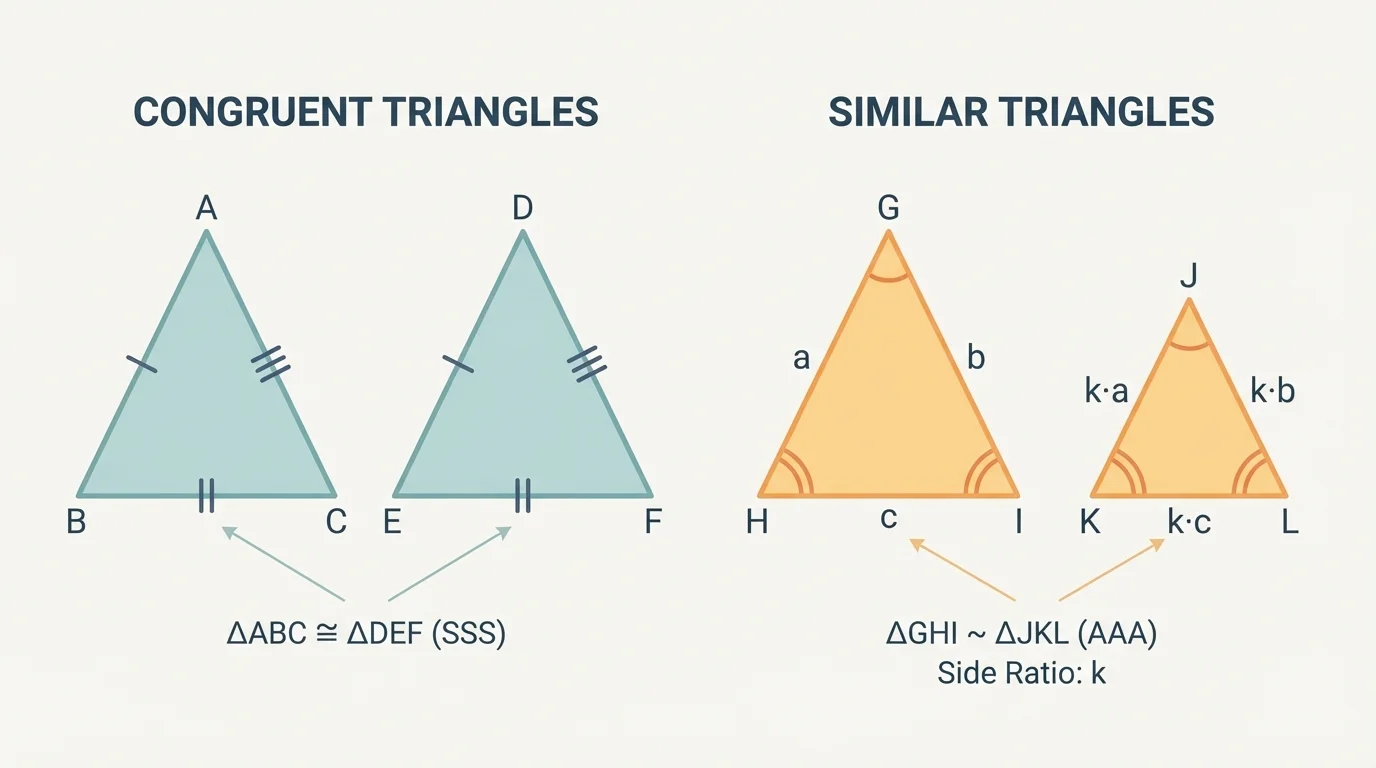
Similarity does not preserve side lengths, but it does preserve shape. That is why a blueprint, a map, and a digital model can represent a much larger object accurately. Congruence preserves both shape and size, so it is useful when we need exact matching pieces, such as in manufacturing or symmetrical design.
Congruent triangles are triangles with all corresponding sides and angles equal.
Similar triangles are triangles with all corresponding angles equal and corresponding sides in proportion.
Corresponding parts are sides or angles that occupy matching positions in two triangles.
A key proof idea follows from these definitions. If triangles are congruent, then their corresponding parts are congruent. This is often shortened to CPCTC, which means "corresponding parts of congruent triangles are congruent." If triangles are similar, then corresponding sides are proportional, and corresponding angles are congruent.
There are several tests that guarantee congruence. These criteria are strong enough to force two triangles to be exactly the same.
SSS congruence: If all three pairs of corresponding sides are equal, then the triangles are congruent.
SAS congruence: If two pairs of corresponding sides and the included angle are equal, then the triangles are congruent.
ASA congruence: If two pairs of corresponding angles and the included side are equal, then the triangles are congruent.
AAS congruence: If two pairs of corresponding angles and a non-included side are equal, then the triangles are congruent.
HL congruence: For right triangles only, if the hypotenuse and one corresponding leg are equal, then the triangles are congruent.
There are also combinations that do not guarantee congruence. For example, \(AAA\) tells us only that triangles are similar, not congruent. The information \(SSA\) is usually not enough because different triangles can satisfy it.
A triangle is so rigid that once enough measurements are fixed, its entire shape is locked in place. That rigidity is why triangular trusses appear in bridges, roofs, and towers.
When writing a proof with congruence, the pattern is usually: identify equal sides or angles, choose the correct criterion, conclude the triangles are congruent, and then use corresponding parts to prove the desired relationship.
AA similarity, SAS similarity, and SSS similarity are the main ways to prove triangles similar. Parallel lines often create equal angles and therefore similar triangles, as [Figure 2] illustrates in a larger triangle cut by a segment parallel to one side.
AA similarity: If two angles of one triangle are equal to two angles of another triangle, then the triangles are similar. This works because the third angles must also be equal.
SAS similarity: If two pairs of corresponding sides are proportional and the included angle is equal, then the triangles are similar.
SSS similarity: If all three pairs of corresponding sides are proportional, then the triangles are similar.
Suppose in \(\triangle ABC\), a segment \(DE\) is drawn so that \(D\) lies on \(AB\), \(E\) lies on \(AC\), and \(DE \parallel BC\). Then corresponding angles are equal: \(\angle ADE = \angle ABC\) and \(\angle AED = \angle ACB\). Therefore, \(\triangle ADE \sim \triangle ABC\). From similarity, we get proportional sides such as
\[\frac{AD}{AB} = \frac{AE}{AC} = \frac{DE}{BC}\]
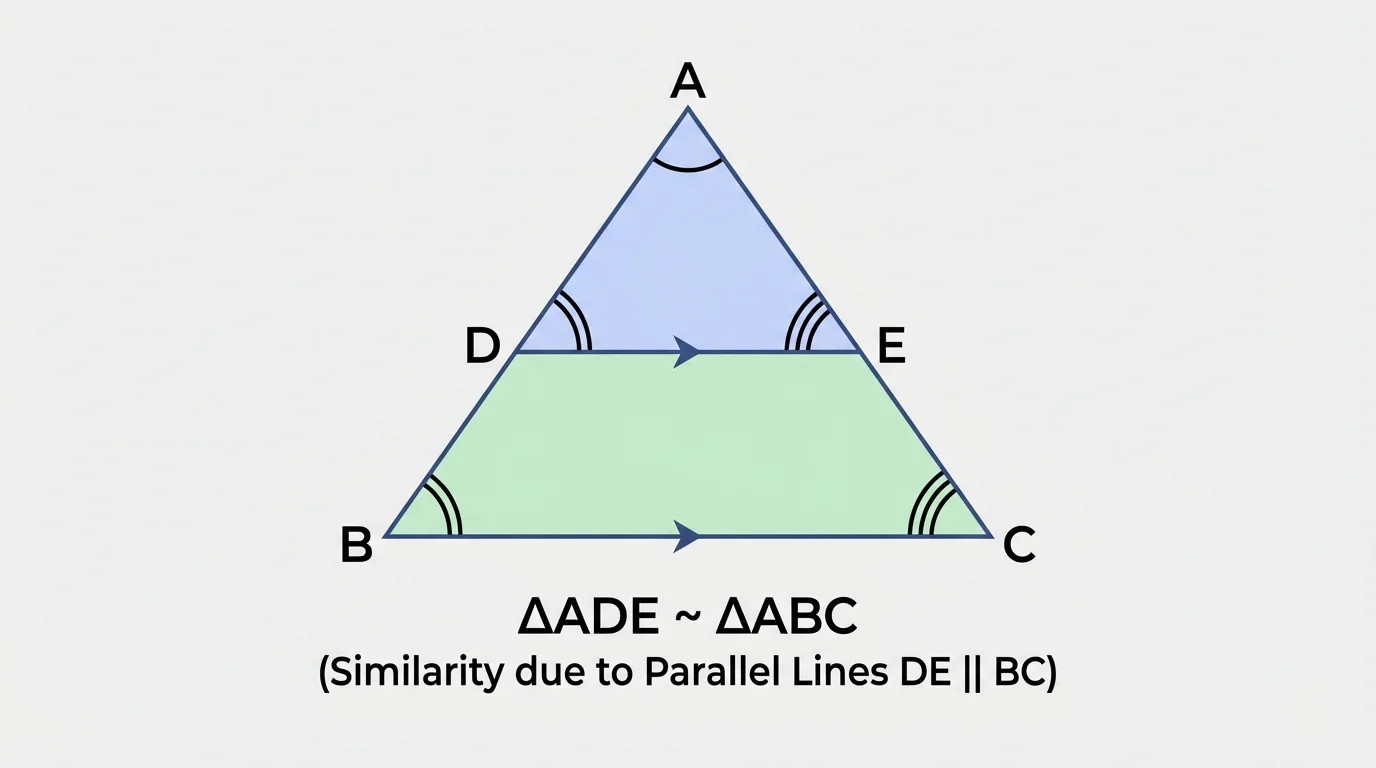
This one idea appears constantly in geometry. A line parallel to one side of a triangle creates a smaller triangle similar to the original. That means unknown lengths can often be found with proportions instead of direct measurement.
Similarity turns shape into equations. Once triangles are proven similar, geometry becomes algebra. Matching side ratios create proportions, and those proportions can be solved for missing lengths. This is why similarity is such a powerful bridge between visual reasoning and symbolic calculation.
As we saw earlier in [Figure 1], matching the correct vertices is essential. If the vertex order is wrong, the proportion can be set up incorrectly, and even simple problems will give false answers.
Similarity is not only for finding lengths. It is also a proof tool. If triangles are similar, then corresponding angles are equal and corresponding sides are proportional. That lets us prove relationships among segments inside larger figures.
For example, if \(DE \parallel BC\) in \(\triangle ABC\), then \(\triangle ADE \sim \triangle ABC\). From this, we know \(\dfrac{AD}{AB} = \dfrac{AE}{AC}\). This can be rearranged to show that a line parallel to one side of a triangle divides the other two sides proportionally.
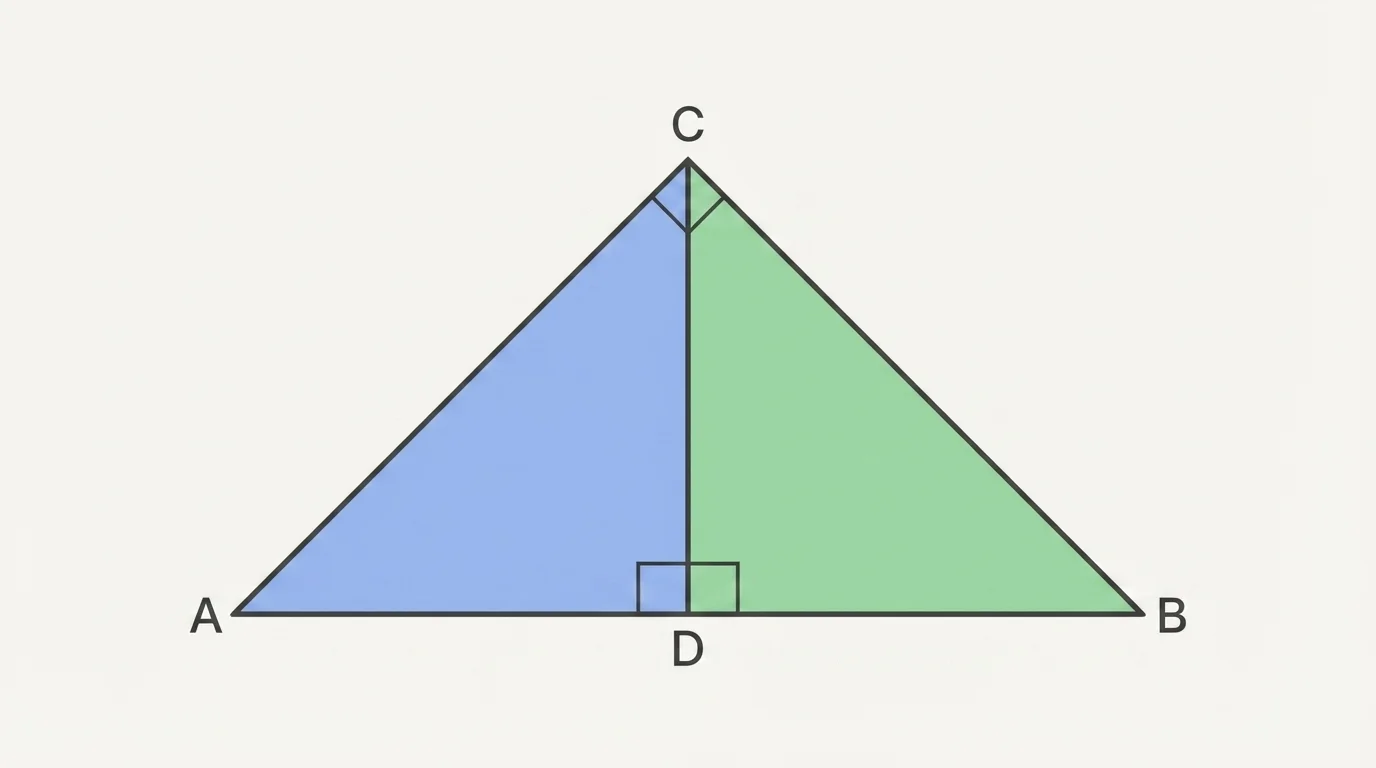
[Figure 3] Another important fact appears in right triangles. When an altitude is drawn from the right angle to the hypotenuse, it creates two smaller triangles that are each similar to the original triangle and to each other. This leads to several elegant relationships among the segments.
In \(\triangle ABC\), points \(D\) and \(E\) lie on \(AB\) and \(AC\), and \(DE \parallel BC\). Suppose \(AD = 6\), \(AB = 15\), and \(AC = 20\). Find \(AE\).
Worked example: finding a missing side with similar triangles
Step 1: Prove the triangles are similar.
Since \(DE \parallel BC\), corresponding angles are equal, so \(\triangle ADE \sim \triangle ABC\) by \(AA\) similarity.
Step 2: Write a proportion using corresponding sides.
\(\dfrac{AD}{AB} = \dfrac{AE}{AC}\), so \(\dfrac{6}{15} = \dfrac{AE}{20}\).
Step 3: Solve the proportion.
Simplify \(\dfrac{6}{15} = \dfrac{2}{5}\). Then \(\dfrac{2}{5} = \dfrac{AE}{20}\), so \(AE = 20 \cdot \dfrac{2}{5} = 8\).
Therefore,
\(AE = 8\)
This example shows why corresponding order matters. The small side from \(A\) to \(D\) must match the large side from \(A\) to \(B\), and the small side from \(A\) to \(E\) must match the large side from \(A\) to \(C\).
Suppose \(AB = AC\), and \(AD\) bisects \(\angle A\) in \(\triangle ABC\), meeting \(BC\) at \(D\). Prove that \(\triangle ABD \cong \triangle ACD\), and then conclude that \(BD = DC\).
Worked example: using congruence to prove equal segments
Step 1: Identify the given equal parts.
We know \(AB = AC\). Since \(AD\) bisects \(\angle A\), we have \(\angle BAD = \angle DAC\). Also, \(AD = AD\) by the reflexive property.
Step 2: Choose the congruence criterion.
The two sides \(AB\) and \(AC\) are equal, the side \(AD\) is common, and the included angles \(\angle BAD\) and \(\angle DAC\) are equal. Therefore, \(\triangle ABD \cong \triangle ACD\) by \(SAS\).
Step 3: Use corresponding parts.
Because the triangles are congruent, corresponding sides are equal. So \(BD = DC\).
The result is
\(BD = DC\)
This is a classic geometric proof: first prove triangles congruent, then use corresponding parts to establish the relationship you actually want.
An altitude to the hypotenuse creates one of the richest right-triangle configurations in geometry. In this figure, right triangle \(\triangle ABC\) has a right angle at \(C\), and altitude \(CD\) meets hypotenuse \(AB\) at \(D\). The three triangles in this figure are all similar.
Prove that \(CD^2 = AD \cdot DB\).
Worked example: proving a right-triangle relationship from similarity
Step 1: Identify similar triangles.
\(\triangle ACD \sim \triangle CBD\). Each has a right angle at \(D\), and one acute angle in the first matches one acute angle in the second because both come from the original right triangle.
Step 2: Match corresponding sides.
In these similar triangles, the hypotenuse of one small triangle corresponds to the leg of the other in a consistent order. A useful proportion is \(\dfrac{AD}{CD} = \dfrac{CD}{DB}\).
Step 3: Cross-multiply.
Multiplying gives \(CD^2 = AD \cdot DB\).
So the altitude is the geometric mean of the two hypotenuse segments:
\[CD^2 = AD \cdot DB\]
Later, whenever you see this altitude configuration again, remember [Figure 3]. It also leads to \(AC^2 = AD \cdot AB\) and \(BC^2 = DB \cdot AB\), two more geometric-mean relationships.
Similarity produces a whole family of useful results.
Triangle proportionality theorem: If a line is parallel to one side of a triangle and intersects the other two sides, then it divides those sides proportionally.
Right-triangle altitude relationships: In a right triangle, the altitude to the hypotenuse creates similar triangles and geometric-mean relationships.
Perimeter scaling: If two triangles are similar with scale factor \(k\), then their perimeters are also in the ratio \(k:1\).
Area scaling: If two triangles are similar with scale factor \(k\), then their areas are in the ratio \(k^2:1\).
For instance, if one triangle is similar to another with scale factor \(3\), then every side length triples, the perimeter triples, and the area becomes \(3^2 = 9\) times as large. This surprises many students at first: lengths scale linearly, but areas scale quadratically.
| Relationship | If scale factor is \(k\) |
|---|---|
| Corresponding side lengths | Multiply by \(k\) |
| Perimeters | Multiply by \(k\) |
| Areas | Multiply by \(k^2\) |
Table 1. How measurements change when triangles are similar.
One common mistake is using a criterion that is too weak. For congruence, \(AAA\) is not enough. For similarity, however, \(AA\) is enough. Another common mistake is matching sides in the wrong order. If \(\triangle ABC \sim \triangle DEF\), then \(AB\) corresponds to \(DE\), not automatically to any side you choose.
A good proof strategy is to move carefully through four questions: What triangles am I comparing? Which angles or sides are known to match? Which criterion applies? What relationship follows once the triangles are proved congruent or similar?
"Geometry is not just about figures; it is about relationships that must be true."
That idea is especially important in proofs. You are not guessing that two segments are equal or proportional. You are showing that they must be equal or proportional because the triangle relationship forces it.
Similarity allows indirect measurement. If a building and its shadow form one triangle, and a meter stick and its shadow form a similar triangle at the same time of day, then the building's height can be found by proportional reasoning. Surveyors use related methods to estimate distances across rivers or canyons.
Congruence matters in manufacturing and construction. If triangular supports in a roof truss are congruent, then the structure distributes loads more predictably. In computer graphics, similar triangles help resize objects without distorting shape, while congruent triangles help model repeated identical parts.
Real-world application example
A person who is \(1.8\) meters tall casts a shadow \(1.2\) meters long. At the same moment, a tree casts a shadow \(8\) meters long. Assuming the sun creates similar triangles, find the tree's height.
Step 1: Set up the proportion.
\(\dfrac{1.8}{1.2} = \dfrac{h}{8}\).
Step 2: Solve.
\(\dfrac{1.8}{1.2} = 1.5\), so \(h = 8 \cdot 1.5 = 12\).
The tree's height is
\[12 \textrm{ m}\]
This kind of reasoning works because the sun's rays are effectively parallel, creating equal corresponding angles. That same parallel-line logic appears again in [Figure 2], where a smaller triangle keeps the same shape as the larger one.
