An arrow on a map, a force in physics, and a velocity on a highway can all represent the same mathematical idea: a vector. What makes vectors powerful is that one number can instantly change them. Multiply a vector by \(2\), and it becomes twice as long. Multiply by \(-3\), and it becomes three times as long but flips direction. That simple action, scalar multiplication, is one of the fastest ways to understand how size and direction work together in mathematics.
Vectors describe quantities that have both magnitude and direction. In real life, that means not just how much, but also which way. A car traveling east at \(20\) units and a car traveling west at \(20\) units do not have the same velocity, even though their speeds match. Scalar multiplication lets us model these changes efficiently.
If \(\mathbf{v}\) is a vector and \(c\) is a real number, then \(c\mathbf{v}\) is called a scalar multiple of \(\mathbf{v}\). The number \(c\) is a scalar because it scales the vector. Depending on the value of \(c\), the new vector may be longer, shorter, unchanged in length, or even reversed in direction.
A vector is a quantity with both size and direction. A scalar is an ordinary real number, such as \(2\), \(-5\), or \(\dfrac{1}{3}\). When a vector is written as \(\mathbf{v}\), its length is called its magnitude and is written as \(\|\mathbf{v}\|\).
You may already know that if \(\mathbf{v} = \langle a,b \rangle\), then its magnitude is \(\|\mathbf{v}\| = \sqrt{a^2+b^2}\). That formula still matters here, but scalar multiplication gives an even quicker way to find the magnitude of a new vector when it is a multiple of an old one.
For example, if \(\|\mathbf{v}\| = 4\), then a vector with the same direction and twice the size should have magnitude \(8\). A vector with the opposite direction and three times the size should have magnitude \(12\). Notice that magnitude measures size only, not direction. That idea is the key to the main rule.
When a vector \(\mathbf{v}\) is multiplied by a scalar \(c\), the magnitude of the result is found by multiplying the original magnitude by the absolute value of the scalar.
Magnitude of a scalar multiple follows the rule
\[\|c\mathbf{v}\| = |c|\,\|\mathbf{v}\|\]
The absolute value \(|c|\) is used because magnitude cannot be negative.
This formula is easy to underestimate. It says something very important: the sign of \(c\) does not affect the magnitude directly. Only the size of \(c\) matters for length. For instance, multiplying by \(5\) and multiplying by \(-5\) both make a vector five times as long in magnitude. The difference between those two cases is direction, not size.
Suppose \(\|\mathbf{v}\| = 7\). Then:
if \(c = 3\), \(\|3\mathbf{v}\| = |3|\cdot 7 = 21\); if \(c = -3\), \(\|-3\mathbf{v}\| = |-3|\cdot 7 = 21\); if \(c = \dfrac{1}{2}\), \(\|\dfrac{1}{2}\mathbf{v}\| = \dfrac{1}{2}\cdot 7 = 3.5\).
The absolute value is the reason the magnitudes in the first two cases are equal. One vector points in the same direction as \(\mathbf{v}\), and the other points in the opposite direction, but both have the same length.
Why absolute value appears
Length is always nonnegative. A negative scalar changes direction, but it does not create a "negative length." That is why the formula uses \(|c|\) instead of just \(c\).
The direction rule is just as important as the magnitude rule. When \(|c|\,\|\mathbf{v}\| \ne 0\), the vector \(c\mathbf{v}\) points in the same direction as \(\mathbf{v}\) if \(c>0\), and in the opposite direction if \(c<0\), as [Figure 1] illustrates with arrows on the same line.
There are really three cases to remember. If \(c>0\), the vector is stretched or shrunk but keeps its direction. If \(c<0\), the vector is stretched or shrunk and also reversed. If \(c=0\), then \(c\mathbf{v} = \mathbf{0}\), the zero vector, which has magnitude \(0\) and no defined direction.
This means scalar multiplication affects vectors in two separate ways: \(|c|\) changes the size, and the sign of \(c\) controls whether the direction stays the same or flips. That split is one of the cleanest ideas in vector mathematics.
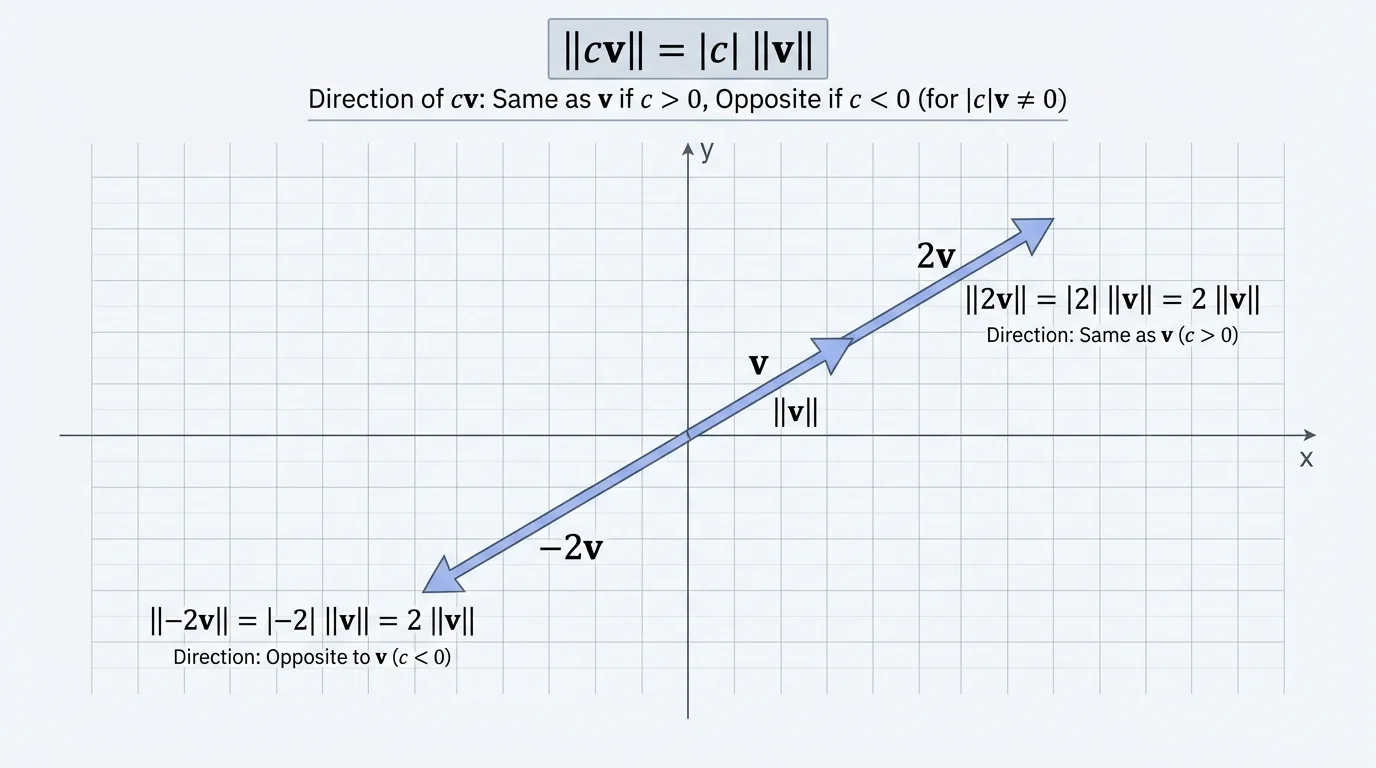
A useful shortcut is this: a positive scalar means along the original vector, and a negative scalar means against the original vector. That language often appears in geometry and physics because it describes direction without needing a compass direction like east or west.
When a vector is written in coordinates, scalar multiplication is very direct, and the picture becomes clear on a graph, as [Figure 2] shows for a vector and its triple. If \(\mathbf{v} = \langle a,b \rangle\), then
\[c\mathbf{v} = c\langle a,b \rangle = \langle ca,cb \rangle\]
In words, multiply every component by the scalar. For example, if \(\mathbf{v} = \langle 2,-1 \rangle\), then \(3\mathbf{v} = \langle 6,-3 \rangle\) and \(-2\mathbf{v} = \langle -4,2 \rangle\).
You can then find the magnitude either from the coordinate formula or from the scalar-multiple rule. Both methods must agree. In many cases, the scalar-multiple rule is faster because it avoids recalculating the whole square root from scratch.
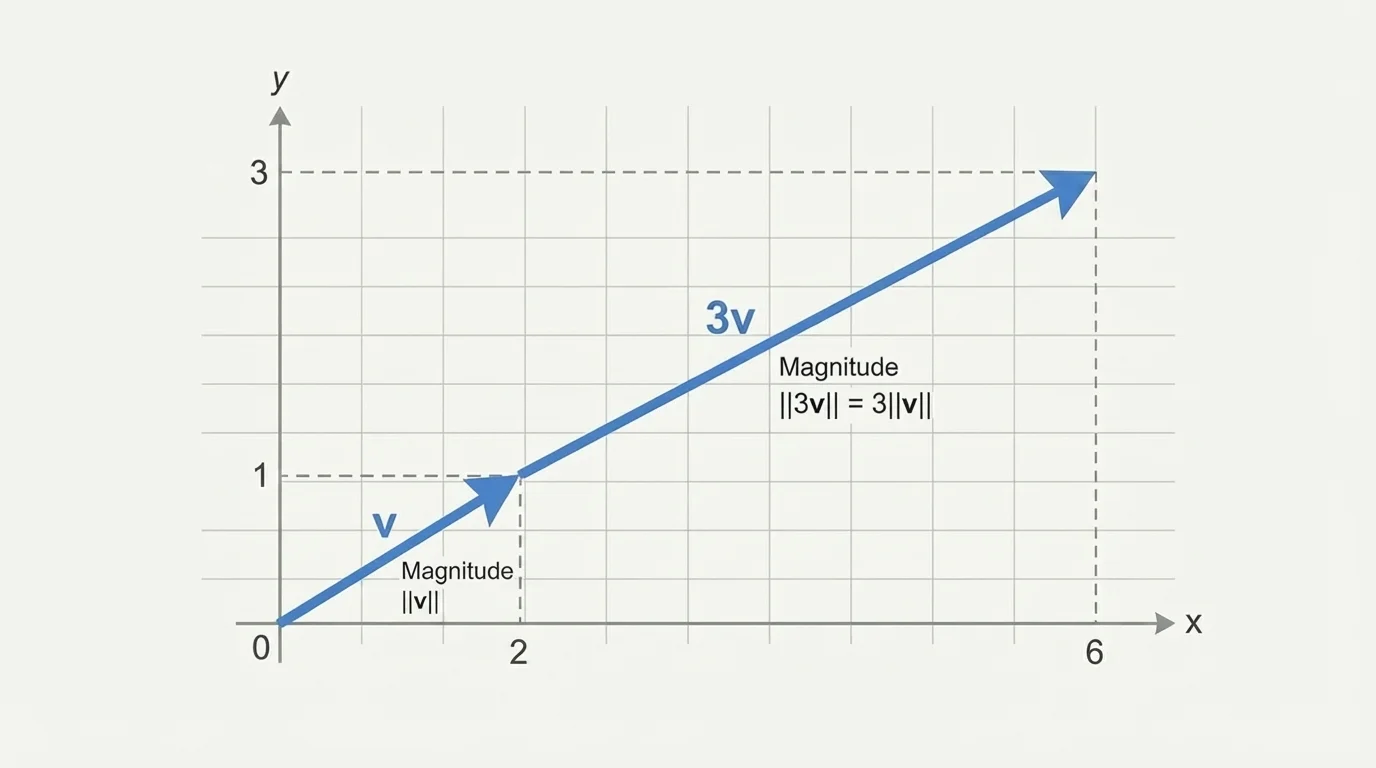
For instance, if \(\mathbf{v} = \langle 2,1 \rangle\), then \(\|\mathbf{v}\| = \sqrt{2^2+1^2} = \sqrt{5}\). So \(\|3\mathbf{v}\| = 3\sqrt{5}\). If you compute \(3\mathbf{v} = \langle 6,3 \rangle\), then \(\|3\mathbf{v}\| = \sqrt{6^2+3^2} = \sqrt{45} = 3\sqrt{5}\), which matches perfectly.
The best way to learn this idea is to compute both magnitude and direction repeatedly until the pattern feels automatic.
Worked Example 1
Let \(\|\mathbf{v}\| = 5\). Find the magnitude and direction of \(4\mathbf{v}\).
Step 1: Use the magnitude rule.
\(\|4\mathbf{v}\| = |4|\,\|\mathbf{v}\| = 4\cdot 5 = 20\).
Step 2: Determine the direction.
Since \(4>0\), the vector \(4\mathbf{v}\) points in the same direction as \(\mathbf{v}\).
The magnitude is \(20\), and the direction is along \(\mathbf{v}\).
Notice how quickly the answer comes from the sign and absolute value of the scalar. There is no need for coordinates when the original magnitude is already known.
Worked Example 2
Let \(\|\mathbf{v}\| = 8\). Find the magnitude and direction of \(-\dfrac{3}{2}\mathbf{v}\).
Step 1: Apply the magnitude formula.
\(\| -\dfrac{3}{2}\mathbf{v} \| = \left| -\dfrac{3}{2} \right| \cdot 8 = \dfrac{3}{2}\cdot 8 = 12\).
Step 2: Analyze the sign of the scalar.
Because \(-\dfrac{3}{2}<0\), the vector points in the opposite direction from \(\mathbf{v}\).
The magnitude is \(12\), and the direction is against \(\mathbf{v}\).
This example shows that a fraction can still enlarge a vector if its absolute value is greater than \(1\). Since \(\left| -\dfrac{3}{2} \right| = 1.5\), the new vector is \(1.5\) times as long.
Worked Example 3
Let \(\mathbf{v} = \langle 3,4 \rangle\). Find \(-2\mathbf{v}\), then compute its magnitude and direction.
Step 1: Multiply each component by \(-2\).
\(-2\mathbf{v} = -2\langle 3,4 \rangle = \langle -6,-8 \rangle\).
Step 2: Find the original magnitude.
\(\|\mathbf{v}\| = \sqrt{3^2+4^2} = \sqrt{9+16} = 5\).
Step 3: Use the scalar-multiple rule.
\(\|-2\mathbf{v}\| = |-2|\cdot 5 = 10\).
Step 4: Determine direction.
Since \(-2<0\), the vector points opposite to \(\mathbf{v}\).
The scalar multiple is \(\langle -6,-8 \rangle\), its magnitude is \(10\), and its direction is opposite to \(\mathbf{v}\).
This is a classic example because \(\langle 3,4 \rangle\) has a simple magnitude. It also confirms that changing both coordinates to negatives reverses the direction.
Worked Example 4
Let \(\mathbf{v} = \langle -2,5 \rangle\). Find the magnitude and direction of \(\dfrac{1}{2}\mathbf{v}\).
Step 1: Compute the original magnitude.
\(\|\mathbf{v}\| = \sqrt{(-2)^2+5^2} = \sqrt{4+25} = \sqrt{29}\).
Step 2: Use the scalar-multiple rule.
\(\left\|\dfrac{1}{2}\mathbf{v}\right\| = \left|\dfrac{1}{2}\right|\sqrt{29} = \dfrac{\sqrt{29}}{2}\).
Step 3: Find the direction.
Because \(\dfrac{1}{2}>0\), the direction is the same as \(\mathbf{v}\).
The new vector has magnitude \(\dfrac{\sqrt{29}}{2}\) and points in the same direction as \(\mathbf{v}\).
When the absolute value of the scalar is between \(0\) and \(1\), the vector shrinks. The direction stays the same if the scalar is positive and flips if it is negative.
Worked Example 5
Let \(\|\mathbf{v}\| = 11\). Find the magnitude and direction of \(0\mathbf{v}\).
Step 1: Compute the product.
\(0\mathbf{v} = \mathbf{0}\).
Step 2: Find the magnitude.
\(\|0\mathbf{v}\| = |0|\cdot 11 = 0\).
Step 3: State the direction.
The zero vector has no defined direction.
The result is the zero vector, with magnitude \(0\) and no direction.
Several patterns appear again and again. If \(|c|>1\), the vector gets longer. If \(0<|c|<1\), it gets shorter. If \(|c|=1\), the magnitude stays the same. In particular, \(1\mathbf{v} = \mathbf{v}\), while \(-1\mathbf{v}\) has the same magnitude as \(\mathbf{v}\) but points in the opposite direction.
As we saw earlier in [Figure 1], positive and negative multiples lie on the same line as the original vector. Scalar multiplication does not create a new line of direction; it only changes how far the vector reaches and whether it points one way or the reverse way along that line.
| Scalar \(c\) | Effect on Magnitude | Effect on Direction |
|---|---|---|
| \(c>1\) | Gets longer | Same direction |
| \(0<c<1\) | Gets shorter | Same direction |
| \(c=1\) | Unchanged | Same direction |
| \(-1<c<0\) | Gets shorter | Opposite direction |
| \(c<-1\) | Gets longer | Opposite direction |
| \(c=0\) | Magnitude becomes \(0\) | No defined direction |
Table 1. How the value of the scalar affects the length and direction of a vector.
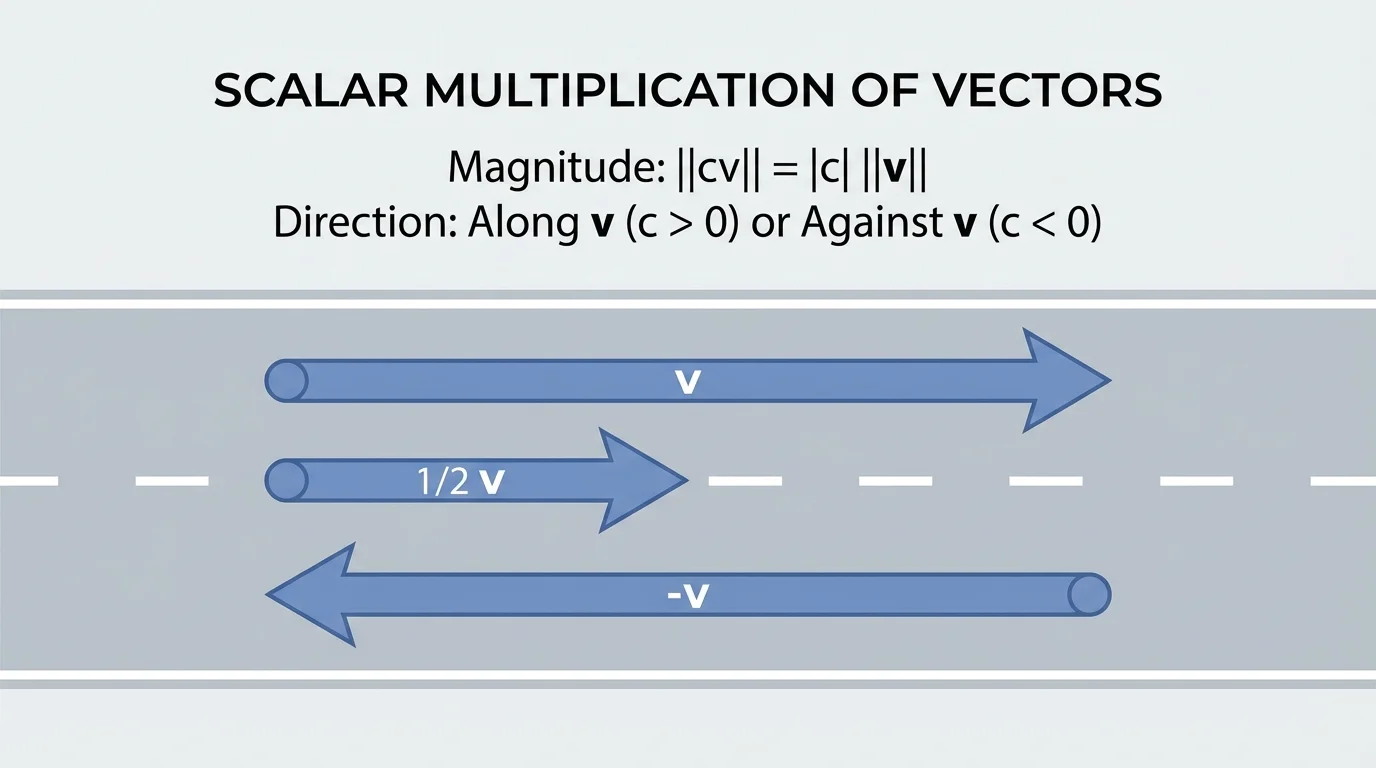
These rules are not just abstract. In motion problems, changing a velocity vector by a scalar models speeding up, slowing down, or reversing direction, as [Figure 3] shows with arrows of different lengths. If a cyclist's velocity is \(\mathbf{v}\), then \(2\mathbf{v}\) means twice the speed in the same direction, while \(-\mathbf{v}\) means the same speed in the opposite direction.
In physics, force vectors behave the same way. If a machine applies force \(\mathbf{F}\), then \(3\mathbf{F}\) represents triple the force in the same direction. If the force changes to \(-\dfrac{1}{2}\mathbf{F}\), its magnitude becomes half as large and the direction reverses.
Computer graphics also use scalar multiples constantly. To resize motion vectors, light directions, and object transformations, software multiplies vectors by numbers. The mathematics is exactly the same: coordinates scale, magnitudes change by \(|c|\), and negative scalars reverse direction.
Navigation and robotics rely on this too. If a robot plans to move in the direction of a vector \(\mathbf{v}\), then a smaller scalar like \(0.2\) makes a cautious short move in the same direction, while a negative scalar commands movement backward along the same line. The same visual logic still applies even when the vector represents motion in a programmed system.
Modern game engines and physics simulations perform huge numbers of vector-scaling operations every second. A simple rule like \(\|c\mathbf{v}\| = |c|\,\|\mathbf{v}\|\) helps computers update movement and direction efficiently.
One frequent mistake is writing \(\|c\mathbf{v}\| = c\,\|\mathbf{v}\|\) without absolute value. That fails when \(c\) is negative because magnitude cannot be negative. The correct rule is always \(\|c\mathbf{v}\| = |c|\,\|\mathbf{v}\|\).
Another mistake is confusing magnitude with direction. A negative scalar does not make the magnitude negative. It makes the vector point in the opposite direction. For example, if \(\|\mathbf{v}\| = 6\), then \(\|-2\mathbf{v}\| = 12\), not \(-12\).
A third mistake is giving a direction for the zero vector. When \(c=0\), the result is \(\mathbf{0}\), and the zero vector does not point any way at all. Its magnitude is \(0\), so direction is undefined.
Finally, when vectors are written in coordinates, students sometimes multiply only one component by the scalar. Every component must be multiplied. If \(\mathbf{v} = \langle a,b \rangle\), then \(c\mathbf{v} = \langle ca,cb \rangle\), not \(\langle ca,b \rangle\).
"A scalar changes how much; its sign tells which way."
That short statement captures the whole topic. The absolute value controls size, and the sign controls direction.
