Have you ever noticed that some math facts seem to follow a hidden rule? When you look carefully at addition and multiplication tables, numbers do not appear randomly. They grow in regular ways, switch places without changing the answer, and sometimes produce surprising results. For example, multiplying any whole number by \(4\) always gives an even number. That is not a trick. It happens for a reason, and math lets us explain exactly why.
Arithmetic means working with numbers using operations like addition, subtraction, multiplication, and division. A pattern in arithmetic is something that repeats in a predictable way. When a pattern is predictable, we can notice it, describe it, and explain it.
You may already know some patterns. When you count by \(2\), you say \(2, 4, 6, 8, 10, ...\). When you count by \(5\), you say \(5, 10, 15, 20, ...\). These are arithmetic patterns because each new number follows a rule.
Patterns are important because they help us learn facts faster and understand why math works. Instead of memorizing every fact by itself, we can look for structure. Structure means the way numbers are organized.
You already know that addition joins amounts and multiplication can mean equal groups. You also know that even numbers can be split into pairs with no leftovers, while odd numbers leave one extra.
These ideas help us explain many arithmetic patterns. We do not just say, "It works." We say why it works.
An arithmetic pattern is a repeated rule in number facts. The rule might involve adding the same amount each time, making equal groups, or noticing how answers change when numbers change.
Arithmetic pattern is a repeated and predictable rule with numbers.
Property of operations is a rule that tells how numbers behave when we add or multiply.
Even number is a number that can be split into two equal whole-number groups.
Odd number is a number that has one left over when split into two equal whole-number groups.
For example, in the sums \(3 + 1 = 4\), \(3 + 2 = 5\), and \(3 + 3 = 6\), the first addend stays the same, but the second addend increases by \(1\). The sum also increases by \(1\). That is a pattern.
In multiplication, the products in the \(6\) row of a multiplication table are \(6, 12, 18, 24, 30, ...\). Each product increases by \(6\). That is another pattern.
Patterns are easier to understand when we ask two questions: What changes? and What stays the same?
An addition table helps us see many patterns at once, as [Figure 1] shows with rows, columns, and matching sums. In an addition table, one addend is listed across the top and another addend is listed down the side. Each box shows the sum.
Suppose a row begins with \(2 + 0 = 2\), \(2 + 1 = 3\), \(2 + 2 = 4\), \(2 + 3 = 5\). As the second addend increases by \(1\), the sum also increases by \(1\). This happens all across the table.
Columns work the same way. If a column uses \(+4\), then \(0 + 4 = 4\), \(1 + 4 = 5\), \(2 + 4 = 6\), and \(3 + 4 = 7\). Each time the first addend increases by \(1\), the sum increases by \(1\).
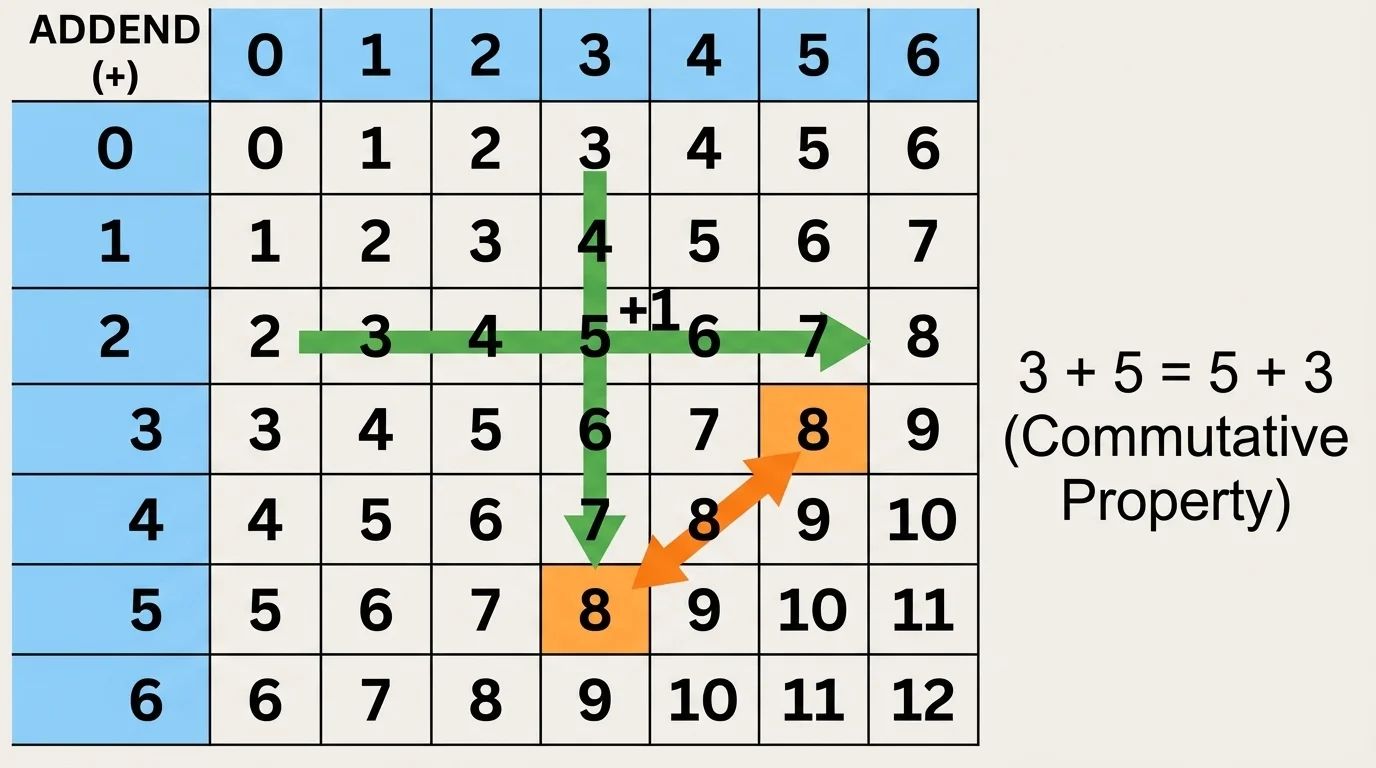
Another important pattern in addition is that switching the order of the addends does not change the sum. For example, \(3 + 5 = 8\) and \(5 + 3 = 8\). This is called the commutative property of addition.
You can see this pattern in an addition table because matching facts appear on opposite sides of a diagonal. The sum for \(2 + 6\) matches the sum for \(6 + 2\). The same is true for \(4 + 7\) and \(7 + 4\). The table looks balanced.
Addition also shows patterns with even and odd numbers. Look at these examples: \(2 + 4 = 6\), \(8 + 6 = 14\), and \(10 + 2 = 12\). An even number plus an even number gives an even number. Now look at \(1 + 3 = 4\) and \(5 + 7 = 12\). An odd number plus an odd number also gives an even number.
But if you add one even number and one odd number, the sum is odd. For example, \(2 + 3 = 5\) and \(6 + 1 = 7\). This pattern happens because pairing changes depending on whether both numbers have extras or only one does.
Later, when you look back at [Figure 1], the table's symmetry helps explain why \(a + b\) and \(b + a\) match. The order changes, but the total does not.
A multiplication table also reveals regular patterns. Multiplication is closely connected to repeated addition and equal groups, so its patterns are often very strong.
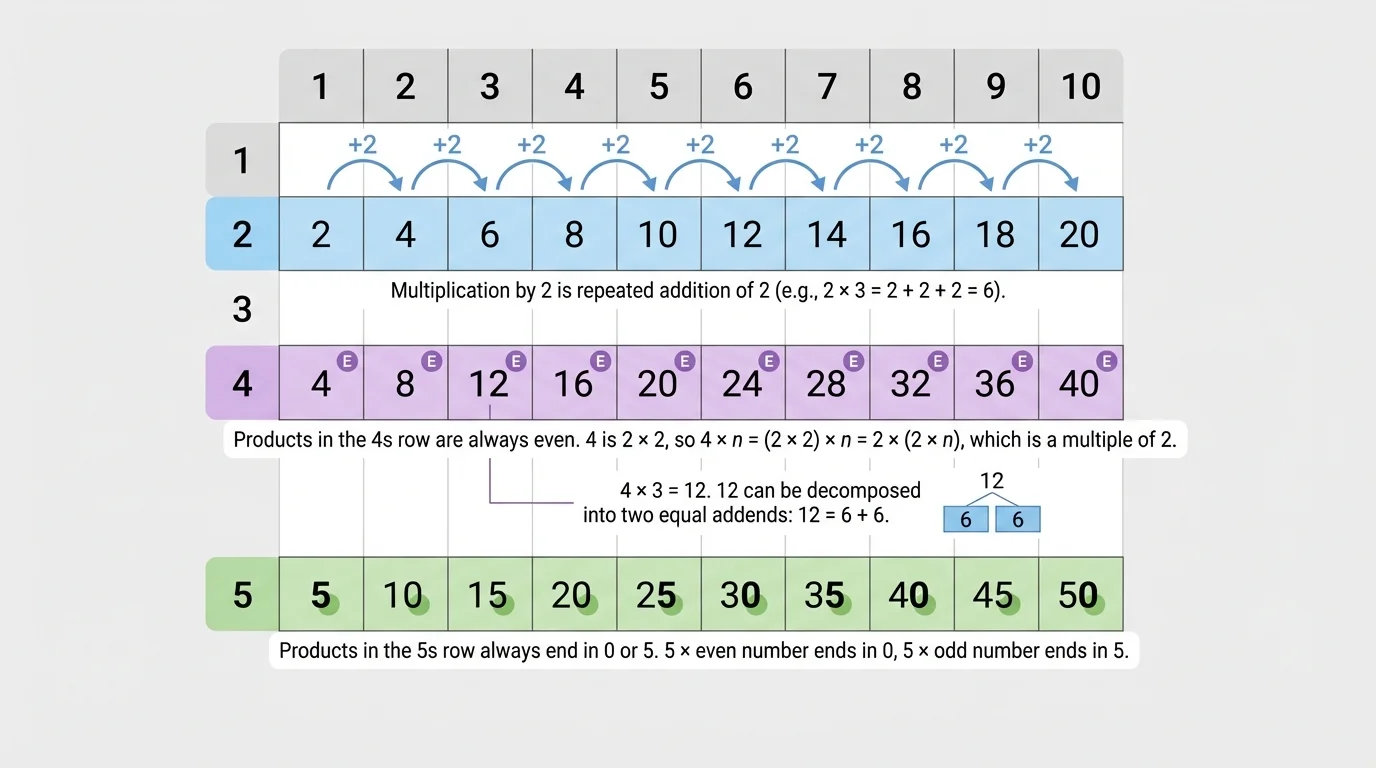
[Figure 2] Look at the \(3\) row: \(3, 6, 9, 12, 15, ...\). Each product increases by \(3\). In the \(5\) row, the products are \(5, 10, 15, 20, 25, ...\). Each product increases by \(5\). This is because moving one step across a row means one more group of that number.
Some rows have special patterns. The \(2\) row always gives even numbers: \(2, 4, 6, 8, 10, ...\). The \(5\) row ends in \(0\) or \(5\): \(5, 10, 15, 20, 25, ...\). The \(10\) row ends in \(0\): \(10, 20, 30, 40, ...\).
The row for \(4\) has an important pattern too: \(4, 8, 12, 16, 20, ...\). Every product is even. Why? Because \(4\) means two groups of \(2\), and two groups of \(2\) make pairs. Any number of groups of \(4\) can be organized into pairs with no leftovers.
Multiplication also shows a commutative pattern. For example, \(2 \times 7 = 14\) and \(7 \times 2 = 14\). This is the commutative property of multiplication. You can think of \(2 \times 7\) as \(2\) groups of \(7\), and \(7 \times 2\) as \(7\) groups of \(2\). The groups are arranged differently, but the total number of objects is the same.
Doubling patterns are helpful too. Since \(4\) is double \(2\), the products in the \(4\) row are double the products in the \(2\) row. For example, \(2 \times 6 = 12\), so \(4 \times 6 = 24\). And \(24\) is double \(12\).
The multiplication table has mirror facts across a diagonal, just like the addition table. That means \(3 \times 8\) matches \(8 \times 3\), and \(4 \times 6\) matches \(6 \times 4\).
This mirror pattern happens because multiplication, like addition, is commutative.
Patterns become more powerful when we can explain them. A property of operations is a rule about how numbers work when we add or multiply. As [Figure 3] illustrates, one useful way to explain a pattern is to break a number fact into smaller equal parts.
Let us look at the statement: \(4\) times any whole number is even. Suppose the number is \(n\). Then \(4 \times n\) can be split into two equal addends:
\[4 \times n = 2 \times n + 2 \times n\]
The two addends are equal because both are \(2 \times n\). Since the total is made of two equal whole-number parts, the product is even.
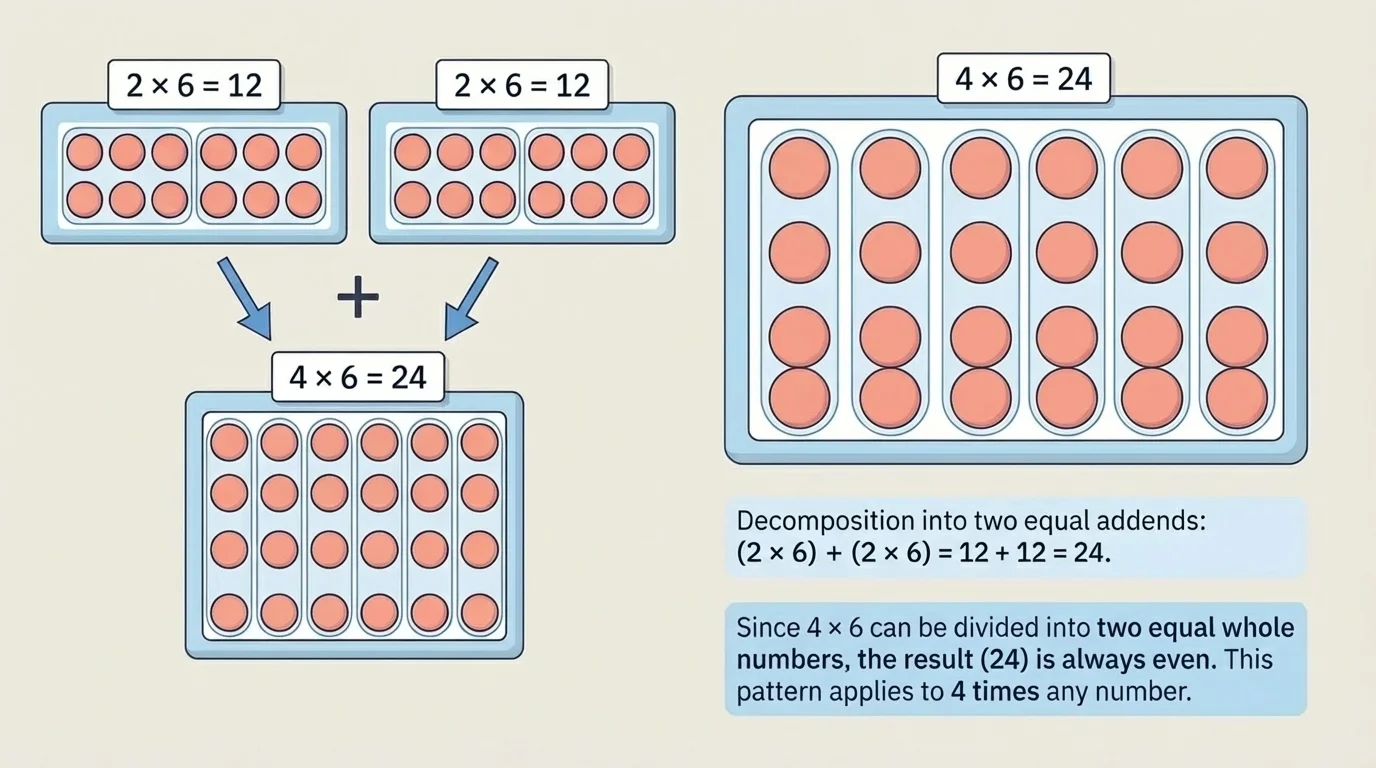
Here is the same idea with a number. If \(n = 5\), then \(4 \times 5 = 20\). We can decompose it as \(10 + 10\), because \(2 \times 5 = 10\). Since \(20\) is made from two equal addends, \(20\) is even.
This uses the idea of decompose, which means to break something into parts. In math, decomposing helps us explain how a bigger fact is built from smaller facts.
Another useful property is the distributive property. It says we can break apart a factor and multiply each part. For example, \(4 \times 7\) can be thought of as \((2 + 2) \times 7\). Then:
\[4 \times 7 = 2 \times 7 + 2 \times 7 = 14 + 14 = 28\]
This not only gives the answer, but also explains why the answer is even: it is the sum of two equal addends.
The [Figure 3] model also helps show that multiplication can be seen as equal groups or equal rows in an array. When the groups can be split into two matching halves, the total is even.
Using properties to explain patterns
When students explain a pattern, they should say more than what they notice. A strong explanation tells which operation property is working. For example, if \(3 + 6 = 6 + 3\), the commutative property explains why the sum stays the same. If \(4 \times 8\) is even because \(4 \times 8 = 2 \times 8 + 2 \times 8\), the explanation uses decomposition and equal addends.
Other multiplication patterns can be explained in the same way. Any product with \(2\) is even because \(2 \times n\) means two equal groups of \(n\). Any product with \(10\) is ten groups, which makes counting by tens easy because each new group adds another \(10\).
Now let us use what we know to explain patterns step by step.
Worked example 1
Explain why \(6 + 4\) and \(4 + 6\) have the same sum.
Step 1: Find both sums.
\(6 + 4 = 10\) and \(4 + 6 = 10\).
Step 2: Notice what changed.
The addends switched places, but the total stayed the same.
Step 3: Name the property.
This is the commutative property of addition.
The explanation is: switching the order of addends does not change the sum, so \(6 + 4 = 4 + 6\).
This kind of explanation is better than only saying, "They are both \(10\)." In mathematics, the reason matters too.
Worked example 2
Describe the pattern in \(3 \times 1\), \(3 \times 2\), \(3 \times 3\), and \(3 \times 4\).
Step 1: Find the products.
\(3 \times 1 = 3\), \(3 \times 2 = 6\), \(3 \times 3 = 9\), and \(3 \times 4 = 12\).
Step 2: Compare the answers.
The products are \(3, 6, 9, 12\). Each answer increases by \(3\).
Step 3: Explain why.
Each time the second factor increases by \(1\), there is one more group of \(3\), so the product increases by \(3\).
The pattern is that the products in the \(3\) row go up by \(3\) each time.
Patterns in multiplication often come from adding one more equal group.
Worked example 3
Explain why \(4 \times 6\) is even.
Step 1: Find the product.
\(4 \times 6 = 24\).
Step 2: Decompose the multiplication.
\(4 \times 6 = 2 \times 6 + 2 \times 6\).
Step 3: Calculate each equal addend.
\(2 \times 6 = 12\), so \(4 \times 6 = 12 + 12\).
Step 4: Explain the pattern.
Since \(24\) is the sum of two equal whole-number addends, it is even.
So \(4\) times a number is even because it can be split into two equal parts.
Notice that this explanation does not depend only on \(6\). The same idea works for any whole number.
Worked example 4
Use the distributive property to explain \(5 \times 7\).
Step 1: Break apart \(5\).
Think of \(5\) as \(2 + 3\).
Step 2: Multiply each part by \(7\).
\((2 + 3) \times 7 = 2 \times 7 + 3 \times 7\).
Step 3: Compute.
\(2 \times 7 = 14\) and \(3 \times 7 = 21\).
Step 4: Add the partial products.
\(14 + 21 = 35\).
So \(5 \times 7 = 35\), and the distributive property helps explain how one multiplication fact can be built from smaller known facts.
Arithmetic patterns are not only for tables on paper. They appear in everyday life.
If chairs are arranged in \(4\) equal rows of \(5\), then there are \(4 \times 5 = 20\) chairs. The total is even because the rows can be split into two equal pairs of rows. This is the same reasoning used earlier for \(4\) times a number.
In music, beats often repeat in groups. If a rhythm has \(4\) beats in each measure and there are \(6\) measures, then there are \(4 \times 6 = 24\) beats. Again, the total is even.
On a calendar, if an event happens every \(5\) days, the dates form a pattern that grows by \(5\). In sports practice, if a team does \(3\) sets of \(8\) jumping jacks, the total is \(24\), and each new set adds \(8\) more. That is a multiplication pattern.
Store workers use arithmetic patterns when they stack objects in equal rows and columns. Arrays help them count quickly without counting one item at a time.
These real-world situations use the same ideas as addition and multiplication tables: repeated change, equal groups, and operation properties.
When you notice a pattern, try to say it as a rule. A good rule uses math words and gives a reason.
For example, instead of saying, "The \(4\) row looks even," you can say, "Every product in the \(4\) row is even because \(4 \times n = 2 \times n + 2 \times n\), which makes two equal addends."
Instead of saying, "These addition facts match," you can say, "The sum stays the same when the addends switch places because of the commutative property of addition."
Here are some strong pattern statements:
When you explain a pattern, try to include three parts: what you notice, an example, and the property or reason.
"Patterns help us see that math answers are connected, not separate facts."
The more patterns you notice, the more number facts make sense. Math becomes easier when you can see the rules underneath the numbers.
