A missing number can feel like a mystery, but in math, there are clues to help you solve it. If you know that one box holds the same number of apples as every other box, or that a team score comes from equal groups of points, you can figure out what number belongs in the empty space. That is exactly what happens in equations such as \(8 \times ? = 48\) or \(5 = \square \div 3\). We use what we know about multiplication and division to make the equation true.
When a number is missing in an equation, we are asked to find the unknown. The unknown is the number we do not know yet. It might be shown by \(?\), a blank, or a letter such as \(n\).
Finding missing numbers helps in many everyday situations. If \(4\) bags have the same number of marbles and there are \(28\) marbles altogether, you can find how many marbles are in each bag. If \(3\) friends share \(15\) crackers equally, you can find how many crackers each friend gets. These are both missing-number problems.
Remember: Multiplication means putting together equal groups. Division means separating into equal groups or finding how many are in each group.
An equation is a math sentence with an equal sign. The equal sign means "has the same value as." So an equation is true only when both sides are equal.
A equation is true when the amount on one side matches the amount on the other side. For example, \(6 \times 7 = 42\) is true because both sides equal \(42\). But \(6 \times 7 = 40\) is false because \(42\) is not the same as \(40\).
When an equation has a missing number, our job is to find the number that makes the equation true. In \(8 \times ? = 48\), the missing number must be the one that works with \(8\) to make \(48\).
Unknown, factor, product, dividend, divisor, quotient are important math words for this topic. In multiplication, the numbers being multiplied are called factors, and the answer is the product. In division, the number being divided is the dividend, the number you divide by is the divisor, and the answer is the quotient.
[Figure 1] Sometimes the unknown is one of the numbers you start with, and sometimes it is the answer. You can still solve the equation by thinking carefully about what multiplication or division is happening.
Inverse operations are operations that undo each other. Multiplication and division are inverse operations. That means if you know one multiplication fact, you can use it to find related division facts. The connection among \(6\), \(8\), and \(48\) shows that since \(6 \times 8 = 48\), we also know \(48 \div 6 = 8\) and \(48 \div 8 = 6\).
This group of related facts is called a fact family. A fact family helps you move between multiplication and division to find a missing number.
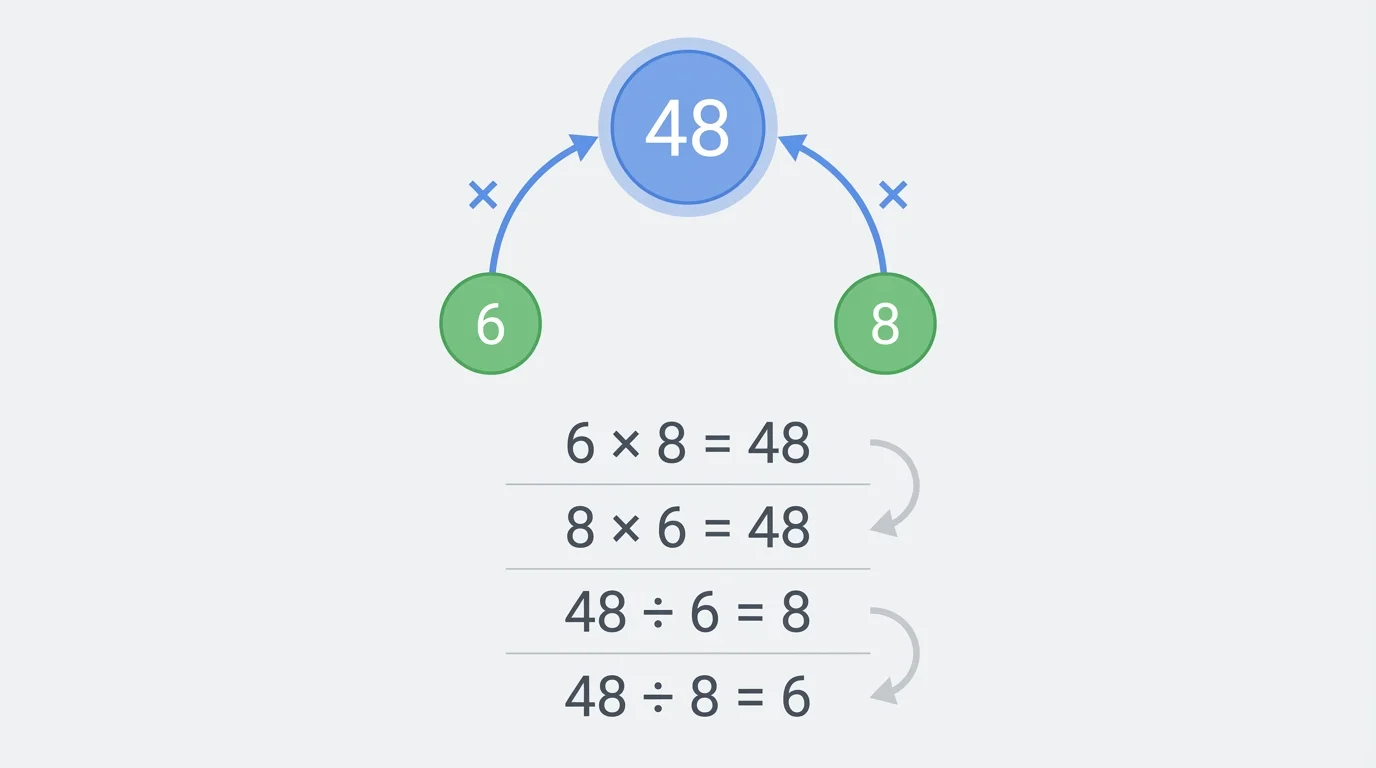
If you know that \(7 \times 5 = 35\), then you also know \(35 \div 7 = 5\) and \(35 \div 5 = 7\). This is why multiplication can help you solve division equations, and division can help you solve multiplication equations.
Use the related fact to solve a missing-number equation. Ask yourself, "What multiplication fact or division fact belongs with these numbers?" When you find the related fact, the missing number becomes much easier to see.
Fact families are especially helpful because they show that the same three numbers can make several true equations. Later, when you check your work, the fact family idea helps again, as we saw with the numbers in [Figure 1].
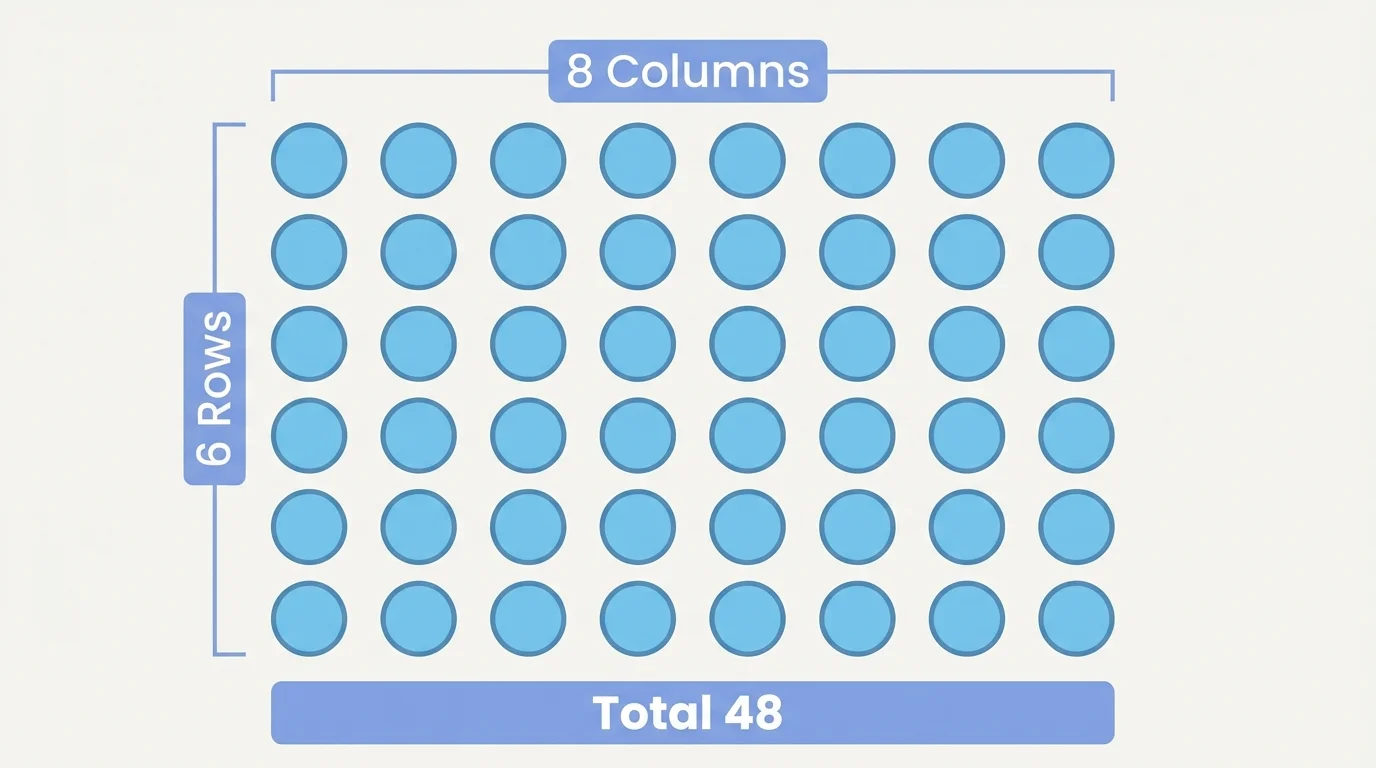
[Figure 2] In a multiplication equation, the unknown may be a factor or the product. An array model helps show that multiplication is made of equal rows or equal columns. If you know the total and one factor, you can divide to find the missing factor.
Look at \(8 \times ? = 48\). Here, \(48\) is the total. One factor is \(8\), but the other factor is missing. We ask, "What number times \(8\) equals \(48\)?" Since \(48 \div 8 = 6\), the missing number is \(6\).
Now look at \(6 \times 6 = ?\). This time, both factors are known, so we multiply. Since \(6 \times 6 = 36\), the missing number is \(36\).
Here is a useful rule: if the unknown is the answer in multiplication, multiply the factors. If the unknown is one factor, divide the product by the known factor.
For example, in \(? \times 9 = 54\), we divide \(54 \div 9 = 6\), so the missing factor is \(6\). In \(4 \times 7 = ?\), we multiply \(4 \times 7 = 28\), so the missing product is \(28\).
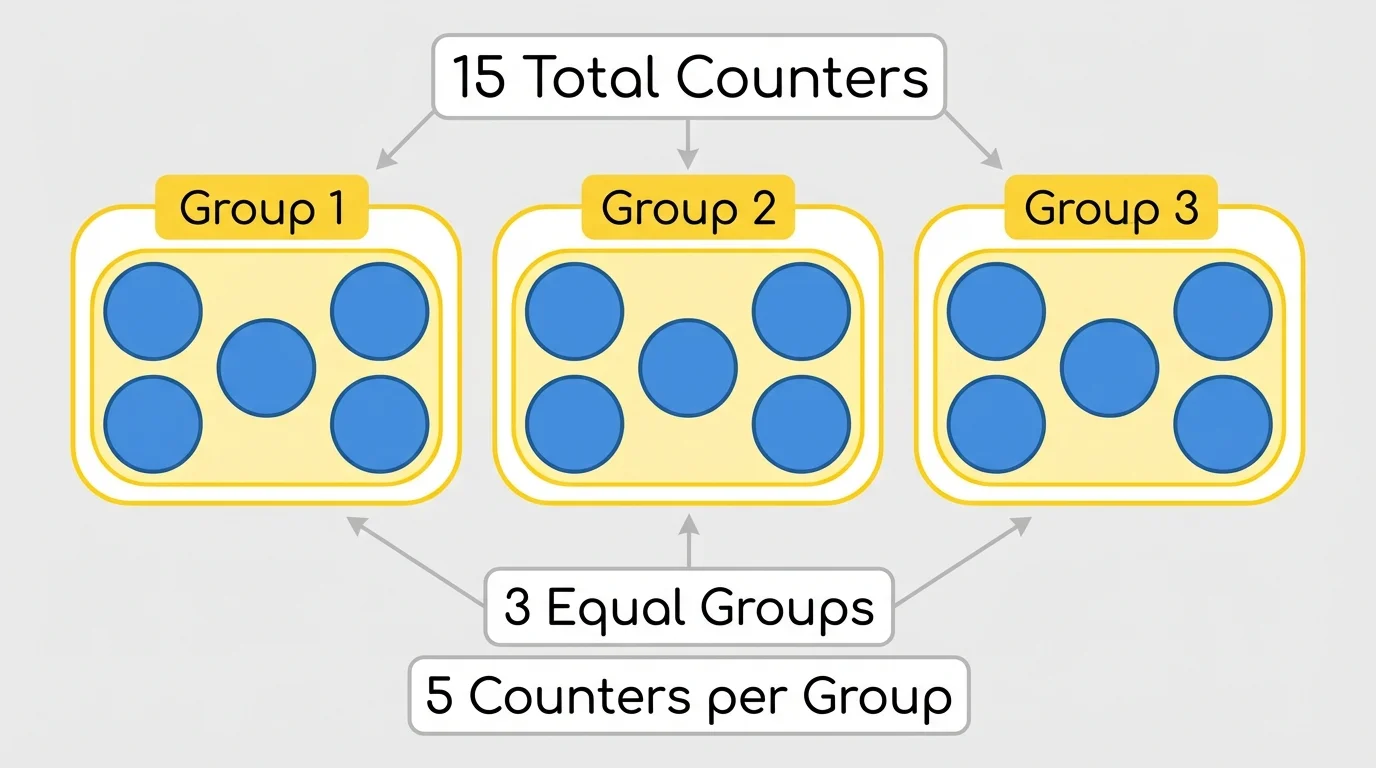
[Figure 3] Division equations can also have a missing number in different places. Equal groups help us see what division means. In \(15 \div 3 = 5\), the total amount is split into \(3\) equal groups, and each group has \(5\).
Sometimes the equation may be written in a different order, like \(5 = \square \div 3\). This can be rewritten as \(\square \div 3 = 5\). We ask, "What number divided by \(3\) equals \(5\)?" Since \(15 \div 3 = 5\), the missing number is \(15\).
If the unknown is the dividend, multiply the divisor and quotient. For \(? \div 4 = 6\), we think \(6 \times 4 = 24\), so the missing dividend is \(24\).
If the unknown is the quotient, divide. For \(20 \div 5 = ?\), we compute \(20 \div 5 = 4\), so the missing quotient is \(4\).
At this grade level, division equations usually involve whole numbers with no remainders. That means the answer is a whole number and the groups come out evenly.
Many students solve division equations faster when they first think of the related multiplication fact. For example, solving \(28 \div 7\) becomes easier if you already know \(7 \times 4 = 28\).
The picture of equal groups stays useful later, too. When you look again at [Figure 3], you can see why multiplying \(3\) groups by \(5\) in each group gives the total \(15\).
It is important to check whether your missing number really makes the equation true. The easiest way is to put your answer back into the equation.
Suppose you found that \(8 \times ? = 48\) has the answer \(6\). Check by substituting \(6\): \(8 \times 6 = 48\). That is true, so \(6\) is correct.
Suppose you found that \(5 = \square \div 3\) has the answer \(15\). Check by substituting \(15\): \(15 \div 3 = 5\). That is true, so \(15\) is correct.
You can also check by using the related fact family. The multiplication-and-division connections from [Figure 1] show why checking with the inverse operation works so well.
Let's work through several equations step by step.
Worked example 1
Find the missing number in \(8 \times ? = 48\).
Step 1: Decide what is missing.
The missing number is a factor because it is one of the numbers being multiplied.
Step 2: Use division to find the missing factor.
Divide the product by the known factor: \(48 \div 8 = 6\).
Step 3: Check the answer.
Substitute \(6\) into the equation: \(8 \times 6 = 48\).
The missing number is \(6\).
The array idea from [Figure 2] matches this example: \(48\) objects can be arranged in \(6\) rows of \(8\), so the missing factor is \(6\).
Worked example 2
Find the missing number in \(5 = \square \div 3\).
Step 1: Rewrite the idea in words.
We need a number that, when divided by \(3\), gives \(5\).
Step 2: Use the related multiplication fact.
If \(\square \div 3 = 5\), then \(5 \times 3 = \square\).
Step 3: Multiply.
\(5 \times 3 = 15\).
Step 4: Check the answer.
\(15 \div 3 = 5\), so the equation is true.
The missing number is \(15\).
This example shows why division and multiplication are related operations. The equal groups in [Figure 3] help explain how a total of \(15\) can be split into \(3\) equal groups of \(5\).
Worked example 3
Find the missing number in \(6 \times 6 = ?\).
Step 1: Notice what is missing.
The missing number is the product, which is the answer to a multiplication equation.
Step 2: Multiply the factors.
\(6 \times 6 = 36\).
Step 3: Check.
The equation becomes \(6 \times 6 = 36\), which is true.
The missing number is \(36\).
When the product is missing, there is no need to divide. Multiply the two known factors.
Worked example 4
Find the missing number in \(? \div 4 = 7\).
Step 1: Identify what the unknown means.
The unknown is the dividend, the number being divided.
Step 2: Use the related multiplication fact.
If \(? \div 4 = 7\), then \(7 \times 4 = ?\).
Step 3: Multiply.
\(7 \times 4 = 28\).
Step 4: Check.
\(28 \div 4 = 7\).
The missing number is \(28\).
Notice the pattern: unknown factor means divide, unknown dividend means multiply, and unknown product or quotient means do the operation shown.
Missing-number equations appear in many real situations. If \(9\) pencils are packed in each box and there are \(45\) pencils total, then \(9 \times ? = 45\). The missing number tells how many boxes there are. Since \(45 \div 9 = 5\), there are \(5\) boxes.
If \(4\) children share \(20\) stickers equally, then \(20 \div 4 = ?\). The answer is \(5\), so each child gets \(5\) stickers.
If each table in a classroom seats \(6\) students and there are \(30\) students, then \(? \times 6 = 30\). Dividing \(30 \div 6 = 5\) shows that \(5\) tables are needed.
Math models real groups by using equal groups, rows, and totals. Multiplication helps when groups are combined, and division helps when a total is split or when the size of a group must be found.
Sports can use this idea too. If a player scores \(3\) points each time and has \(18\) points total, then \(3 \times ? = 18\). The player scored \(6\) times.
One common mistake is using the wrong operation. In \(8 \times ? = 48\), some students try to multiply again. But the product is already given. Since a factor is missing, divide: \(48 \div 8 = 6\).
Another mistake is reading division equations backward. In \(5 = \square \div 3\), the blank is not \(5\). The blank is the number being divided. We need a number that gives \(5\) after division by \(3\), so the blank is \(15\).
A third mistake is forgetting to check. A quick substitution can catch errors right away.
| Equation form | What is missing? | Helpful move |
|---|---|---|
| \(a \times ? = c\) | factor | Compute \(c \div a\) |
| \(? \times b = c\) | factor | Compute \(c \div b\) |
| \(a \times b = ?\) | product | Compute \(a \times b\) |
| \(? \div b = c\) | dividend | Compute \(c \times b\) |
| \(a \div b = ?\) | quotient | Compute \(a \div b\) |
Table 1. A quick guide to deciding whether to multiply or divide in common missing-number equations.
Every missing-number equation asks the same big question: "What number makes this equation true?" The answer must fit the equal sign correctly.
Think about what the unknown stands for. Is it a factor, a product, a dividend, or a quotient? Once you know that, the right operation becomes clearer.
Use related multiplication and division facts. Fact families, arrays, and equal groups are not just pictures or tricks. They help show why the answer makes sense.
