Have you ever shared snacks, packed crayons into boxes, or lined up chairs in rows and noticed a pattern? Division helps answer questions like these, but here is the exciting part: sometimes the fastest way to divide is to think about multiplying. Instead of asking, "What is \(32 \div 8\)?" you can ask, "What number multiplied by \(8\) makes \(32\)?" That number is \(4\), because \(8 \times 4 = 32\). So \(32 \div 8 = 4\).
Division and multiplication are closely connected. They are like two ways of looking at the same fact. If you know a multiplication fact, you can use it to solve a division fact. This helps you solve problems more quickly and understand what the numbers mean.
When we divide, we are often separating a total amount into equal groups. For example, if there are \(32\) blocks and each group has \(8\) blocks, we want to know how many groups there are. We can write that as \(32 \div 8\).
But instead of starting with division alone, we can think about the multiplication fact that matches it. We ask: "\(8\) times what number equals \(32\)?" We can write the unknown number with a box, a blank, or a letter: \(8 \times \Box = 32\), \(8 \times ? = 32\), or \(8 \times n = 32\). The missing number is \(4\), so \(32 \div 8 = 4\).
Division as an unknown-factor problem means solving a division fact by finding the missing number in a multiplication equation.
For example, to solve \(18 \div 3\), think: \(3 \times ? = 18\). Since \(3 \times 6 = 18\), the answer is \(6\).
This idea works because multiplication and division are related facts. They use the same numbers in connected ways. If \(5 \times 7 = 35\), then \(35 \div 5 = 7\) and \(35 \div 7 = 5\). The numbers stay connected.
A factor is a number that is multiplied by another number. In \(8 \times 4 = 32\), the numbers \(8\) and \(4\) are factors, and \(32\) is the product. When one factor is missing, we call it an unknown factor.
So if you see \(32 \div 8\), you can think of it as the question \(8 \times ? = 32\). The unknown factor is the answer to the division problem. This is why division can be understood as finding a missing factor.
Here are some examples of division written as unknown-factor equations:
When you know your multiplication facts, these division problems become much easier. You are not learning two separate ideas. You are using one idea in two directions.
Remember: multiplication means equal groups put together. For example, \(4 \times 3 = 12\) means \(4\) groups of \(3\), or \(3 + 3 + 3 + 3 = 12\). Division asks the matching question about those same equal groups.
Sometimes the unknown factor tells how many groups there are. Other times it tells how many are in each group. Both ideas are connected to multiplication.
In [Figure 1], an array is shown as a neat arrangement in rows and columns. It helps you see multiplication and division clearly. The total of \(32\) objects is arranged in \(4\) rows of \(8\). That shows \(4 \times 8 = 32\), and it also helps us solve \(32 \div 8 = 4\).
Equal groups work the same way. If \(32\) counters are put into groups of \(8\), there are \(4\) groups. The division problem \(32 \div 8\) is asking for the number of groups. The multiplication equation \(8 \times 4 = 32\) gives the answer. This matches the array model shown above.
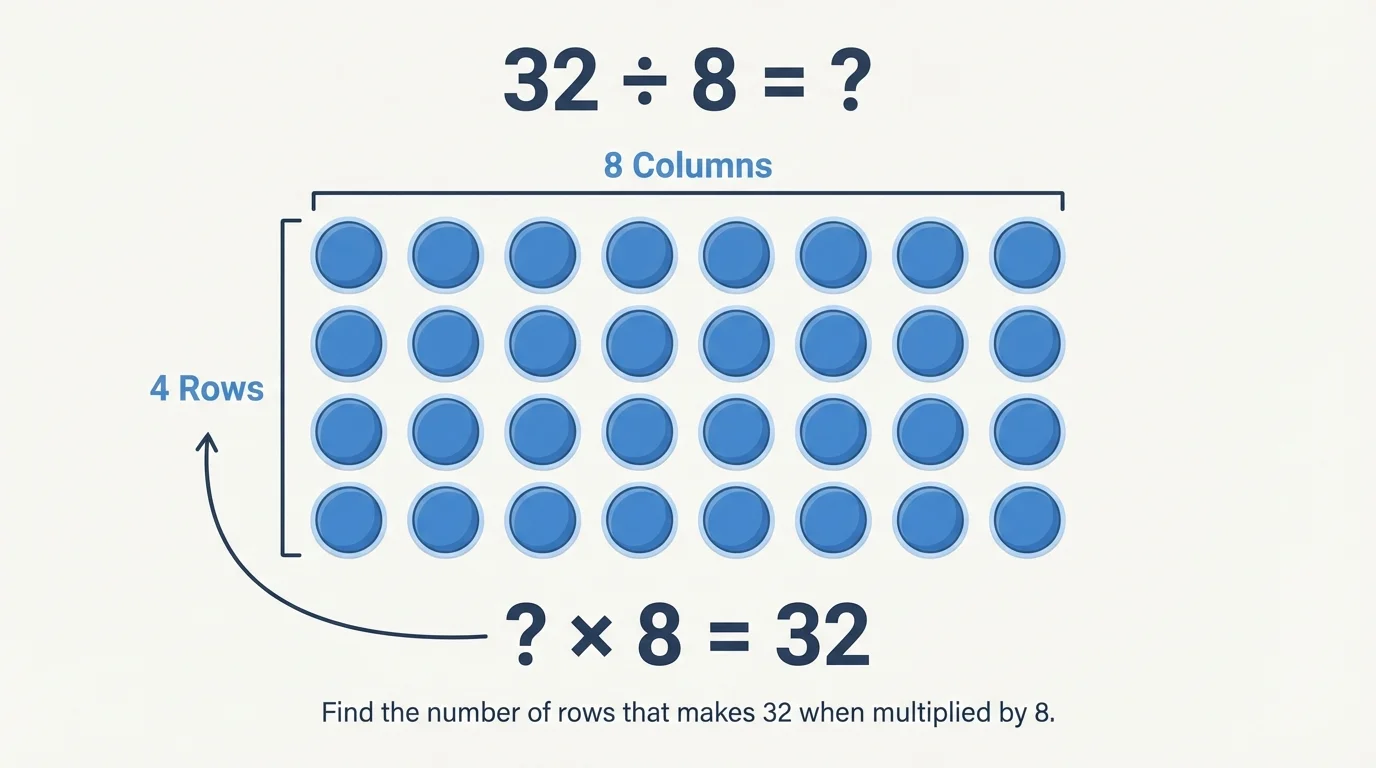
You can also turn the picture around in your mind. If there are \(32\) counters in \(4\) equal groups, then each group has \(8\). That means \(32 \div 4 = 8\). One array can help with more than one division fact.
This is one reason arrays are so useful. They show that multiplication and division belong together. Later, when you solve facts without drawing, you can still picture the rows and groups in your mind.
Two ways to think about division
Sometimes division asks, "How many groups?" For example, \(32 \div 8\) asks how many groups of \(8\) make \(32\). Sometimes division asks, "How many in each group?" For example, \(32 \div 4\) asks how many are in each group if there are \(4\) equal groups. Both questions are connected to the same multiplication fact: \(4 \times 8 = 32\).
As you keep learning multiplication facts, this picture idea becomes a mental tool. Even without counters or drawings, you can think: "What equal groups fit this total?"
Now let's solve division problems by finding the unknown factor. In each one, we change the division problem into a multiplication question.
Worked example 1
Find \(32 \div 8\).
Step 1: Write the matching multiplication question.
Ask: \(8 \times ? = 32\)
Step 2: Think of the multiplication fact.
Since \(8 \times 4 = 32\), the missing number is \(4\).
Step 3: Write the division answer.
\[32 \div 8 = 4\]
The quotient is \(4\).
This example shows the main idea of the lesson: division can be solved by finding what factor is missing.
Worked example 2
Find \(21 \div 3\).
Step 1: Turn it into an unknown-factor equation.
\(3 \times ? = 21\)
Step 2: Use a known fact or skip-count by \(3\).
\(3, 6, 9, 12, 15, 18, 21\)
That is \(7\) jumps, so \(3 \times 7 = 21\).
Step 3: Write the answer.
\[21 \div 3 = 7\]
The quotient is \(7\).
Skip-counting is helpful when you are still building multiplication facts. It is another way to find the unknown factor.
Worked example 3
Find \(45 \div 5\).
Step 1: Ask the multiplication question.
\(5 \times ? = 45\)
Step 2: Think of multiples of \(5\).
\(5, 10, 15, 20, 25, 30, 35, 40, 45\)
The missing factor is \(9\), because \(5 \times 9 = 45\).
Step 3: Write the quotient.
\[45 \div 5 = 9\]
The quotient is \(9\).
Notice that each time, the answer to the division problem is the same as the missing number in the multiplication equation.
Worked example 4
A class has \(24\) markers. The teacher puts them into \(6\) equal cups. How many markers go in each cup?
Step 1: Write the division problem.
\(24 \div 6 = ?\)
Step 2: Change it to a multiplication question.
\(6 \times ? = 24\)
Step 3: Find the unknown factor.
Since \(6 \times 4 = 24\), the missing number is \(4\).
Step 4: State the answer.
\[24 \div 6 = 4\]
Each cup gets \(4\) markers.
Word problems become easier when you ask yourself whether the missing number tells the number of groups or the number in each group.
In [Figure 2], a fact family is shown using the numbers \(4\), \(8\), and \(32\). A fact family is a group of multiplication and division equations that use the same three numbers.
These are the four related facts:
When you know one multiplication fact, you often know two division facts too. This is a powerful shortcut. It means your facts work together instead of staying separate. The diagram below shows this relationship clearly.
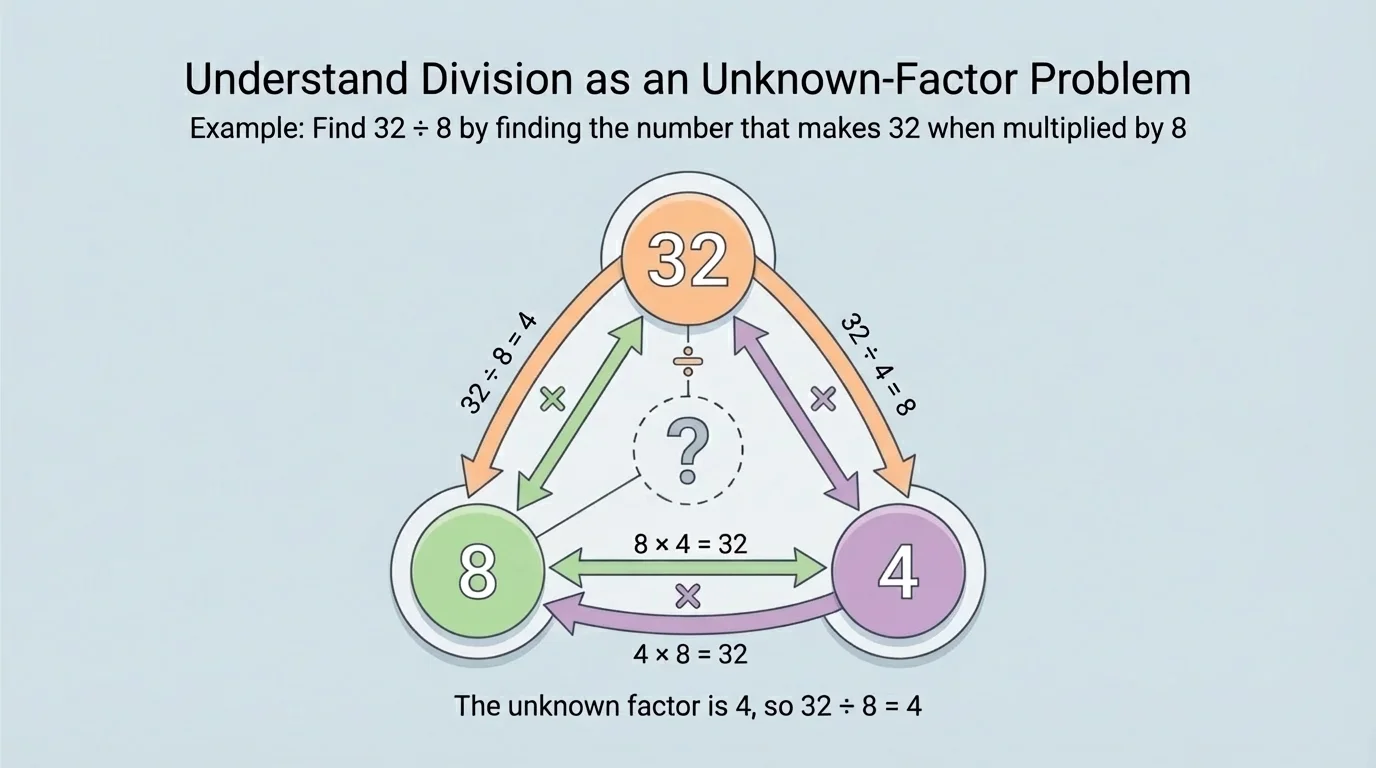
For example, if you know \(7 \times 6 = 42\), then you also know \(42 \div 7 = 6\) and \(42 \div 6 = 7\). The division answer is the missing factor from multiplication.
As you practice, you will notice patterns. Facts with \(2\), \(5\), and \(10\) are often easy to remember because skip-counting helps. Facts with \(3\), \(4\), \(6\), \(7\), \(8\), and \(9\) become easier when you use arrays, repeated addition, and facts you already know.
| Multiplication fact | Matching division facts |
|---|---|
| \(3 \times 4 = 12\) | \(12 \div 3 = 4\), \(12 \div 4 = 3\) |
| \(5 \times 6 = 30\) | \(30 \div 5 = 6\), \(30 \div 6 = 5\) |
| \(8 \times 2 = 16\) | \(16 \div 8 = 2\), \(16 \div 2 = 8\) |
| \(9 \times 3 = 27\) | \(27 \div 9 = 3\), \(27 \div 3 = 9\) |
Table 1. Examples of multiplication facts and their matching division facts.
Looking at a table like this helps you see the pattern: the total in multiplication becomes the starting number in division, and the missing factor becomes the answer.
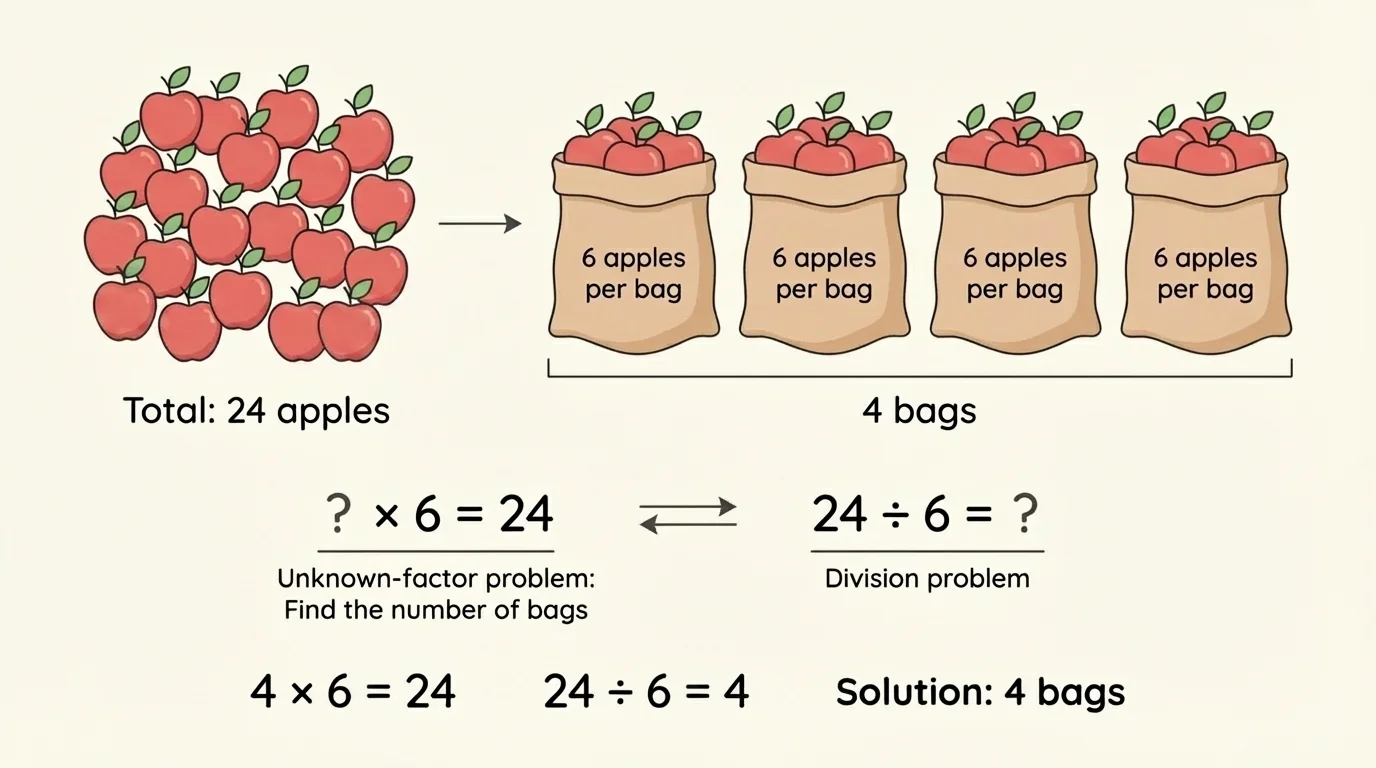
In [Figure 3], division as an unknown-factor problem shows up in an everyday situation: apples are packed into equal bags. If there are \(24\) apples and each bag holds \(6\), the question is not just "divide." The real question is "\(6\) times what number makes \(24\)?" The answer is \(4\), so there are \(4\) bags.
Think about sports. If \(20\) players are making teams of \(5\), you can ask: \(5 \times ? = 20\). Since \(5 \times 4 = 20\), there are \(4\) teams. This is the same idea shown in the picture above.
Think about chairs in rows. If \(18\) chairs are arranged in rows of \(3\), then \(18 \div 3 = ?\) becomes \(3 \times ? = 18\). The answer is \(6\), so there are \(6\) rows.
Think about stickers. If \(28\) stickers are shared equally among \(4\) friends, then \(28 \div 4 = ?\) becomes \(4 \times ? = 28\). Since \(4 \times 7 = 28\), each friend gets \(7\) stickers.
Multiplication and division help people organize real things every day, like seats in theaters, boxes in warehouses, and food packed into equal trays.
These situations may look different, but the math structure is the same. There is a total, there is a group size or number of groups, and one part is unknown.
Many division problems in basic fact practice have equal whole groups, such as \(24 \div 6 = 4\). But sometimes a total does not split into equal whole groups without something left over.
For example, if you try \(22 \div 5\), you can ask: "What whole number multiplied by \(5\) is closest to \(22\) without going over?" Since \(5 \times 4 = 20\) and \(5 \times 5 = 25\), there are \(4\) full groups of \(5\) and \(2\) left over.
At this stage, the most important idea is still the unknown-factor thinking. Even when there is a leftover, multiplication helps you find the greatest whole number of equal groups.
There are several smart ways to solve division as an unknown-factor problem. The best strategy depends on the numbers and what you know well.
Use a known multiplication fact: If you know \(6 \times 7 = 42\), then \(42 \div 6 = 7\).
Use skip-counting: To solve \(24 \div 3\), count by \(3\): \(3, 6, 9, 12, 15, 18, 21, 24\). That is \(8\) counts, so \(24 \div 3 = 8\).
Use an array or equal groups picture: As we saw earlier in [Figure 1], a visual model helps you see rows, columns, and totals. This can make the unknown factor easier to find.
Use a fact family: The relationships shown in [Figure 2] help you move back and forth between multiplication and division.
Sometimes one strategy leads to another. You might draw a quick array first, then notice a fact family, and finally remember the multiplication fact. That is strong mathematical thinking.
"If you know a multiplication fact, you can unlock its division facts."
The more multiplication facts you learn, the more division facts you can solve. This is why learning facts is not just about memorizing. It is about seeing connections.
When you solve \(32 \div 8\) by asking "What number makes \(32\) when multiplied by \(8\)?" you are thinking like a mathematician. You are not only getting an answer. You are understanding why the answer makes sense.
