A pizza can be cut into slices, but a number line tells a different story: fractions are not only pieces of objects, they are also numbers with places of their own. That means \(\dfrac{1}{2}\), \(\dfrac{1}{3}\), and \(\dfrac{1}{4}\) can each be found at exact spots on a line, just like \(0\) and \(1\).
When we use a number line, we think about numbers as locations and distances. Whole numbers such as \(0\), \(1\), and \(2\) already have places on the line. Fractions do too. A fraction tells how far you move from \(0\) when a whole has been split into equal parts.
If you know where the whole is, you can find a fraction. For this lesson, the whole is the distance from \(0\) to \(1\). Once that distance is chosen, we can break it into equal parts and name each part.
You already know that a whole can be divided into equal shares. On a shape, equal shares might be equal slices. On a number line, equal shares are equal lengths.
This idea is important because fractions depend on equal parts. If the parts are not equal, they do not correctly show fractions such as \(\dfrac{1}{3}\) or \(\dfrac{1}{4}\).
To place fractions on a number line, we first decide what counts as one whole. As shown in [Figure 1], the interval from \(0\) to \(1\) is the whole. The word interval means the distance between two numbers on a number line.
If the distance from \(0\) to \(1\) is one whole, then every fraction between \(0\) and \(1\) must fit somewhere inside that space. Fractions smaller than \(1\) are found between those two numbers.
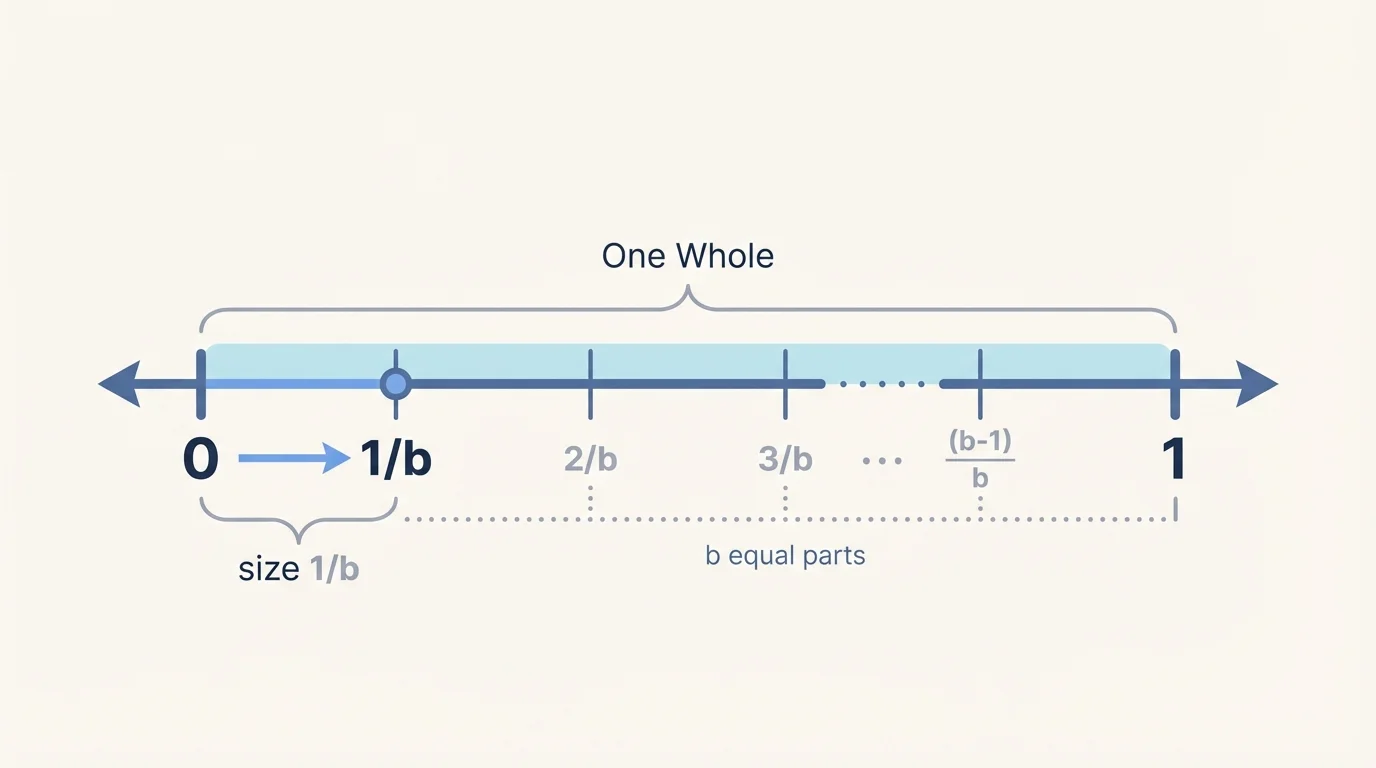
This is different from just looking at a shape. On a number line, we do not color pieces of a circle or rectangle. Instead, we look at how far a point is from \(0\).
Whole means the complete distance from \(0\) to \(1\) on the number line in this lesson.
Unit fraction means a fraction with \(1\) in the numerator, such as \(\dfrac{1}{2}\), \(\dfrac{1}{3}\), or \(\dfrac{1}{8}\).
Every unit fraction is made by taking one whole and splitting it into equal parts. The denominator tells how many equal parts the whole has been split into.
Suppose we want to show \(\dfrac{1}{4}\). We start with the whole from \(0\) to \(1\), and then we partition that whole into \(4\) equal parts. To partition means to split something into equal parts.
The denominator, which is the bottom number, tells how many equal parts to make. For \(\dfrac{1}{4}\), the denominator is \(4\), so the whole must be divided into \(4\) equal lengths, as shown in [Figure 2].
Equal parts matter. If one part is longer or shorter than another part, the number line does not correctly show fourths. Every space must be the same size.
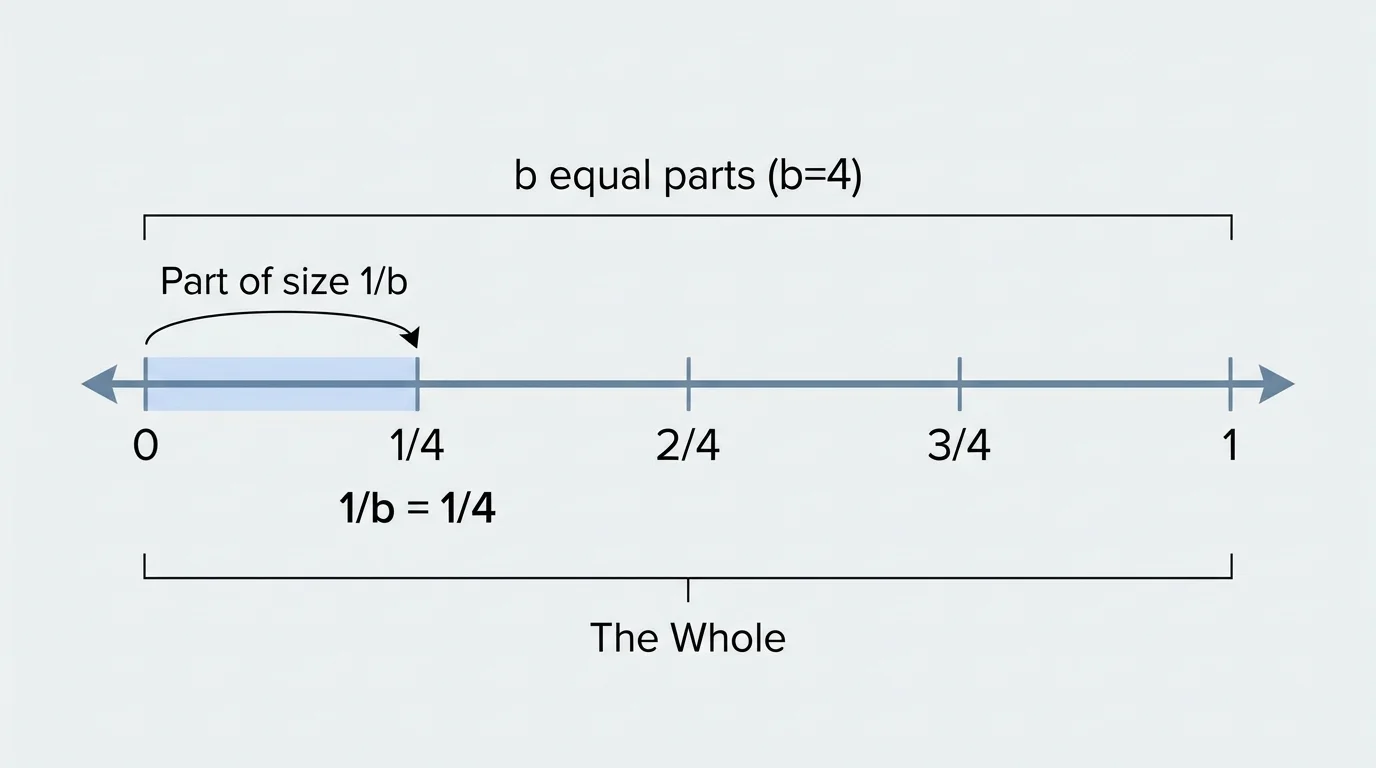
When the whole from \(0\) to \(1\) is split into \(4\) equal parts, each part has size \(\dfrac{1}{4}\). This means each jump from one tick mark to the next is one fourth of the whole.
The same pattern works for any denominator \(b\). If the whole is split into \(b\) equal parts, then each part has size \(\dfrac{1}{b}\).
The denominator tells the number of equal parts. If a fraction is \(\dfrac{1}{b}\), then the whole from \(0\) to \(1\) is partitioned into \(b\) equal lengths. Each length is exactly one of those \(b\) equal parts, so each one is \(\dfrac{1}{b}\).
This rule helps us read many fractions. For \(\dfrac{1}{2}\), make \(2\) equal parts. For \(\dfrac{1}{3}\), make \(3\) equal parts. For \(\dfrac{1}{8}\), make \(8\) equal parts.
Now we can answer the big question: where is \(\dfrac{1}{b}\) on the number line? As shown in [Figure 3], after the whole from \(0\) to \(1\) is split into \(b\) equal parts, the endpoint of the first part starting at \(0\) is the point for \(\dfrac{1}{b}\).
This is a powerful idea. The fraction \(\dfrac{1}{b}\) is not the shaded segment itself, but the number located at the endpoint of the first equal part.
For example, if the whole is split into \(5\) equal parts, each part has size \(\dfrac{1}{5}\). Starting at \(0\), one part takes you to \(\dfrac{1}{5}\). Two parts would take you to \(\dfrac{2}{5}\), but the first endpoint is \(\dfrac{1}{5}\).
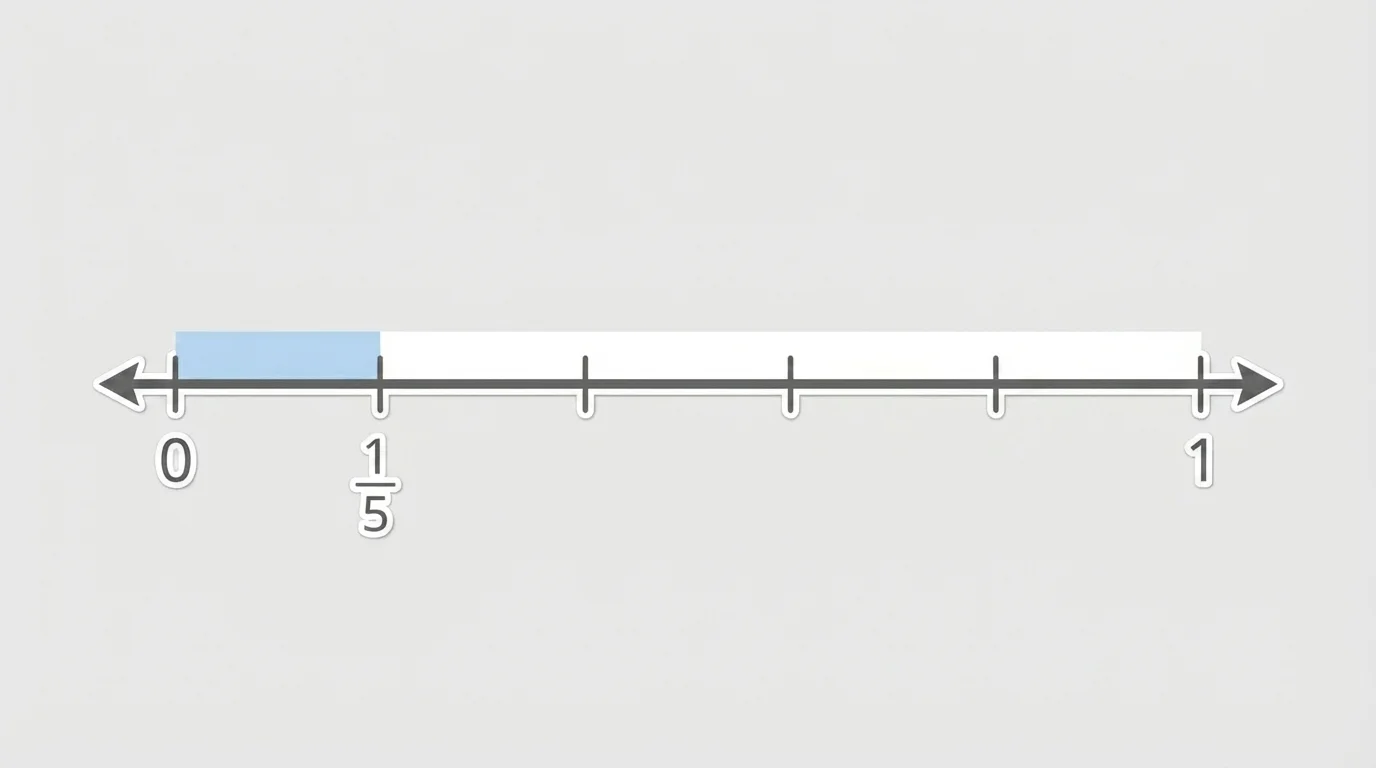
This is why fractions are numbers: each one names a location. The point \(\dfrac{1}{5}\) has a place on the line just like \(1\) has a place on the line.
We can say it like this:
If the interval from \(0\) to \(1\) is partitioned into \(b\) equal parts, each part has size \(\dfrac{1}{b}\).
And the first part based at \(0\) ends at \(\dfrac{1}{b}\).
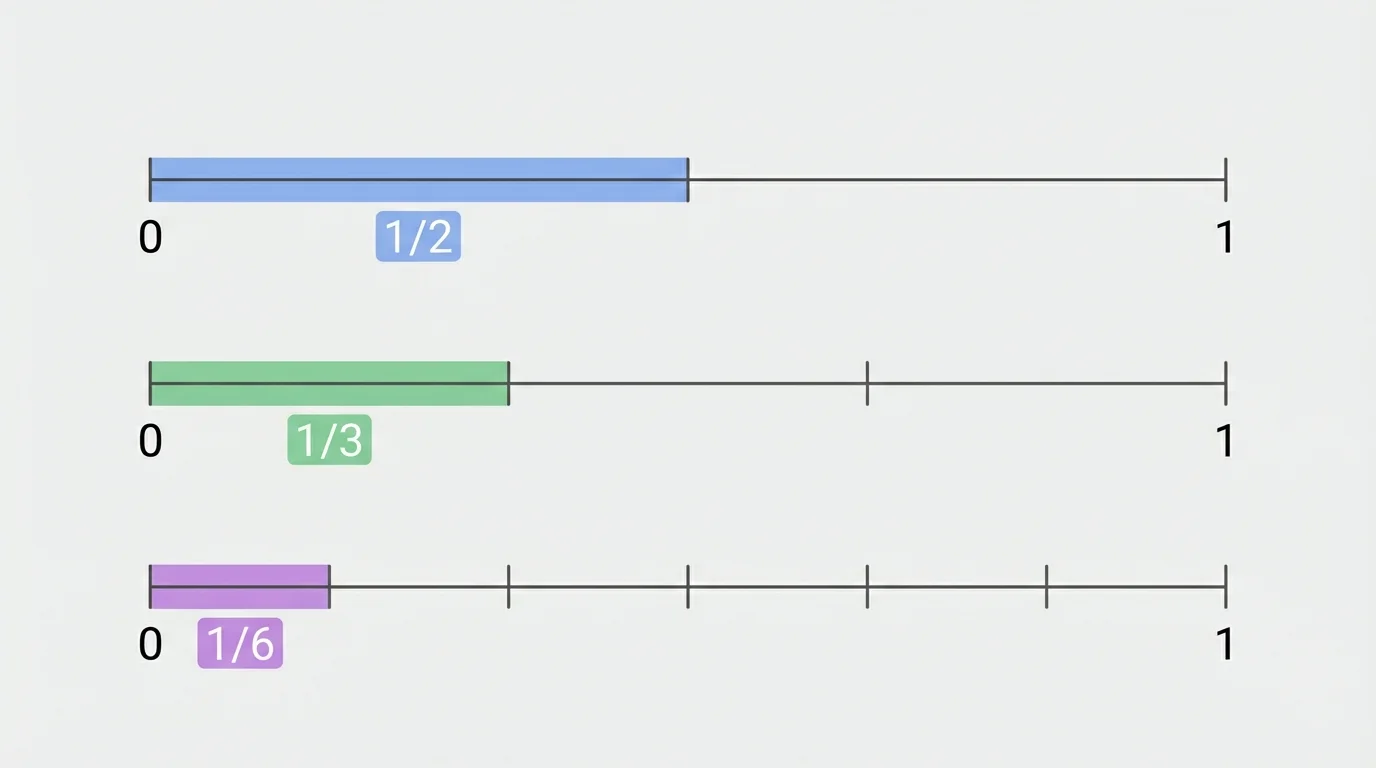
Different unit fractions come from different numbers of equal parts. When the whole is split into more parts, each part gets smaller. That is why \(\dfrac{1}{2}\) is larger than \(\dfrac{1}{3}\), and \(\dfrac{1}{3}\) is larger than \(\dfrac{1}{6}\).
Think about a chocolate bar. As [Figure 4] makes clear, if two friends share one bar equally, each gets \(\dfrac{1}{2}\). If six friends share the same bar equally, each gets \(\dfrac{1}{6}\). More equal shares mean smaller pieces.
On the number line, this means the point for \(\dfrac{1}{2}\) is farther from \(0\) than the point for \(\dfrac{1}{3}\), and the point for \(\dfrac{1}{6}\) is even closer to \(0\).
Here are some common unit fractions:
| Fraction | How many equal parts in the whole | Size of one part |
|---|---|---|
| \(\dfrac{1}{2}\) | \(2\) | One of two equal parts |
| \(\dfrac{1}{3}\) | \(3\) | One of three equal parts |
| \(\dfrac{1}{4}\) | \(4\) | One of four equal parts |
| \(\dfrac{1}{5}\) | \(5\) | One of five equal parts |
| \(\dfrac{1}{8}\) | \(8\) | One of eight equal parts |
Table 1. Unit fractions and how each denominator tells the number of equal parts in the whole.
Notice the pattern: as the denominator gets bigger, the unit fraction gets smaller. That matches what we saw earlier in [Figure 4].
A ruler is a great fraction tool. If one inch is the whole, then marks at halves, fourths, and eighths show fractions as distances on a line.
This is one reason number lines are so useful. They help us see that fractions are sizes and locations, not just pieces of shapes.
Let's work through some examples step by step.
Worked Example 1
Show \(\dfrac{1}{2}\) on a number line.
Step 1: Decide what the whole is.
The whole is the distance from \(0\) to \(1\).
Step 2: Look at the denominator.
The denominator is \(2\), so split the whole into \(2\) equal parts.
Step 3: Find one part starting at \(0\).
The endpoint of the first equal part is \(\dfrac{1}{2}\).
The point halfway between \(0\) and \(1\) is \(\dfrac{1}{2}\).
This example shows that \(\dfrac{1}{2}\) is one jump of size \(\dfrac{1}{2}\) from \(0\).
Worked Example 2
Show \(\dfrac{1}{3}\) on a number line.
Step 1: Use the whole from \(0\) to \(1\).
That interval is one whole.
Step 2: Partition the whole.
Because the denominator is \(3\), divide the whole into \(3\) equal parts.
Step 3: Locate the first endpoint.
Starting at \(0\), the endpoint of the first part is \(\dfrac{1}{3}\).
The answer is \(\dfrac{1}{3}\), which is closer to \(0\) than \(\dfrac{1}{2}\).
That last fact makes sense: splitting the whole into \(3\) equal parts makes smaller pieces than splitting it into \(2\) equal parts.
Worked Example 3
Show \(\dfrac{1}{5}\) on a number line.
Step 1: Name the whole.
The distance from \(0\) to \(1\) is the whole.
Step 2: Read the denominator.
The denominator is \(5\), so partition the whole into \(5\) equal lengths.
Step 3: Mark the first part from \(0\).
One equal part from \(0\) ends at \(\dfrac{1}{5}\).
The answer is \(\dfrac{1}{5}\).
This matches the idea shown earlier in [Figure 3]: the first endpoint after dividing into five equal parts names \(\dfrac{1}{5}\).
Worked Example 4
A number line from \(0\) to \(1\) is split into \(8\) equal parts. What fraction names each part, and where is the first endpoint?
Step 1: Count the equal parts.
There are \(8\) equal parts.
Step 2: Name one part.
Each part has size \(\dfrac{1}{8}\).
Step 3: Locate the first endpoint.
The endpoint of the first part starting at \(0\) is at \(\dfrac{1}{8}\).
Each part is \(\dfrac{1}{8}\), and the first endpoint is also \(\dfrac{1}{8}\).
Notice something neat: the size of the first part and the location of its endpoint are named by the same fraction.
One common mistake is making parts that are not equal. Fractions on a number line must come from equal distances, not just any marks.
Another mistake is counting tick marks instead of spaces. If a line from \(0\) to \(1\) has been split into \(4\) equal parts, there may be \(5\) tick marks, but there are still only \(4\) spaces. The denominator tells the number of spaces, or parts.
A third mistake is forgetting what the whole is. In this lesson, the whole is always the interval from \(0\) to \(1\), just as we saw in [Figure 1]. If you use a different whole by accident, your fraction location will not be correct.
Count spaces, not just marks. On a number line, the denominator tells how many equal spaces fit between \(0\) and \(1\). The fraction \(\dfrac{1}{b}\) is found at the endpoint of the first of those spaces.
Checking these ideas can help you avoid errors: What is the whole? Are the parts equal? How many spaces are there? Where does the first part end?
Fractions on number lines connect to real objects you use every day. A ruler shows fractions as lengths. If one inch is the whole, then the mark halfway is \(\dfrac{1}{2}\), quarter marks are \(\dfrac{1}{4}\), and smaller marks may show \(\dfrac{1}{8}\).
Time is another example. On a clock, one hour can be a whole. Half an hour is \(\dfrac{1}{2}\) of an hour, and fifteen minutes is \(\dfrac{1}{4}\) of an hour. These are amounts of time, but they can also be thought of as distances along a timeline.
Cooking uses fractions too. If a recipe calls for \(\dfrac{1}{3}\) cup of milk, that amount is one of three equal parts of a full cup. The same thinking we use on a number line helps us understand measuring cups.
Sports and games use fractions when people talk about parts of a lap, parts of a field, or parts of a turn. Fractions help describe where something is and how far it has gone.
So a fraction is much more than a piece of food. It is a number that tells a size, a distance, or a location.
"A fraction is a number, and every number has a place."
When you look at a unit fraction now, you can think of it in a very clear way: divide the whole from \(0\) to \(1\) into equal parts, then find the endpoint of the first part starting at \(0\).
