If you have ever packed a suitcase, filled a toy box, or stacked books into a shelf, you have already used the idea of volume. Volume tells how much space is inside an object. A small lunch box and a large moving box may look similar in shape, but the bigger one can hold much more because it has more volume.
Volume is the amount of space inside a solid figure. When we measure volume, we use cubic units. A cubic unit is a cube that is \(1\) unit long, \(1\) unit wide, and \(1\) unit high. It could be \(1\) cubic centimeter, \(1\) cubic inch, or \(1\) cubic foot, depending on the situation.
Volume is the number of cubic units needed to fill a solid figure without gaps or overlaps.
Cubic units are units used to measure volume, such as \(\textrm{cm}^3\), \(\textrm{in}^3\), or cubic blocks.
Think of volume as the number of tiny cubes that fit inside a box. If a box fits \(24\) cubes that are each \(1\) cubic unit, then the box has a volume of \(24\) cubic units.
A right rectangular prism is a box-shaped solid with rectangular faces. It has three important measurements, as shown in [Figure 1]: length, width, and height. These tell us how long, how wide, and how tall the prism is.
The word right means the edges meet at square corners, or right angles. Many everyday objects are right rectangular prisms, such as cereal boxes, bricks, shipping cartons, and drawers.
The bottom of the prism is called the base. For a rectangular prism, the base is a rectangle. Its area can be found by multiplying the length and width of the base.
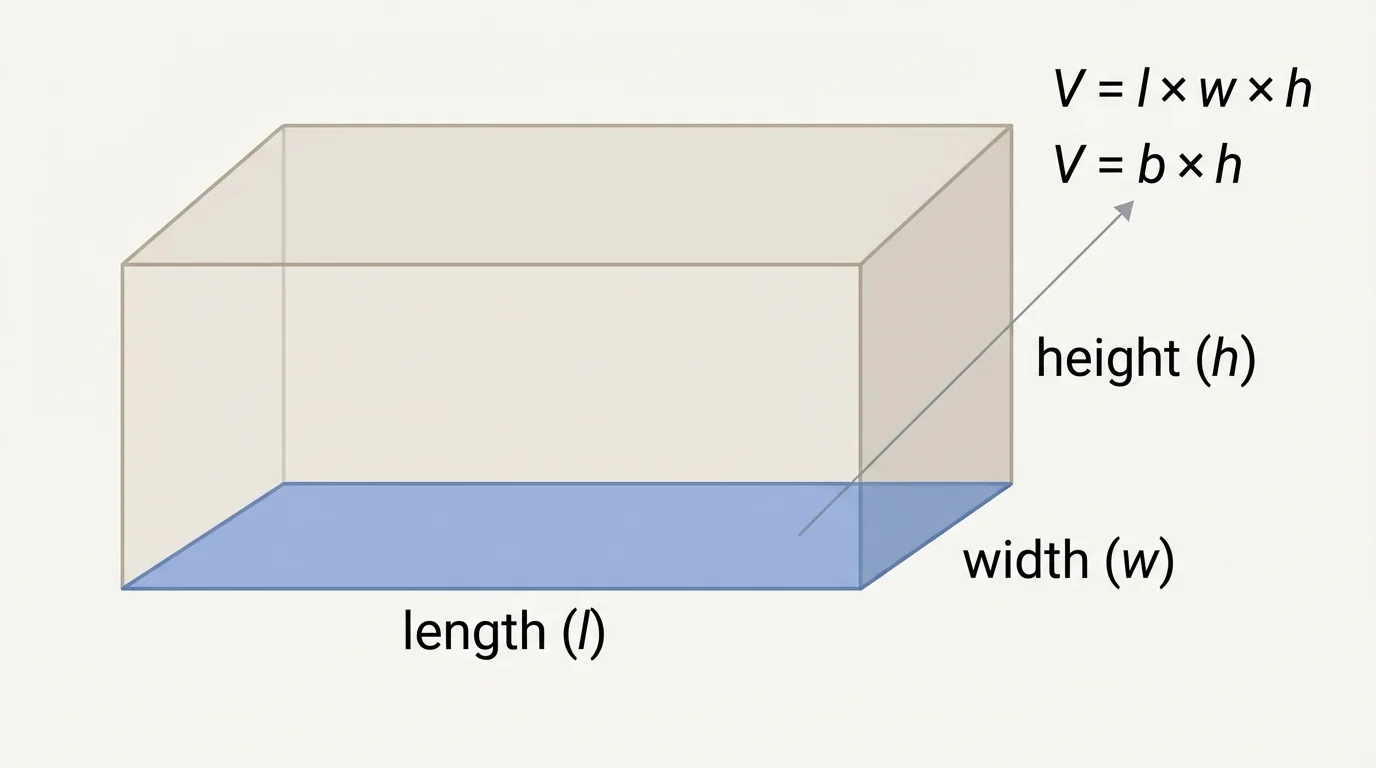
There are two closely related formulas for the volume of a right rectangular prism.
The first formula uses all three dimensions:
\[V = l \times w \times h\]
Here, \(V\) stands for volume, \(l\) stands for length, \(w\) stands for width, and \(h\) stands for height.
The second formula uses the area of the base first:
\[V = b \times h\]
In this formula, \(b\) means the area of the base. Since the base of a rectangular prism is a rectangle, \(b = l \times w\). So the two formulas match:
\[V = b \times h = (l \times w) \times h\]
This means you can either multiply all three dimensions at once, or find the base area first and then multiply by the height.
To find the area of a rectangle, multiply length by width: \(A = l \times w\). Volume builds on that idea by adding height.
Notice that area measures a flat surface in square units, but volume measures space inside a solid in cubic units. That difference is very important.
One of the best ways to understand volume is to picture a prism made of unit cubes. As [Figure 2] shows, one layer on the bottom has rows and columns of cubes. If there are \(4\) cubes in each row and \(3\) rows, then one layer has \(4 \times 3 = 12\) cubes.
If the prism is \(5\) cubes tall, then there are \(5\) identical layers. So the total number of cubes is \(12 + 12 + 12 + 12 + 12 = 60\). Using multiplication, that is \(12 \times 5 = 60\).
This is exactly why the formula works. The base tells how many cubes are in one layer, and the height tells how many layers there are.
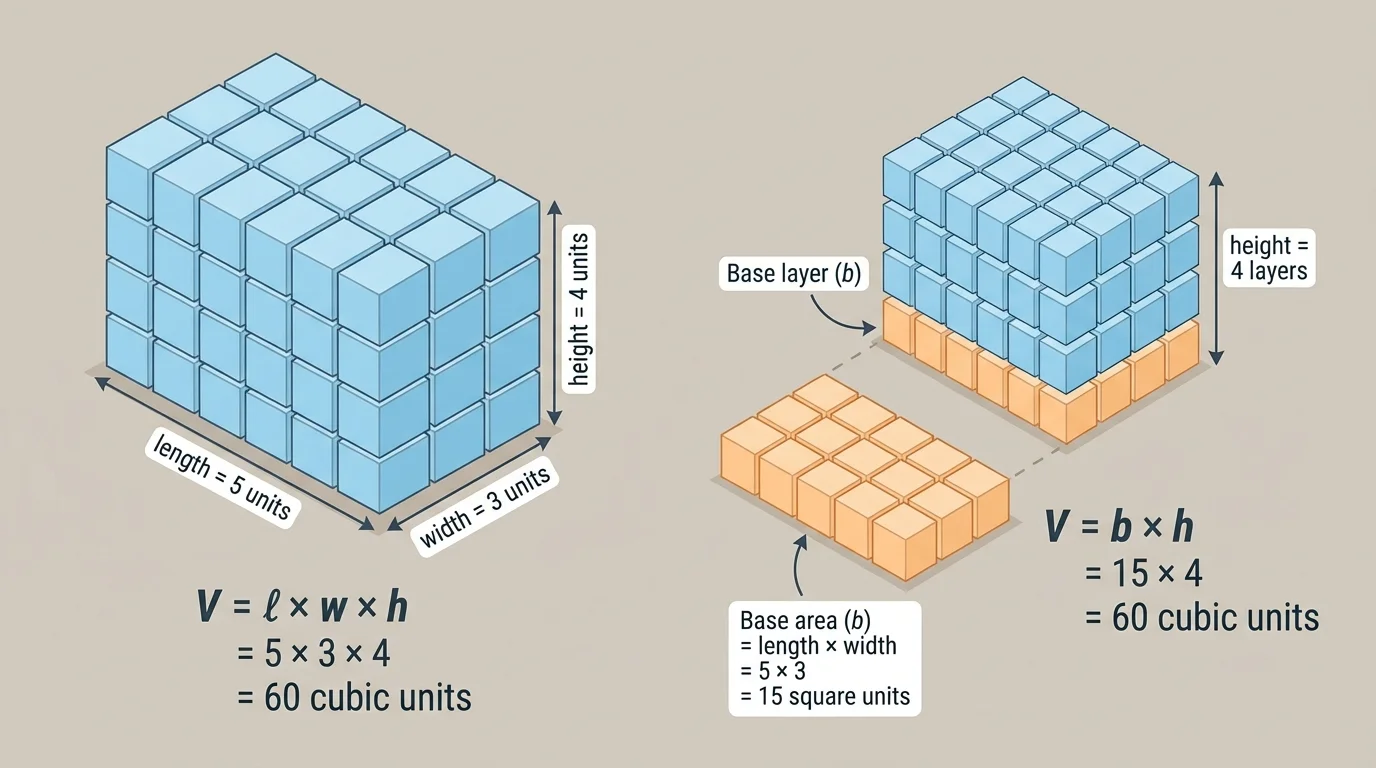
We can also see volume as repeated addition. If a prism has base area \(b = 12\) square units and height \(h = 5\) units, then its volume is \(12 + 12 + 12 + 12 + 12 = 60\) cubic units, or simply \(12 \times 5 = 60\) cubic units.
Why multiplication and addition both work
Volume can be found by adding equal layers or by multiplying. If each layer has the same number of cubes, repeated addition and multiplication give the same result. That is why volume connects to both operations.
This idea helps when solving problems in more than one way. Some students like to think in layers, while others prefer a formula right away.
Suppose a toy box is \(6\) inches long, \(4\) inches wide, and \(3\) inches high. Find its volume.
Worked example
Step 1: Write the formula.
Use \(V = l \times w \times h\).
Step 2: Substitute the dimensions.
\(V = 6 \times 4 \times 3\)
Step 3: Multiply.
First, \(6 \times 4 = 24\).
Then, \(24 \times 3 = 72\).
So the volume is \(72 \textrm{ in}^3\).
This means the toy box can hold \(72\) cubic inches of space.
Now suppose a rectangular prism has a base that is \(7\) units by \(2\) units, and the prism is \(5\) units high. We will use the base-area method.
Worked example
Step 1: Find the area of the base.
\(b = 7 \times 2 = 14\)
Step 2: Use the volume formula \(V = b \times h\).
\(V = 14 \times 5\)
Step 3: Multiply.
\(14 \times 5 = 70\)
So the volume is \(70\) cubic units.
We would get the same answer by using \(V = l \times w \times h\): \(7 \times 2 \times 5 = 70\).
A classroom storage bin is \(9\) inches long, \(5\) inches wide, and \(4\) inches high. How much space is inside the bin?
Worked example
Step 1: Choose a formula.
Use \(V = l \times w \times h\).
Step 2: Substitute.
\(V = 9 \times 5 \times 4\)
Step 3: Multiply step by step.
\(9 \times 5 = 45\)
\(45 \times 4 = 180\)
So the storage bin has a volume of \(180 \textrm{ in}^3\).
The unit is cubic inches because the measurements were in inches.
A shipping box is \(8\) feet long, \(3\) feet wide, and \(2\) feet high. Find its volume.
Worked example
Step 1: Write the formula.
\(V = l \times w \times h\)
Step 2: Substitute the dimensions.
\(V = 8 \times 3 \times 2\)
Step 3: Multiply.
\(8 \times 3 = 24\)
\(24 \times 2 = 48\)
So the volume is \(48 \textrm{ ft}^3\).
This tells us how much space is inside the box.
Suppose one prism measures \(4\) by \(3\) by \(2\), and another measures \(4\) by \(3\) by \(5\). The first volume is \(4 \times 3 \times 2 = 24\). The second volume is \(4 \times 3 \times 5 = 60\). The length and width stayed the same, but the greater height made the volume much larger.
Students sometimes confuse area and volume. Area is for flat shapes. For example, a base that is \(6\) by \(4\) has area \(24\) square units. But if the prism is \(3\) units tall, then the volume is \(24 \times 3 = 72\) cubic units.
Another common mistake is forgetting the units. If the side lengths are measured in centimeters, the answer must be in cubic centimeters, written as \(\textrm{cm}^3\).
| Measurement | What it describes | Example formula | Units |
|---|---|---|---|
| Length | Distance from one end to another | None by itself | units |
| Area | Space on a flat surface | \(l \times w\) | square units |
| Volume | Space inside a solid | \(l \times w \times h\) | cubic units |
Table 1. Comparison of length, area, and volume.
A box that looks only a little taller can hold much more. Changing just one dimension changes the total volume because all three dimensions are multiplied together.
As we saw earlier in [Figure 1], each dimension has a different job: length and width make the base, and height tells how many layers of that base are stacked.
Sometimes a solid figure can be split into smaller rectangular prisms. In that case, as [Figure 3] illustrates, you can find the volume of each smaller prism and then add the volumes. This works because total volume is the sum of the spaces inside all the parts.
For example, imagine a large box-shaped solid made of two rectangular prisms. One prism has dimensions \(4\), \(2\), and \(3\). Its volume is \(4 \times 2 \times 3 = 24\). The other prism has dimensions \(2\), \(2\), and \(3\). Its volume is \(2 \times 2 \times 3 = 12\).
The total volume is \(24 + 12 = 36\) cubic units.
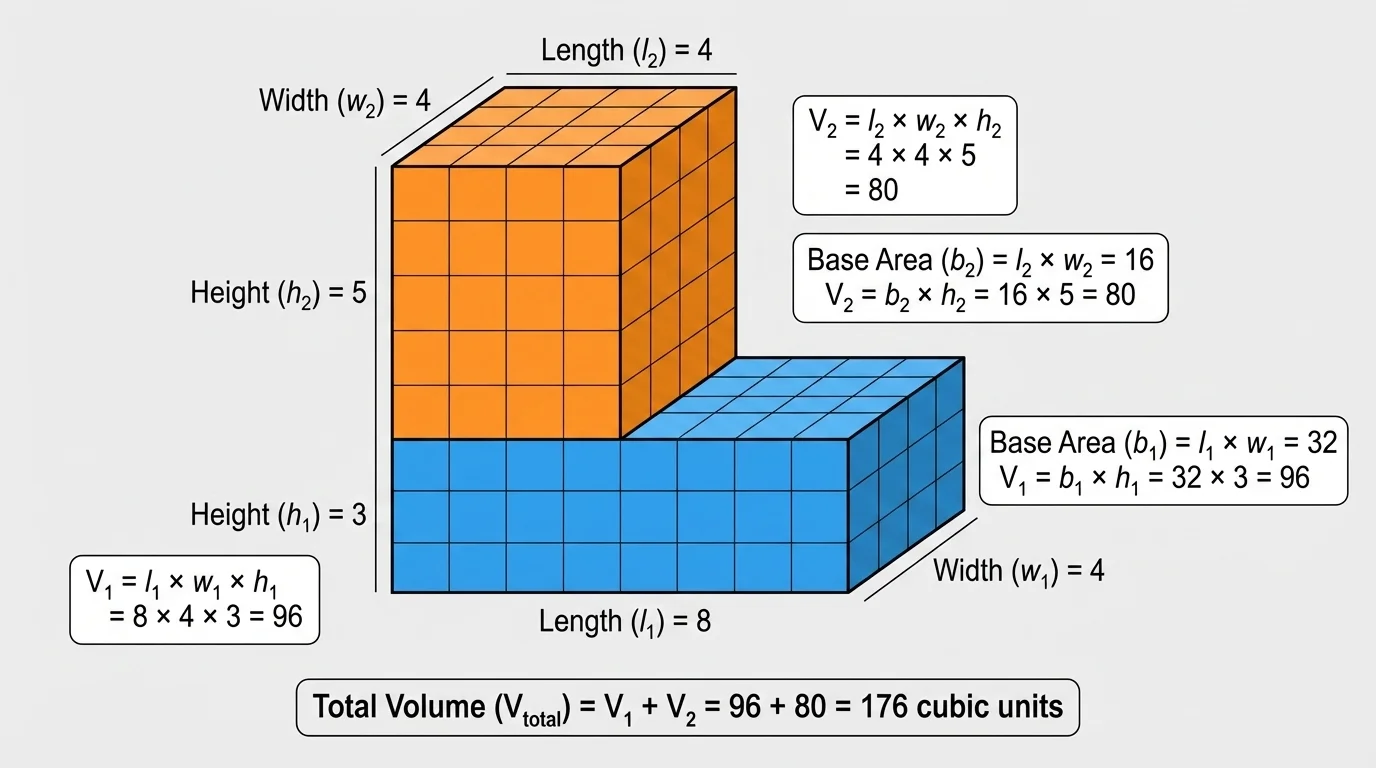
This idea is helpful when a solid is not one simple prism but can be broken apart into simple parts. Later, you can use this strategy for more complex figures too.
The unit-cube picture from [Figure 2] also helps here: if a solid is made of groups of cubes, the cubes in each part can be counted and then added together.
Volume is useful in many everyday situations. A fish tank, a refrigerator box, a drawer, a storage shelf, and a moving carton all involve volume. People use volume when deciding how much something can hold.
If a moving company has a box with volume \(60\) cubic feet and another with volume \(30\) cubic feet, the first box can hold twice as much space inside. If an aquarium is \(10\) inches long, \(6\) inches wide, and \(8\) inches high, its volume is \(10 \times 6 \times 8 = 480\) cubic inches.
In classrooms, volume helps when choosing bins for supplies. In stores, it helps with packaging. In building and design, it helps people plan shelves, cabinets, and storage spaces so objects fit well.
Even video game designers and engineers think about three-dimensional space. Whenever something has length, width, and height, volume can help describe how much room it takes up or how much it can contain.
