Think about a moving box, a toy chest, or a fish tank. Two containers can look almost the same from the outside, but one might hold much more inside. This idea of "how much space fits inside" is called volume, and it helps us describe real objects all around us.
When we measure length, we use units such as inches, centimeters, or feet. When we measure area, we use square units such as square inches because we are covering a flat surface. But when we measure the inside space of a solid object, we need a different kind of unit. We use cubes.
Volume is the amount of space inside a solid figure. A solid figure is a shape that takes up space in three dimensions: length, width, and height.
If you fill a box with small cubes that all match, the number of cubes that fit inside tells the volume of the box. The more cubes that fit, the greater the volume. So volume is not about how long a side is or how much surface is covered. It is about the total space inside.
Volume is the amount of space inside a solid figure.
Cubic unit is the volume of a cube that measures \(1\) unit on each side.
Unit cube is a cube with length \(1\) unit, width \(1\) unit, and height \(1\) unit.
A cereal box, a suitcase, and a storage bin all have volume because they all take up space and can hold things. A drawing of a square on paper has area, but not volume, because it is flat.
[Figure 1] A unit cube is a cube with side length \(1\) unit. That means its length is \(1\) unit, its width is \(1\) unit, and its height is \(1\) unit.
This one small cube is the basic building block for measuring volume. Just as a ruler is marked with equal units for measuring length, unit cubes help us measure space inside solid objects. One unit cube has a volume of exactly one cubic unit.
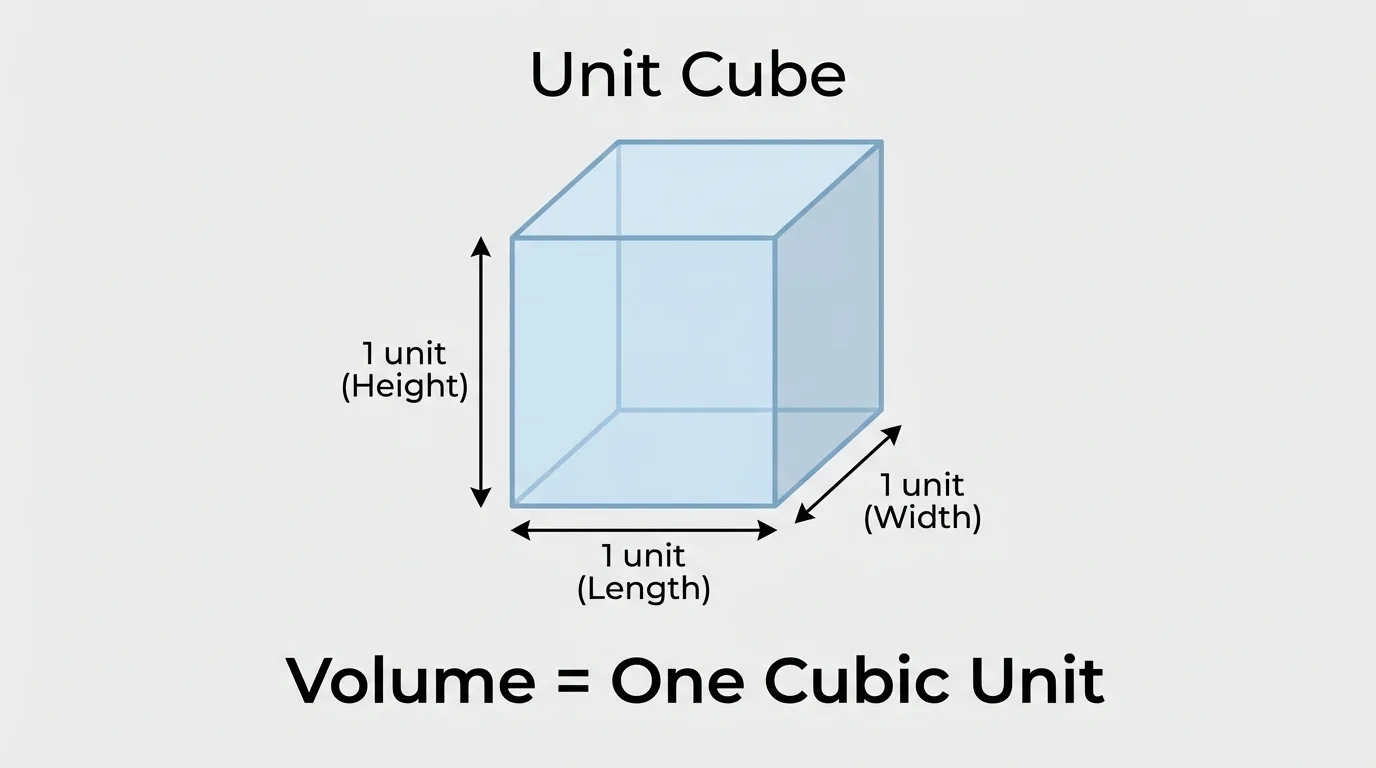
The word cubic is important. It tells us that the unit measures space in three dimensions. A square unit covers a flat region, but a cubic unit fills space.
For example, if the side length of a cube is \(1\) inch, then its volume is \(1\) cubic inch. If the side length is \(1\) centimeter, then its volume is \(1\) cubic centimeter. The kind of unit changes, but the idea stays the same.
A large solid can have the same volume no matter how it is turned. Turning a box does not change the amount of space inside it.
This is why unit cubes are so useful. They give us a standard way to measure volume fairly and exactly.
[Figure 2] Suppose you build a solid shape from unit cubes. The cubic unit is the basic volume unit, and the cubes can be counted to find the volume.
If a shape is made of \(8\) unit cubes, then its volume is \(8\) cubic units. If a shape is made of \(20\) unit cubes, then its volume is \(20\) cubic units. Each cube adds one more cubic unit of space.
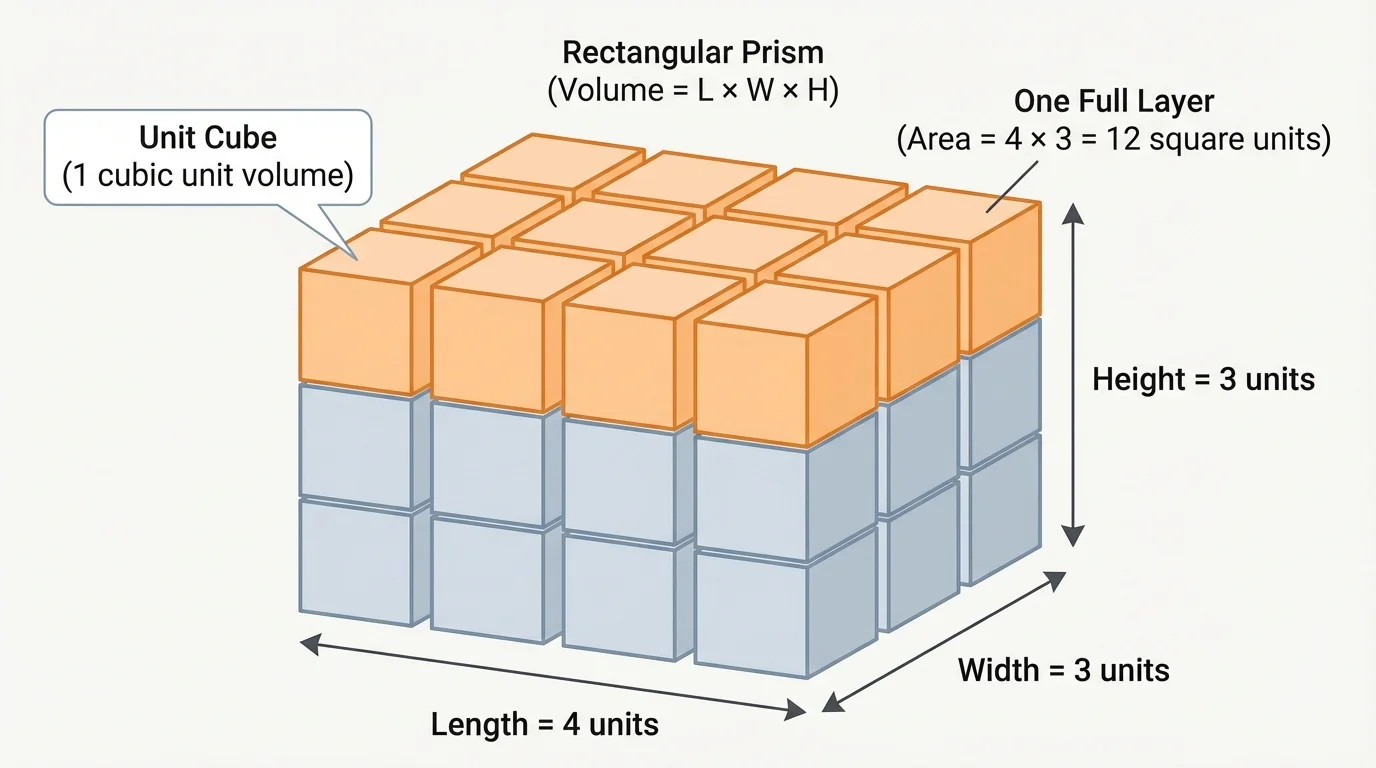
To measure volume correctly with unit cubes, the cubes must fill the solid completely. There should be no empty spaces between cubes, and the cubes should not overlap. If there are gaps or overlaps, the count will not match the true volume.
This idea works especially well for rectangular prisms, which are box-shaped solids. A rectangular prism can be filled neatly with layers of unit cubes.
A solid figure has three dimensions. That is why volume is measured with cubes instead of lines or squares. One dimension measures length. Two dimensions measure area. Three dimensions measure volume.
Think of it this way:
| What is measured | Dimensions involved | Type of unit |
|---|---|---|
| Length | \(1\) | units |
| Area | \(2\) | square units |
| Volume | \(3\) | cubic units |
Table 1. Comparison of length, area, and volume by number of dimensions and units used.
If you draw a square with side length \(1\) unit, it covers \(1\) square unit. If you build a cube with side length \(1\) unit, it fills \(1\) cubic unit. A cube is not simply a square extended upward; it is a true three-dimensional unit for measuring space.
You already know that multiplication can describe equal groups and arrays. That same idea helps with volume because layers of cubes form equal groups too.
This connection between cubes and dimensions helps you understand why volume makes sense as a measurement, not just as a rule to memorize.
[Figure 3] Counting cubes one by one works, but it can take a long time. A faster method is to look for equal rows, equal columns, and equal layers. One layer forms an array, and several equal layers are stacked to build the whole solid.
Suppose one layer has \(4\) cubes in each row and \(3\) rows. Then one layer contains \(4 \times 3 = 12\) cubes. If there are \(2\) equal layers, the total number of cubes is \(12 \times 2 = 24\). So the volume is \(24\) cubic units.
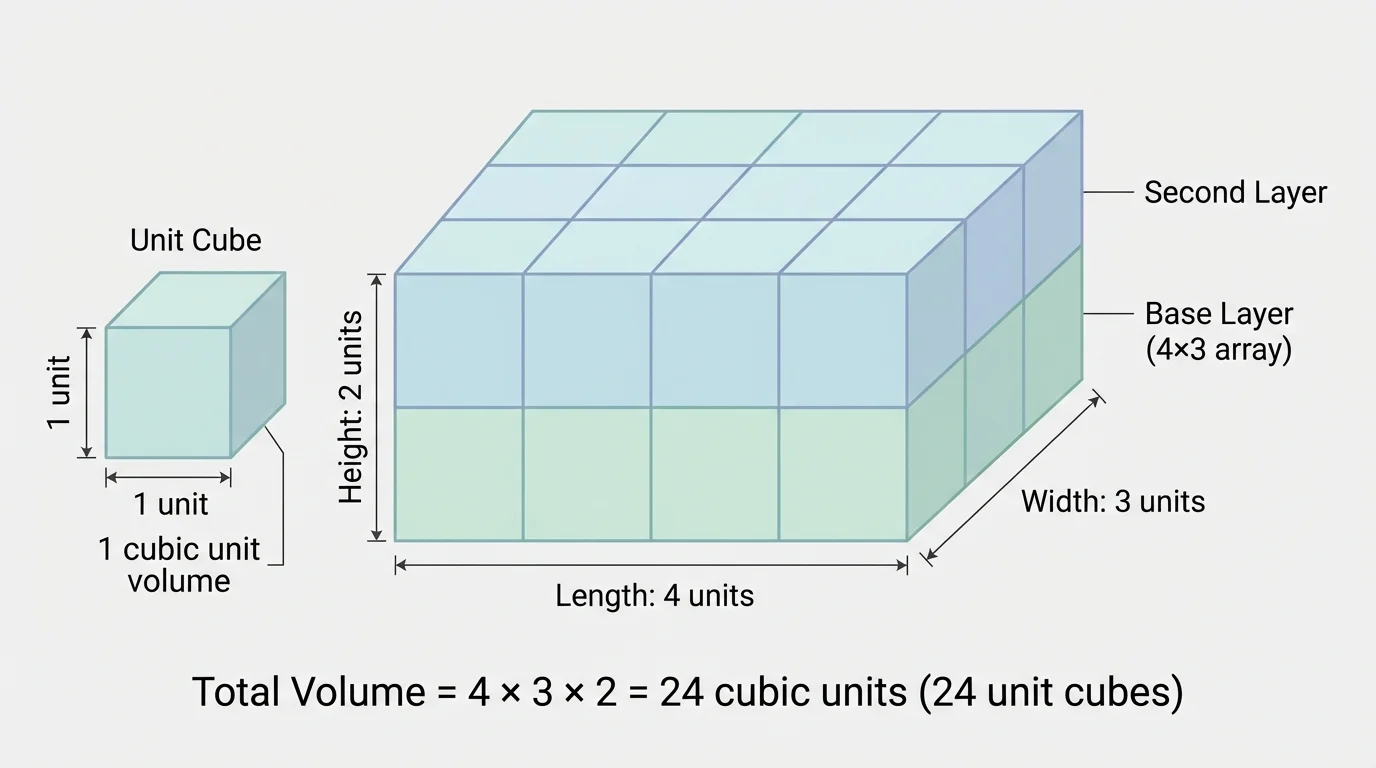
This leads to an important volume formula for rectangular prisms:
Volume equals length times width times height.
In symbols,
\[V = l \times w \times h\]
Here, \(V\) means volume, \(l\) means length, \(w\) means width, and \(h\) means height. This formula works because the base layer has \(l \times w\) cubes, and then the height tells how many equal layers there are.
You can also think of it as:
\[V = B \times h\]
where \(B\) is the area of the base in square units. Then multiplying by the height in units gives volume in cubic units.
Later, when you work with larger prisms, this multiplication idea is much more efficient than counting each cube separately. The structure shown earlier in [Figure 2] helps explain why multiplication works: each layer has the same number of cubes.
Now let's use unit cubes and multiplication to find volume step by step.
Worked example 1
A solid figure is built from \(9\) unit cubes. What is its volume?
Step 1: Identify the unit being counted.
Each unit cube has a volume of \(1\) cubic unit.
Step 2: Count the cubes.
There are \(9\) unit cubes.
Step 3: State the volume.
\[V = 9 \textrm{ cubic units}\]
The figure has volume \(9\) cubic units.
This first example shows the most basic idea: if you know the number of unit cubes, you know the volume.
Worked example 2
A rectangular prism has \(5\) cubes along its length, \(2\) cubes along its width, and \(3\) layers in height. Find the volume.
Step 1: Find the number of cubes in one layer.
One layer has \(5 \times 2 = 10\) cubes.
Step 2: Multiply by the number of layers.
There are \(3\) layers, so \(10 \times 3 = 30\).
Step 3: Write the volume.
\[V = 30 \textrm{ cubic units}\]
The rectangular prism has volume \(30\) cubic units.
Notice that this is the same as using the formula \(V = l \times w \times h\): \(V = 5 \times 2 \times 3 = 30\).
Worked example 3
A rectangular prism has length \(4\) units, width \(4\) units, and height \(2\) units. What is its volume?
Step 1: Use the volume formula for a rectangular prism.
\(V = l \times w \times h\)
Step 2: Substitute the values.
\(V = 4 \times 4 \times 2\)
Step 3: Multiply.
First, \(4 \times 4 = 16\). Then, \(16 \times 2 = 32\).
Step 4: Write the answer with units.
\[V = 32 \textrm{ cubic units}\]
The volume is \(32\) cubic units.
Because the base is \(4 \times 4 = 16\) square units and there are \(2\) layers, the prism contains \(32\) unit cubes in all.
Worked example 4
A prism has a base layer of \(6\) unit cubes and a height of \(4\) layers. Find the volume.
Step 1: Interpret the base layer.
Each layer contains \(6\) unit cubes.
Step 2: Multiply by the number of layers.
\(6 \times 4 = 24\)
Step 3: Write the result.
\[V = 24 \textrm{ cubic units}\]
The volume is \(24\) cubic units.
Even when you do not know the exact arrangement in each row, knowing the number of cubes per layer and the number of equal layers is enough to find the total volume.
Volume is useful in everyday life. A shipping box must have enough volume to hold the items packed inside. A toy bin must have enough volume to fit toys. A fish tank's volume tells how much water it can hold.
Builders, movers, store owners, and designers all think about volume. If two boxes have the same front shape but one is taller, the taller box usually has more volume because it has more layers of space inside. The stacked layers idea from [Figure 3] matches this real-world thinking exactly.
Why unit cubes matter in real measurements
Unit cubes create a standard measurement. If everyone uses cubes with side length \(1\) unit, then volume can be compared fairly. This is similar to how rulers use equal marks to measure length. Standard units make math useful in real life.
Suppose a storage container is \(6\) units long, \(3\) units wide, and \(2\) units high. Its volume is \(6 \times 3 \times 2 = 36\) cubic units. That means it holds the same space as \(36\) unit cubes.
When people say a room feels "bigger," they often mean it has more volume. The room may be longer, wider, taller, or some combination of all three.
One common mistake is mixing up area and volume. Area measures a flat surface in square units. Volume measures space inside a solid in cubic units.
Another common mistake is forgetting the units in the answer. If the problem is about volume, the answer should be in cubic units, such as \(12\) cubic units, not just \(12\).
Students also sometimes count cubes they cannot see incorrectly. If a rectangular prism is completely filled, you must remember the hidden cubes inside or in back layers. That is one reason multiplication is so helpful. The full structure of packed cubes in [Figure 2] reminds us that every layer counts, even if not every cube is visible from one view.
It is also important to remember that unit cubes must fit exactly with no gaps and no overlaps. If cubes are loose, tilted, or stacked unevenly, they do not measure the volume correctly.
"Volume tells how much space is inside, and unit cubes let us measure that space fairly."
Once you understand the unit cube, volume becomes much more logical. You are not memorizing an isolated formula. You are counting space in a careful, organized way.
