Modern medicine can build a three-dimensional image of a body by taking many thin slices in a scanner. That idea is not just useful in hospitals; it is also one of the most powerful ideas in geometry. If two solids have equal cross-sectional areas at every level, then even if they look very different from the outside, they can have the same volume. This surprising fact leads to one of the most elegant arguments in geometry: an informal explanation of why a sphere has volume \(\dfrac{4}{3}\pi r^3\).
When we study area in two dimensions, we often break a shape into simpler pieces. In three dimensions, we can do something similar by cutting a solid into thin horizontal slices. Each slice is a two-dimensional cross-section. If we know the area of each slice at every height, we get powerful information about the whole solid, as [Figure 1] suggests.
That is the basic intuition behind cross-sections. A cross-section is the shape formed when a plane cuts through a solid. For example, a horizontal cut through a cylinder gives a circle, and a horizontal cut through a rectangular prism gives a rectangle. The size of these slices changes with height in some solids and stays constant in others.
You already know several volume formulas, such as \(V = Bh\) for prisms and cylinders, where \(B\) is the area of the base, and \(V = \dfrac{1}{3}Bh\) for cones and pyramids. The goal here is not just to use those formulas, but to understand why they make sense through comparisons of slices.
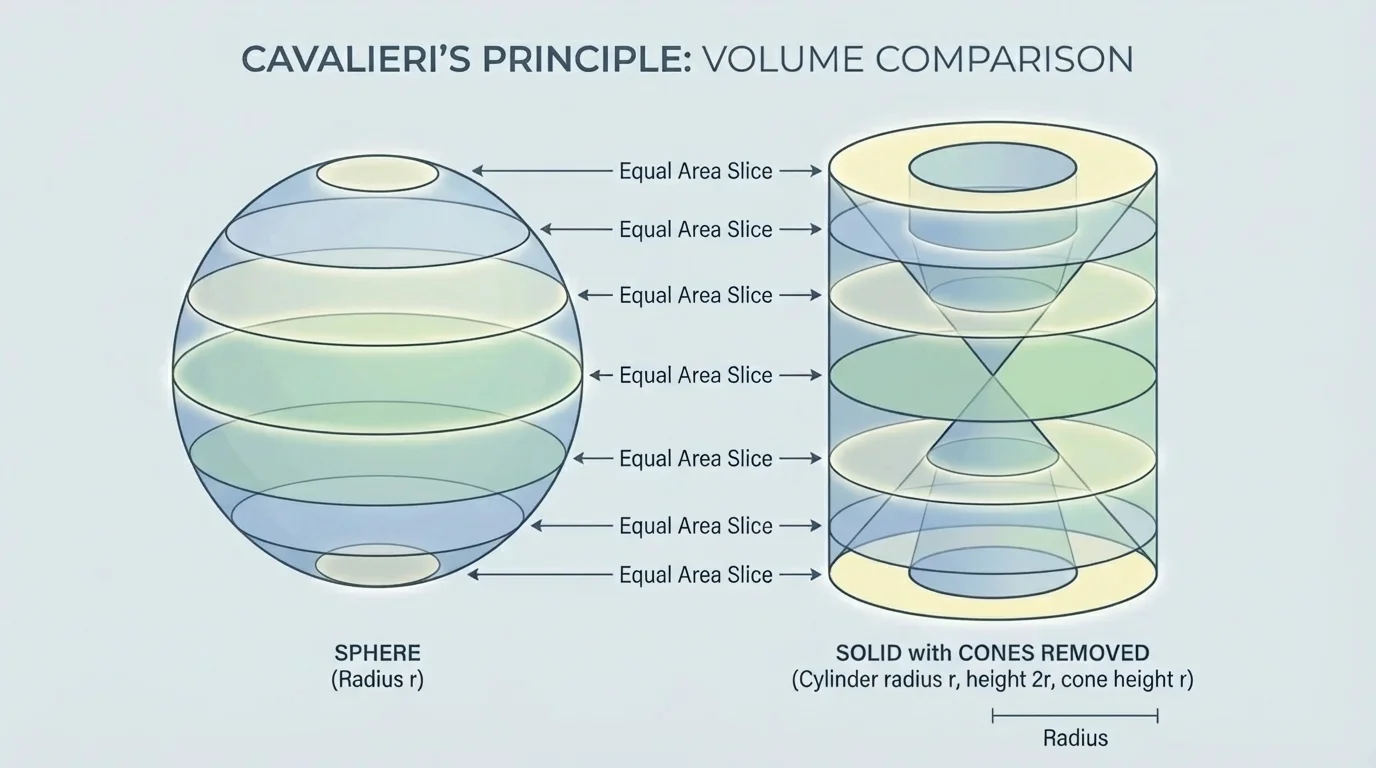
Thinking in slices is especially helpful when a solid has a curved surface, like a sphere. A sphere is harder to decompose into familiar pieces than a prism or cylinder, but its horizontal slices are circles, and circles are shapes whose area we understand well. This viewpoint will be important in the sphere comparison shown in [Figure 2].
Cavalieri's principle says that if two solids have the same height and if every cross-section taken parallel to their bases has the same area at the same height, then the two solids have the same volume. The solids do not need to have the same shape. They only need to match slice-for-slice in area.
Informally, you can think of building each solid from extremely thin layers. If at every height one solid contributes exactly as much area as the other, then stacking all those equal layers produces equal total volume.
This is not a formal proof from calculus, but it is a convincing geometric argument. It works because volume depends on how much space each level of the solid occupies. If that amount matches all the way from bottom to top, then the total space must match too.
Cavalieri's principle states that for two solids of equal height, if the areas of corresponding cross-sections at every height are equal, then the volumes of the solids are equal.
Cross-section means the two-dimensional shape formed by slicing a solid with a plane.
A common way to use the principle is to compare a difficult solid with an easier one. If we can show their slices always have equal area, then we immediately know their volumes are equal, even if one formula would otherwise be hard to derive.
Suppose a prism has base area \(B\) and height \(h\). Every horizontal slice has area \(B\), so stacking those equal slices gives volume \(V = Bh\). A cylinder works the same way. Every horizontal slice is a circle with the same area as the base, so its volume is also \(V = Bh\).
The idea becomes more interesting when slice area changes with height. In a cone or a pyramid, slices shrink as you move upward. In a sphere, slices grow from a point, reach a maximum at the middle, and then shrink again. What matters is not just the outside shape but the area of each slice.
Why matching slices matters
Volume can be thought of as accumulated area through height. If one solid and another solid have equal area at height \(y = 0\), equal area at height \(y = 1\), equal area at height \(y = 2\), and so on for every possible height, then neither solid ever gains more space than the other. Their total volumes must therefore be equal.
This same slice-by-slice view explains why slanting a prism without changing its height and base area does not change its volume. The slices remain congruent or at least equal in area, so the total volume stays the same.
To understand the sphere formula, we compare a hemisphere to another solid with easier volume. Consider a hemisphere of radius \(r\). Now compare it with a cylinder of radius \(r\) and height \(r\), but with a cone removed from the cylinder. This comparison is the key idea.
Why choose that strange-looking solid? Because at every height, its cross-section can be computed using areas we already know: the area of a circle in the cylinder minus the area of a smaller circle from the cone's cross-section.
Set the solids so their flat bases lie at the same level and measure height \(y\) upward from the base, where \(0 \le y \le r\). In the hemisphere, the radius of the horizontal slice at height \(y\) comes from the equation of a circle: \(x^2 + y^2 = r^2\). So the slice radius is \(\sqrt{r^2 - y^2}\), and the slice area is \(\pi(r^2 - y^2)\).
Now look at the comparison solid. The cylinder slice always has area \(\pi r^2\). For the inverted cone removed from it, the slice radius at height \(y\) is \(y\), so the removed slice has area \(\pi y^2\). That leaves area \(\pi r^2 - \pi y^2 = \pi(r^2 - y^2)\).
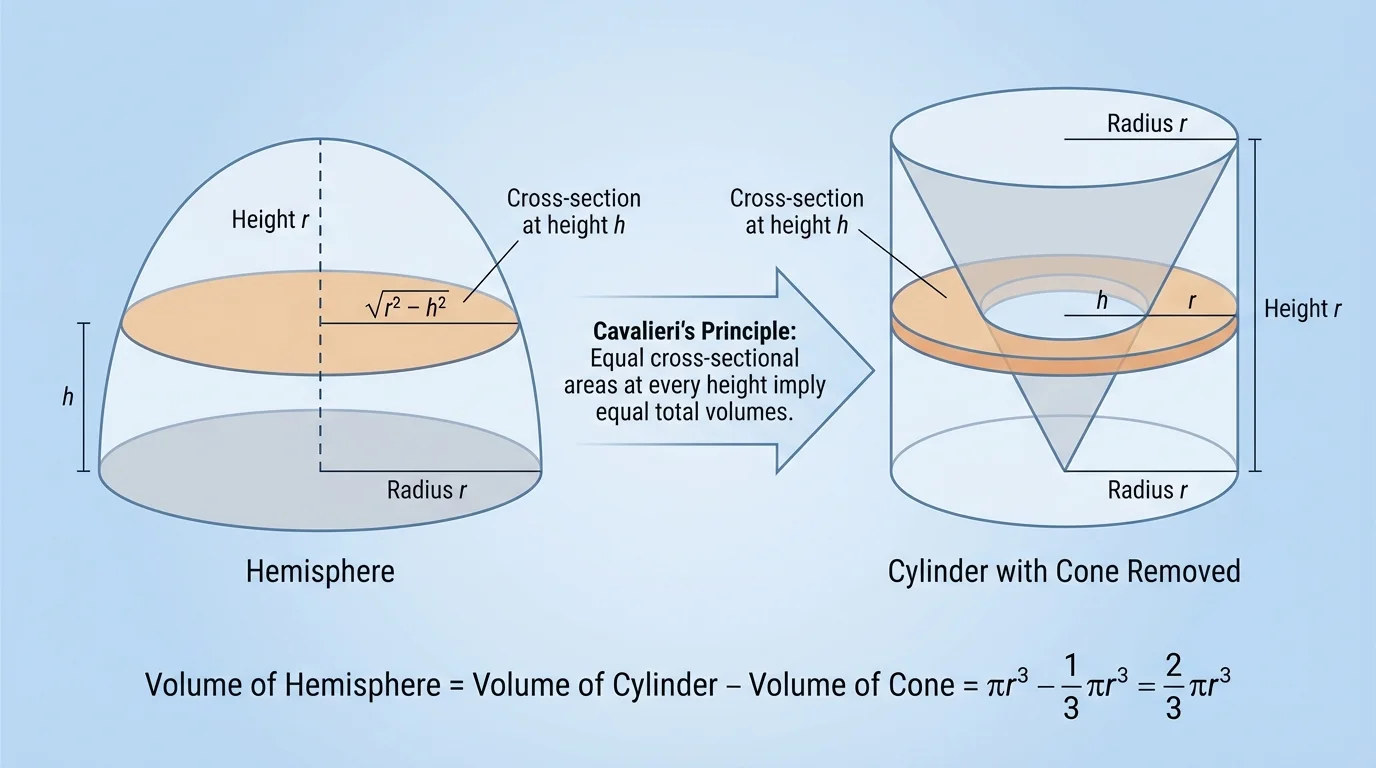
The two slice areas are exactly the same at every height \(y\). Since the hemisphere and the cylinder-minus-cone solid have the same height \(r\), Cavalieri's principle tells us they have the same volume.
Once the cross-sections match, the rest is algebra. The volume of the comparison solid is the volume of the cylinder minus the volume of the cone.
The cylinder has radius \(r\) and height \(r\), so its volume is \(\pi r^2 \cdot r = \pi r^3\). The cone also has radius \(r\) and height \(r\), so its volume is \(\dfrac{1}{3}\pi r^2 \cdot r = \dfrac{1}{3}\pi r^3\).
Therefore the hemisphere volume is
\[V_{\textrm{hemisphere}} = \pi r^3 - \frac{1}{3}\pi r^3 = \frac{2}{3}\pi r^3\]
A full sphere is two hemispheres, so
\[V_{\textrm{sphere}} = 2\left(\frac{2}{3}\pi r^3\right) = \frac{4}{3}\pi r^3\]
Archimedes was so proud of this sphere result that he wanted a sphere and cylinder carved on his tomb. He considered this one of his greatest discoveries.
This argument is powerful because it does more than provide a formula. It explains why the formula is true. The sphere is not being guessed; it is being matched slice-by-slice to a solid whose volume we already know. Later, when you think again about the comparison in [Figure 2], the elegance becomes even clearer: a curved object is measured by comparing it to straight-sided solids.
Cavalieri's principle also explains why an oblique prism has the same volume as a right prism with the same base area and height, as [Figure 3] shows. If the prism is sheared so that the top face slides sideways without changing the base area or perpendicular height, then every horizontal slice still has the same area. So the volume remains \(V = Bh\).
The same is true for an oblique cylinder compared with a right cylinder. Even though one leans, each horizontal slice is still a congruent circle of area \(B\), and the height is unchanged. Therefore both have volume \(Bh\).
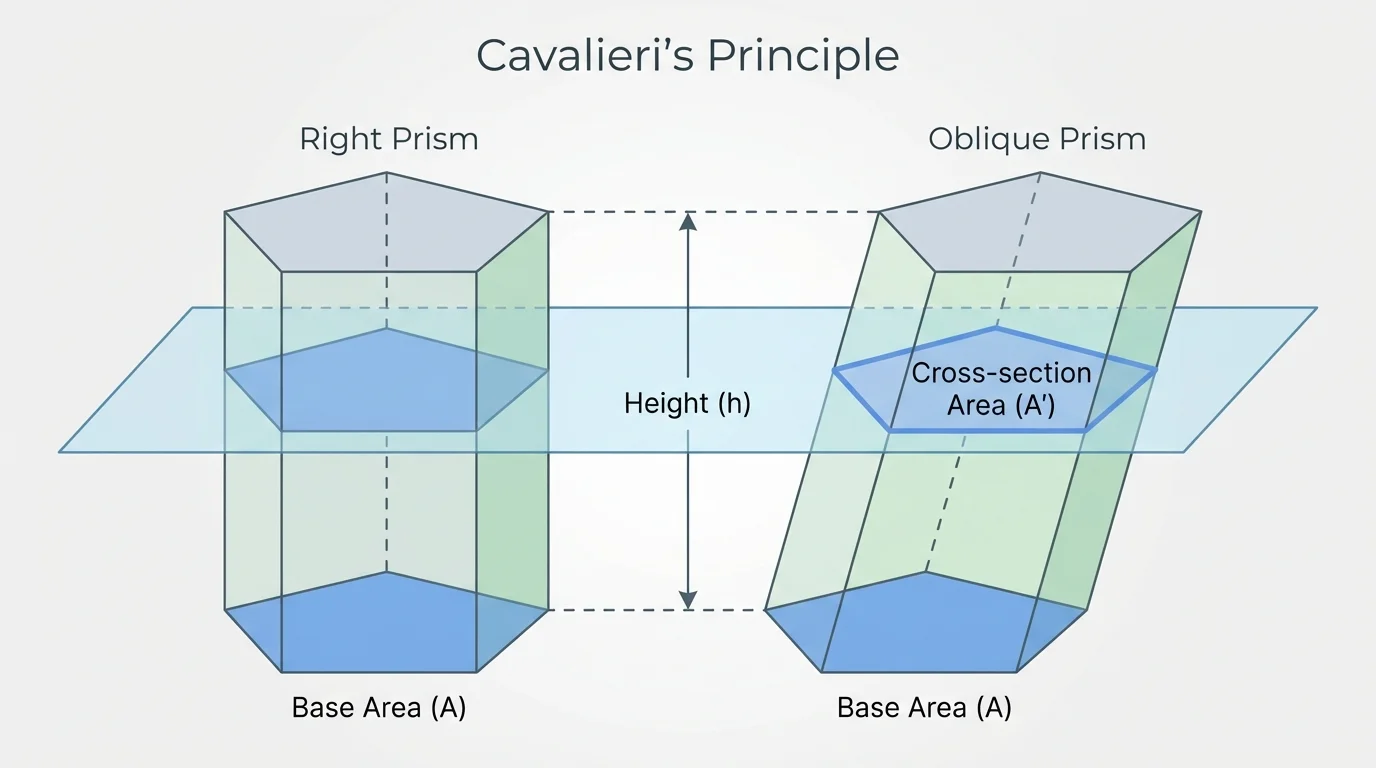
This idea helps explain why volume depends on perpendicular height, not slant height, for these solids. Slanting changes appearance, but not the area of the horizontal slices.
For pyramids and cones, Cavalieri-style reasoning can compare solids with equal heights and bases whose slices shrink in the same way. A pyramid and a cone each have volume \(\dfrac{1}{3}Bh\), where \(B\) is the base area and \(h\) is the perpendicular height. Their slice areas scale so that each height level contributes one-third as much total volume as a prism or cylinder with the same base and height.
Although a full derivation of \(\dfrac{1}{3}Bh\) often uses additional geometric arguments, Cavalieri's principle gives strong intuition: if slices scale the same way from bottom to top, then volume comparisons become possible.
| Solid | Key cross-section idea | Volume formula |
|---|---|---|
| Prism | Same area at every height | \(V = Bh\) |
| Cylinder | Same area at every height | \(V = Bh\) |
| Pyramid | Slices shrink with height | \(V = \dfrac{1}{3}Bh\) |
| Cone | Circular slices shrink with height | \(V = \dfrac{1}{3}Bh\) |
| Sphere | Match slices with cylinder minus cone | \(V = \dfrac{4}{3}\pi r^3\) |
Table 1. Volume formulas and the cross-section ideas that help justify them.
Now apply these ideas to actual calculations. In each example, the formula works because of the slice-based reasoning developed above.
Worked example 1
Find the volume of a sphere with radius \(6 \textrm{ cm}\).
Step 1: Write the sphere formula.
\(V = \dfrac{4}{3}\pi r^3\)
Step 2: Substitute \(r = 6\).
\(V = \dfrac{4}{3}\pi(6^3) = \dfrac{4}{3}\pi(216)\)
Step 3: Simplify.
\(\dfrac{4}{3} \cdot 216 = 288\), so \(V = 288\pi\).
\[V = 288\pi \textrm{ cm}^3\]
This answer means the sphere occupies exactly \(288\pi \textrm{ cm}^3\), which is about \(904.78 \textrm{ cm}^3\) if you use a decimal approximation for \(\pi\).
Worked example 2
A hemisphere has radius \(9 \textrm{ m}\). Find its volume.
Step 1: Use the hemisphere formula.
Since a hemisphere is half a sphere, \(V = \dfrac{1}{2}\left(\dfrac{4}{3}\pi r^3\right) = \dfrac{2}{3}\pi r^3\).
Step 2: Substitute \(r = 9\).
\(V = \dfrac{2}{3}\pi(9^3) = \dfrac{2}{3}\pi(729)\)
Step 3: Simplify.
\(\dfrac{2}{3} \cdot 729 = 486\), so \(V = 486\pi\).
\[V = 486\pi \textrm{ m}^3\]
The same result could be found by remembering the Cavalieri comparison: the hemisphere has the same volume as a cylinder of radius \(9\) and height \(9\), minus a cone with the same radius and height.
Worked example 3
A right cylinder and an oblique cylinder each have base area \(25\pi \textrm{ cm}^2\) and height \(12 \textrm{ cm}\). Find the volume of each, and explain why they are equal.
Step 1: Use \(V = Bh\).
Here \(B = 25\pi\) and \(h = 12\).
Step 2: Compute the volume.
\(V = 25\pi \cdot 12 = 300\pi\)
Step 3: Explain the equality.
At every height, both cylinders have circular cross-sections of area \(25\pi\). Since their heights are the same, Cavalieri's principle says the volumes are equal.
\[V = 300\pi \textrm{ cm}^3\]
The picture of the slanted prism comparison in [Figure 3] helps here too. Leaning a solid does not change its volume if equal-height slices keep the same area.
Worked example 4
A solid is formed by drilling a cone out of a cylinder. The cylinder has radius \(5 \textrm{ in}\) and height \(5 \textrm{ in}\), and the removed cone has the same radius and height. Find the volume of the remaining solid.
Step 1: Find the cylinder volume.
\(V_{\textrm{cyl}} = \pi r^2 h = \pi(5^2)(5) = 125\pi\)
Step 2: Find the cone volume.
\(V_{\textrm{cone}} = \dfrac{1}{3}\pi r^2 h = \dfrac{1}{3}\pi(5^2)(5) = \dfrac{125}{3}\pi\)
Step 3: Subtract.
\(V_{\textrm{remaining}} = 125\pi - \dfrac{125}{3}\pi = \dfrac{250}{3}\pi\)
\[V = \frac{250}{3}\pi \textrm{ in}^3\]
If you doubled this remaining solid in the right way, you would recover the sphere-style comparison used earlier. That is exactly why the sphere argument works.
These ideas appear in many areas beyond classroom geometry. In medical imaging, doctors estimate the volume of organs or tumors by analyzing many slices. In manufacturing, engineers check whether a redesigned part uses the same amount of material by comparing cross-sections. In 3D printing, objects are literally built layer by layer, so slice area determines how much material is added at each height.
Architects and industrial designers also use volume reasoning when comparing tanks, domes, and curved surfaces. A hemispherical dome, for example, encloses space according to \(\dfrac{2}{3}\pi r^3\), while a full spherical tank holds \(\dfrac{4}{3}\pi r^3\). Knowing these formulas helps estimate capacity and material needs.
Even computer graphics uses a slice-like mindset. Software often models complex 3D forms by stacking thin layers or by using many planar cuts to approximate volume.
One mistake is thinking that two solids with equal base areas and equal heights must always have equal volumes. That is not enough. Their cross-sectional areas must match at every height, not just at the bottom and top.
Another mistake is comparing the perimeters of slices instead of their areas. Cavalieri's principle is about area of cross-sections, because area accumulates into volume.
It is also important to use perpendicular height, not slant height, in formulas such as \(V = Bh\) and \(V = \dfrac{1}{3}Bh\). A slanted solid may look longer, but if the slice areas match level-by-level, the volume depends on vertical height.
Finally, for the sphere argument, the comparison is not with a whole cylinder and a whole cone placed separately. It is with one solid formed by removing a cone from a cylinder. That difference matters because the cross-sections must match exactly at each height.
"To understand a solid, compare what happens at every level."
— Geometric idea behind Cavalieri's principle
Once you start thinking in slices, many volume formulas become less mysterious. Instead of memorizing disconnected results, you can see a common structure underneath them: equal cross-sections through equal heights create equal volumes.
