A circle looks simple, but it hides some surprisingly precise geometry. Engineers use circular arcs in bridges, designers use them in lenses and domes, and mathematicians have discovered that certain angles inside a circle always follow exact patterns. Once you understand those patterns, a complicated diagram often becomes a short calculation.
When points lie on a circle, their positions are not random. A chord, an angle, and the center of the circle are linked in ways that let you find missing measures quickly. In many problems, you are asked to move between three connected ideas: the size of an arc, the measure of an angle, and the position of a chord.
These relationships are especially important because they connect visual geometry to exact reasoning. If you can identify what kind of angle you are looking at and what arc it intercepts, you can often solve the entire problem.
A circle is the set of all points in a plane that are the same distance from one fixed point, called the center. That common distance is the radius. You should also remember that congruent segments have equal length, and that a perpendicular line meets another line at a right angle of \(90^\circ\).
To work confidently, you need a clear picture of the basic parts, as [Figure 1] shows. A single circle can contain radii, chords, central angles, inscribed angles, and arcs, and each one helps describe the others.
A radius is a segment from the center of the circle to a point on the circle. All radii in the same circle are congruent. If the center is point \(O\) and \(A\) is on the circle, then \(\overline{OA}\) is a radius.
A chord is a segment whose endpoints are both on the circle. If \(A\) and \(B\) are points on the circle, then \(\overline{AB}\) is a chord. A diameter is a special chord that passes through the center, so it is also the longest chord in a circle.
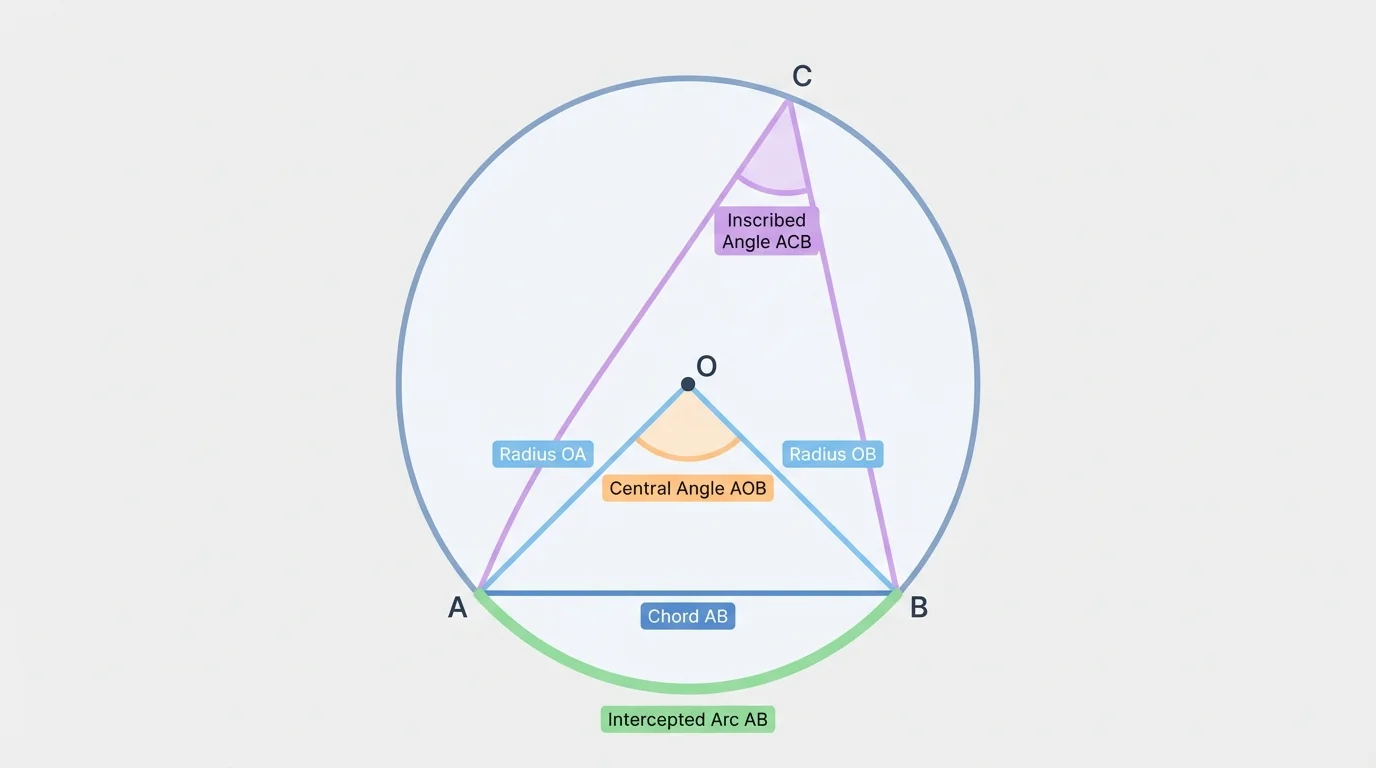
A central angle has its vertex at the center of the circle. For example, \(\angle AOB\) is a central angle if \(O\) is the center. The measure of a central angle equals the measure of its intercepted arc.
An inscribed angle has its vertex on the circle, and its sides are chords. If point \(C\) lies on the circle, then \(\angle ACB\) is an inscribed angle. The arc cut off by the sides of the angle is called the intercepted arc. In this case, the intercepted arc is arc \(AB\).
Central angle: an angle with vertex at the center of a circle.
Inscribed angle: an angle with vertex on the circle and sides that are chords.
Intercepted arc: the arc that lies inside an angle and is cut off by the sides of the angle.
Be careful about what is being measured. A chord is a segment length, an arc is part of the circle, and an angle is measured in degrees. These are different objects, even though they are related.
The key theorem in this topic is easiest to see when you compare an inscribed angle to a central angle that intercepts the same arc, as [Figure 2] illustrates. If an inscribed angle and a central angle intercept the same arc, then the inscribed angle is half the measure of the central angle.
This gives the main relationship:
\[m\angle = \frac{1}{2} m\widehat{\phantom{AB}}\]
Because a central angle has the same measure as its intercepted arc, you can also write:
\[m\angle \textrm{(inscribed)} = \frac{1}{2} m\angle \textrm{(central)}\]
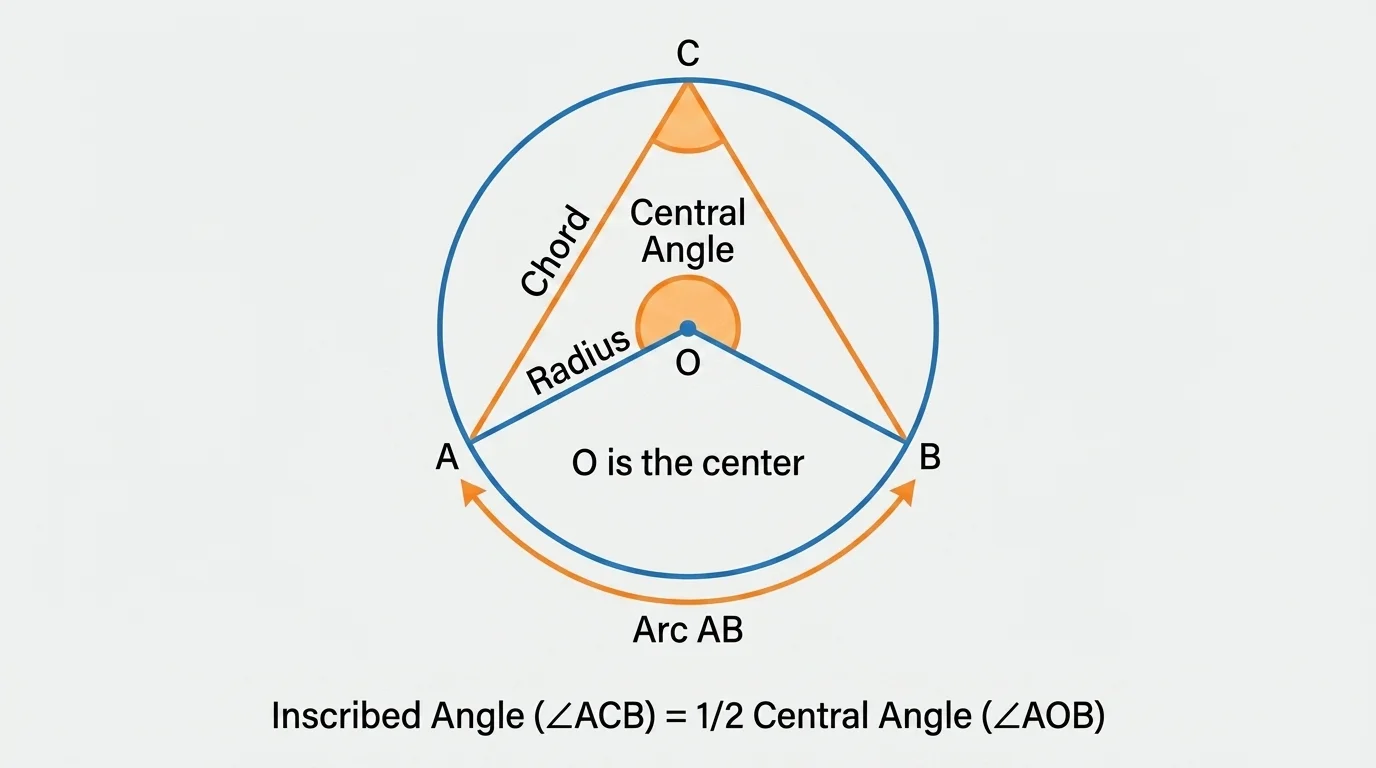
For example, if arc \(AB\) measures \(100^\circ\), then any inscribed angle intercepting arc \(AB\) measures \(50^\circ\). If the central angle intercepting arc \(AB\) is \(100^\circ\), the inscribed angle intercepting that same arc is again \(50^\circ\).
This theorem is powerful because many different inscribed angles can intercept the same arc. Whenever that happens, all of those inscribed angles are congruent. The circle is enforcing a pattern.
Why the theorem matters
The Inscribed Angle Theorem lets you move back and forth between arcs and angles. If you know the arc, you can find the angle by halving. If you know the inscribed angle, you can find the intercepted arc by doubling. This is one of the fastest ways to decode a circle diagram.
Another useful way to think about it is that the arc carries the "full turn information," while the inscribed angle only captures half of that arc's measure.
Some circle situations appear often enough that they are worth memorizing. One of the most famous is the angle inscribed in a semicircle. If an inscribed angle intercepts a diameter, then it intercepts a semicircle of measure \(180^\circ\). By the theorem, the angle measure is \(\dfrac{1}{2}(180^\circ) = 90^\circ\).
So an angle inscribed in a semicircle is always a right angle. This idea appears in proofs, constructions, and coordinate geometry.
A second special case is that inscribed angles intercepting the same arc are congruent. If \(\angle ACB\) and \(\angle ADB\) both intercept arc \(AB\), then \(m\angle ACB = m\angle ADB\).
A useful extension is the cyclic quadrilateral, a quadrilateral whose vertices all lie on a circle. In such a figure, opposite angles are supplementary:
\[m\angle A + m\angle C = 180^\circ\]
and
\[m\angle B + m\angle D = 180^\circ\]
This works because opposite inscribed angles intercept arcs whose measures add to \(360^\circ\), so half of that total is \(180^\circ\).
A theorem from ancient geometry says that if a triangle is inscribed in a circle and one side is a diameter, then the triangle must be a right triangle. That fact still appears in modern geometry courses because it is elegant and extremely useful.
As we saw earlier, the whole pattern depends on identifying the intercepted arc correctly. Students often know to "take half," but they halve the wrong arc. The first job is always to locate the arc cut off by the angle's sides.
The geometry of chords becomes much clearer when you bring in the center. Since radii connect the center to the circle, they help explain why some chords are equal, why some are bisected, and how distance from the center affects chord length.
[Figure 3] One important theorem says that in the same circle, or in congruent circles, congruent chords intercept congruent arcs. The converse is also true: congruent arcs correspond to congruent chords. So if arc \(AB\) and arc \(CD\) have equal measure, then chord \(\overline{AB}\) and chord \(\overline{CD}\) have equal length.
Another major relationship involves a perpendicular from the center to a chord. If a radius or diameter is perpendicular to a chord, then it bisects the chord. In other words, if \(OM\) is perpendicular to chord \(AB\), then \(M\) is the midpoint of \(\overline{AB}\), so \(AM = MB\).
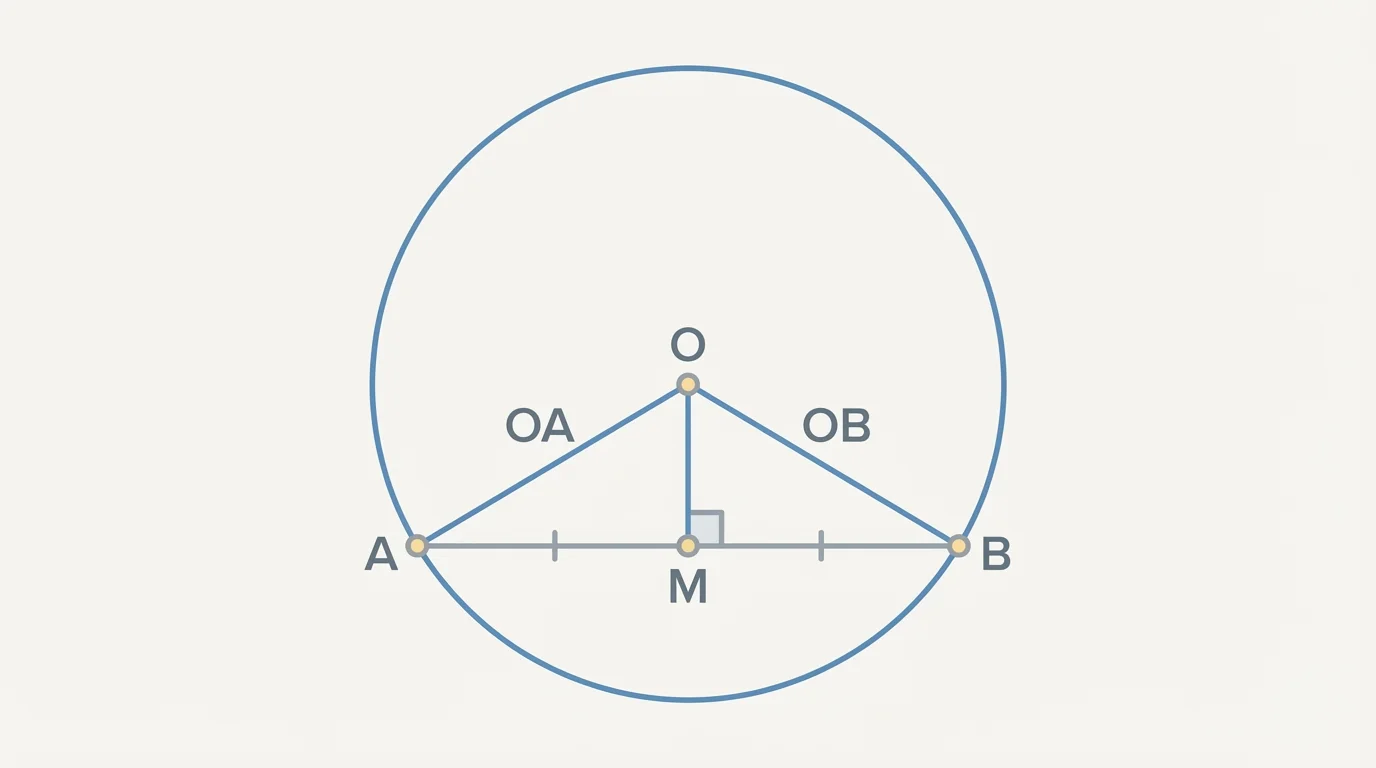
The converse is also useful: if a line from the center of the circle bisects a chord, then that line is perpendicular to the chord. These two facts often appear together in proofs.
There is another pattern connecting chords to the center: among chords in the same circle, the chord closer to the center is longer. Equivalently, congruent chords are equidistant from the center. So if two chords have equal length, their perpendicular distances from the center are equal.
| Relationship | What it tells you |
|---|---|
| Congruent chords | They intercept congruent arcs. |
| Congruent arcs | They correspond to congruent chords. |
| Radius or diameter perpendicular to a chord | It bisects the chord. |
| Line from center bisecting a chord | It is perpendicular to the chord. |
| Chords equidistant from center | They are congruent. |
| Longer chord | It is closer to the center. |
Table 1. Key relationships among chords, arcs, and distances from the center.
The perpendicular-bisector idea often combines with triangle facts. Since \(OA\) and \(OB\) are radii, \(OA = OB\). If \(OM\) is perpendicular to chord \(AB\), then triangles \(\triangle OAM\) and \(\triangle OBM\) are congruent, which explains why \(AM = MB\).
Solved Example 1: Finding an inscribed angle from an arc
Arc \(PQ\) measures \(86^\circ\). Find the measure of an inscribed angle that intercepts arc \(PQ\).
Step 1: Use the Inscribed Angle Theorem.
An inscribed angle equals half its intercepted arc.
Step 2: Substitute the arc measure.
\(m\angle PRQ = \dfrac{1}{2}(86^\circ) = 43^\circ\)
The inscribed angle measures \(43^\circ\).
This is a direct "halve the arc" problem. When the arc is known, the angle is usually quick to find.
Solved Example 2: Finding an arc from an inscribed angle
Suppose \(m\angle RST = 37^\circ\), where \(\angle RST\) is an inscribed angle intercepting arc \(RT\). Find \(m\widehat{RT}\).
Step 1: Write the relationship.
\(m\angle RST = \dfrac{1}{2} m\widehat{RT}\)
Step 2: Substitute the known angle.
\(37^\circ = \dfrac{1}{2} m\widehat{RT}\)
Step 3: Multiply by \(2\).
\(m\widehat{RT} = 74^\circ\)
The intercepted arc measures \(74^\circ\).
This is the reverse process: if the inscribed angle is known, double it to get the intercepted arc.
Solved Example 3: A radius perpendicular to a chord
In a circle with center \(O\), segment \(OM\) is perpendicular to chord \(AB\) at point \(M\). If \(AB = 18\), find \(AM\) and \(MB\).
Step 1: Use the chord theorem.
A line from the center perpendicular to a chord bisects the chord.
Step 2: Split the chord into two equal parts.
\(AM = MB = \dfrac{18}{2} = 9\)
The two chord segments are \(AM = 9\) and \(MB = 9\).
That midpoint fact is exactly the relationship illustrated earlier. Once the center-to-chord line is perpendicular, the chord is cut into two equal pieces.
Solved Example 4: Congruent chords and arcs
In the same circle, chord \(\overline{CD}\) is congruent to chord \(\overline{EF}\). If arc \(CD\) measures \(112^\circ\), find the measure of arc \(EF\). Then find an inscribed angle intercepting arc \(EF\).
Step 1: Use the chord-arc relationship.
Congruent chords intercept congruent arcs, so \(m\widehat{EF} = 112^\circ\).
Step 2: Find the inscribed angle.
An inscribed angle intercepting arc \(EF\) measures \(\dfrac{1}{2}(112^\circ) = 56^\circ\).
The results are \(m\widehat{EF} = 112^\circ\) and an inscribed angle intercepting arc \(EF\) measures \(56^\circ\).
Notice how the problem moves through all three ideas: chord to arc, then arc to angle.
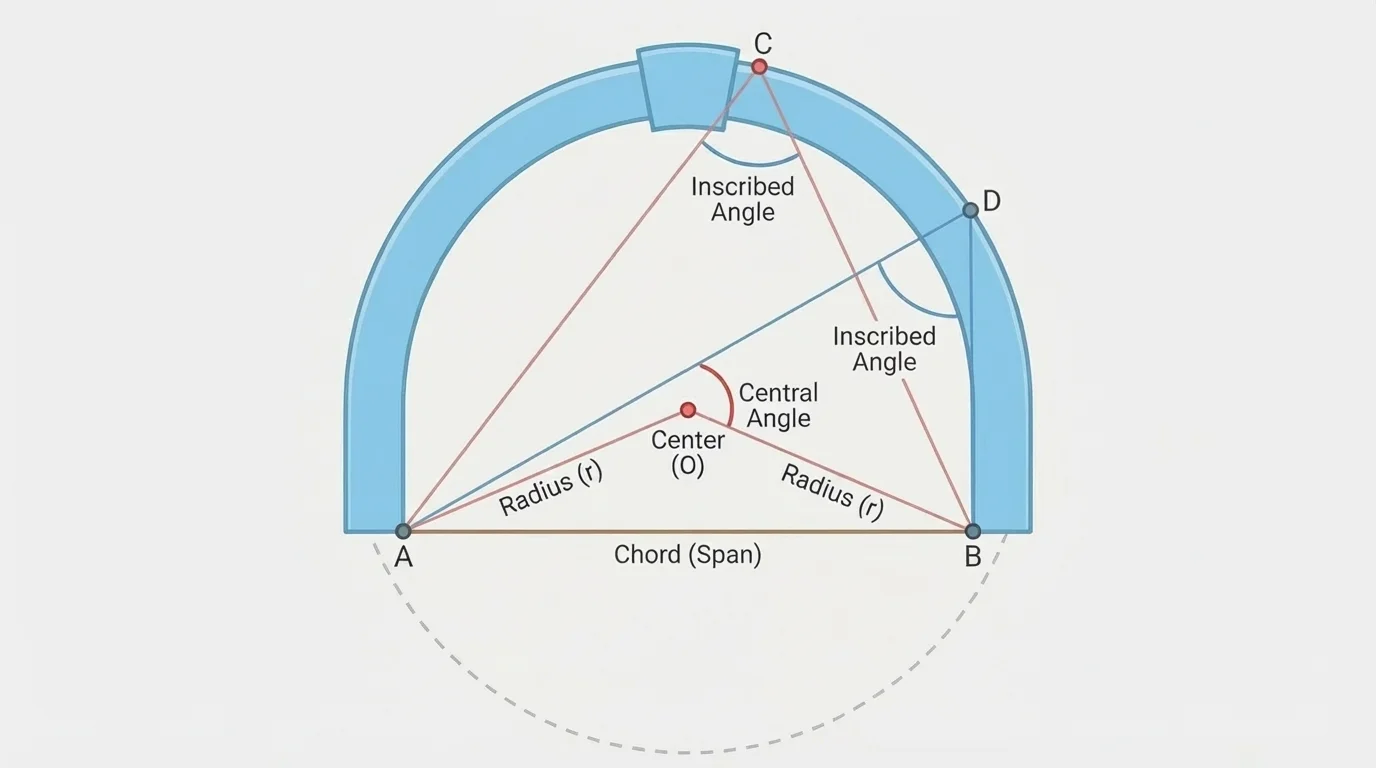
Circular geometry is not only theoretical. Architects, engineers, and designers regularly use relationships among arcs, chords, and angles, as [Figure 4] illustrates with an arch. In a circular arch, the width across the opening is a chord, while the curved top is an arc. Knowing the angle and radius helps determine how wide or steep the structure will be.
In bridge design, stadium roofs, and dome windows, the distance from the center to a chord can affect both appearance and strength. A wider chord in the same circular frame sits closer to the center and creates a broader opening.
Camera lenses and radar systems also use angular ideas related to arcs. A viewing region can often be modeled by a central angle, while points on the edge of the field trace an arc. Understanding how angle size controls visible spread is an applied version of the same geometry.
Even in manufacturing, circular parts such as gears, pipes, and turbine components are tested using measurements based on chords and radii. Sometimes a curved edge is hard to measure directly, so technicians use chord lengths and distances from the center instead.
A common error is confusing a central angle with an inscribed angle. A central angle equals its intercepted arc, but an inscribed angle is only half of its intercepted arc. If a vertex is at the center, do not divide by \(2\). If the vertex is on the circle, usually you do divide by \(2\).
Another mistake is using the wrong arc. The intercepted arc must be the arc inside the angle, cut off by the sides of the angle. In complex diagrams, trace the two sides of the angle to the circle before deciding which arc to use.
Students also mix up chord length and arc measure. A chord is a straight segment; an arc is curved. They may correspond, but they are not measured in the same way.
A good checking strategy
Ask three questions: Where is the vertex? Which arc is intercepted? Is the problem asking about an angle measure, an arc measure, or a segment length? Those questions prevent most circle-geometry mistakes.
When you return to earlier diagrams such as [Figure 1], you can see that most circle problems become manageable once the parts are named correctly. Geometry often rewards careful labeling as much as calculation.
The major relationships among inscribed angles, radii, and chords form a connected system. Inscribed angles are tied to arcs by a factor of one-half. Central angles match their arcs exactly. Congruent chords match congruent arcs, and lines from the center reveal symmetry by bisecting chords or meeting them at right angles.
That is what makes circle geometry elegant: one diagram can contain several facts at the same time. If you know where the center is, which points lie on the circle, and which arc is being intercepted, then missing values are often forced by the structure of the circle itself.
