A skateboard at the top of a ramp, two magnets pushed close together, and a pair of charged objects brought near each other all have something in common: they can store energy before anything starts moving. That idea is powerful because it means energy is not only about motion. Sometimes energy is stored because of how objects are arranged, even when the objects are not touching.
Energy can appear in different forms. Kinetic energy is the energy of motion. If a ball is rolling, it has kinetic energy. Potential energy is stored energy related to position or arrangement. In this lesson, the focus is on potential energy stored in a system of two objects that interact at a distance.
Potential energy is stored energy associated with the positions or arrangement of objects in a system.
Kinetic energy is the energy an object has because it is moving.
System means the objects being considered together as one whole.
It is important to say that the energy is stored in the system, not just in one object by itself. For example, a lifted book and Earth form a gravitational system. The stored energy depends on the arrangement of the book and Earth together.
Some objects affect each other even when they are not touching. These are called interactions at a distance. In this topic, there are three kinds to know: gravitational, electric, and magnetic interactions.
A gravitational interaction happens between objects with mass. Earth pulls a dropped pencil downward. An electric interaction happens between electrically charged objects. Opposite charges attract, and like charges repel. A magnetic interaction happens between magnets. Opposite magnetic poles attract, and like poles repel.
These interactions can change the motion of objects, but they can also store energy depending on how the objects are arranged. That is the main idea to model.
Force and energy are related, but they are not the same thing. A force is a push or pull. Energy is the ability to cause change. When forces act at a distance, the arrangement of the objects can store energy in the system.
When you describe these systems, focus on examples with only two objects and only gravitational, electric, and magnetic interactions.
Changing the arrangement of two interacting objects changes how much energy is stored in the system. A different position means the objects may be closer together, farther apart, or facing differently. Because the interaction changes with arrangement, the stored potential energy also changes.
Think of stretching a rubber band as an analogy, even though that is a contact force rather than a distance interaction. When the arrangement changes, the stored energy changes. For distance interactions, we focus on how far apart the objects are or how they are oriented relative to each other.
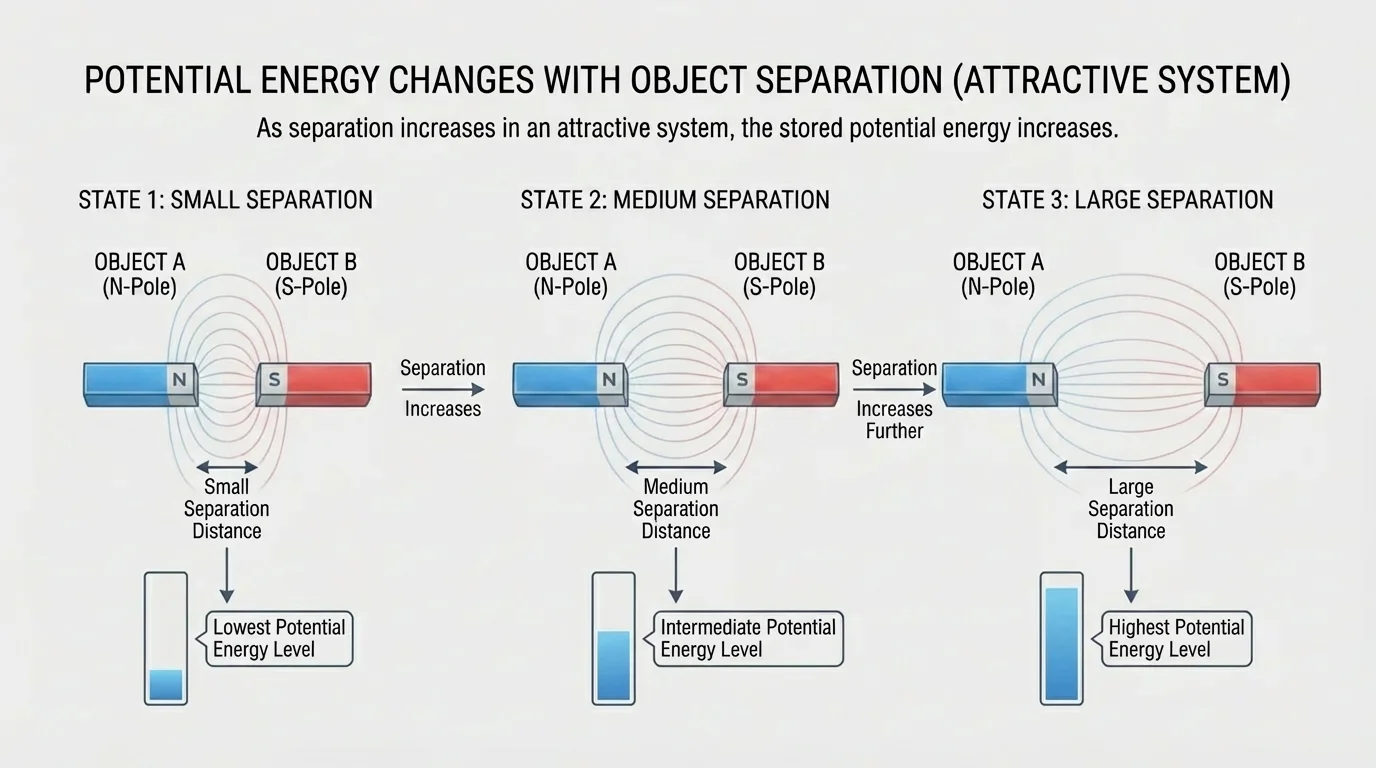
In many middle school models, you do not need an exact number to compare energies. Often it is enough to say one arrangement stores more potential energy than another. For example, a ball held higher above Earth stores more gravitational potential energy than the same ball held lower.
The same idea works for electric and magnetic systems. Two like electric charges pushed closer together store more electric potential energy. Two like magnetic poles pushed closer together store more magnetic potential energy. In each case, the arrangement matters.
Stored energy depends on relative position
Potential energy is not about motion happening right now. It is about what the system can do because of its arrangement. If the arrangement changes in a way that goes against an attractive or repulsive interaction, energy can be stored. If the objects are allowed to move afterward, that stored energy can change into kinetic energy.
This is why a model should always answer two questions: Which two objects are interacting? and How has their arrangement changed?
A good model for this topic tracks the two objects, the type of interaction between them, and the arrangement. The model does not have to be complicated. A sketch with labels is often enough.
Your model can include object names, arrows showing attraction or repulsion, the distance between the two objects, and a comparison of stored energy such as "lower," "higher," or "same."
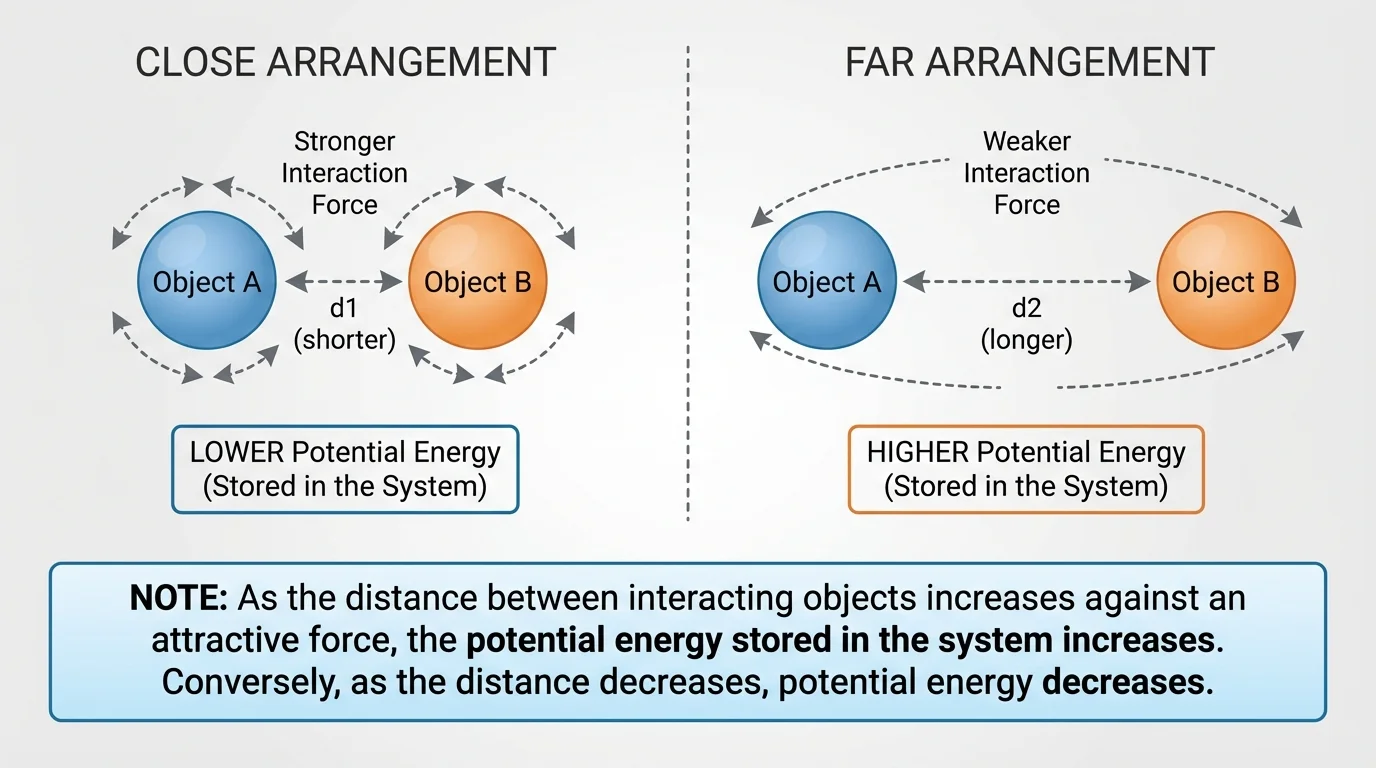
For example, if two unlike magnet poles are far apart and then moved closer, your model should show that the arrangement changed. Because unlike poles attract, the closer arrangement usually has less stored magnetic potential energy than a farther arrangement. If you separate them against the attraction, the system stores more energy.
Models are useful because they help you explain patterns. Instead of memorizing many cases, you can reason from the interaction. Ask whether the objects attract or repel, then ask whether the arrangement moves with that interaction or against it.
Example: Building a simple comparison model
Two positively charged objects are moved from far apart to close together.
Step 1: Identify the interaction.
Because both objects have positive charge, they repel.
Step 2: Compare the arrangements.
Far apart is one arrangement. Close together is another arrangement.
Step 3: Decide which arrangement stores more energy.
Pushing repelling objects closer together goes against the interaction, so the closer arrangement stores more electric potential energy.
A simple model would label the two positive charges, show a smaller distance in the second arrangement, and mark the second arrangement as having higher stored energy.
Notice that this model does not need a complicated equation. It only needs the relationship between interaction and arrangement.
Gravitational systems are familiar because Earth is involved in so many everyday examples. A book held above the floor, a basketball raised before a free throw, and a climber standing higher on a hill all have stored energy because of gravitational interaction.
When an object is lifted higher relative to Earth, the gravitational potential energy of the object-Earth system increases. If the object is released, that stored energy can change into kinetic energy as the object speeds up while falling.
For situations near Earth's surface, gravitational potential energy is often modeled by the equation
\(PE = mgh\)
In this equation, \(m\) is mass, \(g\) is the strength of gravity near Earth, and \(h\) is height. This formula works well for simple school-level examples near the ground.
Example: Comparing two heights
A \(2 \textrm{ kg}\) ball is held at \(1 \textrm{ m}\) and then at \(3 \textrm{ m}\) above the ground. Use \(g \approx 9.8 \textrm{ m/s}^2\).
Step 1: Calculate the energy at \(1 \textrm{ m}\).
Substitute into \(PE = mgh\): \(PE = 2 \cdot 9.8 \cdot 1 = 19.6 \textrm{ J}\).
Step 2: Calculate the energy at \(3 \textrm{ m}\).
\(PE = 2 \cdot 9.8 \cdot 3 = 58.8 \textrm{ J}\).
Step 3: Compare the results.
Because \(58.8 > 19.6\), the ball-Earth system stores more gravitational potential energy at \(3 \textrm{ m}\).
The higher arrangement stores more energy.
This example supports the pattern seen earlier in [Figure 1]: changing arrangement changes stored energy. For gravitational systems near Earth, greater height means more stored gravitational potential energy.
Real-world machines use this idea. Cranes lift materials higher, storing gravitational potential energy. Hydroelectric dams store water at a higher level so gravity can help move it later. Even a diver standing on a tall platform has more gravitational potential energy than on a low one.
Electric interactions involve charged objects. Opposite charges attract, and like charges repel. This creates clear patterns in how electric potential energy changes when distance changes.
If two like charges are pushed closer together, the system stores more electric potential energy because you are forcing repelling objects into a tighter arrangement. If two like charges move farther apart, the stored energy decreases.
If two opposite charges are pulled farther apart, the system stores more electric potential energy because you are separating objects that attract each other. If opposite charges move closer together, the stored energy decreases.
Example: Predicting electric potential energy
Object A has positive charge. Object B has negative charge. They are moved from \(10 \textrm{ cm}\) apart to \(30 \textrm{ cm}\) apart.
Step 1: Determine whether the objects attract or repel.
Positive and negative charges attract.
Step 2: Decide whether the new arrangement goes with or against that interaction.
Moving them farther apart goes against attraction.
Step 3: State the energy change.
The electric potential energy of the two-object system increases.
The farther-apart arrangement stores more electric potential energy.
This helps explain everyday static electricity. When charges build up on materials, electric interactions can store energy. That stored energy may later be released in a tiny spark.
Lightning is a giant example of electric energy being released after charge separation creates a large amount of stored electric potential energy in the atmosphere.
Even though lightning involves far more than two objects in the real world, the basic school model still begins with understanding how the arrangement of charges affects stored energy.
Magnets are excellent for modeling distance interactions because you can feel the push or pull without direct contact and because both distance and pole arrangement matter. Two north poles repel. A north pole and a south pole attract.
When like poles are pushed closer together, magnetic potential energy increases because the arrangement goes against repulsion. When unlike poles are pulled farther apart, magnetic potential energy increases because the arrangement goes against attraction.
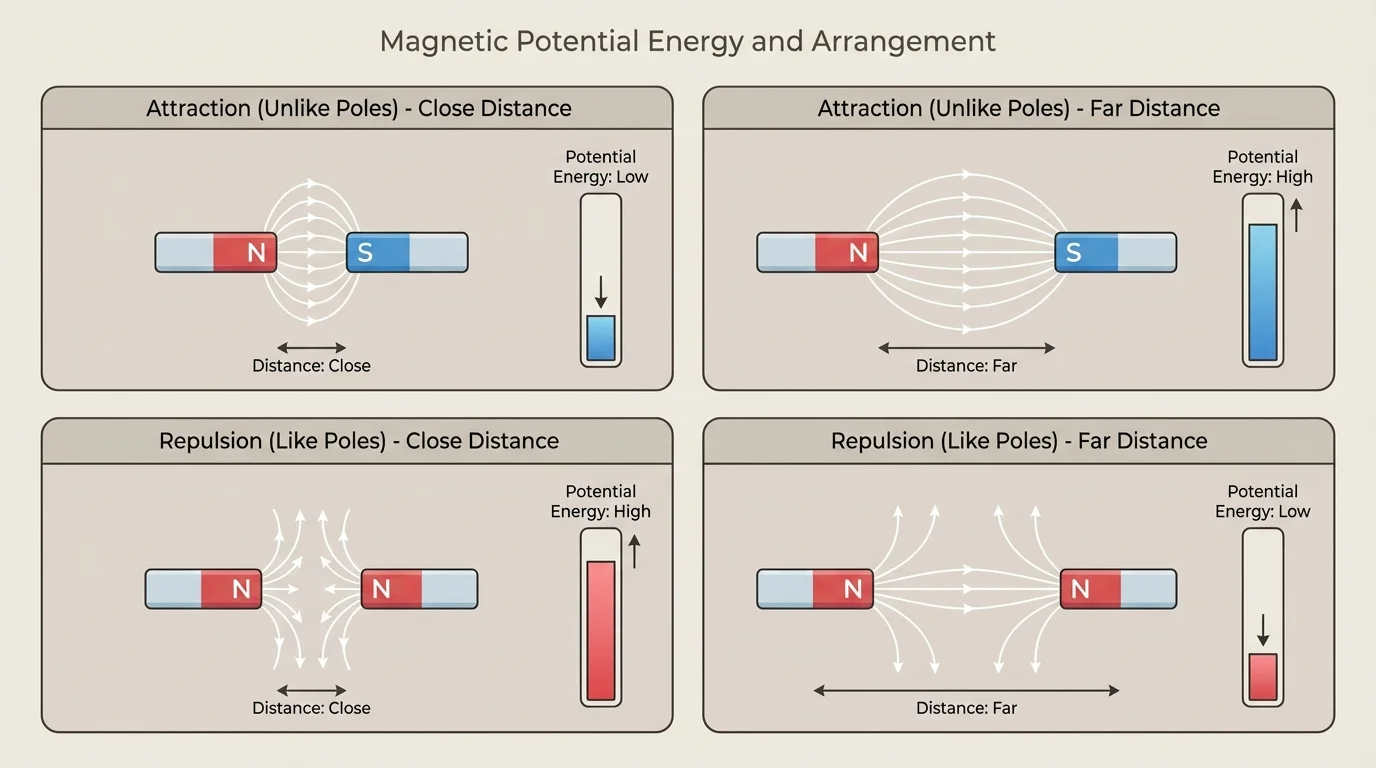
If you let two attracting poles move together, the stored magnetic potential energy decreases while motion can increase. If you force two repelling poles close and then release them, they shoot apart because stored energy changes into kinetic energy.
This is the same pattern seen with electric systems. The important question is whether the new arrangement is working with the interaction or against it.
Magnetic latches in cabinets, magnetic levitation demonstrations, and some electric motors all involve magnetic interactions. Engineers pay attention to arrangement because that controls how much energy is stored and how the system behaves.
At this level, models are often qualitative. That means you describe changes using words such as increases, decreases, or stays the same. You do not always need exact numbers.
The table below summarizes useful comparison rules for two-object systems.
| Interaction | Arrangement change | Stored potential energy |
|---|---|---|
| Gravitational | Object raised higher relative to Earth | Increases |
| Gravitational | Object lowered closer to Earth | Decreases |
| Electric, like charges | Moved closer together | Increases |
| Electric, like charges | Moved farther apart | Decreases |
| Electric, opposite charges | Moved farther apart | Increases |
| Electric, opposite charges | Moved closer together | Decreases |
| Magnetic, like poles | Moved closer together | Increases |
| Magnetic, like poles | Moved farther apart | Decreases |
| Magnetic, unlike poles | Moved farther apart | Increases |
| Magnetic, unlike poles | Moved closer together | Decreases |
Table 1. How stored potential energy changes in common two-object gravitational, electric, and magnetic systems.
A useful way to think about this is: energy increases when you change the arrangement against the natural interaction. For attraction, separating objects usually stores more energy. For repulsion, pushing objects closer usually stores more energy.
Potential energy and kinetic energy can trade places
When a system changes from a higher-potential-energy arrangement to a lower-potential-energy arrangement, some of that stored energy can become kinetic energy. A falling ball speeds up. Two repelling magnets move apart quickly. Opposite charges moving together can also gain motion.
That is why potential energy matters even when nothing is moving yet. It helps predict what motion may happen next.
Stored gravitational potential energy is important in sports and engineering. A basketball player jumps to release the ball from a higher point. A wrecking ball lifted by a crane stores gravitational potential energy before it swings. Water stored behind a dam can later move downward and drive turbines.
Stored electric potential energy matters in devices that separate charge, such as batteries and circuits. A battery creates conditions that allow charges to move and transfer energy through a circuit. While a full battery is more complex than a two-object model, the simple idea of energy depending on electric arrangement still helps build understanding.
Stored magnetic potential energy is used in magnetic catches, speakers, and motors. As with the arrangements in [Figure 3], engineers can design systems where magnets attract or repel in useful ways.
Example: Choosing the higher-energy arrangement
Compare these situations.
Case A: A \(1 \textrm{ kg}\) object is held \(2 \textrm{ m}\) above the ground.
\(PE = 1 \cdot 9.8 \cdot 2 = 19.6 \textrm{ J}\).
Case B: The same object is held \(5 \textrm{ m}\) above the ground.
\(PE = 1 \cdot 9.8 \cdot 5 = 49 \textrm{ J}\).
Decision: Compare the values.
Because \(49 > 19.6\), the object-Earth system in Case B stores more gravitational potential energy.
This shows how a model and a simple formula can work together.
In each application, the key idea remains the same: changing arrangement changes stored energy in the system.
One common mistake is saying that potential energy is "inside" a single object. For this topic, it is better to say the energy is stored in the system of two interacting objects.
Another mistake is mixing up force and energy. A stronger pull or push does not automatically mean more potential energy unless the arrangement also changes in a way that affects the system.
A third mistake is forgetting that attraction and repulsion behave differently. If objects attract, separating them usually stores more energy. If objects repel, pushing them closer usually stores more energy. The modeling approach from [Figure 2] helps organize this thinking clearly.
When you analyze any two-object system, ask: What are the two objects? What type of interaction acts between them? How did their arrangement change? Did the new arrangement go with the interaction or against it? Those questions are enough to build a strong explanation.
