Have you ever noticed that shoes, socks, and bicycle wheels seem to love partners? Some things fit nicely into pairs, and some leave one all alone. That simple idea helps us learn about numbers called odd and even. When we look at groups of objects and see whether they make perfect pairs, we can tell something important about the number in the group.
When a number can be split into pairs with no objects left over, it is an even number. When a number has one object left over after making pairs, it is an odd number.
Even number: a number of objects that can be grouped into twos with no leftovers.
Odd number: a number of objects that can be grouped into twos with one leftover.
Here are some examples. The number \(6\) is even because we can make \(3\) pairs: \(2 + 2 + 2 = 6\). The number \(7\) is odd because we can make \(3\) pairs and have \(1\) left over: \(2 + 2 + 2 + 1 = 7\).
Up to \(20\), the even numbers are \(2, 4, 6, 8, 10, 12, 14, 16, 18, 20\). The odd numbers are \(1, 3, 5, 7, 9, 11, 13, 15, 17, 19\).
One easy way to test a group is to pair the objects, as [Figure 1] shows. You can use counters, cubes, buttons, crayons, or drawn circles. Put the objects into groups of \(2\). If every object has a partner, the number is even. If one object does not have a partner, the number is odd.
Suppose you have \(8\) buttons. Pair them like this: \(2, 2, 2, 2\). There is no leftover, so \(8\) is even. Suppose you have \(9\) buttons. Pair them: \(2, 2, 2, 2\) and \(1\) left. That means \(9\) is odd.
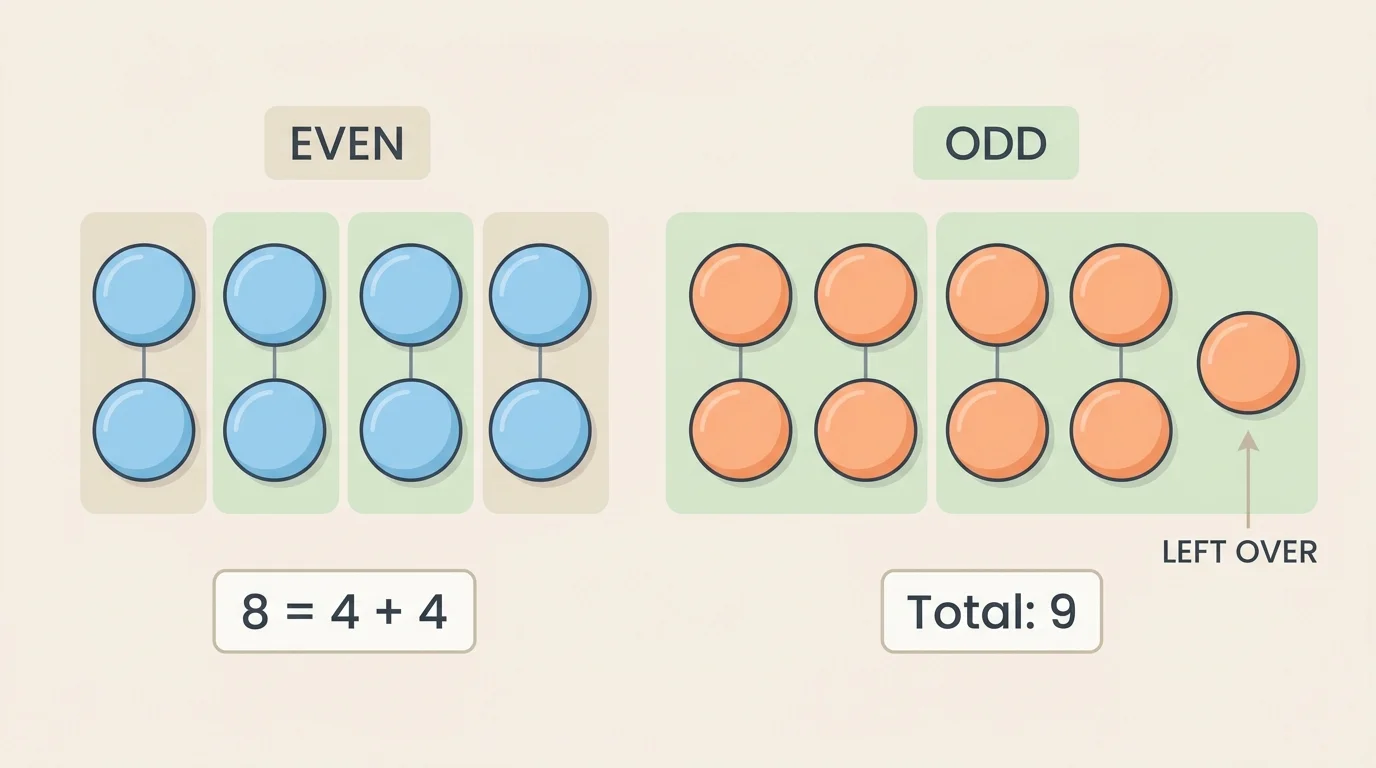
Pairing works well because even numbers are made of twos. It is like forming teams of \(2\). If every student can join a team, the class size is even. If one student is left without a partner, the class size is odd.
Later, when you look at a number quickly, you may already know whether it is odd or even. But pairing gives you a strong way to determine the answer and explain why it is true.
Another helpful method is counting by \(2\)s. On a number line, the jumps of \(2\) land on even numbers, as [Figure 2] illustrates. Starting at \(0\), the pattern goes \(0, 2, 4, 6, 8, 10\), and so on. These numbers are even because they are made from twos.
If you count by \(2\)s and land exactly on a number, that number is even. If a number is one more than an even number, it is odd. For example, \(12\) is even because it is in the counting-by-\(2\)s pattern. The number \(13\) is odd because it is \(1\) more than \(12\).
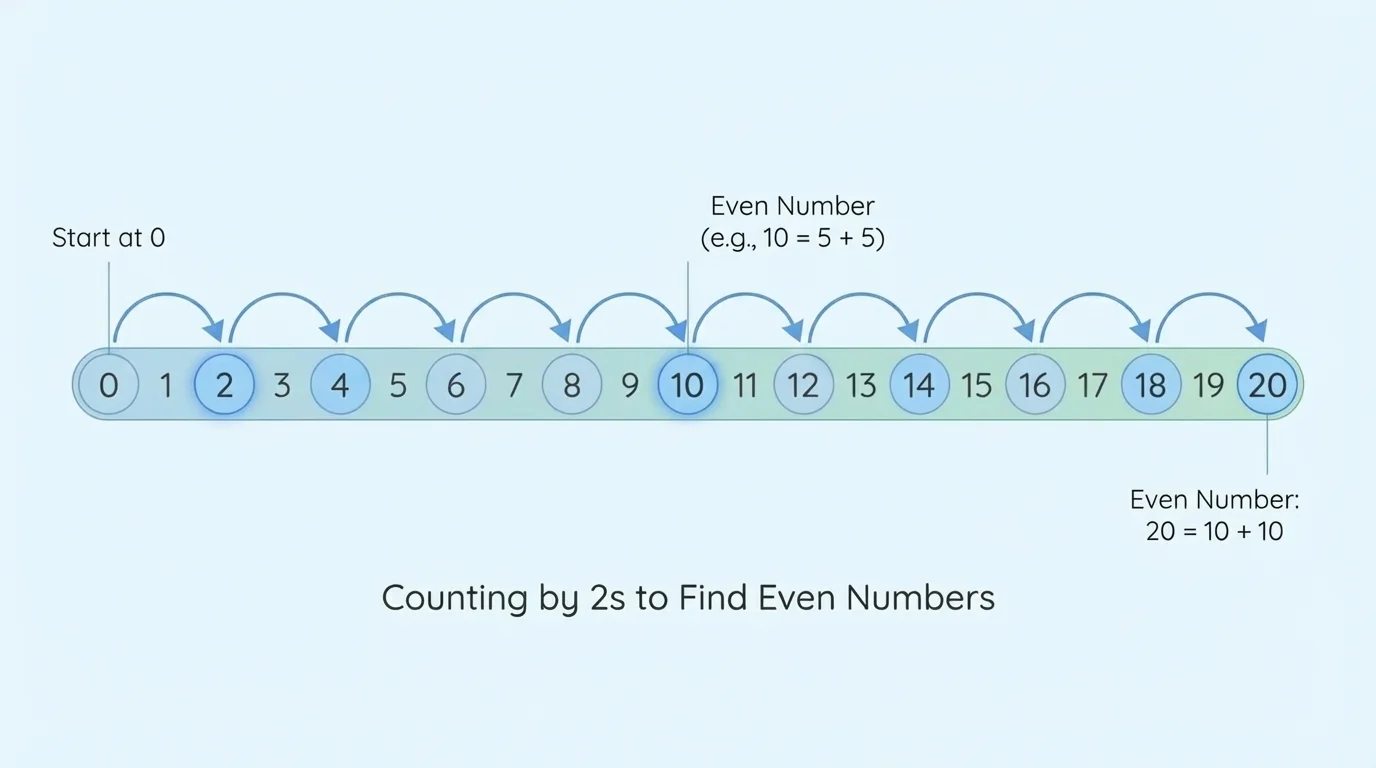
Listen to the pattern: \(2, 4, 6, 8, 10\). These are all even. The odd numbers fit between them: \(1, 3, 5, 7, 9\). This means odd and even numbers take turns. After every even number comes an odd number. After every odd number comes an even number.
When you keep counting, odd and even numbers continue taking turns forever. This pattern never breaks.
That alternating pattern helps you check your work. If \(14\) is even, then \(15\) must be odd, and \(16\) must be even again.
Even numbers are special because they can be split into two equal groups. That means we can write an equation showing the even number as a sum of two equal addends. An equation with equal addends uses the same number two times, as [Figure 3] shows.
For example, \(6\) is even, so we can split it into two equal groups of \(3\). The equation is \(6 = 3 + 3\). The number \(10\) is even, so we can split it into two equal groups of \(5\). The equation is \(10 = 5 + 5\).
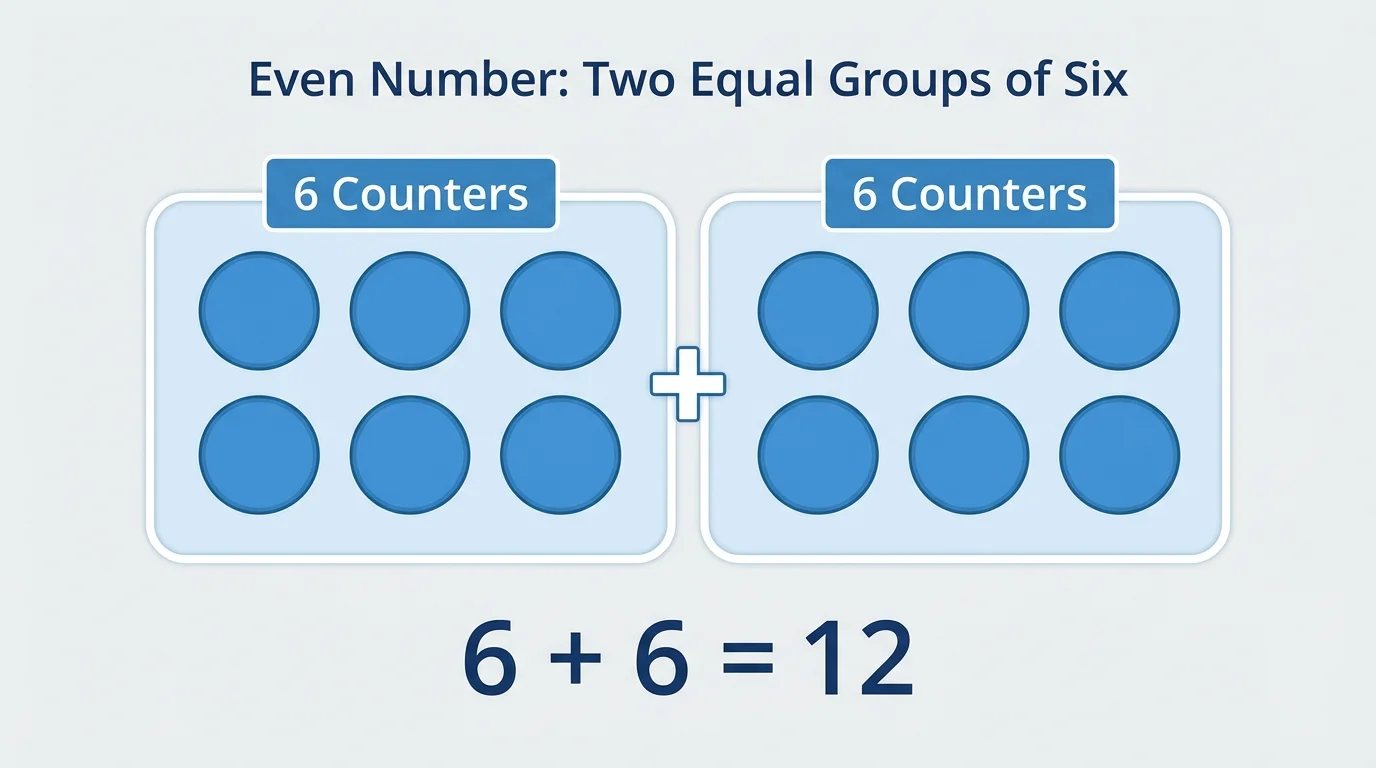
Here are more examples of even numbers written as two equal addends:
\(2 = 1 + 1\)
\(4 = 2 + 2\)
\(8 = 4 + 4\)
\(12 = 6 + 6\)
\(20 = 10 + 10\)
This works because the two parts are exactly the same size. We are not just adding any two numbers. We are adding equal numbers.
Why equal addends matter
When an even number is split into two equal groups, each group has the same number of objects. This matches the idea of fairness and balance. If \(14\) counters are shared equally by \(2\) friends, each friend gets \(7\), so \(14 = 7 + 7\).
Numbers that have no leftovers can be arranged neatly. That same neat arrangement helps us make two equal groups from an even number.
Let's work through several examples step by step.
Worked Example 1
There are \(11\) toy cars. Is \(11\) odd or even?
Step 1: Make pairs.
Pair the cars in groups of \(2\): \(2 + 2 + 2 + 2 + 2 = 10\).
Step 2: Check for leftovers.
After pairing \(10\) cars, \(1\) car is left over.
Step 3: Decide the number type.
Because there is \(1\) leftover, \(11\) is odd.
Answer: \(11\) is odd.
Notice that \(11\) is also between \(10\) and \(12\). Since \(10\) and \(12\) are even, \(11\) is the odd number between them.
Worked Example 2
Use counting by \(2\)s to decide whether \(18\) is odd or even.
Step 1: Count by \(2\)s.
\(2, 4, 6, 8, 10, 12, 14, 16, 18\)
Step 2: Check whether \(18\) is in the pattern.
Yes, \(18\) appears when we count by \(2\)s.
Step 3: Decide the number type.
Numbers in this pattern are even.
Answer: \(18\) is even.
The skip-count pattern makes this easier to see because each jump of \(2\) lands on an even number.
Worked Example 3
Write an equation to show \(16\) as a sum of two equal addends.
Step 1: Think about splitting \(16\) into two equal groups.
If \(16\) is even, each half is the same size.
Step 2: Find the size of each group.
\(16\) split into \(2\) equal groups gives \(8\) in each group.
Step 3: Write the equation.
\(16 = 8 + 8\)
Answer: \(16\) can be written as \(8 + 8\).
In the same way, the equal groups idea helps us write equations for any even number up to \(20\).
Worked Example 4
There are \(14\) crayons. Is the number odd or even, and what equal-addends equation matches it?
Step 1: Decide odd or even.
Pair the crayons: \(2 + 2 + 2 + 2 + 2 + 2 + 2 = 14\). There is no leftover.
Step 2: Name the number type.
No leftover means \(14\) is even.
Step 3: Write two equal addends.
Two equal groups of \(7\) make \(14\).
\(14 = 7 + 7\)
Answer: \(14\) is even, and the equation is \(14 = 7 + 7\).
Odd numbers cannot be split into two equal whole-number groups without a leftover. For example, \(9\) can be split into \(4\) and \(5\), but those are not equal. So \(9\) is not the sum of two equal whole-number addends.
If we try to make two equal groups from \(7\) counters, one group might have \(3\) and the other \(4\). The groups are almost equal, but not exactly equal. That is another clue that \(7\) is odd.
You already know how to add doubles such as \(3 + 3 = 6\) and \(5 + 5 = 10\). Those doubles are a helpful way to recognize even numbers.
Doubles are connected to even numbers because a double uses the same addend twice. Every double makes an even total.
Odd and even numbers appear in everyday life. If \(12\) students are playing a partner game, everyone can have a partner because \(12\) is even. If \(13\) students are playing, one student will be without a partner because \(13\) is odd.
Think about setting a table. If there are \(8\) forks and \(8\) spoons, they can be matched in pairs. If there are \(9\) napkins for \(8\) plates, one napkin will not match a plate. Pairing helps us organize objects and notice whether groups are balanced.
Rows of chairs are another example. If a teacher places \(20\) chairs in \(2\) equal rows, each row has \(10\) chairs, so \(20 = 10 + 10\). Equal rows connect odd and even thinking to the idea of equal groups, which is also important in multiplication later on.
Many games use pairs on purpose. Matching games, partner dances, and doubles in sports all work best when the number of players is even.
These real situations show why odd and even numbers matter. They help us decide whether objects can be shared equally, paired easily, or arranged in neat equal groups.
It helps to compare numbers up to \(20\) in order.
| Number | Odd or Even | Equal Addends if Even |
|---|---|---|
| \(1\) | Odd | — |
| \(2\) | Even | \(1 + 1\) |
| \(3\) | Odd | — |
| \(4\) | Even | \(2 + 2\) |
| \(5\) | Odd | — |
| \(6\) | Even | \(3 + 3\) |
| \(7\) | Odd | — |
| \(8\) | Even | \(4 + 4\) |
| \(9\) | Odd | — |
| \(10\) | Even | \(5 + 5\) |
| \(11\) | Odd | — |
| \(12\) | Even | \(6 + 6\) |
| \(13\) | Odd | — |
| \(14\) | Even | \(7 + 7\) |
| \(15\) | Odd | — |
| \(16\) | Even | \(8 + 8\) |
| \(17\) | Odd | — |
| \(18\) | Even | \(9 + 9\) |
| \(19\) | Odd | — |
| \(20\) | Even | \(10 + 10\) |
Table 1. Numbers from \(1\) to \(20\), showing whether each is odd or even and the equal-addends equation for each even number.
Looking at the table, you can see the pattern clearly: odd, even, odd, even, repeating again and again. You can also see that every even number has a doubles fact that matches it.
