A bridge engineer, a pharmacist, and a track official all measure things for very different reasons, but they share one rule: reporting more digits than the measuring process supports can be misleading. Writing a length as \(12.347891 \textrm{ cm}\) may look impressive, but if the ruler only measures to the nearest millimeter, most of those digits are invented. In mathematics and science, honesty about measurement matters just as much as calculation.
Some numbers are exact. For example, a rectangle has \(4\) sides, and a dozen means \(12\). These values are defined or counted, so there is no uncertainty in them. Other numbers are measured: the mass of a sample, the length of a desk, the temperature outside, or the speed of a car. Measured values always depend on an instrument, a method, and sometimes human judgment.
When you report a measured quantity, you should choose a level of precision that matches the real limits of the measurement. If a digital scale reads \(54.2 \textrm{ g}\), reporting \(54.2000 \textrm{ g}\) suggests a level of precision the scale never gave. On the other hand, reporting only \(50 \textrm{ g}\) throws away useful information. Good reporting finds the balance between too much precision and too little.
Measured quantity means a value obtained using a tool or procedure, such as a ruler, thermometer, or stopwatch.
Exact quantity means a value that is counted or defined, with no measurement uncertainty.
Accuracy refers to how close a measurement is to the true value, while precision refers to how finely a measurement is reported or how closely repeated measurements agree.
This topic is not just about rounding. It is about reasoning with quantities and units so that the final number accurately reflects what was actually measured.
Every measurement tool has a limit. A ruler marked only in centimeters cannot support the same reporting detail as one marked in millimeters, as [Figure 1] shows. The markings on the tool set the smallest clearly measured unit, and the user may estimate one digit beyond that in many situations.
Suppose a stick is measured with a ruler that has marks every \(1 \textrm{ cm}\). You might report its length as \(14.3 \textrm{ cm}\), where the \(14\) centimeters are read directly and the tenths digit is estimated. But reporting \(14.327 \textrm{ cm}\) would be unjustified because the tool does not resolve thousandths of a centimeter.
This reporting limit reflects measurement uncertainty. Even if the true length stays fixed, different tools or observers may produce slightly different values. A careful scientist or mathematician does not hide this limitation; they report a value that fits it.
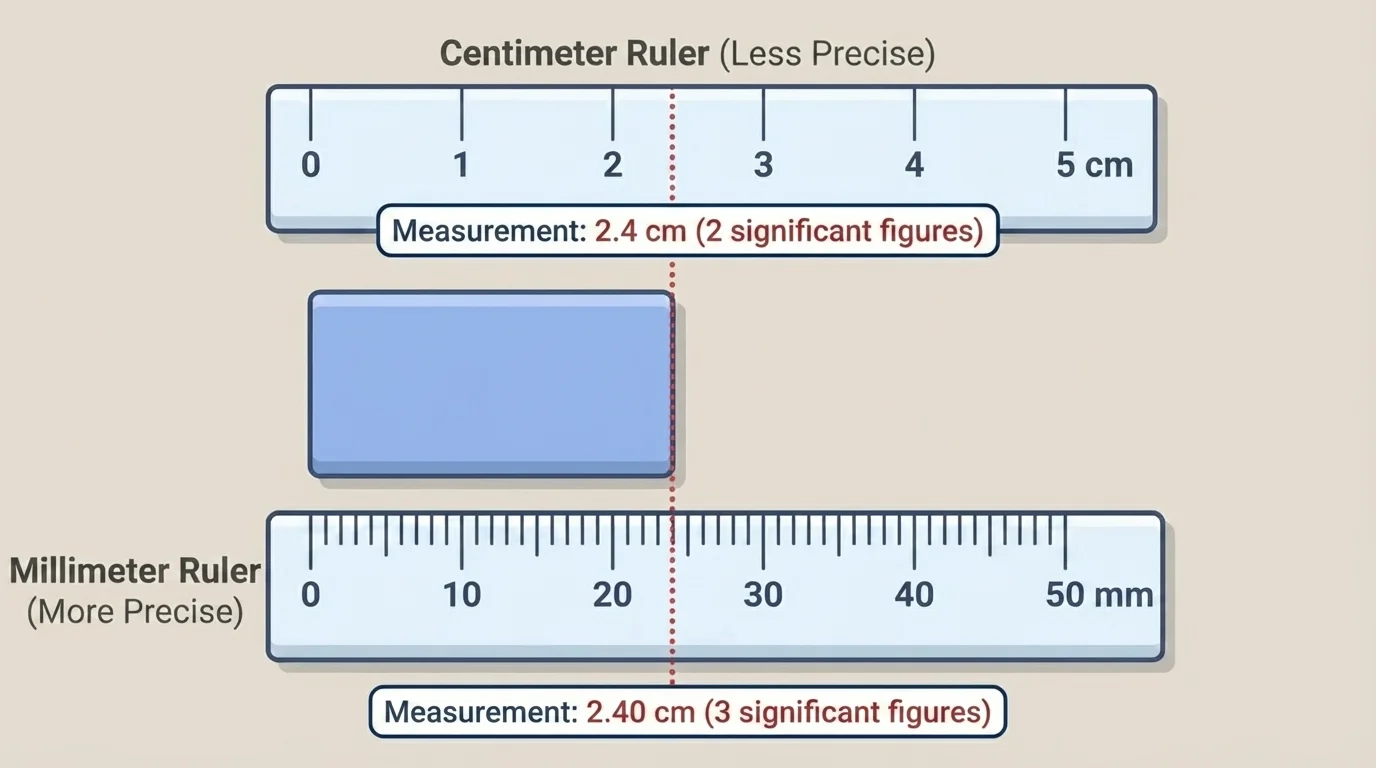
Limitations do not only come from the tool. They can also come from the object being measured. A rough rock does not have a perfectly clear edge. A stopwatch may depend on a person's reaction time. A thermometer reading may fluctuate slightly. So the correct level of accuracy depends on both the measuring instrument and the measuring situation.
Recall that place value matters when reading decimals. In \(7.46\), the \(4\) is in the tenths place and the \(6\) is in the hundredths place. Choosing a level of accuracy often means deciding which place value is the last one worth keeping.
That is why a quantity should usually be reported to the nearest whole number, tenth, hundredth, or another clearly justified decimal place, rather than with a random number of digits.
[Figure 2] One useful way to describe reporting precision is with significant digits. Significant digits are the digits in a measurement that carry meaningful information. Usually, all certain digits plus one estimated digit are significant. The idea of the final estimated digit is visible in many measuring situations, such as a scale reading between marks.
For example, if a ruler measurement is reported as \(8.4 \textrm{ cm}\), then the digits \(8\) and \(4\) are significant. If the measurement is \(8.40 \textrm{ cm}\), the zero may also be significant because it shows the value was measured to the nearest hundredth of a centimeter, not just the nearest tenth.
Zeros can be tricky. In \(0.0052\), the leading zeros are not significant; they only locate the decimal point. In \(5200\), the number of significant digits depends on context. If it means exactly \(5200\), that is different from a measured value rounded to the nearest hundred. Scientific notation often helps make this clear: \(5.2 \times 10^3\) has \(2\) significant digits, while \(5.200 \times 10^3\) has \(4\).
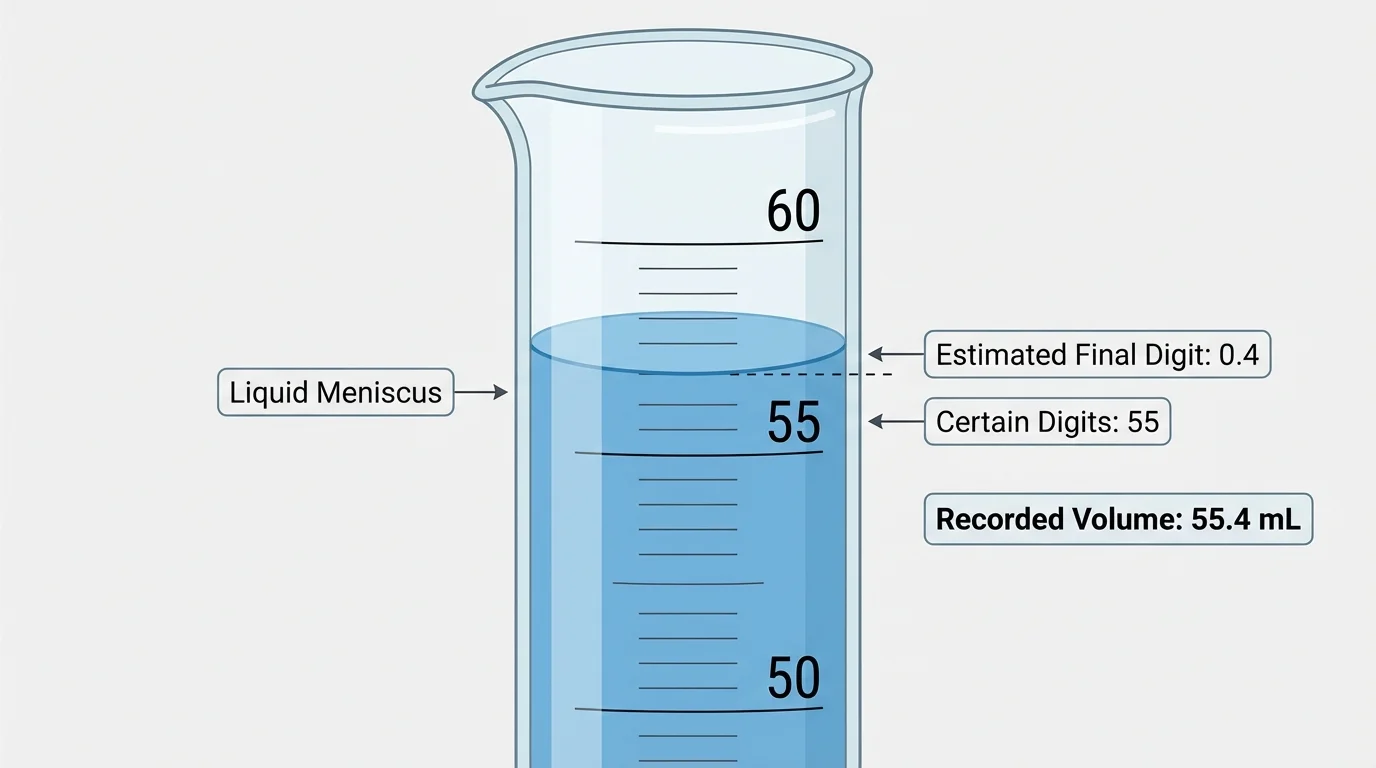
Significant digits are not just a formatting rule. They are a communication rule. They tell the reader how carefully a quantity was measured. Later, when calculations are done using those measurements, the reporting precision should still reflect the original limits.
Choosing an appropriate level of precision means asking, What does the measurement method support? If a road sign says a town is \(18\) miles away, reporting \(18.000\) miles would be unjustified. If a chemistry lab balance gives \(2.631 \textrm{ g}\), reporting only \(3 \textrm{ g}\) would be too rough.
Rounding is often used to match the needed accuracy. To round to a given place value, look at the digit to the right. If it is \(5\) or more, round up; if it is less than \(5\), round down. For example, \(7.846\) rounded to the nearest tenth is \(7.8\), and rounded to the nearest hundredth is \(7.85\).
But appropriate accuracy depends on context, not on a universal rule that "more digits are always better." In a weather report, a temperature of \(21.4^\circ \textrm{C}\) may be reasonable, but a daily forecast of \(21.437^\circ \textrm{C}\) would suggest unrealistic certainty. In contrast, in a laboratory titration, hundredths or thousandths may be appropriate.
Over-reporting and under-reporting
Over-reporting happens when you include more digits than the measurement justifies. This creates a false impression of certainty. Under-reporting happens when you round so much that important information is lost. Good quantitative reasoning avoids both by matching the report to the measurement process and purpose.
A useful habit is to identify the smallest unit your tool can read, decide whether one extra estimated digit is reasonable, and then report all digits up to that point.
Units are part of the quantity, not decoration. Saying \(3.5\) without a unit is incomplete if the context is measurement. It could mean \(3.5 \textrm{ cm}\), \(3.5 \textrm{ s}\), \(3.5 \textrm{ kg}\), or something else entirely.
When converting units, the physical quantity stays the same, but the way it is written changes. However, a conversion does not create more measurement precision. For example, if a board is measured as \(2.4 \textrm{ m}\), then converting gives \(240 \textrm{ cm}\). That does not mean the board was measured exactly to the nearest centimeter. The original measurement had precision only to the nearest tenth of a meter.
If a mass is reported as \(3.20 \textrm{ kg}\), then converting to grams gives \(3200 \textrm{ g}\), but the precision still reflects the original \(3\) significant digits. Writing \(3200.000 \textrm{ g}\) would falsely suggest far more detail.
| Original measurement | Converted measurement | Meaning about precision |
|---|---|---|
| \(2.4 \textrm{ m}\) | \(240 \textrm{ cm}\) | Still measured only to the nearest \(0.1 \textrm{ m}\) |
| \(0.85 \textrm{ L}\) | \(850 \textrm{ mL}\) | Still based on \(2\) significant digits |
| \(3.20 \textrm{ kg}\) | \(3200 \textrm{ g}\) | Still based on \(3\) significant digits |
Table 1. Examples showing that unit conversion changes the form of a quantity but not the underlying measurement precision.
This is especially important in science and engineering, where a mistaken sense of precision can lead to incorrect conclusions.
When measured quantities are used in calculations, the result should not be reported as more precise than the measurements used to produce it. The rules differ slightly depending on the operation.
For rounding after addition or subtraction, focus on the least precise decimal place. If one value is measured to the nearest tenth and another to the nearest hundredth, the result should usually be reported to the nearest tenth.
Example: \(12.4 \textrm{ cm} + 3.27 \textrm{ cm} = 15.67 \textrm{ cm}\). Since \(12.4\) is only precise to the nearest tenth, the sum should be reported as \(15.7 \textrm{ cm}\).
For multiplication or division, focus on the number of significant digits. If one factor has \(2\) significant digits and another has \(4\), the product should usually be reported with \(2\) significant digits.
Example: \(4.2 \textrm{ m} \times 3.15 \textrm{ m} = 13.23 \textrm{ m}^2\). Because \(4.2\) has \(2\) significant digits, the area should be reported as \(13 \textrm{ m}^2\) or \(13.\textrm{ m}^2\), depending on notation, with \(2\) significant digits.
These rules protect the honesty of the final answer. The calculator may display many decimals, but mathematics is not just about what a calculator prints; it is about what the data actually supports.
The best way to understand appropriate reporting is to see it in action.
Worked example 1: Reporting a ruler measurement
A student measures a notebook with a ruler marked in millimeters and reads the length as about \(21.36 \textrm{ cm}\). What is an appropriate reported measurement?
Step 1: Identify the tool limitation.
Millimeter marks mean the ruler directly shows lengths to the nearest \(1 \textrm{ mm}\), which is \(0.1 \textrm{ cm}\).
Step 2: Decide whether an estimated digit is reasonable.
With careful reading, one extra estimated digit is often reasonable, so reporting to the nearest \(0.01 \textrm{ cm}\) can make sense.
Step 3: Check whether the reported value matches that precision.
The measurement \(21.36 \textrm{ cm}\) has hundredths of a centimeter, which matches a millimeter-marked ruler with one estimated digit.
An appropriate report is \[21.36 \textrm{ cm}\]
If the same notebook were measured with a ruler marked only in centimeters, that same report would be far too precise.
Worked example 2: Addition with measured lengths
A board of length \(8.7 \textrm{ ft}\) is joined to a board of length \(12.34 \textrm{ ft}\). Find the total length and report it appropriately.
Step 1: Add the measurements.
\(8.7 + 12.34 = 21.04\), so the calculator gives \(21.04 \textrm{ ft}\).
Step 2: Find the least precise decimal place.
The value \(8.7\) is measured to the nearest tenth, while \(12.34\) is measured to the nearest hundredth.
Step 3: Round the result to the nearest tenth.
\(21.04\) rounded to the nearest tenth is \(21.0\).
The appropriate reported total is \[21.0 \textrm{ ft}\]
This answer preserves the precision supported by the original measurements instead of pretending the total is known to the nearest hundredth.
Worked example 3: Multiplication and area
A rectangular table is measured as \(1.25 \textrm{ m}\) by \(0.8 \textrm{ m}\). Find the area and report it appropriately.
Step 1: Multiply the dimensions.
\(1.25 \times 0.8 = 1.0\), so the calculated area is \(1.0 \textrm{ m}^2\).
Step 2: Count significant digits.
\(1.25\) has \(3\) significant digits, but \(0.8\) has only \(1\) significant digit.
Step 3: Report the product with the smaller number of significant digits.
The result should have \(1\) significant digit.
The appropriate reported area is \[1 \textrm{ m}^2\]
This may feel less satisfying than \(1.0 \textrm{ m}^2\), but it is more truthful. One rough measurement limits the whole result.
Worked example 4: Unit conversion without false precision
A water bottle contains \(0.75 \textrm{ L}\). Express this amount in milliliters with appropriate accuracy.
Step 1: Use the conversion factor.
Since \(1 \textrm{ L} = 1000 \textrm{ mL}\), multiply: \(0.75 \times 1000 = 750\).
Step 2: Keep the original measurement precision.
The number \(0.75\) has \(2\) significant digits, so the converted value should reflect \(2\) significant digits as well.
Step 3: Report the converted quantity.
The appropriate report is \(750 \textrm{ mL}\), not \(750.000 \textrm{ mL}\).
The final answer is \[750 \textrm{ mL}\]
[Figure 3] Examples like these show that appropriate reporting is really a habit of careful thinking.
Different fields choose reporting precision based on risk, purpose, and instrument quality through examples from medicine, weather, and sports. A medication dose may need very careful measurement because small differences matter. A race time may be reported to hundredths of a second because the timer supports it and close finishes depend on it. A city's population may be rounded to the nearest thousand when discussing broad trends.
In engineering, over-reporting can be dangerous because it can hide uncertainty. In manufacturing, a machine part might need a diameter of \(12.50 \textrm{ mm}\) to fit correctly, while a rough wood cut for framing may only need the nearest \(0.1 \textrm{ cm}\) or \(0.01 \textrm{ m}\). In environmental science, rainfall, pollution concentration, and temperature are all reported at levels that match the instruments and the decisions being made.
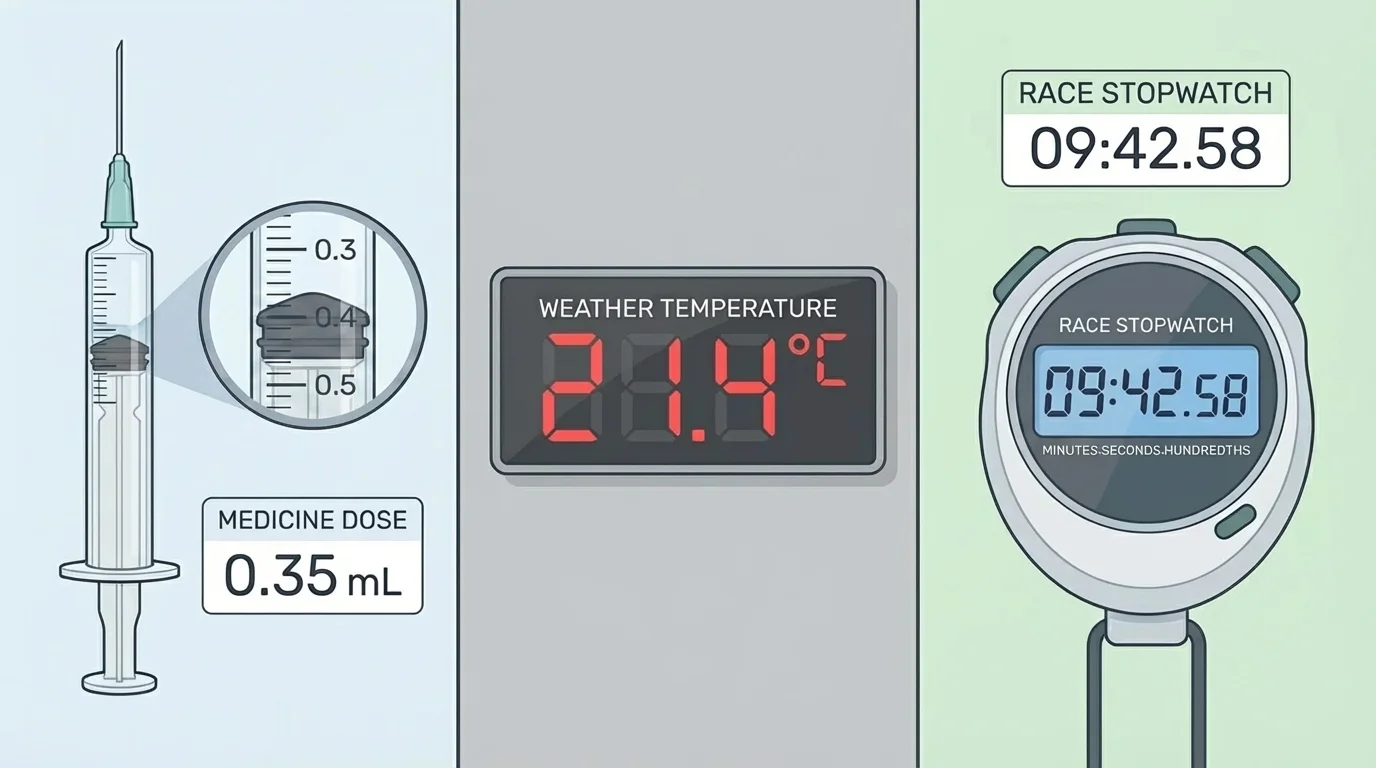
In sports statistics, a batting percentage is often reported to the nearest tenth of a percent, but no one measures a player's height to \(2.000000 \textrm{ m}\) unless the tool and context justify it. Similarly, in physics labs, we may compute speed using \(v = \dfrac{d}{t}\), but if distance and time are measured only roughly, the speed should also be reported roughly.
Later, when comparing data, the same logic still matters. The thermometer reading between marks in [Figure 2] reminds us that one estimated digit is useful, but several invented digits are not. Likewise, the tool comparison in [Figure 1] shows why a finer instrument can justify a more detailed report.
Modern scientific instruments can measure incredibly small differences, but researchers still report only the digits supported by calibration and uncertainty analysis. More digits on a screen do not automatically mean more trustworthy knowledge.
The main goal is clear communication. A reported quantity should help someone else understand what is known, how well it is known, and what decisions can reasonably be based on it.
One common mistake is copying every digit from a calculator. If the calculator shows \(6.283185307\), that does not mean your experiment measured something to ten decimal places. Another mistake is dropping units. Reporting \(15.7\) instead of \(15.7 \textrm{ cm}\) leaves the quantity incomplete.
A third mistake is confusing exact numbers with measured ones. If \(3\) boards each measure \(2.4 \textrm{ m}\), then the count \(3\) is exact, but the length \(2.4 \textrm{ m}\) is measured. The product \(3 \times 2.4 = 7.2\) is still limited by the measured value, not by the exact count.
Good habits include checking the measuring tool, keeping units attached, thinking about place value or significant digits, and asking whether the final answer sounds more precise than the original data. If it does, revise it.
"A good measurement is not the longest number. It is the most honest number."
When you report quantities carefully, you are doing more than rounding. You are showing that mathematics describes reality best when numbers reflect both what is known and what is uncertain.
