Have you ever picked up two backpacks and known right away that one was much heavier? Or poured juice into cups and noticed one bottle did not hold enough for everyone? Every day, people measure how heavy things are and how much liquid containers can hold. These measurements help us cook, shop, pack, pour, and solve problems. When we learn to measure carefully, numbers become useful in real life.
There are two important ideas in this topic. One is mass, which tells how heavy an object is. The other is liquid volume, which tells how much liquid a container holds.
Mass tells how heavy an object is. Liquid volume tells how much liquid is in a container or how much the container can hold. We use standard units to describe these amounts so everyone understands the measurement in the same way.
If you hold an apple and then hold a bowling ball, the bowling ball has a greater mass. If you compare a cup of water with a big jug of water, the jug has a greater liquid volume.
Measuring uses standard units. A standard unit is a unit that people agree on and use the same way. That makes measurements clear and fair.
For mass, we often use the gram and the kilogram. For liquid volume, we use the liter. Different objects need different units, as [Figure 1] shows when it compares light objects, heavy objects, and liquid containers.
A gram, written as \(\textrm{g}\), is used for lighter objects. A paper clip, an eraser, or a few crayons might be measured in grams. A kilogram, written as \(\textrm{kg}\), is used for heavier objects. A watermelon, a dog, or a bag of rice might be measured in kilograms.
A liter, written as \(\textrm{l}\), is used for liquid volume. A bottle of juice, a pitcher of water, or a container of milk can be measured in liters.
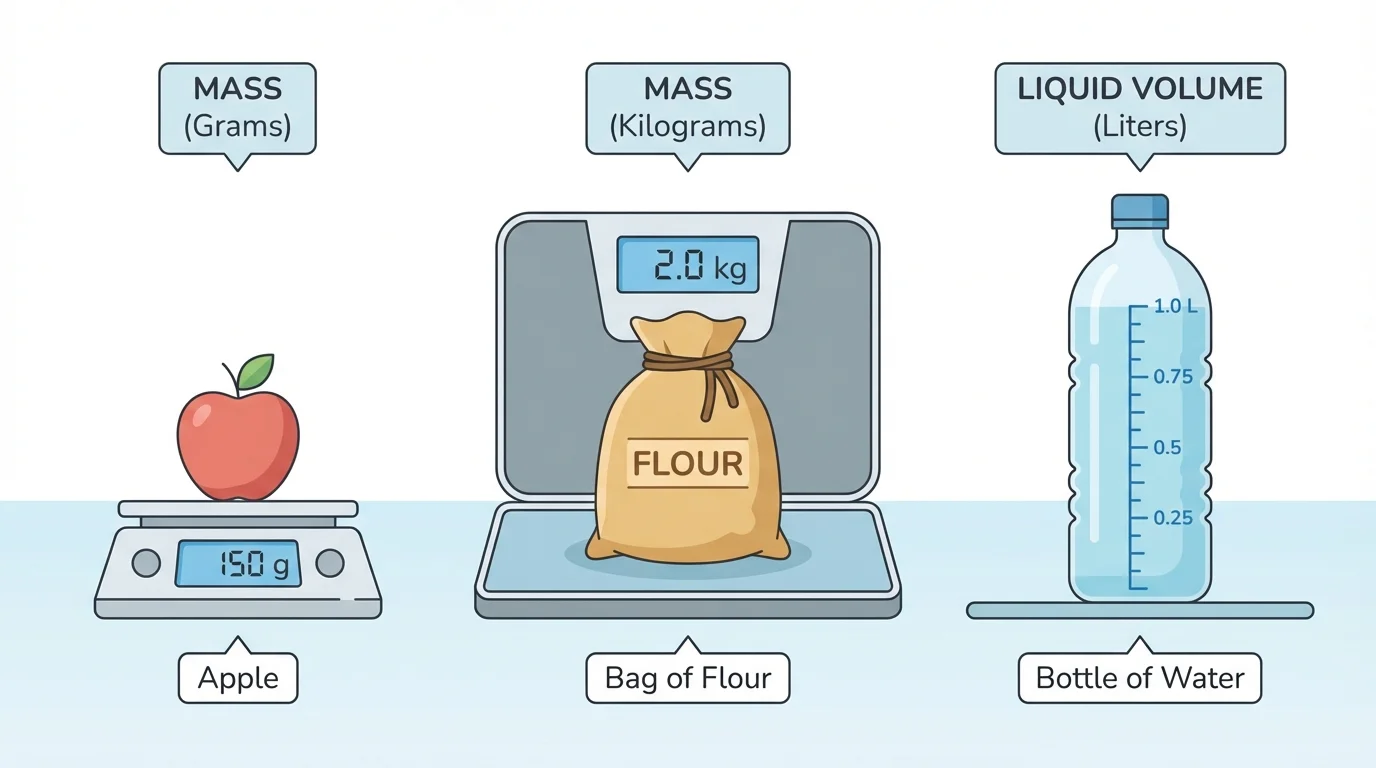
It is important to choose a unit that makes sense. Measuring a feather in kilograms would not be very helpful because a kilogram is too large for such a light object. Measuring a large dog in grams would also not be helpful because the number would be very big.
You can think of the units like this:
| Measurement | Unit | Good for |
|---|---|---|
| Mass | \(\textrm{g}\) | Light objects |
| Mass | \(\textrm{kg}\) | Heavier objects |
| Liquid volume | \(\textrm{l}\) | Liquids in containers |
Table 1. Standard units for mass and liquid volume.
Later, when you solve word problems, the unit matters. If a problem gives measurements in liters, the answer should stay in liters. If a problem gives measurements in grams, the answer should stay in grams unless the problem tells you to do something different.
Sometimes you do not need an exact measurement right away. You can make an estimate, which is a close guess based on what you know. Estimating helps you decide whether an answer is reasonable.
Why estimation matters
Estimation is like checking whether a number makes sense. If one apple is about \(200\) grams, then saying a single apple has a mass of \(8\) kilograms would not make sense. A good estimate helps you catch mistakes before they grow.
You can estimate by comparing an object to something familiar. For example, if a small bag of sugar feels much heavier than an eraser, then grams may be too small and kilograms may make more sense. If a water bottle looks like it holds much less than a bucket, then its liquid volume is probably about \(1\) liter or less.
Here are some reasonable estimates:
Good estimators ask, "Is this object light or heavy?" and "Does this container hold a little liquid or a lot?"
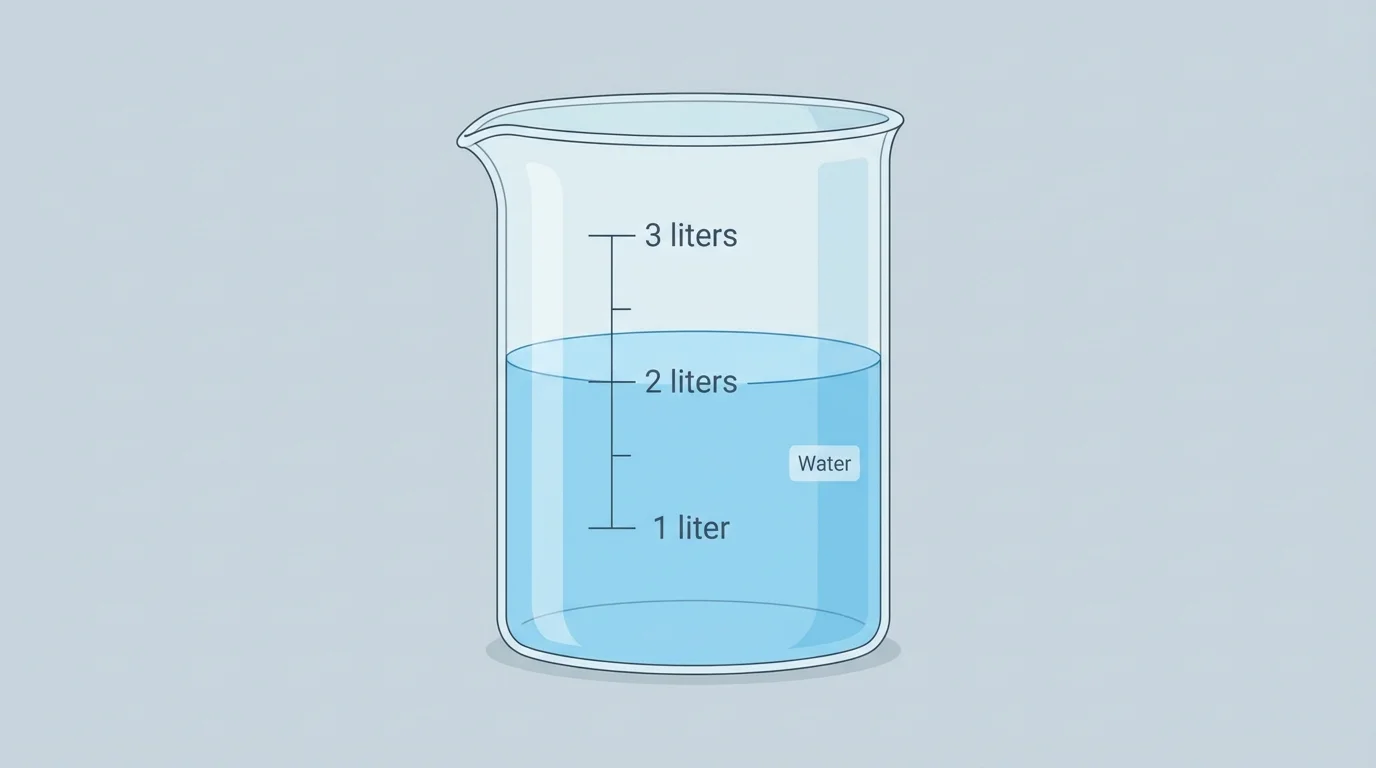
To measure liquid volume, people often use containers with marks on the side. These marks make a scale. The scale shows how much liquid is in the container, as [Figure 2] illustrates with a beaker marked in equal parts.
If the marks are equal, each space stands for the same amount. For example, a beaker might have lines for \(1\) liter, \(2\) liters, and \(3\) liters. If the water reaches the line marked \(2\), then the liquid volume is \(2\) liters.
Sometimes the liquid level is between two marks. Then you read carefully and estimate the amount. If the level is halfway between \(1\) liter and \(2\) liters, it is about \(1.5\) liters.
Mass can be measured with a scale as well. A kitchen scale might show the mass of fruit in grams. A larger scale might show the mass of a person or a large object in kilograms.
As we saw with the beaker in [Figure 2], reading the marks carefully is important. You must look at the number the liquid reaches, not just guess from the top of the container.
When you count marks on a measuring tool, make sure the spaces are equal. If one line stands for \(1\) liter, then the next equal space also stands for \(1\) liter unless the tool says otherwise.
A word problem tells a story with numbers. In one-step problems, you use one operation to solve the problem. You may add, subtract, multiply, or divide. Drawings can help you see what the numbers mean, and [Figure 3] shows how equal groups and sharing pictures can match multiplication and division stories.
Use addition when two or more amounts are put together. Use subtraction when one amount is taken away or when you compare to find how much more or less. Use multiplication when there are equal groups. Use division when an amount is shared equally or split into equal groups.
Always check that the measurements are in the same unit. If a problem uses grams, keep working in grams. If it uses liters, keep working in liters.
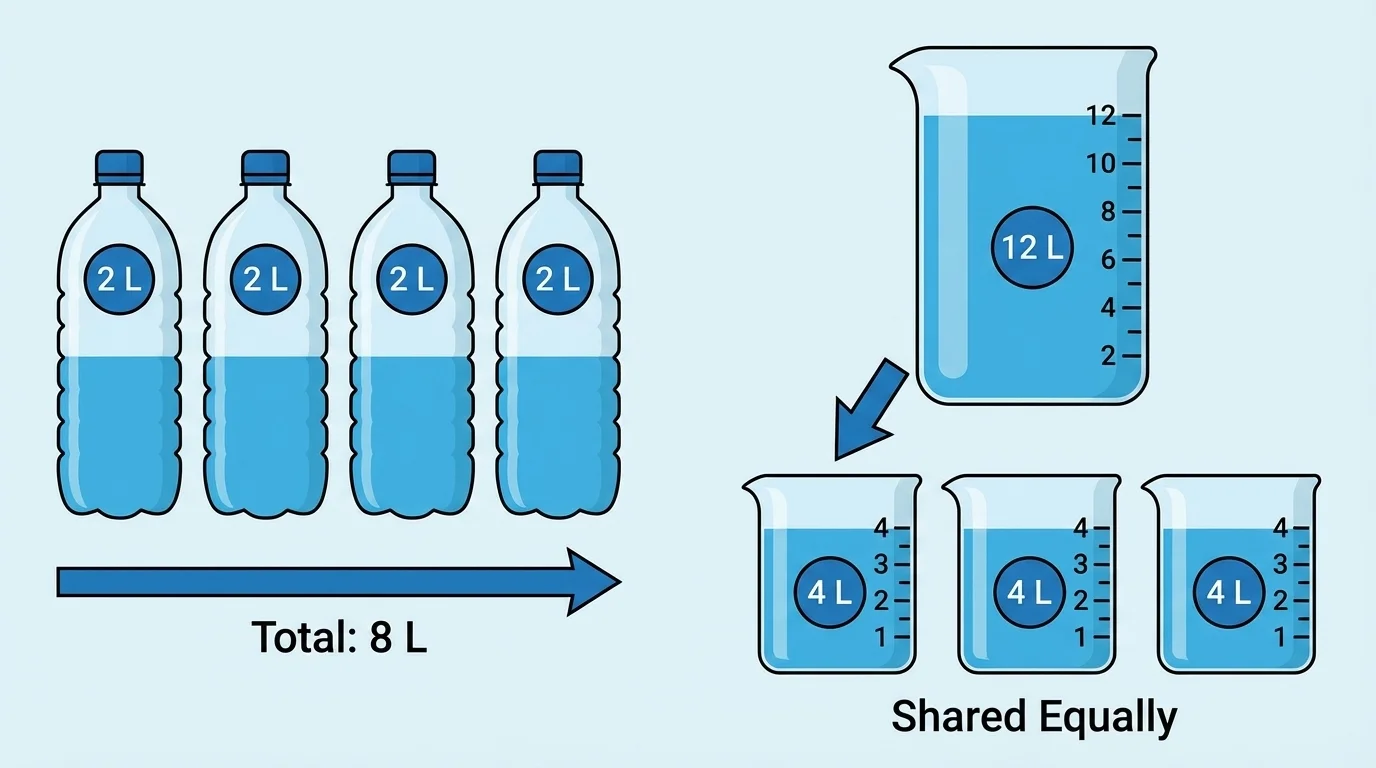
A drawing can make the problem easier. If there are \(4\) bottles with \(2\) liters in each bottle, you can draw \(4\) bottles and label each one \(2\) liters. Then you can count by twos: \(2, 4, 6, 8\). So the total is \(8\) liters.
If \(12\) liters are shared equally into \(3\) containers, draw \(3\) empty containers and split the \(12\) liters evenly. Since \(12 \div 3 = 4\), each container gets \(4\) liters. This is the same sharing idea shown in [Figure 3].
Now let's solve several one-step problems carefully.
Worked example 1: Addition with liters
Mila pours \(3\) liters of water into a tank. Then she pours in \(2\) more liters. How much water is in the tank now?
Step 1: Decide which operation to use.
The amount is being put together, so use addition.
Step 2: Add the amounts.
\(3 + 2 = 5\)
Step 3: Write the answer with the unit.
\[5\ \textrm{l}\]
The tank now has \(5\) liters of water.
When amounts are combined, addition is often the right choice. Notice that both numbers were in liters, so the answer is also in liters.
Worked example 2: Subtraction with grams
A bag of apples has a mass of \(900\) grams. Ben takes out apples with a mass of \(200\) grams. What is the mass of the apples left in the bag?
Step 1: Decide which operation to use.
An amount is taken away, so use subtraction.
Step 2: Subtract.
\(900 - 200 = 700\)
Step 3: Write the answer with the unit.
\[700\ \textrm{g}\]
The apples left in the bag have a mass of \(700\) grams.
Subtraction helps when something is removed or when you need to find what remains.
Worked example 3: Multiplication with kilograms
There are \(4\) bags of rice. Each bag has a mass of \(3\) kilograms. What is the total mass of the rice?
Step 1: Look for equal groups.
There are \(4\) equal groups of \(3\) kilograms.
Step 2: Multiply.
\(4 \times 3 = 12\)
Step 3: Write the answer with the unit.
\[12\ \textrm{kg}\]
The total mass is \(12\) kilograms.
Multiplication is a fast way to add equal groups. Instead of \(3 + 3 + 3 + 3\), you can write \(4 \times 3\).
Worked example 4: Division with liters
A large container holds \(12\) liters of juice. The juice is poured equally into \(3\) pitchers. How many liters go into each pitcher?
Step 1: Decide which operation to use.
The juice is shared equally, so use division.
Step 2: Divide.
\(12 \div 3 = 4\)
Step 3: Write the answer with the unit.
\[4\ \textrm{l}\]
Each pitcher gets \(4\) liters of juice.
Division is useful when an amount is split equally. The answer is still in liters because the whole amount was measured in liters.
Drawings are powerful because they turn words into something you can see. For a liquid volume problem, you might draw containers, bottles, or a beaker with marks. For a mass problem, you might draw objects with labels showing their masses.
Suppose a problem says, "Two bottles each hold \(2\) liters." You can draw two bottles and write \(2\) liters on each. Then you add: \(2 + 2 = 4\). The drawing helps you understand that there are two equal amounts.
Suppose a problem says, "A puppy has a mass of \(5\) kilograms. A cat has a mass of \(3\) kilograms. How much heavier is the puppy?" You can draw both animals and label them \(5\) kilograms and \(3\) kilograms. Then subtract: \(5 - 3 = 2\). The puppy is \(2\) kilograms heavier.
Many measuring cups and science beakers are marked with scales because people need quick, accurate ways to read liquid amounts. Bakers, doctors, and scientists all depend on careful measurement.
Measuring mass and liquid volume is not just a math skill. It is used in everyday life. In cooking, a recipe may need \(2\) liters of soup or a certain mass of ingredients. At a grocery store, fruit may be sold by mass. At home, families may compare which milk jug holds more.
In sports and health, people sometimes measure the mass of equipment or the amount of water they drink. In science, students use beakers and scales to measure materials carefully. When packing for a trip, people think about how heavy a suitcase is. All of these situations use the same ideas you are learning.
The comparison of units from [Figure 1] matters in these real situations. A chef would not measure a large pot of soup in grams because grams measure mass, not liquid volume. Choosing the correct unit helps the measurement make sense.
One common mistake is mixing up units. If a problem uses kilograms, do not answer in grams unless you are told to change units. If a problem uses liters, do not answer in kilograms.
Another mistake is choosing the wrong operation. Read the story carefully. Ask yourself: Are amounts being put together, taken away, grouped equally, or shared equally?
A third mistake is forgetting to write the unit in the answer. The number \(6\) by itself is not complete. You need to say whether it means \(6\) grams, \(6\) kilograms, or \(6\) liters.
It also helps to estimate before solving. If your answer says a small spoon has a mass of \(10\) kilograms, your estimate should tell you something went wrong.
"Measure carefully, think clearly, and let the units guide your answer."
Careful measurement makes math useful. When you know what the unit means, how to read a scale, and which operation to choose, you can solve real problems with confidence.
