How do video games, treasure maps, and city street grids all tell you exactly where something is? They use a system for location. In math, one powerful location system uses two crossing number lines. With just two numbers, such as \((3, 4)\), you can tell the exact place of a point on a flat surface. That idea is the heart of the coordinate plane.
Sometimes words like "near the desk" or "a little to the left" are not clear enough. Math needs exact locations. A coordinate system gives every point a precise address. This is useful in geometry, map reading, computer graphics, sports statistics, and even planning where things belong on a screen.
When you learn coordinates, you are learning how to describe position using numbers. That means you can look at a point and name its location, or you can take a location and place the point exactly where it belongs.
You already know how to read a number line. On a number line, numbers increase as you move to the right and decrease as you move to the left. A coordinate plane uses this idea twice: once across and once up and down.
A coordinate plane is like combining two number lines at a right angle. One number line goes across, and the other goes up and down. Because they cross, you can locate points in two directions instead of just one.
A coordinate plane is formed by a pair of perpendicular number lines, as [Figure 1] shows. Perpendicular lines meet to form right angles. One line runs from left to right, and the other runs from bottom to top.
The horizontal line is called the x-axis. The vertical line is called the y-axis. The place where the two axes cross is called the origin. The origin is written as \((0, 0)\) because it matches \(0\) on both number lines.
The axes are arranged so that the \(0\) on the horizontal line and the \(0\) on the vertical line are at the same point. That shared point is the starting place for locating all other points.
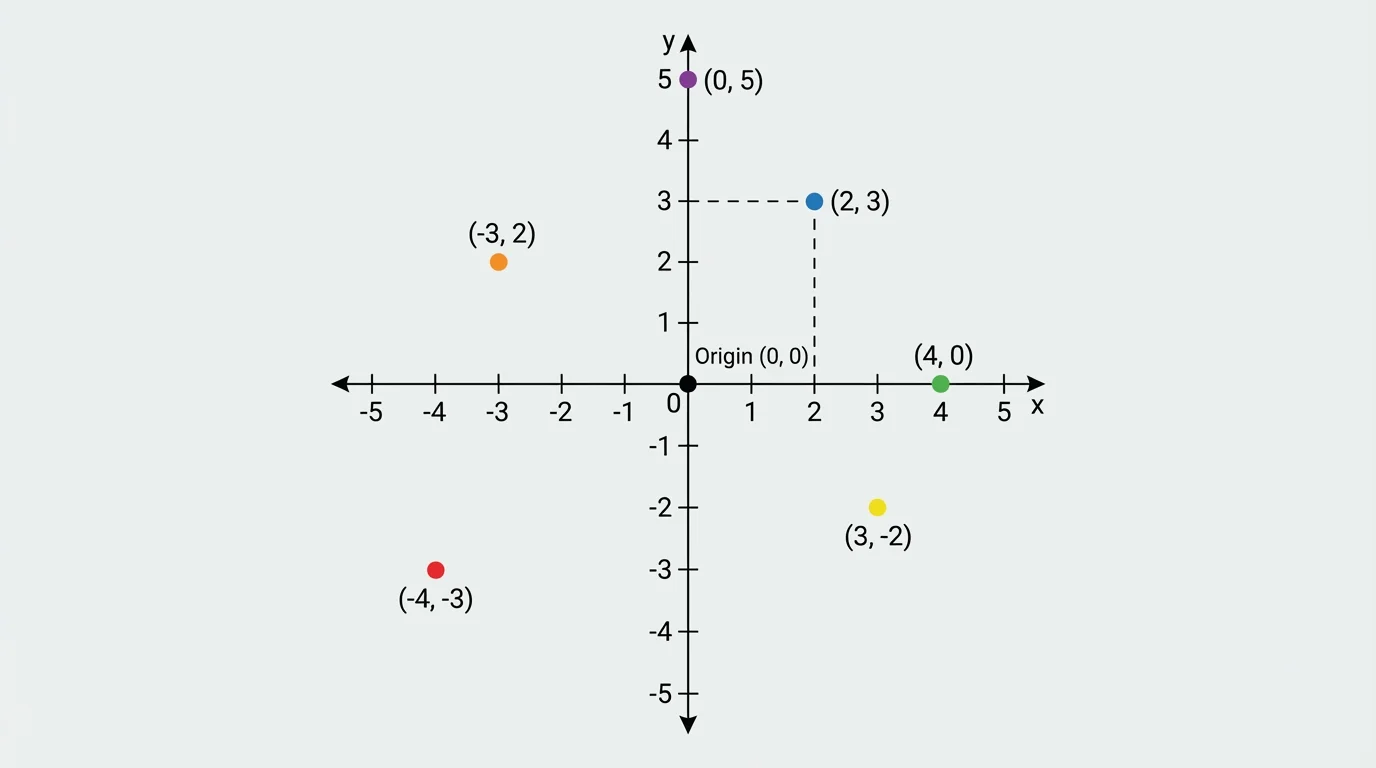
Axes, origin, and coordinates are basic parts of the coordinate system. The x-axis is the horizontal number line, the y-axis is the vertical number line, and the origin is where they meet at \((0, 0)\). A point is named by an ordered pair, which gives its location.
Notice that each axis has its own name. This matters because the first number in a point's name matches the horizontal axis, and the second number matches the vertical axis. So the names correspond: x-axis goes with x-coordinate, and y-axis goes with y-coordinate.
An ordered pair is written with parentheses and a comma, like \((x, y)\). This does not mean multiplication. It is simply a way to record two numbers in a certain order.
The order matters a lot. In the point \((3, 5)\), the first number, \(3\), tells how far to move from the origin in the direction of the x-axis. The second number, \(5\), tells how far to move in the direction of the y-axis. If you switched the numbers and wrote \((5, 3)\), the point would be in a different place.
For grade \(5\) work, we often use points with whole-number coordinates. For example:
If a coordinate is \(0\), the point lies on one of the axes. A point with y-coordinate \(0\) lies on the x-axis. A point with x-coordinate \(0\) lies on the y-axis. The point \((0, 0)\) lies on both because it is the origin.
To plot a point, always begin at the origin. Then follow the ordered pair, as [Figure 2] illustrates: first move in the direction of the x-axis using the first number, and then move in the direction of the y-axis using the second number.
If the point is \((4, 2)\), start at \((0, 0)\). Move \(4\) units to the right on the x-axis. Then move \(2\) units up in the direction of the y-axis. Where you stop is the point \((4, 2)\).
You can also work backward. If a point is already plotted, begin at the origin and count how far across and how far up or down the point is. Those two counts give the coordinates.
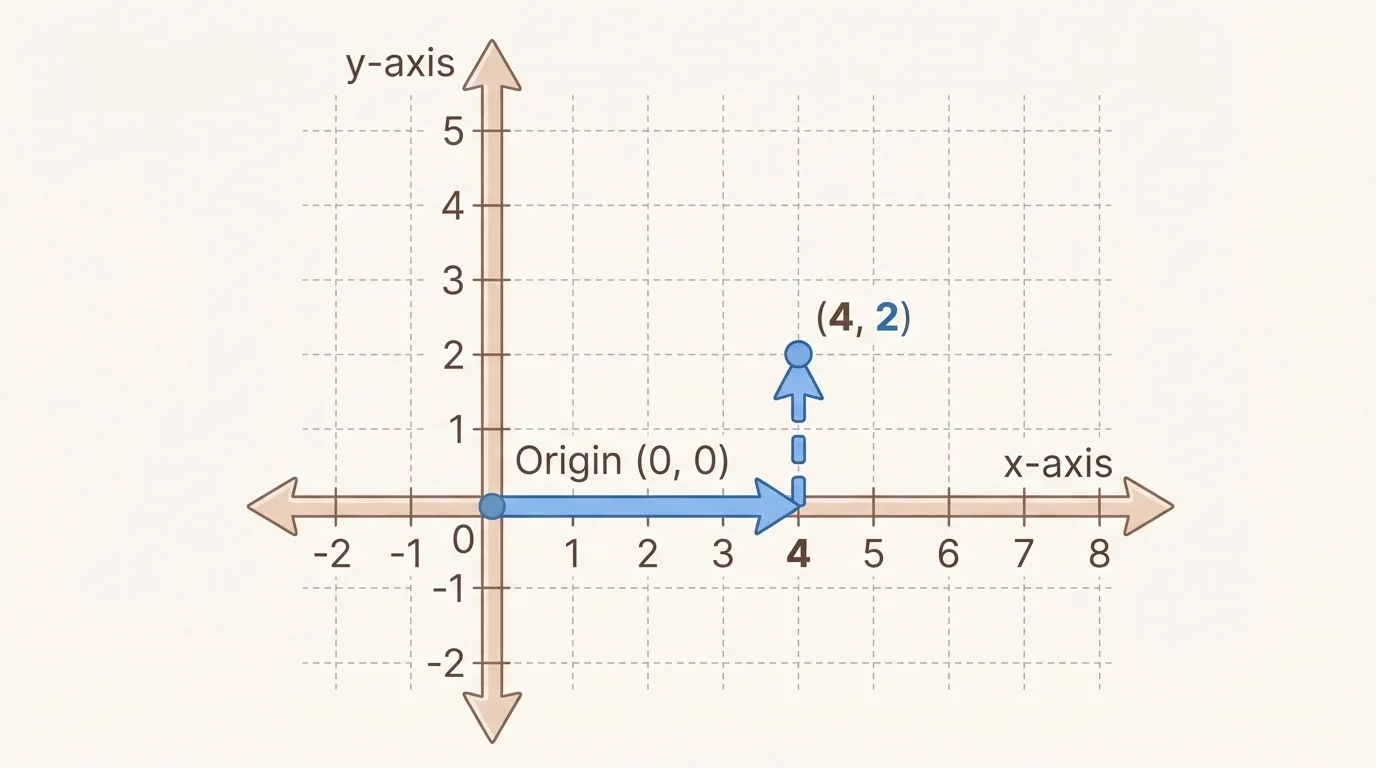
The order tells the path. The x-coordinate comes first because you move in the horizontal direction first. The y-coordinate comes second because you move in the vertical direction second. A helpful way to remember this is: across first, then up or down.
Suppose you want to locate \((1, 6)\). You do not go up \(1\) and right \(6\). That would mix up the axes. You go right \(1\) and up \(6\). Matching each coordinate to the correct axis is one of the most important skills in this topic.
Worked examples help show exactly how coordinates are read and plotted. Read each step carefully and notice how the first number always matches the x-axis and the second number always matches the y-axis.
Worked example 1
Plot the point \((3, 4)\).
Step 1: Start at the origin.
The origin is \((0, 0)\).
Step 2: Use the first coordinate.
The first number is \(3\), so move \(3\) units to the right on the x-axis.
Step 3: Use the second coordinate.
The second number is \(4\), so move \(4\) units up in the direction of the y-axis.
Step 4: Mark the point.
The location is \((3, 4)\).
The point is \((3, 4)\).
This example shows the basic rule clearly: the first number tells the horizontal movement, and the second number tells the vertical movement. The same idea works for every ordered pair on the plane.
Worked example 2
A point is plotted \(5\) units to the right of the origin and \(2\) units up. What are its coordinates?
Step 1: Find the x-coordinate.
The point is \(5\) units to the right, so the x-coordinate is \(5\).
Step 2: Find the y-coordinate.
The point is \(2\) units up, so the y-coordinate is \(2\).
Step 3: Write the ordered pair.
Write x first and y second: \((5, 2)\).
The coordinates are \((5, 2)\).
Writing the pair in the correct order is essential. If you wrote \((2, 5)\), you would be describing a different point.
Worked example 3
What point lies on the y-axis and is \(6\) units above the origin?
Step 1: Use the fact that the point is on the y-axis.
Any point on the y-axis has x-coordinate \(0\).
Step 2: Use the vertical distance.
The point is \(6\) units above the origin, so the y-coordinate is \(6\).
Step 3: Write the ordered pair.
The point is \((0, 6)\).
The point is \((0, 6)\).
Points on an axis are special because one coordinate is \(0\). That makes them easier to identify.
Worked example 4
Point \(A\) is at \((7, 0)\). Describe where it is located.
Step 1: Read the x-coordinate.
The x-coordinate is \(7\), so move \(7\) units to the right from the origin.
Step 2: Read the y-coordinate.
The y-coordinate is \(0\), so there is no up-or-down movement.
Step 3: Describe the location.
The point is on the x-axis, \(7\) units to the right of the origin.
Point \(A\) lies on the x-axis at \((7, 0)\).
As you study points, certain patterns appear. These patterns help you read and compare coordinates faster.
Points with the same x-coordinate line up vertically. For example, \((2, 1)\), \((2, 3)\), and \((2, 5)\) are all directly above or below one another because they all start with \(2\).
Points with the same y-coordinate line up horizontally. For example, \((1, 4)\), \((3, 4)\), and \((6, 4)\) are all on the same horizontal line because they all end with \(4\). This vertical and horizontal structure is easy to notice on the plane shown earlier in [Figure 1].
Another important idea is that coordinates are exact. Saying "the point is somewhere near \((4, 3)\)" is not enough in math. A point is either at \((4, 3)\) or it is not.
Game designers and app creators use coordinate grids to place objects exactly on a screen. When a character moves a certain number of spaces across and up, the computer tracks that movement using coordinates.
A common mistake is to reverse the coordinates. For example, \((2, 5)\) and \((5, 2)\) are not the same point. The first moves \(2\) across and \(5\) up. The second moves \(5\) across and \(2\) up.
Another common mistake is to forget to begin at the origin. Every ordered pair is measured from \((0, 0)\), not from some other point on the graph.
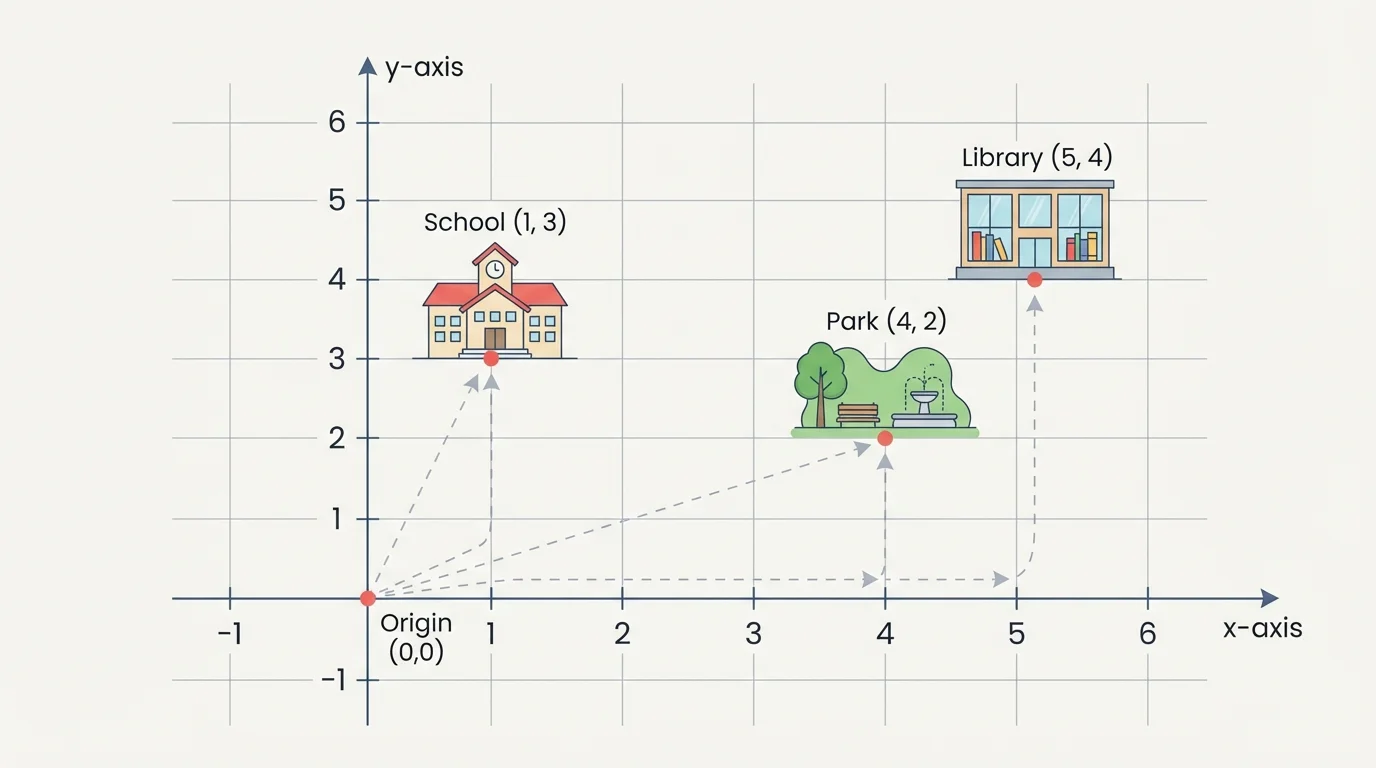
Coordinates help describe places in a clear way, and [Figure 3] shows how a simple town grid can work like a coordinate plane. If a park is at \((2, 4)\) and a library is at \((5, 4)\), you can tell they are on the same horizontal line because they have the same y-coordinate.
In a classroom seating chart, a desk might be described by row and column. In a board game, a piece may move to a square with a specific pair of coordinates. On a map, streets can form a grid that helps people find exact locations.
Suppose a treasure map uses a grid. If the clue says the treasure is at \((6, 1)\), you know to move \(6\) units across and \(1\) unit up from the origin point. Without coordinates, the directions would be much less exact.
Sports can also use coordinates. A coach might track where a ball lands on a practice grid. If one ball lands at \((3, 2)\) and another at \((3, 5)\), the coach can see that both landed along the same vertical line.
Sometimes you need to compare locations instead of just naming one point. For example, compare \((2, 3)\) and \((2, 6)\). They have the same x-coordinate, so they are vertically aligned. The second point is \(3\) units higher because \(6 - 3 = 3\).
Now compare \((1, 4)\) and \((5, 4)\). They have the same y-coordinate, so they are horizontally aligned. The second point is \(4\) units farther to the right because \(5 - 1 = 4\).
These comparisons become easier when you picture the path from the origin, just as in [Figure 2]. First think about the horizontal move, then think about the vertical move. This helps you see whether two points share a row, share a column, or are in completely different places.
| Point | x-coordinate | y-coordinate | What it tells you |
|---|---|---|---|
| \((4, 3)\) | \(4\) | \(3\) | Move \(4\) units across, then \(3\) units up |
| \((0, 5)\) | \(0\) | \(5\) | The point is on the y-axis |
| \((6, 0)\) | \(6\) | \(0\) | The point is on the x-axis |
| \((0, 0)\) | \(0\) | \(0\) | The point is the origin |
Table 1. Examples of ordered pairs and what each coordinate tells you about the point's location.
When you look at a point, ask yourself two questions: How far is it from the origin across the x-axis? How far is it from the origin in the direction of the y-axis? Those two answers give the complete location.
The coordinate system is built from two perpendicular axes. Their intersection is the origin, and every point is named with an ordered pair. The first number belongs to the x-axis, and the second belongs to the y-axis. That matching of names and coordinates is what makes the system organized and useful.
As seen in [Figure 3], coordinates are not just a school math idea. They are a practical way to describe location clearly. Whether you are locating a point on a graph, a building on a map, or an object on a screen, the same rule works: start at the origin, move along the x-axis, then move in the direction of the y-axis.
