A basketball court, a recipe, a road trip, and a science experiment all have something in common: they depend on getting units right. A player's height might be measured in feet and inches, a recipe might use cups and teaspoons, and a car's speed might be given in miles per hour. If you can convert units accurately, you can compare, measure, and solve problems with confidence.
A unit is a label that tells what kind of measurement you have. Length might be measured in inches, feet, centimeters, or meters. Time might be measured in seconds, minutes, or hours. Mass might be measured in grams or kilograms.
Sometimes two different units describe the same amount. For example, \(12 \textrm{ inches}\) and \(1 \textrm{ foot}\) name the same length. Also, \(60 \textrm{ seconds}\) and \(1 \textrm{ minute}\) name the same amount of time. These equal measurements let us build ratios that help us convert.
Equivalent measurements are different unit names for the same amount. A conversion factor is a ratio made from equivalent measurements, such as \(\dfrac{12 \textrm{ inches}}{1 \textrm{ foot}}\) or \(\dfrac{1 \textrm{ foot}}{12 \textrm{ inches}}\). Because the top and bottom are equal amounts, the ratio has a value of \(1\).
Unit conversion is really a ratio problem. You are using one known relationship to find an equivalent measurement in a new unit. The math works because multiplying by \(1\) does not change the actual amount; it only changes the way the amount is named.
For example, if a ribbon is \(3 \textrm{ feet}\) long, you can rewrite that in inches because each foot contains \(12 \textrm{ inches}\). So the total number of inches is \(3 \times 12 = 36\), which means the ribbon is \[3 \textrm{ feet} = 36 \textrm{ inches}\].
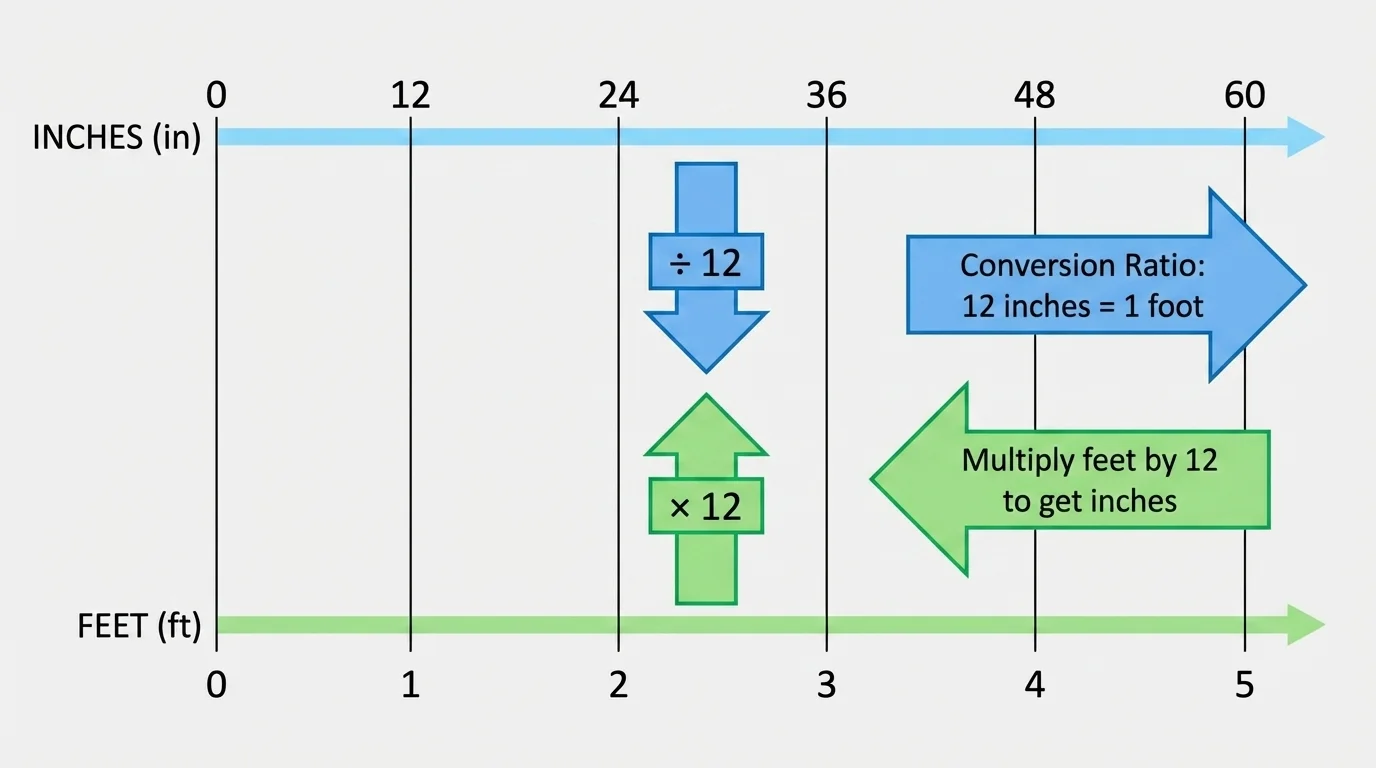
As [Figure 1] shows, a ratio compares two quantities. In unit conversion, the two quantities are usually two units that describe the same measurement. A double number line can match inches and feet so that every point lines up with an equivalent length.
If \(12 \textrm{ inches} = 1 \textrm{ foot}\), then these are all equivalent ratios: \(\dfrac{12 \textrm{ inches}}{1 \textrm{ foot}}\), \(\dfrac{24 \textrm{ inches}}{2 \textrm{ feet}}\), and \(\dfrac{36 \textrm{ inches}}{3 \textrm{ feet}}\). They all describe the same relationship.
A rate is a special kind of ratio that compares quantities with different units, such as \(60 \textrm{ miles per hour}\) or \(120 \textrm{ words per minute}\). Rates are also converted using ratio reasoning. If the unit is "per hour," and you want "per minute," you use the relationship \(1 \textrm{ hour} = 60 \textrm{ minutes}\).
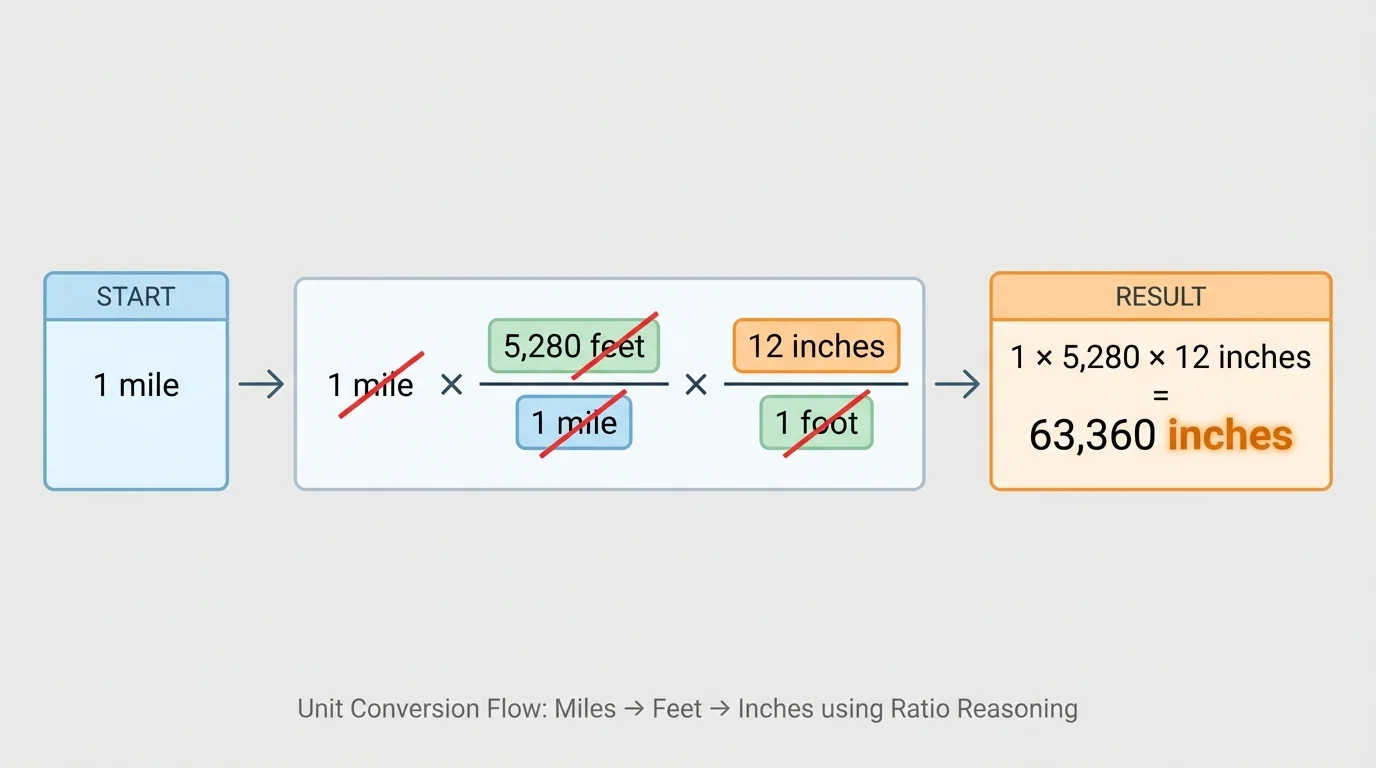
The most useful idea is this: choose a conversion factor so that the old unit cancels and the new unit remains. This is not magic. It is organized ratio reasoning.
You already know that multiplying by a fraction equal to \(1\) does not change a number's value. For example, \(\dfrac{3}{3} = 1\). A conversion factor works the same way, except it uses units, such as \(\dfrac{12 \textrm{ inches}}{1 \textrm{ foot}} = 1\).
Suppose you want to convert \(5 \textrm{ feet}\) to inches. You multiply by the conversion factor with feet in the denominator so feet cancel: \(5 \textrm{ feet} \times \dfrac{12 \textrm{ inches}}{1 \textrm{ foot}} = 60 \textrm{ inches}\).
As [Figure 2] illustrates, units behave like labels in the math. When the same unit appears in the numerator and denominator, it cancels, leaving the new unit behind. This helps you decide whether your conversion setup is correct.
When you convert from a larger unit to a smaller unit, the number usually gets larger. For example, \(2 \textrm{ yards}\) becomes \(6 \textrm{ feet}\) because each yard contains several feet. When you convert from a smaller unit to a larger unit, the number usually gets smaller. For example, \(24 \textrm{ inches}\) becomes \(2 \textrm{ feet}\).
Sometimes the quantity itself involves division, like miles per hour. Then you must think about which part of the rate is changing. To convert \(120 \textrm{ minutes}\) to hours, you divide by \(60\) because there are \(60 \textrm{ minutes}\) in \(1 \textrm{ hour}\). But using conversion factors, the same idea can be written as multiplication: \(120 \textrm{ minutes} \times \dfrac{1 \textrm{ hour}}{60 \textrm{ minutes}} = 2 \textrm{ hours}\).
Units can also be multiplied. If a rectangle is \(3 \textrm{ feet}\) long and \(2 \textrm{ feet}\) wide, its area is \(3 \times 2 = 6\) square feet, written as \(6 \textrm{ ft}^2\). The unit changed because length times length gives area.
That is why area and volume conversions require extra care. A single length conversion and an area conversion are not the same thing. For instance, \(1 \textrm{ foot} = 12 \textrm{ inches}\), but \(1 \textrm{ square foot} \neq 12 \textrm{ square inches}\). The correct area conversion is much larger.
Many conversions happen inside the same system of measurement. In the customary system, common length relationships include \(12 \textrm{ inches} = 1 \textrm{ foot}\), \(3 \textrm{ feet} = 1 \textrm{ yard}\), and \(5{,}280 \textrm{ feet} = 1 \textrm{ mile}\). In the metric system, common relationships include \(10 \textrm{ millimeters} = 1 \textrm{ centimeter}\), \(100 \textrm{ centimeters} = 1 \textrm{ meter}\), and \(1{,}000 \textrm{ meters} = 1 \textrm{ kilometer}\).
The metric system is often easier to convert because it is based on powers of \(10\). Still, the reasoning is the same: use equivalent ratios and choose the conversion factor that cancels the starting unit.
| Measurement type | Equivalent units |
|---|---|
| Length | \(12 \textrm{ inches} = 1 \textrm{ foot}\) |
| Length | \(3 \textrm{ feet} = 1 \textrm{ yard}\) |
| Length | \(100 \textrm{ centimeters} = 1 \textrm{ meter}\) |
| Time | \(60 \textrm{ seconds} = 1 \textrm{ minute}\) |
| Time | \(60 \textrm{ minutes} = 1 \textrm{ hour}\) |
| Mass | \(1{,}000 \textrm{ grams} = 1 \textrm{ kilogram}\) |
| Capacity | \(4 \textrm{ quarts} = 1 \textrm{ gallon}\) |
Table 1. Common equivalent measurements used in ratio-based conversions.
You do not need to memorize every possible conversion at once. What matters most is understanding how to use a known relationship correctly.
A helpful question is: "Should the number get bigger or smaller?" If you convert \(7 \textrm{ feet}\) to inches, the number should get bigger because inches are smaller units. If you convert \(84 \textrm{ inches}\) to feet, the number should get smaller because feet are larger units.
This estimate can catch mistakes. If someone says \(2 \textrm{ miles} = 10{,}560 \textrm{ miles}\), the unit did not even change. If someone says \(2 \textrm{ miles} = 0.0004 \textrm{ feet}\), that cannot be right because converting miles to feet should make the number larger, not tiny.
Why multiplying and dividing both appear
Sometimes students ask whether conversions use multiplication or division. The deeper answer is that conversions always use equivalent ratios. Depending on how the ratio is written, the calculation may look like multiplication by a fraction or division by a unit amount. These are two views of the same idea.
For example, to convert \(180 \textrm{ seconds}\) to minutes, you can divide by \(60\) because each minute has \(60\) seconds. Or you can multiply by \(\dfrac{1 \textrm{ minute}}{60 \textrm{ seconds}}\). Both methods give the same answer: \(3 \textrm{ minutes}\).
Some conversions involve just one step, while others need a chain of equivalent ratios. Area conversions are especially interesting because the unit itself is multiplied, as [Figure 3] shows with a square foot divided into many square inches.
Worked example 1: Convert feet to inches
A jump rope is \(8 \textrm{ feet}\) long. How many inches long is it?
Step 1: Write the known relationship.
\(1 \textrm{ foot} = 12 \textrm{ inches}\)
Step 2: Choose a conversion factor that cancels feet.
\(8 \textrm{ feet} \times \dfrac{12 \textrm{ inches}}{1 \textrm{ foot}}\)
Step 3: Multiply.
\(8 \times 12 = 96\)
\[8 \textrm{ feet} = 96 \textrm{ inches}\]
The rope is \(96 \textrm{ inches}\) long.
Notice that the answer is a larger number because inches are smaller than feet. That matches our estimate.
Worked example 2: Convert minutes to hours
A movie lasts \(150 \textrm{ minutes}\). How many hours is that?
Step 1: Use the relationship between minutes and hours.
\(60 \textrm{ minutes} = 1 \textrm{ hour}\)
Step 2: Multiply by a conversion factor.
\(150 \textrm{ minutes} \times \dfrac{1 \textrm{ hour}}{60 \textrm{ minutes}}\)
Step 3: Simplify.
\(\dfrac{150}{60} = 2.5\)
\[150 \textrm{ minutes} = 2.5 \textrm{ hours}\]
The movie lasts \(2.5 \textrm{ hours}\), or \(2\) hours and \(30\) minutes.
Here the number became smaller because hours are larger than minutes.
Worked example 3: Convert a rate
A runner moves at \(6 \textrm{ miles per hour}\). How many miles per minute is that?
Step 1: Keep the miles and convert the time unit.
\(1 \textrm{ hour} = 60 \textrm{ minutes}\)
Step 2: Rewrite the rate.
\(6 \textrm{ miles per hour} = \dfrac{6 \textrm{ miles}}{1 \textrm{ hour}}\)
Step 3: Convert hours to minutes in the denominator.
\(\dfrac{6 \textrm{ miles}}{1 \textrm{ hour}} \times \dfrac{1 \textrm{ hour}}{60 \textrm{ minutes}} = \dfrac{6 \textrm{ miles}}{60 \textrm{ minutes}}\)
\(\dfrac{6}{60} = 0.1\)
\[6 \textrm{ miles per hour} = 0.1 \textrm{ miles per minute}\]
The runner goes \(0.1 \textrm{ miles per minute}\).
Rates can feel harder at first because the unit is part of a fraction, but the same cancellation idea still works, just as we saw earlier in [Figure 2].
Worked example 4: Convert square feet to square inches
A poster covers \(2 \textrm{ square feet}\). How many square inches is that?
Step 1: Start with the length relationship.
\(1 \textrm{ foot} = 12 \textrm{ inches}\)
Step 2: Square the relationship for area.
\(1 \textrm{ square foot} = 12 \textrm{ inches} \times 12 \textrm{ inches} = 144 \textrm{ square inches}\)
Step 3: Multiply by \(2\).
\(2 \times 144 = 288\)
\[2 \textrm{ square feet} = 288 \textrm{ square inches}\]
The poster covers \(288 \textrm{ square inches}\).
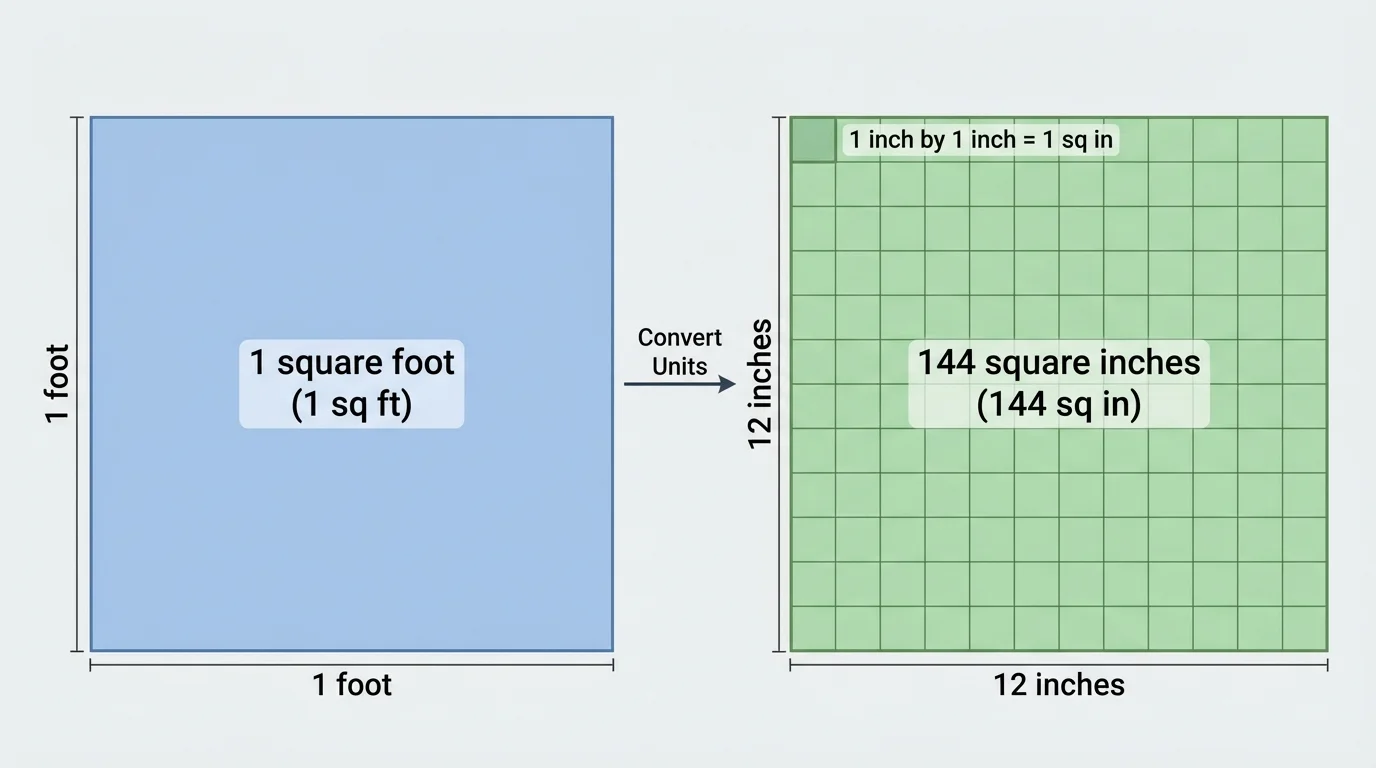
This example is important because it shows why area conversions are not done with the same numbers as length conversions. A single foot contains \(12\) inches, but a square foot contains \(144\) square inches. The visual grid makes that clear.
A track race listed as \(5{,}000 \textrm{ meters}\) is often called a "5K" because \(1{,}000 \textrm{ meters} = 1 \textrm{ kilometer}\). So \(5{,}000 \textrm{ meters} = 5 \textrm{ kilometers}\).
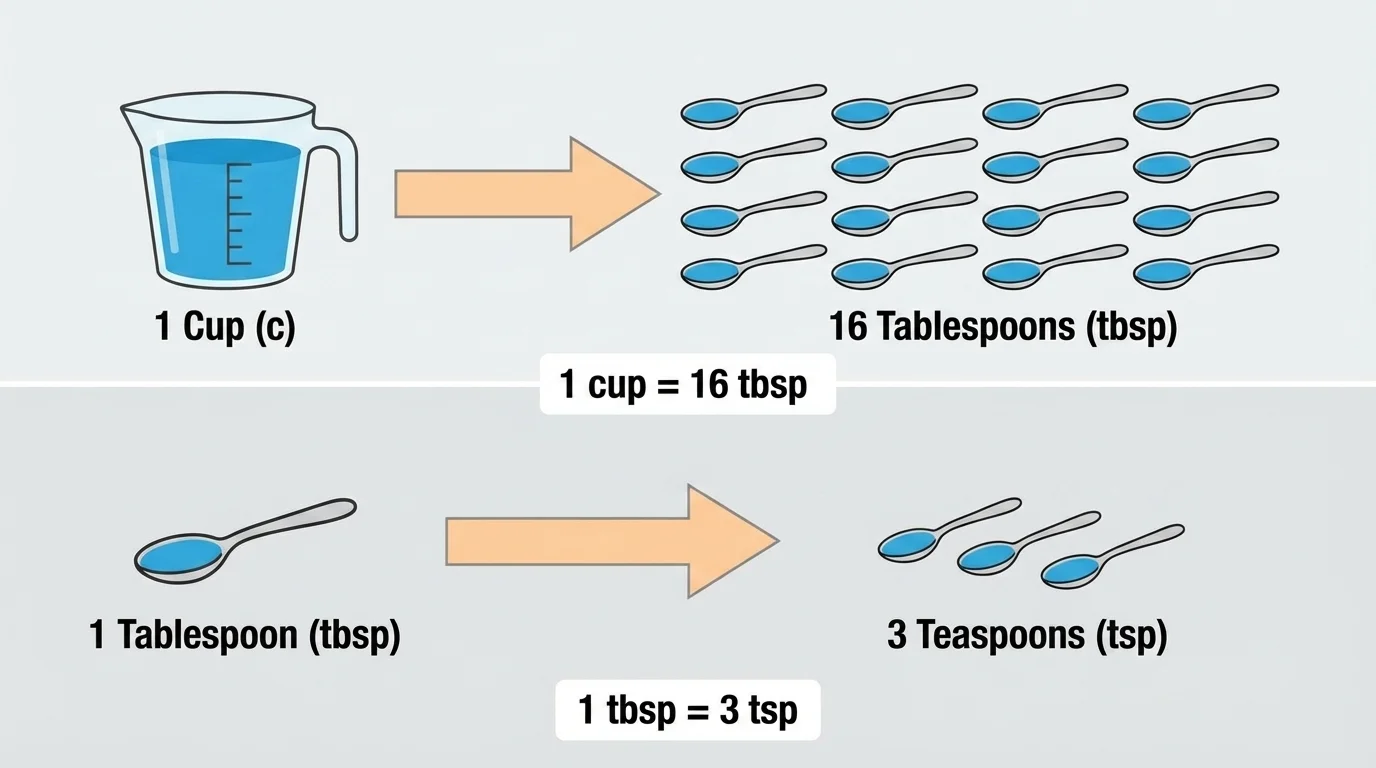
As [Figure 4] shows, unit conversion appears everywhere.
In cooking, a recipe might call for \(1 \textrm{ cup}\), but you may only have tablespoons or teaspoons. Measuring tools often connect these units through equivalent amounts.
Suppose \(1 \textrm{ cup} = 16 \textrm{ tablespoons}\). Then \(2 \textrm{ cups} = 32 \textrm{ tablespoons}\). If \(1 \textrm{ tablespoon} = 3 \textrm{ teaspoons}\), then \(2 \textrm{ tablespoons} = 6 \textrm{ teaspoons}\). Cooks use these conversions constantly when doubling or shrinking recipes.
In sports, speed is a rate. A cyclist's pace might be measured in miles per hour, while a swimmer's pace might be measured in seconds per lap. Converting time units can help compare performances.
In travel, distances may be given in miles, but a map scale might use feet or meters for smaller sections. Builders and designers also convert units when measuring boards, fabric, tile, or paint coverage. A mistake in units can waste money and materials.
Scientists and doctors depend on accurate unit conversions too. Even though this lesson focuses on everyday ratio reasoning, the same skill supports more advanced work later. A small error in units can lead to a very wrong answer, even if the arithmetic is correct.
Later, when you compare rates or solve multi-step problems, the unit labels themselves become guides. The cooking example in [Figure 4] works the same way as a speed conversion or a distance conversion: use equivalent ratios and let the units lead the process.
One common error is using the conversion factor upside down. For example, converting \(4 \textrm{ feet}\) to inches with \(\dfrac{1 \textrm{ foot}}{12 \textrm{ inches}}\) gives \(\dfrac{4}{12}\), which is smaller than \(1\). That cannot be right because inches are smaller than feet, so the number should get larger.
Another common error is forgetting that compound units behave differently. For rates, think carefully about whether the numerator, the denominator, or both need to be converted. For area, remember that the conversion is squared.
You can always check your answer in three ways:
Good mathematicians do not just calculate. They also make sure their answers make sense.
When you solve unit conversion problems, move in an organized way. Write the starting quantity, write the conversion factor, cancel the units, and then calculate. This keeps your work clear and reduces mistakes.
Over time, you will notice that unit conversion is not a separate trick. It is a powerful use of ratio reasoning. Whether you are converting length, time, area, or a rate, the same idea stays true: equivalent ratios let you rename a quantity without changing its actual value.
