A skilled basketball player does not always take a harder shot when an easier one gives the same result. Algebra works that way too. Two expressions can look very different but still mean exactly the same thing. For example, the expressions \(3(x + 2)\) and \(3x + 6\) look different, but they are equal for every value of \(x\). Learning to rewrite expressions is like learning efficient moves in a game: you choose the form that helps you most.
When two expressions always have the same value, they are called equivalent expressions. Algebra often asks you to rewrite an expression, not because the original one is wrong, but because another form is more useful. One form may make addition easier. Another form may make a pattern easier to see. Another may show how a quantity changes in a real-world situation.
For example, compare \(4x + 8\) and \(4(x + 2)\). The first form is expanded. The second form is factored. Both are correct. If you want to add another \(x\)-term, the expanded form may help. If you want to see that every term has a factor of \(4\), the factored form is better.
Linear expression means an expression in which the variable has an exponent of \(1\), such as \(2x - 5\) or \(\dfrac{3}{4}y + 7\).
Coefficient is the number multiplying a variable, such as \(2\) in \(2x\) or \(\dfrac{3}{4}\) in \(\dfrac{3}{4}y\).
Rational number is any number that can be written as a fraction of integers. Integers, fractions, and terminating or repeating decimals are all rational numbers.
In Grade \(7\), you work with linear expressions that may include integers like \(-3\), fractions like \(\dfrac{2}{5}\), and decimals like \(1.2\). These are all rational numbers, so they can all be coefficients.
A rational coefficient can be positive, negative, whole, fractional, or decimal. In the expression \(-2.5x + \dfrac{1}{3}\), the coefficient of \(x\) is \(-2.5\), and the constant term is \(\dfrac{1}{3}\). In \(\dfrac{7}{8}y - 4\), the coefficient of \(y\) is \(\dfrac{7}{8}\).
Working with rational coefficients follows the same algebra rules as working with whole numbers. The main difference is that you need to be careful with fraction and decimal arithmetic. If you can add, subtract, multiply, and divide rational numbers, then you can use those skills in algebra expressions.
Before simplifying expressions, remember two important ideas from earlier work: terms with the same variable part are like terms, and the sign in front of a term belongs to that term. For example, in \(5x - 2x\), the second term is really \(-2x\).
That sign idea is especially important when subtraction appears. Expression work is often really about keeping track of positive and negative terms carefully.
The properties of operations are the rules that let you rewrite expressions without changing their value. One of the most powerful ideas, as [Figure 1] illustrates, is that distribution breaks one product into smaller products, while factoring reverses that process.
The main properties used in this topic are:
Commutative property of addition: changing the order does not change the sum. For example, \(a + b = b + a\). So \(2x + 5 = 5 + 2x\) if you simply reorder the terms.
Associative property of addition: changing the grouping does not change the sum. For example, \((a + b) + c = a + (b + c)\). So \((x + 3) + 2 = x + (3 + 2)\).
Distributive property: multiplying a number by a sum means multiply it by each term inside the parentheses. \(a(b + c) = ab + ac\). Also, \(a(b - c) = ab - ac\).
Identity property of addition: adding \(0\) changes nothing. \(a + 0 = a\).
Additive inverse: a number plus its opposite is \(0\). \(a + (-a) = 0\).
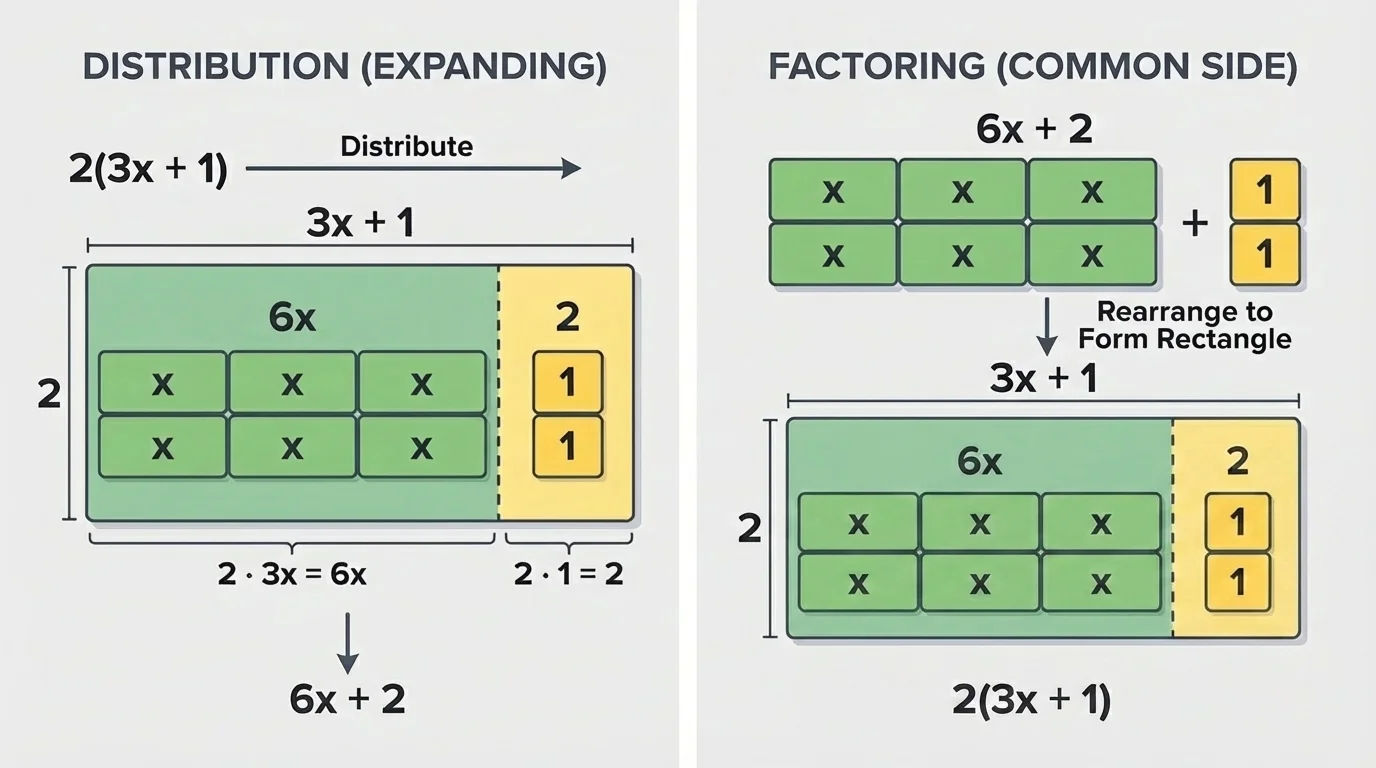
The distributive property is the key tool for expanding and factoring. For instance, \(5(x + 4) = 5x + 20\). Reversing the process gives \(5x + 20 = 5(x + 4)\). Later, when you decide which form is more useful, you are really deciding whether to distribute or factor.
Notice that subtraction can be treated as adding a negative. For example, \(x - 3\) can be thought of as \(x + (-3)\). This helps properties stay consistent even when negative numbers are involved.
Like terms have the same variable part. Terms such as \(3x\), \(-2x\), and \(\dfrac{1}{4}x\) are like terms because they all have \(x\). Terms such as \(5\) and \(-1.2\) are also like terms because both are constants. Grouping these correctly, as [Figure 2] shows, makes simplification much easier.
You can add or subtract only like terms. For example:
\(4x + 3x = 7x\)
\(6 - 2 = 4\)
But \(4x + 6\) cannot be combined into one term because one term has \(x\) and the other does not.
To simplify an expression, first look for like terms. Then add or subtract their coefficients.
For example, simplify \(2x + 5 - 3x + 7\). Group the like terms: \(2x - 3x + 5 + 7\). Then combine: \(-x + 12\).
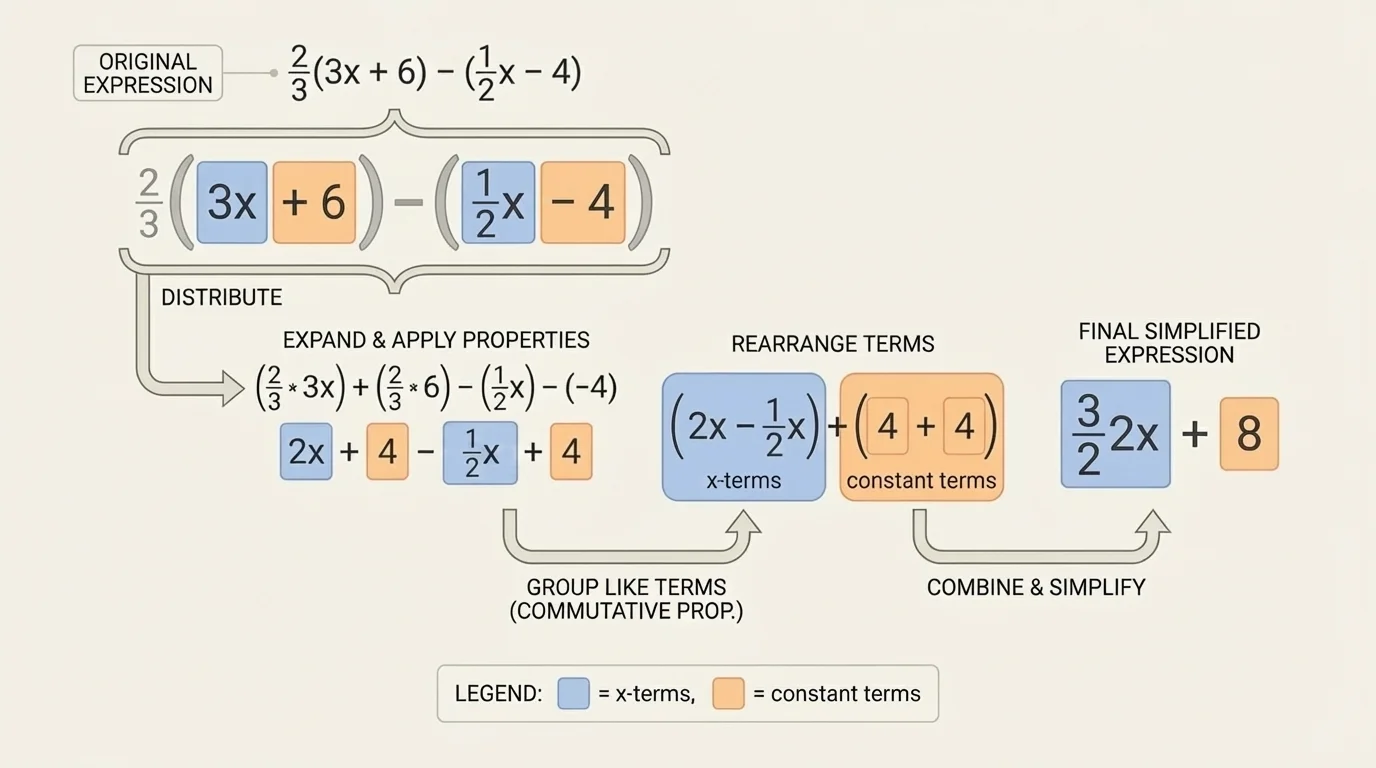
Fractions and decimals work the same way. In \(0.6y + 1.4y\), the coefficients add to \(2.0\), so the expression simplifies to \(2y\). In \(\dfrac{3}{5}x - \dfrac{1}{10}x\), write both fractions with denominator \(10\): \(\dfrac{6}{10}x - \dfrac{1}{10}x = \dfrac{5}{10}x = \dfrac{1}{2}x\).
Separating variable terms from constant terms helps prevent one of the most common mistakes: trying to combine unlike terms.
Why only like terms combine
Think of \(x\) as a label. You can combine \(3x\) and \(2x\) because they are amounts of the same thing, just as \(3\) apples and \(2\) apples make \(5\) apples. But \(3x\) and \(2\) are not the same kind of quantity, so they do not merge into one term.
This is why structure matters in algebra. The variable part tells you what kind of quantity the term represents.
To expand an expression means to remove parentheses by multiplying a factor through each term inside. This is where the distributive property becomes a strategy, not just a rule to memorize.
Example: \(3(x + 5) = 3x + 15\). The \(3\) multiplies \(x\), and it also multiplies \(5\).
Example with subtraction: \(-2(y - 4) = -2y + 8\). Multiply \(-2\) by \(y\) to get \(-2y\), and multiply \(-2\) by \(-4\) to get \(8\).
Example with fractions: \(\dfrac{1}{2}(8x + 6) = 4x + 3\).
Example with decimals: \(1.5(2x - 4) = 3x - 6\).
A very common mistake is distributing to only the first term. In \(4(a + 7)\), the correct result is \(4a + 28\), not just \(4a + 7\). Every term inside the parentheses must be multiplied by the outside factor.
To factor an expression means to write it as a product. Factoring is the reverse of distributing. If expansion breaks apart a product, factoring puts it back together.
For example, in \(6x + 12\), both terms have a common factor of \(6\). So you can factor it as \(6(x + 2)\).
In \(-3x + 9\), both terms have a common factor of \(3\). One possible factorization is \(3(-x + 3)\). Another useful one is \(-3(x - 3)\). Both are equivalent, but many students prefer factoring out the negative so that the coefficient of the variable inside the parentheses is positive.
Factoring can also use rational numbers. For example, \(\dfrac{1}{2}x + \dfrac{3}{2}\) can be factored as \(\dfrac{1}{2}(x + 3)\).
Factoring helps you notice structure. The expression \(8x + 20\) becomes \(4(2x + 5)\), which clearly shows that each term is built from a group of \(4\).
The best way to understand these properties is to see them used step by step.
Worked example 1
Simplify \(\dfrac{3}{4}x + \dfrac{1}{2}x - 5 + 2\).
Step 1: Identify like terms.
The \(x\)-terms are \(\dfrac{3}{4}x\) and \(\dfrac{1}{2}x\). The constants are \(-5\) and \(2\).
Step 2: Add the coefficients of the like terms.
Rewrite \(\dfrac{1}{2}\) as \(\dfrac{2}{4}\). Then \(\dfrac{3}{4}x + \dfrac{2}{4}x = \dfrac{5}{4}x\).
Step 3: Combine the constants.
\(-5 + 2 = -3\).
The simplified expression is \(\dfrac{5}{4}x - 3\).
This example shows that combining like terms is really coefficient arithmetic plus careful grouping.
Worked example 2
Expand \(-\dfrac{2}{3}(9x - 6)\).
Step 1: Distribute the factor to each term.
Multiply \(-\dfrac{2}{3}\) by \(9x\), and multiply \(-\dfrac{2}{3}\) by \(-6\).
Step 2: Compute each product.
\(-\dfrac{2}{3} \cdot 9x = -6x\)
\(-\dfrac{2}{3} \cdot (-6) = 4\)
Step 3: Write the expanded expression.
Combine the results: \(-6x + 4\).
The final answer is \(-6x + 4\).
Notice how the negative signs matter. A negative times a negative becomes positive, which is why the constant term became \(4\).
Worked example 3
Factor \(1.2x + 3.6\).
Step 1: Find the greatest common factor of the terms.
Both \(1.2\) and \(3.6\) are divisible by \(1.2\).
Step 2: Factor out \(1.2\).
\(1.2x + 3.6 = 1.2(x + 3)\)
Step 3: Check by distributing.
\(1.2(x + 3) = 1.2x + 3.6\), so the factorization is correct.
The factored form is \(1.2(x + 3)\).
Checking by distributing is one of the smartest habits in algebra. It quickly shows whether a factorization is correct.
Worked example 4
Simplify \(4(0.5x - 3) + 2x\).
Step 1: Expand the expression in parentheses.
\(4 \cdot 0.5x = 2x\) and \(4 \cdot (-3) = -12\), so \(4(0.5x - 3) = 2x - 12\).
Step 2: Rewrite the full expression.
Now the expression is \(2x - 12 + 2x\).
Step 3: Combine like terms.
\(2x + 2x = 4x\), so the result is \(4x - 12\).
The simplified expression is \(4x - 12\).
This example combines two skills: distribute first, then combine like terms.
One mistake is combining unlike terms. For example, \(2x + 3\) does not become \(5x\). The \(x\)-term and the constant are different kinds of quantities.
Another mistake is forgetting to distribute to every term. For example, \(-3(x + 4)\) becomes \(-3x - 12\), not \(-3x + 4\).
A third mistake is losing the negative sign during subtraction. In \(5x - 2x + 1\), think of the middle term as \(-2x\). Then \(5x + (-2x) = 3x\).
Students also sometimes factor only part of an expression. For example, \(6x + 9\) factored by \(3\) must become \(3(2x + 3)\), not \(3(2x) + 9\). True factoring rewrites the entire expression as one product.
Computer algebra systems, the software used in calculators and engineering programs, constantly rewrite expressions into equivalent forms. Algebraic structure is not just a school topic; it is part of how technology processes formulas efficiently.
That is one reason mathematicians care so much about equivalent expressions. Different forms can reveal different information.
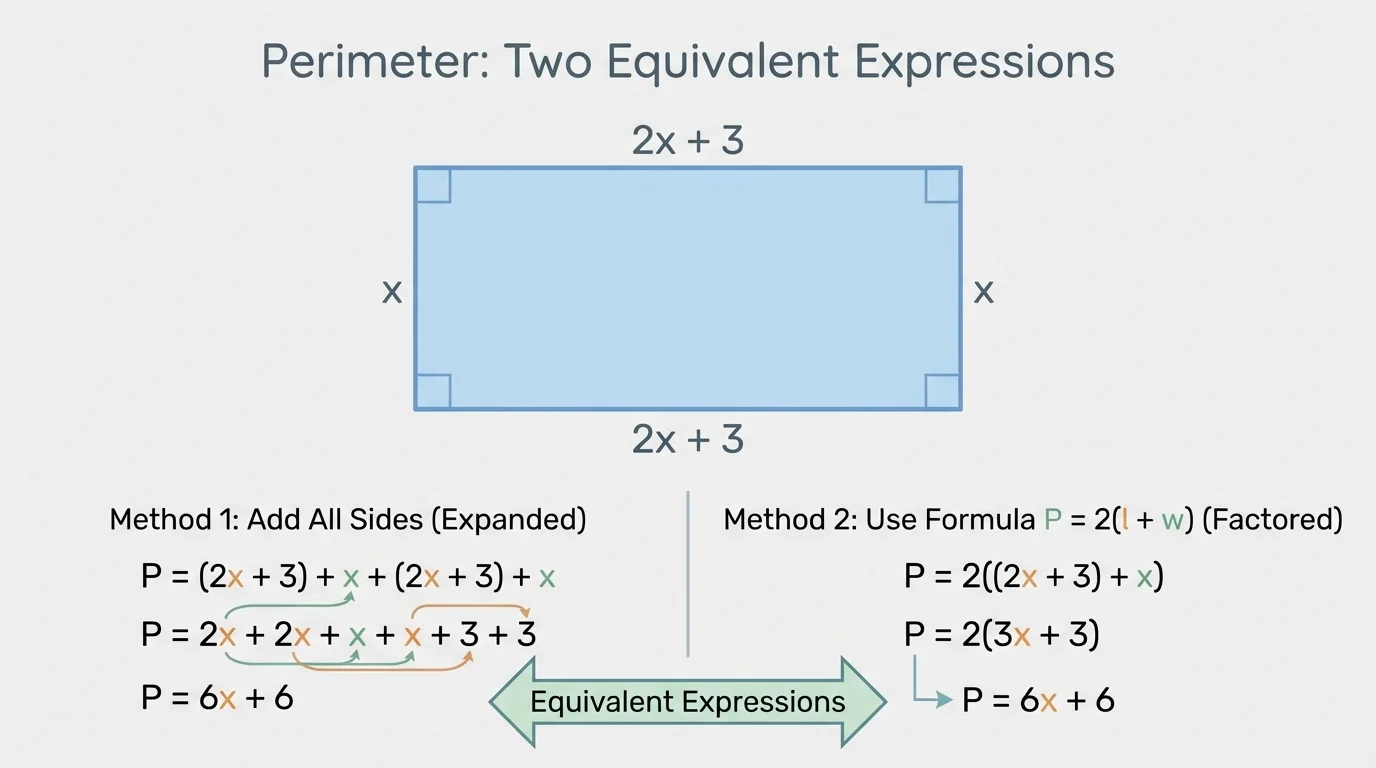
Architects, designers, and engineers often choose the most useful form of an expression, as [Figure 3] shows with perimeter. Sometimes an expanded form helps with total amounts, while a factored form makes repeated parts easier to see.
Suppose a rectangle has side lengths \(x + 3\) and \(x + 5\). The perimeter is \(2(x + 3) + 2(x + 5)\). Expanding gives \(2x + 6 + 2x + 10 = 4x + 16\). Both forms are equivalent. The first shows the repeated side lengths. The second shows the total perimeter more directly.
Budgeting can work the same way. If a streaming service costs $8 per month and a music app costs $5 per month, then the cost for \(m\) months is \(8m + 5m = 13m\). Combining like terms gives the total monthly cost pattern.
In science, repeated measurements can also be simplified. If a machine adds \(0.25x\) liters from one tube and \(0.75x\) liters from another, then the total is \(x\) liters. Simplifying expressions helps reveal the actual relationship between quantities.
Later, when you compare forms, you will notice that factored expressions often highlight repeated groups, while expanded expressions often highlight totals.
Strong algebra students do more than follow rules. They look for structure. They ask questions like these:
For example, \(3x + 12\) can be seen as a sum with like structure, but it can also be seen as \(3(x + 4)\). Both are correct. The choice depends on what you want to do next.
This flexibility is one of the most important ideas in algebra. You are not changing the quantity; you are changing the way it is written so that the next step becomes easier.
"Algebra is the art of saying the same thing in different ways."
That idea captures this whole topic: equivalent expressions are different-looking ways of representing the same relationship.
