People say surprising things all the time: "My backpack weighs a ton," "The baby is an angel," or "The lake was smooth as glass." No one really means a backpack weighs exactly a ton, a baby has wings, or a lake is made of glass. These expressions are powerful because they help us picture what someone means. Writers use this kind of language to make ideas more colorful, clearer, and more memorable.
When authors want readers to understand a feeling, a scene, or a person quickly, they often compare one thing to another. As [Figure 1] shows, these comparisons are a kind of figurative language. Figurative language does not always mean exactly what the words say. Instead, it gives readers a deeper picture or feeling.
For example, if a story says, "The boy was as nervous as a mouse in a room full of cats," you immediately understand that he feels very scared. The writer could have said "The boy was scared," but the comparison gives a stronger image. It helps the reader feel the fear instead of only being told about it.
Figurative language uses words in a non-literal way to create pictures, feelings, or deeper meaning. Two common kinds are similes and metaphors.
Learning to understand figurative language is important in stories, poems, songs, and even everyday conversation. As [Figure 3] shows, when you know how to figure out these comparisons, reading becomes richer and more enjoyable.
A simile is a comparison between two different things using the words like or as. Similes often have a pattern that helps readers notice them right away. In a simile, the writer is not saying the two things are exactly the same. The writer is saying they are alike in one important way.
Here are some simple similes: "as soft as a pillow," "as busy as a bee," "ran like the wind," and "as pretty as a picture." In each one, the comparison helps the reader understand a quality. A pillow feels soft, bees stay busy, wind moves quickly, and a beautiful picture is nice to look at.
When you read a simile, ask yourself, "What quality is being compared?" In "as cold as ice," the quality is coldness. In "as shiny as a mirror," the quality is shininess. This simple question helps you unlock the meaning.
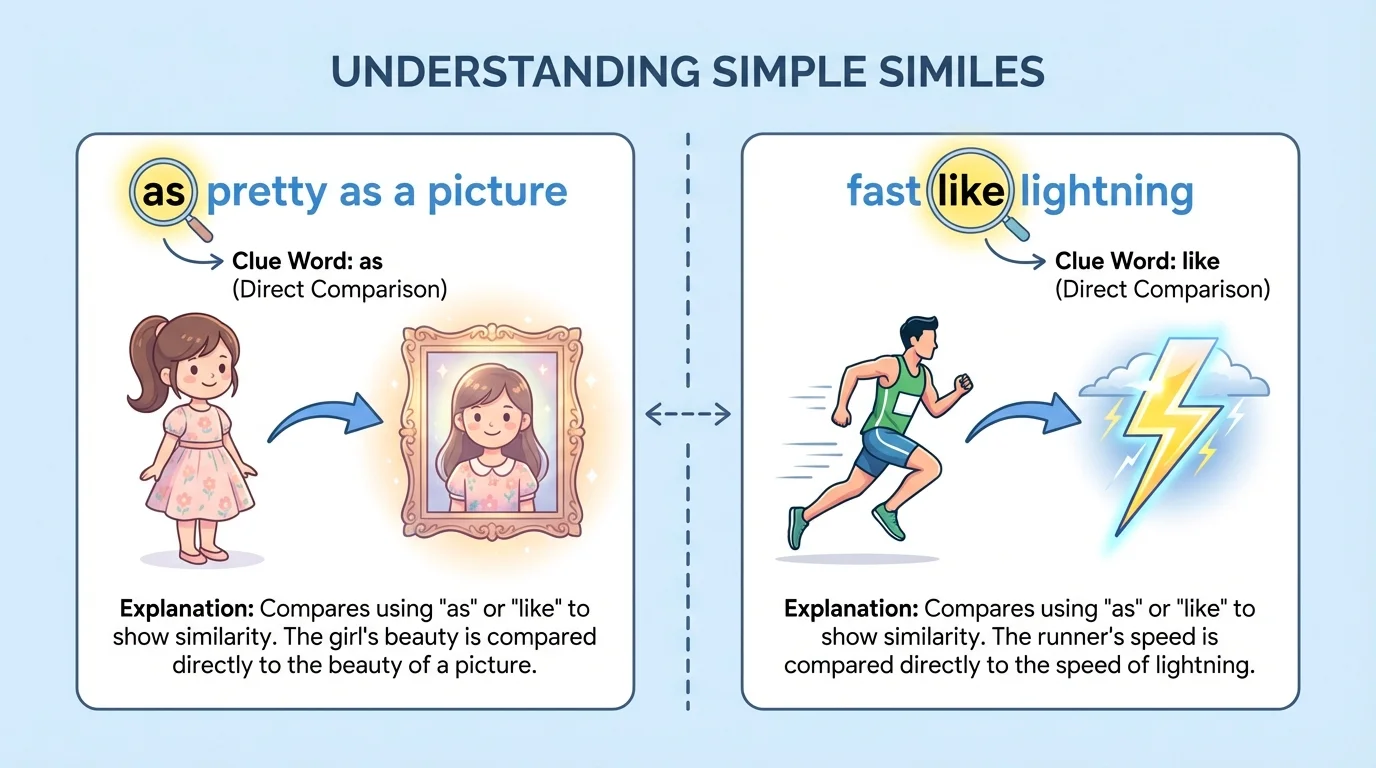
Some similes are very common. You may hear people say, "He slept like a log," which means he slept very deeply. A log cannot really sleep, of course, but the comparison gives the idea of stillness and heavy rest.
Not every sentence with like or as is a simile. If someone says, "This cookie tastes like cinnamon," that might simply be a direct comparison. But if a writer says, "The stars glittered like diamonds," that comparison creates an image and is figurative. Readers must think about whether the sentence is meant literally or figuratively.
As [Figure 2] shows, a metaphor is a comparison that says one thing is another thing, even though they are not actually the same. Unlike a simile, a metaphor does not usually use the words like or as. A metaphor makes a stronger, more direct comparison.
For example, "The classroom was a zoo" is a metaphor. The classroom is not truly a zoo with cages and wild animals. The writer means the classroom was noisy, wild, and hard to control. Another metaphor is "My brother is a rock." This means he is strong, steady, and dependable.
Metaphors often ask readers to think more carefully. In "Her smile was sunshine," the smile is not real sunshine. The comparison suggests warmth, happiness, and brightness. A metaphor can pack many feelings into just a few words.
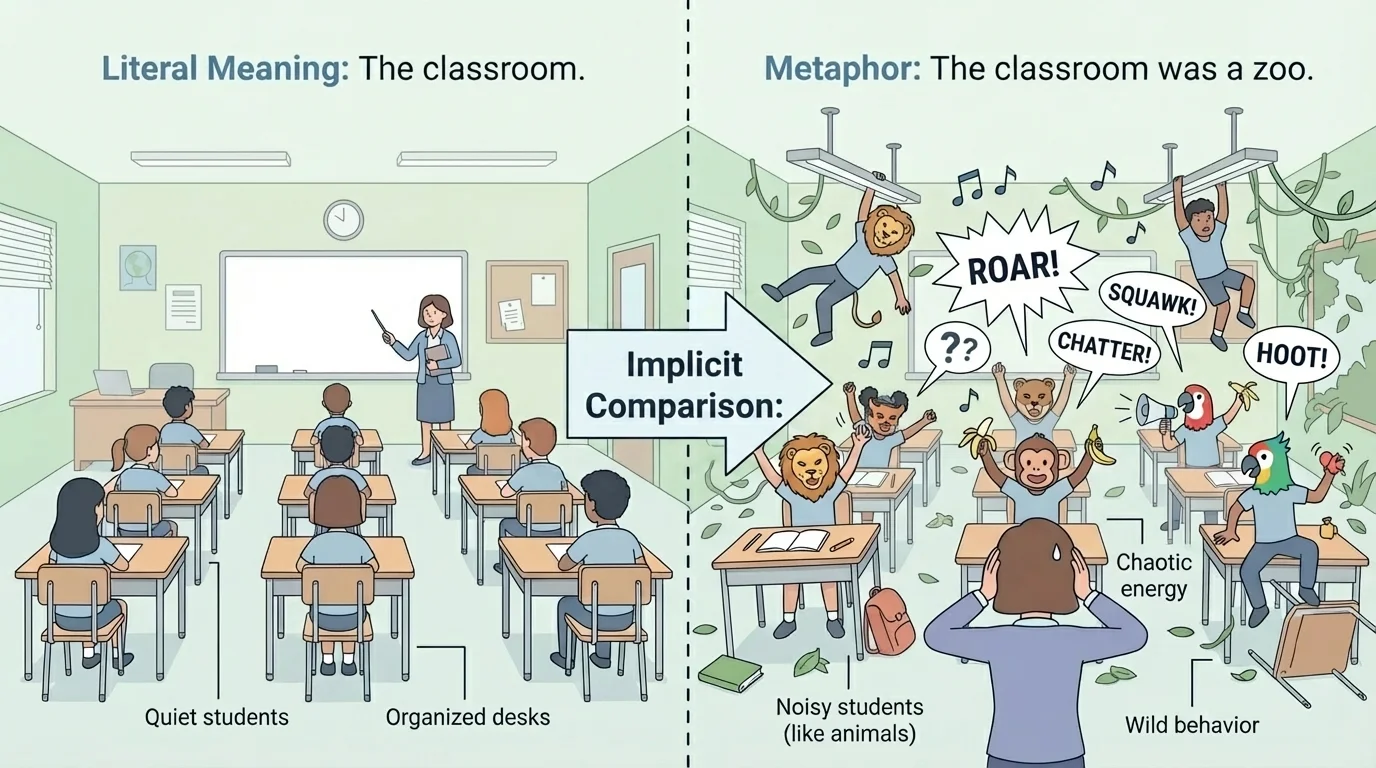
Because metaphors are more direct, they can sound powerful. If a writer says, "The test was a mountain," the reader understands that the test felt huge and difficult to get through. The writer is showing a feeling, not stating a fact.
Similes and metaphors are alike because both compare two unlike things. They are different in how they do it. A simile usually uses like or as. A metaphor usually says one thing is another.
Look at these pairs:
| Expression | Type | Meaning |
|---|---|---|
| as light as a feather | Simile | very light |
| The snow was a white blanket. | Metaphor | the snow covered everything smoothly |
| He was like a rocket on the track. | Simile | he ran very fast |
| Her voice was music. | Metaphor | her voice sounded beautiful |
Table 1. A comparison of simple similes and metaphors with their meanings.
A good reader notices the form first and the meaning second. If you see like or as, think, "This may be a simile." If the sentence directly says one thing is another, think, "This may be a metaphor." Then ask what quality is being compared.
You already know that some words have more than one meaning. The word bright can mean "shining with light," but it can also describe someone who is smart. Figurative language often depends on this kind of flexible thinking.
Still, the most important step is not just naming the kind of comparison. The most important step is understanding what the writer means in that context.
Sometimes a simile or metaphor is easy to understand right away. Other times, you need to look at the words and sentences around it. This is called using context clues. Context clues can come from actions, feelings, setting, and details nearby.
Read this example: "Maya walked onto the stage. Her hands shook, and her stomach twisted. She felt like a leaf in the wind." The simile "like a leaf in the wind" means she felt shaky and unsteady. The surrounding details about her shaking hands and twisting stomach help you understand the comparison.
Now read this one: "After the winning goal, Jamal was a firework. He jumped, shouted, and lit up the field with his smile." The metaphor "was a firework" means he seemed full of energy, excitement, and brightness. The context gives the clues.
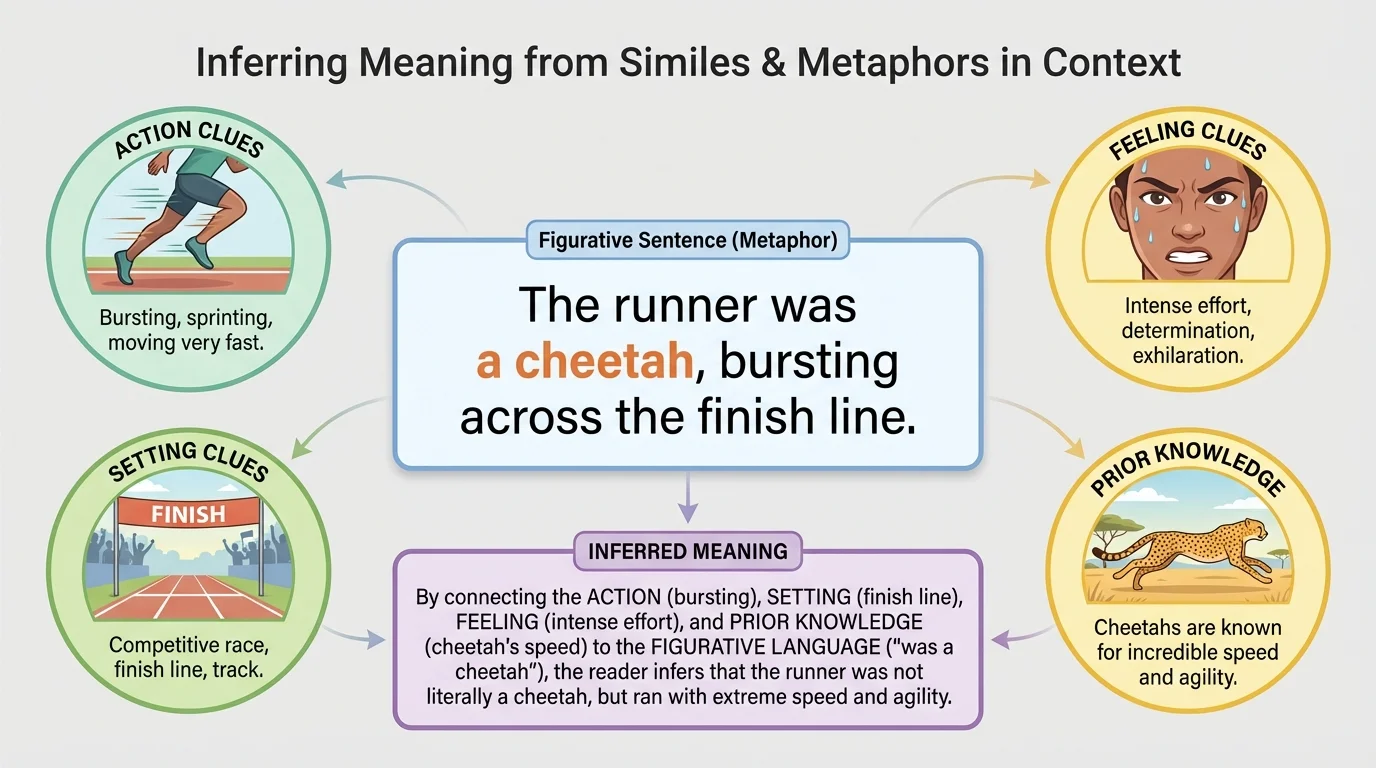
Without context, some figurative language can be confusing. For example, "She is a turtle" might mean she moves slowly. But in another passage, it might mean she is shy and pulls back from others, like a turtle pulling into its shell. The nearby details help the reader choose the best meaning.
How context works
When you find a simile or metaphor, do not stop at the comparison itself. Read the sentence before it and the sentence after it. Look for clues about emotion, action, or setting. These clues help you explain the figurative meaning accurately.
This is why the same comparison can mean slightly different things in different places. Good readers do not guess from one phrase alone. They read around it.
Many similes and metaphors become familiar because people use them often. Even common expressions should be understood by thinking about the picture they create.
As pretty as a picture means very beautiful or pleasing to look at. A picture in this expression usually means a lovely painting or photograph. If a sentence says, "The garden looked as pretty as a picture in the morning light," the simile means the garden looked especially beautiful.
As busy as a bee means very active and hardworking. Bees move from flower to flower and always seem to be working. In the sentence "Dad was as busy as a bee before the party," the simile means Dad was moving quickly and doing many tasks.
As quiet as a mouse means very silent. Mice are small and often move quietly. If a character is "as quiet as a mouse," the reader understands that the character is making almost no sound.
The moon was a silver coin is a metaphor. The moon is not really a coin, but the writer may be comparing its round shape and shiny color to a coin.
The baby was an angel usually means the baby was sweet, calm, or well-behaved. But if the context says the baby smiled peacefully and hardly cried, that meaning becomes clearer. This is another place where context matters, just as we saw earlier in [Figure 3].
Some figurative expressions have been used for so long that people say them without even noticing. Phrases such as "cold as ice" or "busy as a bee" have become part of everyday speech.
Writers can also create their own new comparisons. A poet might write, "The clouds were sleepy sheep drifting across the sky." That metaphor is not a common saying, but readers can still understand it by thinking about how sheep move slowly and softly in a group.
Literal meaning is the exact, ordinary meaning of words. Figurative meaning is the imaginative or non-literal meaning. Strong readers know how to tell which one the author intends.
If someone says, "The ice is cold," that is literal. Ice really is cold. If someone says, "Her stare was ice," that is figurative. The sentence means her stare felt cold, unfriendly, or harsh.
This difference matters because misunderstanding figurative language can change the whole meaning of a passage. If you read "The city never sleeps" literally, it makes no sense. Cities are places, so they cannot sleep. Figuratively, it means the city is always active, day and night.
When you are unsure, ask: "Can this be true exactly as stated?" If the answer is no, the author is probably speaking figuratively.
Sometimes two similes or metaphors seem close in meaning, but they create different feelings. This is called nuance, which means a small difference in meaning or feeling.
Compare these similes: "as light as a feather" and "as light as air." Both suggest something not heavy. But "as light as a feather" may make you picture something soft and delicate, while "as light as air" may make you think of something almost floating away. The meanings are similar, but not exactly the same.
Now compare these metaphors: "The boy was a puppy" and "The boy was a tornado." Both may suggest energy, but the feelings are different. A puppy sounds playful and friendly. A tornado sounds wild and destructive. Writers choose carefully because each comparison creates a different image.
This is one reason figurative language is so powerful. It does more than tell what something is like. It also shapes the mood and tone of the writing.
Reading figurative language closely
Sentence: "On the first day at her new school, Lena felt like a tiny boat in a giant ocean."
Step 1: Notice the clue word.
The word like tells us this is a simile.
Step 2: Find the shared quality.
A tiny boat in a giant ocean would feel small, alone, and maybe unsafe.
Step 3: Use the context.
Because it is Lena's first day at a new school, the simile suggests that she feels small and overwhelmed.
The simile helps the reader understand Lena's emotions in a vivid way.
When readers pay attention to nuance, they become better at explaining why one comparison fits better than another.
Even when you have never heard an expression before, you can still figure it out. Start by spotting the comparison. Look for like and as for similes, or a direct "is" comparison for metaphors.
Next, think about the object being used in the comparison. What do you know about it? If a story says, "Grandpa's hands were sandpaper," you know sandpaper feels rough. That helps you understand the metaphor.
Then read the surrounding details. If the sentence before it says Grandpa worked in the garden every day, the metaphor probably means his hands were rough from hard work. The same metaphor might carry warmth and respect, not just roughness.
Finally, put the idea into your own words. If you can explain the comparison in plain language, you understand it. "Grandpa's hands were sandpaper" can become "Grandpa's hands were very rough."
These steps work in many reading situations, from short poems to chapter books. They also help you understand fresh, original comparisons, not only familiar sayings.
Authors use similes and metaphors to paint word pictures. In poems, they can make a line sound beautiful or emotional. In stories, they can reveal how a character feels. In everyday conversation, they can help people express big ideas quickly.
A sports writer might say, "The goalie was a wall." Readers know that means the goalie blocked nearly every shot. A friend might say, "I'm as hungry as a wolf," which means very hungry. A song might describe love as a journey, using a metaphor to express change, challenge, and movement.
Earlier, [Figure 1] showed how similes often give readers a quick clue with the words like or as. Metaphors, like the classroom example in [Figure 2], can feel stronger because they make the comparison directly. Both forms help language come alive.
The more you read, the more you will notice that figurative language is everywhere. It appears in novels, comics, speeches, advertisements, and song lyrics. Understanding it helps you become a more thoughtful reader who can go beyond the surface meaning of words.
"Words can paint pictures, even without a paintbrush."
When you understand simple similes and metaphors in context, you do more than identify a language feature. You unlock what the writer is really trying to show, feel, or suggest.
