A concert speaker, a medical ultrasound scanner, and a seismometer all depend on the same fundamental principle: waves carry energy and information, but the way they move depends on measurable properties. One of the most powerful relationships in wave science is remarkably concise: \(v = f\lambda\). With that single equation, scientists and engineers can explain why the same note sounds different in air and steel, why ultrasound can form images inside the body, and why seismic waves reveal Earth's interior.
A wave is a disturbance that transfers energy from one place to another. Some waves require matter to travel through, such as sound waves moving through air or water. Other waves, such as light, can travel through empty space. In this lesson, the focus is on how measurable wave properties relate mathematically, especially when waves travel through different media.
Waves matter because they are part of everyday life. Music reaches your ears as sound waves. Your phone receives information through electromagnetic waves. Doctors use sound waves in ultrasound imaging. Geologists study earthquake waves to learn about rock layers deep below Earth's surface. In each case, claims about how the wave behaves can be supported with measurements and with the relationship among speed, frequency, and wavelength.
You already know that a relationship in science often means that when one quantity changes, another quantity changes in a predictable way. Algebra helps express that pattern clearly, and graphs, tables, and equations help support scientific claims with evidence.
To make good scientific claims about waves, you need to know what each wave quantity means and how to connect them without going beyond the evidence. Here, the emphasis is on algebraic relationships and qualitative descriptions: what increases, what decreases, and what stays the same.
As shown in [Figure 1], a medium is the material through which a wave travels. Air, water, a rope, and steel are all examples of media. The wave's behavior depends partly on the properties of that medium. Sound generally travels faster in solids than in liquids, and faster in liquids than in gases. The spacing of the wave pattern helps reveal this relationship.
Frequency is the number of wave cycles that pass a point each second. It is measured in hertz, where \(1 \textrm{ Hz} = 1\textrm{ cycle/s}\). A wave with frequency \(440 \textrm{ Hz}\) completes \(440\) cycles every second. For sound, frequency is closely related to pitch: higher frequency means higher pitch.
Wavelength is the distance between matching points on consecutive waves, such as crest to crest or compression to compression. If one crest is \(2 \textrm{ m}\) from the next crest, then the wavelength is \(2 \textrm{ m}\). This is a spatial measurement, not a time measurement.
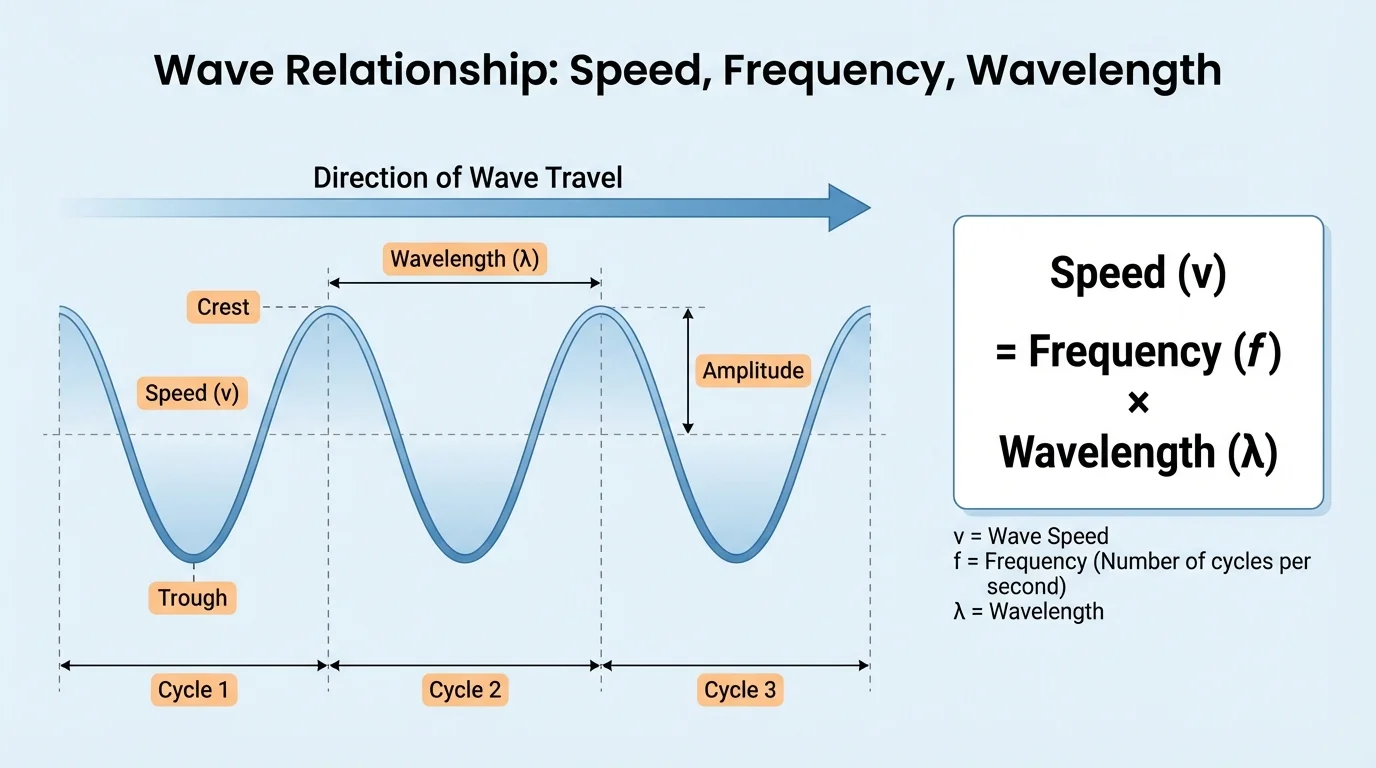
Wave speed is how fast the disturbance travels through the medium. If a pulse moves \(12 \textrm{ m}\) in \(3 \textrm{ s}\), its speed is \(\dfrac{12}{3} = 4 \textrm{ m/s}\). Wave speed depends on the medium and the type of wave.
Frequency tells how many cycles occur each second. Wavelength tells how far apart repeating parts of the wave are. Wave speed tells how quickly the wave travels. Medium is the material through which the wave moves.
These quantities are connected. A wave is not free to have any combination of frequency, wavelength, and speed. Once two of the quantities are known, the third is determined by their mathematical relationship.
The central wave equation is
\[v = f\lambda\]
In this equation, \(v\) is wave speed, \(f\) is frequency, and \(\lambda\) is wavelength. The symbol \(\lambda\) is the Greek letter lambda, commonly used for wavelength.
This equation says that wave speed equals frequency multiplied by wavelength. That means if a wave has a high frequency and each cycle is also widely spaced, the wave must be moving quickly. If the wave speed is fixed by the medium, then frequency and wavelength must adjust so that their product stays equal to that speed.
Suppose a sound wave in air has frequency \(200 \textrm{ Hz}\) and wavelength \(1.7 \textrm{ m}\). Its speed is \(v = 200 \times 1.7 = 340 \textrm{ m/s}\). Written as a full calculation,
\[v = f\lambda = (200 \textrm{ Hz})(1.7 \textrm{ m}) = 340 \textrm{ m/s}\]
Now suppose the speed in the medium stays \(340 \textrm{ m/s}\), but the frequency doubles from \(200 \textrm{ Hz}\) to \(400 \textrm{ Hz}\). The wavelength must become half as large so that the product stays \(340\). The new wavelength is \(\lambda = \dfrac{340}{400} = 0.85 \textrm{ m}\).
Direct and inverse relationships in waves
When wavelength stays constant, increasing frequency increases speed. When speed stays constant, increasing frequency decreases wavelength. This means the relationship depends on which quantity is fixed. Scientific claims about waves must always state the conditions clearly.
This is why mathematical representations are useful. An equation does more than calculate a number: it supports a claim. For example, the claim "in the same medium, higher-frequency waves have shorter wavelengths" is supported by \(v = f\lambda\) when \(v\) is constant.
When a wave moves from one medium into another, one of the most important ideas is that the source still controls the frequency. The crest spacing can change across the boundary, but the frequency remains tied to the vibrating source that produced the wave.
Suppose a speaker produces a tone of \(500 \textrm{ Hz}\). If that sound enters a medium where it travels faster, the frequency stays \(500 \textrm{ Hz}\), but the wavelength increases. If it enters a medium where it travels slower, the frequency still stays \(500 \textrm{ Hz}\), but the wavelength decreases.
As [Figure 2] illustrates, this can be shown algebraically. Since \(v = f\lambda\), if \(f\) stays the same and \(v\) decreases, then \(\lambda\) must also decrease. If \(f\) stays the same and \(v\) increases, then \(\lambda\) increases. That is a mathematical argument supporting a scientific claim.
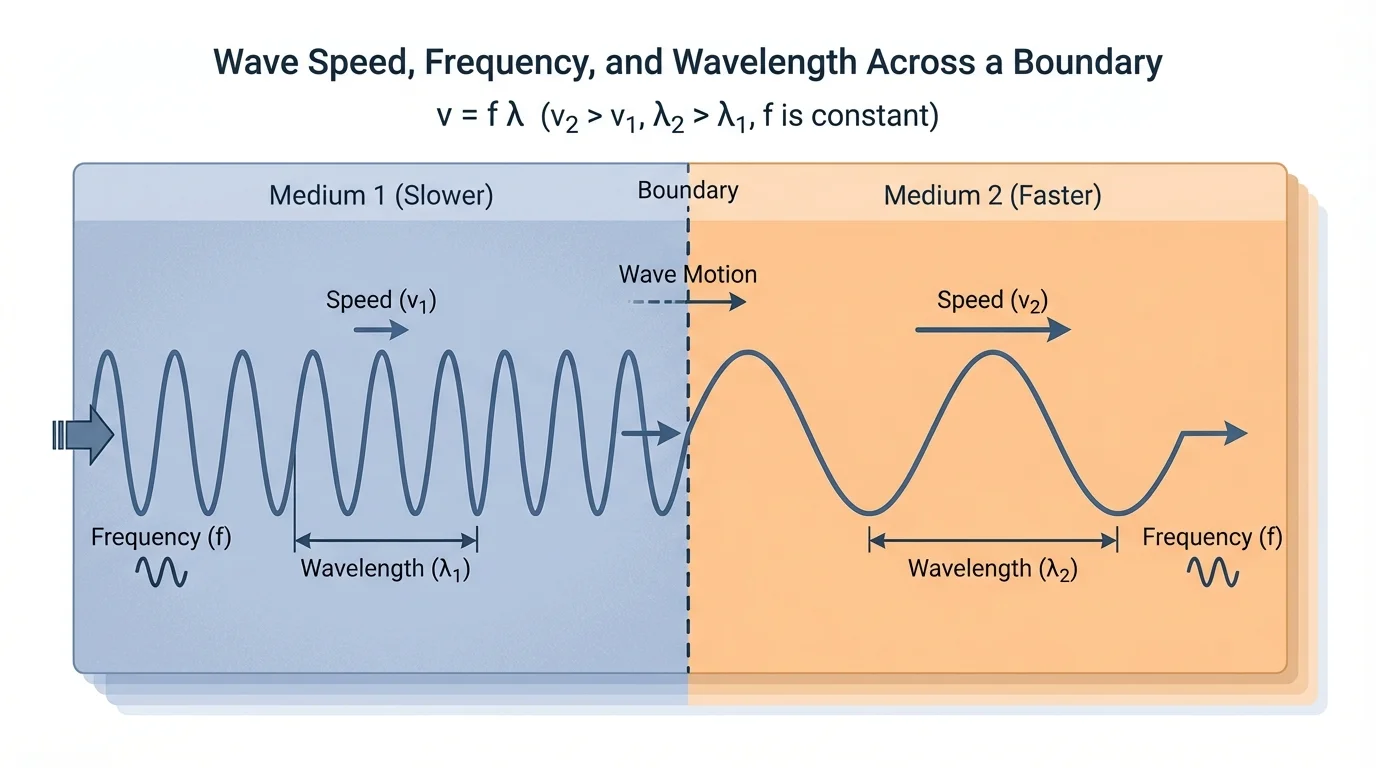
For example, imagine a wave with frequency \(10 \textrm{ Hz}\). In medium A, the speed is \(20 \textrm{ m/s}\), so the wavelength is \(\lambda = \dfrac{20}{10} = 2 \textrm{ m}\). In medium B, the speed is \(10 \textrm{ m/s}\), so the wavelength is \(\lambda = \dfrac{10}{10} = 1 \textrm{ m}\). The lower speed in medium B leads to a shorter wavelength, not a lower frequency.
This point is often misunderstood. Students sometimes think a slower wave must have a lower frequency. That is not necessarily true. If the same source creates the wave before and after the boundary, the frequency stays the same, while the wavelength changes to match the new speed.
Seismic waves from earthquakes change speed as they move through different layers of Earth. By measuring those speed changes, scientists infer where rocks are solid, partially molten, or arranged differently deep underground.
Later, when comparing real media, keep returning to this idea: a change in medium can change speed and wavelength together while leaving frequency unchanged.
The same sound frequency can have very different wavelengths in different materials. This does not happen because the sound source changes its pitch; it happens because the medium changes the wave speed.
Consider a sound wave of frequency \(1{,}000 \textrm{ Hz}\). A typical speed of sound is about \(343 \textrm{ m/s}\) in air, about \(1{,}480 \textrm{ m/s}\) in water, and about \(5{,}960 \textrm{ m/s}\) in steel. Using \(\lambda = \dfrac{v}{f}\), the wavelength is much longer in the faster medium.
| Medium | Wave speed | Frequency | Wavelength |
|---|---|---|---|
| Air | \(343 \textrm{ m/s}\) | \(1{,}000 \textrm{ Hz}\) | \(\dfrac{343}{1{,}000} = 0.343 \textrm{ m}\) |
| Water | \(1{,}480 \textrm{ m/s}\) | \(1{,}000 \textrm{ Hz}\) | \(\dfrac{1{,}480}{1{,}000} = 1.48 \textrm{ m}\) |
| Steel | \(5{,}960 \textrm{ m/s}\) | \(1{,}000 \textrm{ Hz}\) | \(\dfrac{5{,}960}{1{,}000} = 5.96 \textrm{ m}\) |
Table 1. Sound wave speeds and wavelengths for the same frequency in three different media.
As [Figure 3] helps visualize, the table shows a clear pattern. For the same frequency, the faster the wave speed in the medium, the longer the wavelength. This is exactly what the equation predicts. The mathematical representation supports the claim that wave speed depends on the medium and that wavelength adjusts accordingly.
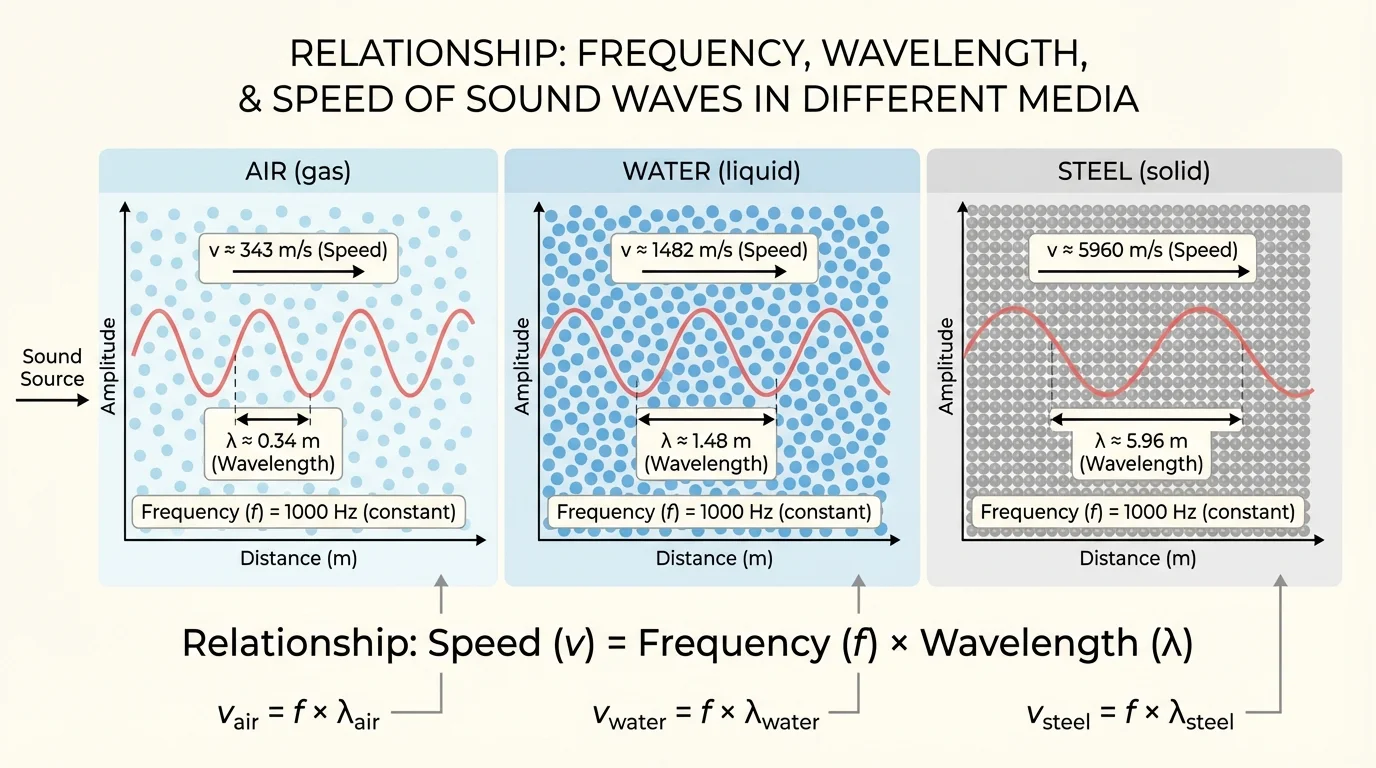
You can also reason in the opposite direction. If two waves have the same wavelength but travel through different media, the one in the faster medium must have the higher frequency. Again, the equation does not just compute answers; it reveals patterns.
Mathematical representations become especially powerful when used to defend a claim with evidence. The examples below stay within simple algebra and qualitative interpretation.
Example 1: Finding wave speed
A wave has frequency \(25 \textrm{ Hz}\) and wavelength \(4 \textrm{ m}\). Find the wave speed and state what the result means.
Step 1: Use the wave equation
Use \(v = f\lambda\).
Step 2: Substitute the values
Substitute \(f = 25 \textrm{ Hz}\) and \(\lambda = 4 \textrm{ m}\): \(v = 25 \times 4\).
Step 3: Calculate
\(v = 100 \textrm{ m/s}\).
The wave speed is \(100 \textrm{ m/s}\). This means the disturbance moves \(100 \textrm{ m}\) through the medium each second.
This example shows a direct use of the equation. The claim "this wave travels at \(100 \textrm{ m/s}\)" is supported by measured values of frequency and wavelength.
Example 2: What happens when frequency increases in the same medium?
A wave travels in a medium at \(60 \textrm{ m/s}\). Its frequency changes from \(10 \textrm{ Hz}\) to \(20 \textrm{ Hz}\). Compare the wavelengths.
Step 1: Find the first wavelength
\(\lambda_1 = \dfrac{v}{f} = \dfrac{60}{10} = 6 \textrm{ m}\).
Step 2: Find the second wavelength
\(\lambda_2 = \dfrac{60}{20} = 3 \textrm{ m}\).
Step 3: Compare the results
When frequency doubles, wavelength is cut in half because the speed stays constant.
This supports the claim that in the same medium, a higher-frequency wave has a shorter wavelength.
The important scientific reasoning here is not just the arithmetic. It is the pattern: with constant speed, frequency and wavelength change in opposite directions.
Example 3: Entering a new medium
A \(500 \textrm{ Hz}\) sound wave travels from air into water. Suppose its speed changes from \(340 \textrm{ m/s}\) in air to \(1{,}500 \textrm{ m/s}\) in water. Find the wavelength in each medium.
Step 1: Wavelength in air
\(\lambda_{air} = \dfrac{340}{500} = 0.68 \textrm{ m}\).
Step 2: Wavelength in water
\(\lambda_{water} = \dfrac{1{,}500}{500} = 3.0 \textrm{ m}\).
Step 3: Interpret
The frequency stays \(500 \textrm{ Hz}\), but the wavelength becomes longer in water because the wave speed is greater there.
This supports the claim that when a wave enters a faster medium, its wavelength increases if the frequency remains fixed by the source.
Notice how each example combines numbers with a qualitative statement. That combination is what makes a scientific claim convincing.
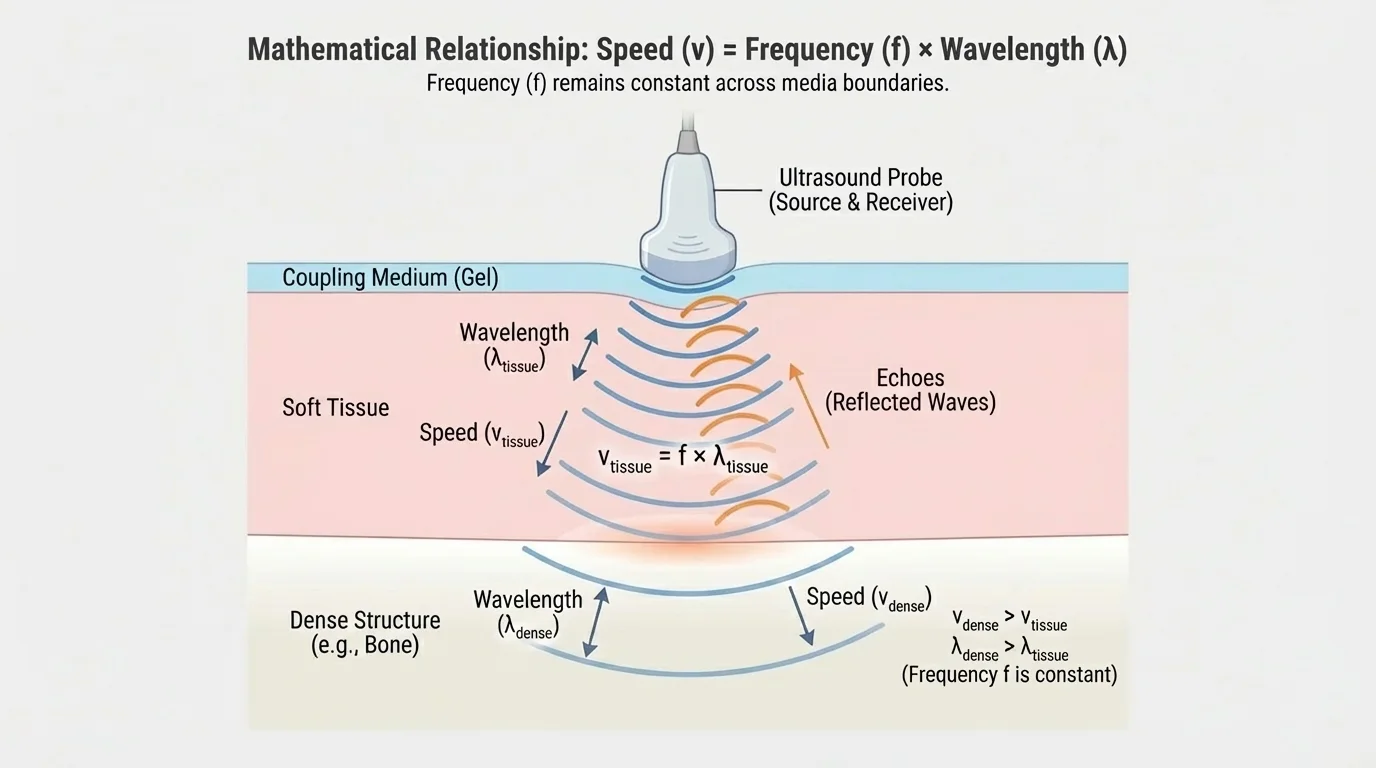
As [Figure 4] shows, medical ultrasound uses sound waves with very high frequencies to produce images of structures inside the body by sending waves into tissue and receiving echoes back. Because frequency is high, wavelength can be very short, which helps create detailed images. The exact wave speed depends on the specific tissue, and technicians use that information to interpret the returning signals.
Musical instruments also reveal the relationship among wave quantities. A flute and a guitar can both produce notes with the same frequency, but wave behavior inside the instruments depends on how vibrations move through air, strings, or wood. Engineers designing concert halls must understand how sound waves travel, reflect, and maintain frequencies while wavelengths depend on the medium and conditions.
Sonar systems send sound through water to locate objects. Since sound travels faster in water than in air, a wave of the same frequency has a longer wavelength in water. This affects how the system is designed and how the reflected signals are interpreted.
Seismologists study earthquake waves moving through rock. As with the boundary example in [Figure 2], changes in speed across layers of Earth lead to changes in wavelength while the source-determined frequency remains connected to the original disturbance. Those patterns help scientists identify underground structures.
"The book of nature is written in the language of mathematics."
— Galileo Galilei
This idea fits wave science well. Equations, tables, and comparisons turn observations into evidence-backed claims about how waves move and what they can tell us.
One common mistake is confusing frequency with speed. A higher-frequency wave is not automatically a faster wave. In one medium, speed may stay constant while frequency changes, causing wavelength to change instead.
Another mistake is confusing frequency with amplitude. For sound, amplitude is more closely related to loudness, while frequency is related to pitch. A louder sound is not necessarily a higher-frequency sound.
A third mistake is assuming that all wave properties change at a boundary. As the comparison in [Figure 3] reinforces for different media, the medium can change speed, and speed changes wavelength, but the frequency remains set by the source when the wave crosses from one medium to another.
How to support a wave claim mathematically
Start by identifying which quantity is fixed: speed, frequency, or wavelength. Then use \(v = f\lambda\) to determine how the other quantities must change. Finally, connect the calculation to a scientific statement such as "the wavelength decreases because the speed stayed constant while frequency increased."
That final step matters. Science is not only about obtaining numbers. It is about using those numbers to justify a conclusion about the natural world.
