Suppose one basketball team scores twice as many points as another team. Does that mean it scored 2 more points? Not at all. If one team scored \(12\) points, then twice as many is \(24\), not \(14\). That small change in wording makes a big difference in math. Learning to notice that difference helps you solve many real-life problems correctly.
Sometimes we compare numbers by finding how much more or less one amount is than another. This is called an additive comparison. For example, if Mia has \(9\) marbles and Leo has \(5\) marbles, then Mia has \(4\) more marbles than Leo because \(9 - 5 = 4\).
Other times we compare by asking how many times as large one amount is as another. This is called a multiplicative comparison. If Mia has \(15\) marbles and Leo has \(5\) marbles, then Mia has \(3\) times as many marbles as Leo because \(15 \div 5 = 3\).
These two kinds of comparison are not the same. "\(4\) more" means add \(4\). "\(4\) times as many" means multiply by \(4\). One uses difference. The other uses a factor.
Additive comparison tells how much more or less one amount is than another.
Multiplicative comparison tells how many times as many or as much one amount is compared to another.
When you read a word problem, the comparison words give you clues. Words like more than, less than, and fewer than often point to additive comparison. Words like times as many, times as much, twice, and three times usually point to multiplicative comparison.
In a multiplicative comparison, one amount is made of equal-size groups of another amount. If Ava has \(4\) times as many pencils as Ben, then Ava's number of pencils is made of \(4\) groups, and each group has the same number as Ben's amount.
We can write this idea with an equation. If Ben has \(b\) pencils, then Ava has
\(4b\)
pencils. If Ben has \(6\) pencils, then Ava has \(4 \times 6 = 24\) pencils.
The unknown number in a problem can be shown with a letter or another symbol. For example, if Ava has \(24\) pencils and that is \(4\) times Ben's amount, we can write
\(4b = 24\)
Then we solve by dividing: \(24 \div 4 = 6\), so \(b = 6\).
You already know that multiplication can show equal groups and division can help undo multiplication. Those same ideas help solve comparison problems.
Some common phrases mean the same kind of thing:
A drawing can make a word problem much easier to understand. A common drawing is a bar model, sometimes called a tape diagram. In a multiplicative comparison, the bars are split into equal parts. If one amount is \(3\) times as many as another, the larger bar has \(3\) equal parts, and each part matches the smaller bar.
[Figure 1] For example, if Sam has \(3\) times as many stickers as Eli, and Eli has \(4\) stickers, you can draw one short bar for Eli and three matching short bars for Sam. Since each part is \(4\), Sam has \(4 + 4 + 4 = 12\) stickers. That is the same as \(3 \times 4 = 12\).
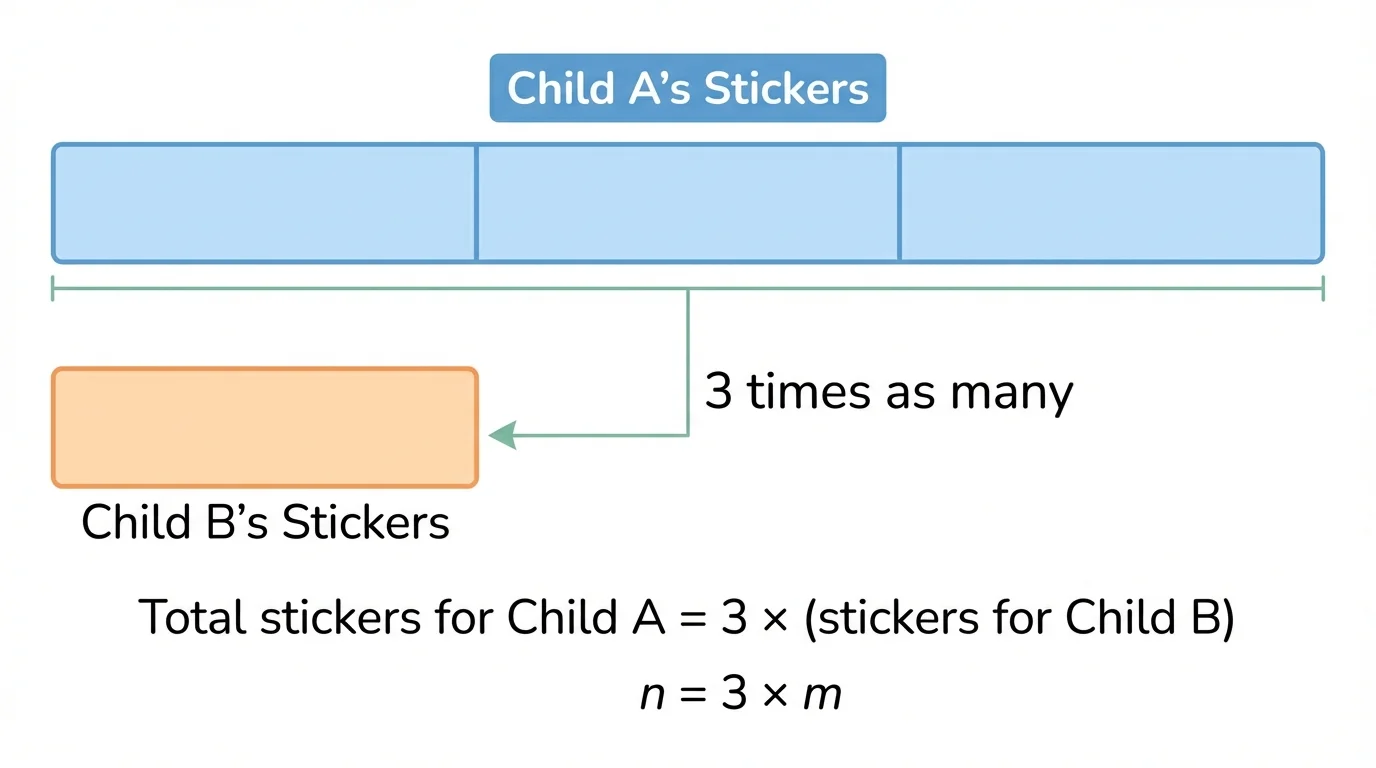
Drawings are especially helpful because they show that multiplicative comparison is based on equal-size parts. The parts must match. If the smaller amount is one unit, the larger amount is several equal units of that same size.
You can also use a drawing when the smaller amount is unknown. Suppose a ribbon is \(20\) centimeters long, and it is \(4\) times as long as a paper clip. A bar model would show the ribbon as \(4\) equal parts with total length \(20\). Each part is \(20 \div 4 = 5\), so the paper clip is \(5\) centimeters long.
Use multiplication when you know the smaller amount and you know how many times as many the larger amount is. Then you multiply to find the larger amount.
For example, if one fish tank has \(7\) fish and another tank has \(5\) times as many fish, then the second tank has
\[5 \times 7 = 35\]
fish.
You can write this with an equation using an unknown. Let \(f\) be the number of fish in the second tank. Then
\[f = 5 \times 7\]
So \(f = 35\).
How to choose multiplication
If the problem tells you one amount and says another amount is a certain number of times as much, think of building equal groups. You are making a bigger amount from a smaller amount, so multiplication is usually the right operation.
Words that often suggest multiplication include times as many, times as much, double, twice, and three times.
Use division when you know the larger amount and the comparison factor, and you need to find the smaller amount. Division helps you undo multiplication.
Suppose a jar has \(32\) beads. That is \(4\) times as many beads as another jar. To find the number in the smaller jar, divide:
\[32 \div 4 = 8\]
If \(b\) is the number of beads in the smaller jar, then the equation is
\(4b = 32\)
Solving gives \(b = 8\).
Division is also used when the two amounts are known and you need to know the comparison. For example, if one plant is \(18\) centimeters tall and another is \(6\) centimeters tall, then the taller plant is \(18 \div 6 = 3\) times as tall.
The words times as many do not always mean you should multiply right away. Sometimes the problem gives the bigger amount first, so you must divide to find the missing smaller amount.
Let's solve several problems carefully. Notice how each one uses words, an equation, and the correct operation.
Worked Example 1
Nora read \(8\) books in summer. Eli read \(3\) times as many books as Nora. How many books did Eli read?
Step 1: Identify what is known.
Nora read \(8\) books. Eli read \(3\) times Nora's amount.
Step 2: Write an equation.
Let \(e\) be the number of books Eli read.
\(e = 3 \times 8\)
Step 3: Solve.
\(3 \times 8 = 24\)
So Eli read
\(24\)
books.
This problem uses multiplication because we know the smaller amount and how many times as many the larger amount is.
Worked Example 2
A robot toy costs \(\$36\). That is \(4\) times as much as a small puzzle. How much does the puzzle cost?
Step 1: Identify the larger amount and the factor.
The robot toy costs \(36\) dollars. It is \(4\) times the cost of the puzzle.
Step 2: Write an equation with an unknown.
Let \(p\) be the cost of the puzzle.
\(4p = 36\)
Step 3: Solve by dividing.
\(p = 36 \div 4 = 9\)
The puzzle costs \(\$9\).
This problem uses division because the larger amount is known and the smaller amount is missing.
Worked Example 3
Jada has \(27\) seashells. Omar has \(9\) seashells. How many times as many seashells does Jada have as Omar?
Step 1: Decide what the question is asking.
We are not finding a number of seashells. We are finding the comparison factor.
Step 2: Divide the larger amount by the smaller amount.
\(27 \div 9 = 3\)
Step 3: State the comparison clearly.
Jada has \(3\) times as many seashells as Omar.
The answer is
\(3\)
times as many.
In this kind of problem, division finds the factor that compares the two amounts.
Worked Example 4
One team collected \(5\) times as many cans as another team. If the larger team collected \(45\) cans, how many cans did the smaller team collect?
Step 1: Write an equation.
Let \(c\) be the number of cans the smaller team collected.
\(5c = 45\)
Step 2: Solve.
\(c = 45 \div 5 = 9\)
Step 3: Check.
\(5 \times 9 = 45\), so the answer makes sense.
The smaller team collected
\(9\)
cans.
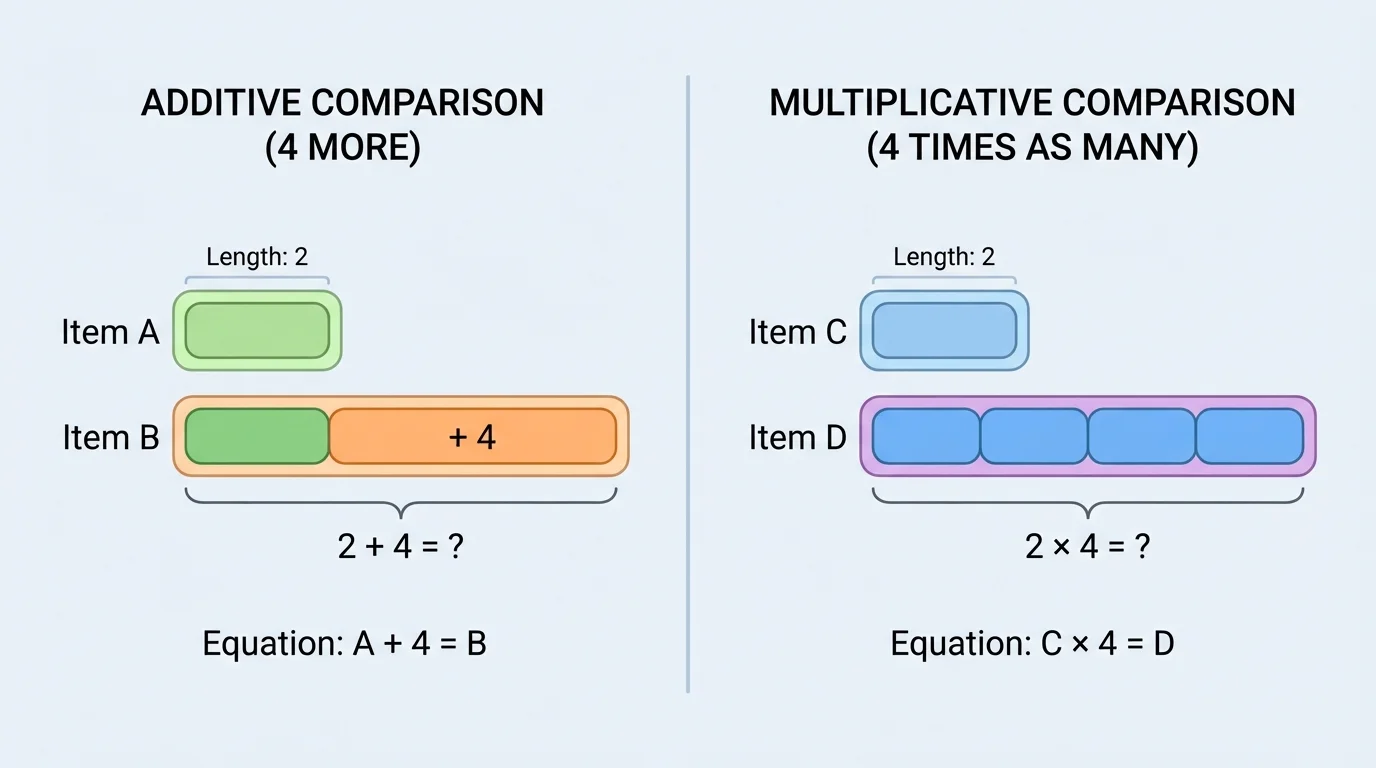
[Figure 2] Some word problems can trick you because the words sound alike. A student might hear "\(4\) times as many" and think "\(4\) more." But those mean different things, as the bar models illustrate. If one child has \(6\) stickers, then:
One clue is to ask yourself: Am I joining on extra ones, or am I making equal groups? If you are joining on extra ones, it is additive comparison. If you are making equal groups of the same size, it is multiplicative comparison.
Another clue is to look at the question. If it asks "how many more," think subtraction. If it asks "how many times as many," think multiplication or division.
| Type of comparison | Question clue | Example | Operation often used |
|---|---|---|---|
| Additive comparison | How many more? How many less? | \(12\) is \(5\) more than \(7\) | Addition or subtraction |
| Multiplicative comparison | How many times as many? Times as much? | \(12\) is \(3\) times \(4\) | Multiplication or division |
Table 1. A comparison of additive and multiplicative comparison clues and operations.
The equal-size parts in the tape diagram are what make the model multiplicative, not additive. The bars do not just show one extra piece added on. They show repeated equal amounts.
Multiplicative comparison appears in many everyday situations. In sports, one team may score \(2\) times as many points as another. In shopping, one item may cost \(3\) times as much as another. In science, one plant may grow to be \(4\) times as tall as another plant.
In a classroom, you might compare collections. If one table group picked up \(6\) markers and another group picked up \(3\) times as many, then the second group picked up \(18\) markers because \(3 \times 6 = 18\).
In cooking, recipes can also use multiplicative thinking. If one batch uses \(2\) cups of flour and a larger batch uses \(3\) times as much flour, then it uses \(6\) cups. Even though recipes often use fractions in later grades, the comparison idea is the same.
Why this matters outside math class
Multiplicative comparison helps people make decisions. It is used to compare prices, distances, scores, amounts collected, and sizes of objects. Knowing whether a situation is "more than" or "times as much" helps you choose the right operation and avoid mistakes.
One common mistake is using addition when the problem is multiplicative. If a bike ride is \(5\) times as long as a short path, and the short path is \(2\) miles, the answer is not \(2 + 5 = 7\). The correct answer is \(5 \times 2 = 10\) miles.
Another mistake is forgetting which amount is larger. If a story says a puppy weighs \(4\) times as much as a kitten, the puppy must weigh more, not less. The phrase "times as much" tells you the amount is being multiplied.
A good way to check your answer is to ask whether it makes sense. If something is \(3\) times as many, the larger amount should be bigger than the smaller one. If you divided and got a larger number for the smaller amount, something went wrong.
You can also check by substituting your answer into the equation. If \(6x = 42\), then \(x = 7\) because \(6 \times 7 = 42\). A correct answer should make the equation true.
"The words in a word problem tell the operation story."
— A useful problem-solving rule
When you slow down, look for the comparison words, draw a model when needed, and write an equation with an unknown, you turn a tricky word problem into clear math.
