If a video game map says your character is at (2, 3) or (-2, 3), a tiny sign change can move you to a completely different part of the screen. That is the power of coordinates. On a coordinate plane, positive and negative numbers are not just numbers to calculate with. They tell direction and location. A positive number can mean moving right or up, while a negative number can mean moving left or down.
You already know that numbers can be shown on a number line. Numbers to the right of 0 are positive, and numbers to the left of 0 are negative. A coordinate plane extends that idea into two dimensions. Instead of just moving left or right, you can also move up or down.
This makes the coordinate plane useful for maps, game design, building plans, and science. A location can be described exactly with an ordered pair, written as (x, y). The first number tells horizontal position, and the second number tells vertical position.
On a number line, positive numbers are to the right of 0 and negative numbers are to the left of 0. On the coordinate plane, that same idea is used for horizontal movement, and another number line is added for vertical movement.
Because the plane uses two numbers, signs matter twice. In (-4, 5), the -4 tells you to go left, and the 5 tells you to go up. In (4, -5), the directions are completely different: right and down.
[Figure 1] The coordinate plane is made by two number lines that cross at right angles. One is horizontal and one is vertical. Their meeting point is called the origin, and it has coordinates (0, 0). The horizontal number line is the x-axis, and the vertical number line is the y-axis. The plane is divided into four regions called quadrants.
To locate a point, start at the origin. Move left or right according to the x-coordinate. Then move up or down according to the y-coordinate. This order is important: first x, then y.
For example, to plot (3, 2), begin at (0, 0), move 3 units right, and then move 2 units up. To plot (-3, 2), begin at the same origin, move 3 units left, and then move 2 units up.
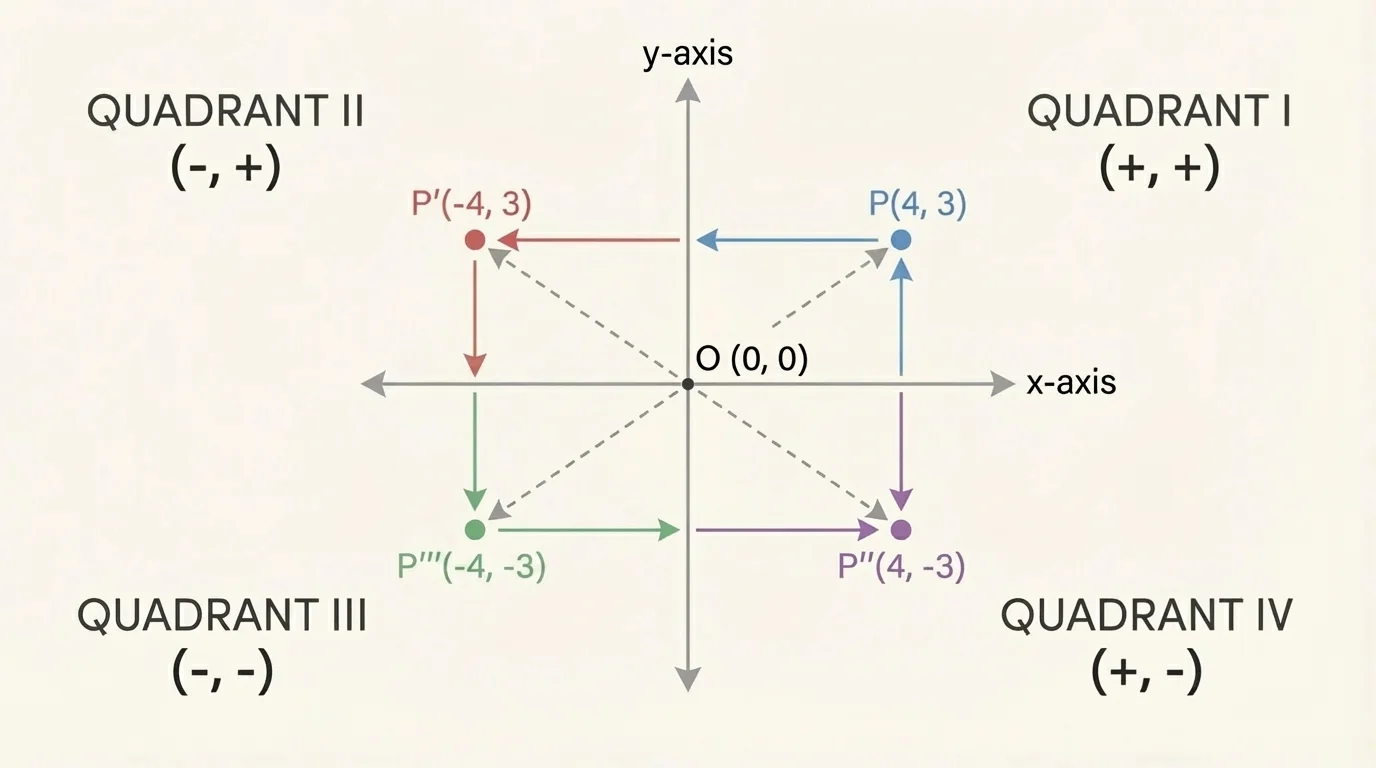
Notice that the sign of each coordinate tells direction from the origin. A positive x-value means right. A negative x-value means left. A positive y-value means up. A negative y-value means down.
Ordered pair: a pair of numbers written as (x, y) that names a point on the coordinate plane.
Origin: the point (0, 0) where the x-axis and y-axis cross.
Quadrant: one of the four regions formed by the x-axis and y-axis.
Reflection: a flip of a point across a line, such as the x-axis or y-axis.
The axes themselves are not inside any quadrant. A point on an axis has either x = 0 or y = 0. The origin is on both axes.
[Figure 2] Each quadrant has its own sign pattern. This is the big idea of the lesson: if you know whether x and y are positive or negative, you can tell where the point is before even plotting it.
Here are the sign rules:
Quadrant I: x is positive and y is positive, so points look like (+, +).
Quadrant II: x is negative and y is positive, so points look like (-, +).
Quadrant III: x is negative and y is negative, so points look like (-, -).
Quadrant IV: x is positive and y is negative, so points look like (+, -).
This means that the signs act like directions. If a point is (-6, -2), both numbers are negative, so the point must be in Quadrant III. If a point is (6, -2), the x-value is positive and the y-value is negative, so it must be in Quadrant IV.
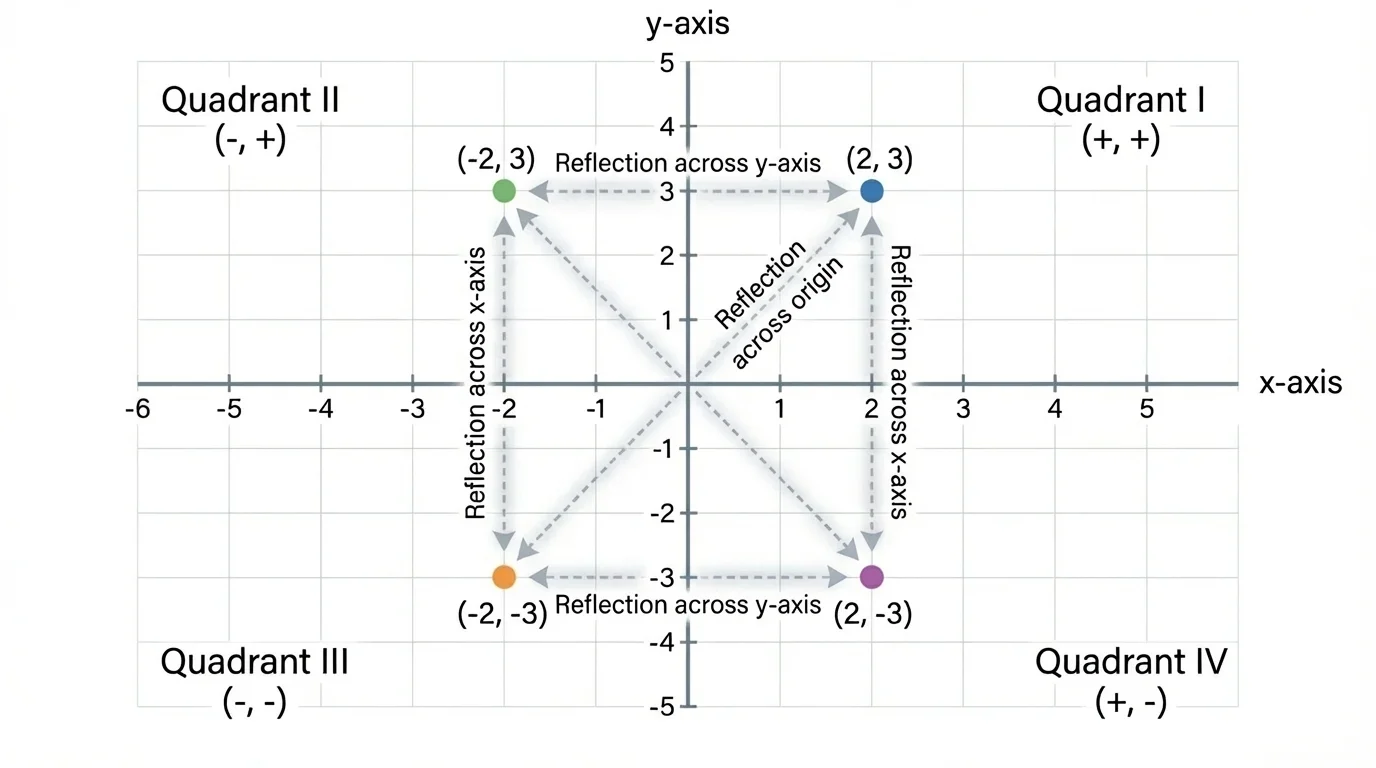
You do not have to graph every point to know its quadrant. Looking at the signs often gives the answer right away. That is one reason the coordinate plane is so useful.
A quick way to remember the quadrants is to move around the plane in order starting from the upper right. Quadrant I is upper right, Quadrant II is upper left, Quadrant III is lower left, and Quadrant IV is lower right.
| Quadrant | Location | Sign Pattern | Example Point |
|---|---|---|---|
| I | upper right | (+, +) | (4, 3) |
| II | upper left | (-, +) | (-4, 3) |
| III | lower left | (-, -) | (-4, -3) |
| IV | lower right | (+, -) | (4, -3) |
Table 1. The four quadrants, their locations, sign patterns, and example points.
Looking back at [Figure 1], you can see that each quadrant is really a combination of horizontal and vertical directions. Right and up give Quadrant I. Left and up give Quadrant II. Left and down give Quadrant III. Right and down give Quadrant IV.
Airplane and ship navigation often uses systems of position that depend on direction and distance. The coordinate plane is a simple mathematical model of that same idea: location is determined by how far and in what direction you move from a starting point.
Because of this, sign patterns are not random rules to memorize. They describe actual movement.
When plotting a point, always follow the order in (x, y). The x-coordinate comes first, and the y-coordinate comes second.
Suppose you want to plot (-5, 4). Start at the origin. Because x = -5, move 5 units left. Because y = 4, move 4 units up. The point lands in Quadrant II.
Now consider (2, -6). Start at the origin, move 2 units right, and then move 6 units down. The point is in Quadrant IV.
A common mistake is to reverse the coordinates. The point (2, -6) is not the same as (-6, 2). Changing the order changes the location completely.
Sometimes points have the same numbers but different signs. For example, compare (3, 5), (-3, 5), (3, -5), and (-3, -5). These points are closely related because each one is the same distance from the axes as the others. Only the directions change.
If two ordered pairs differ only in the sign of the x-coordinate, then one point is a reflection across the y-axis from the other. For example, (4, 2) and (-4, 2) have the same y-coordinate, but opposite x-values. They are the same height, but one is 4 units to the right of the y-axis and the other is 4 units to the left.
If two ordered pairs differ only in the sign of the y-coordinate, then one point is a reflection across the x-axis from the other. For example, (4, 2) and (4, -2) have the same x-coordinate, but opposite y-values. They are the same distance from the x-axis, one above and one below.
If both signs change, then the point is reflected across both axes. For example, (4, 2) becomes (-4, -2). You can think of this as reflecting across the y-axis and then across the x-axis, or the other way around.
[Figure 3] Points that differ only by signs are often easiest to understand through reflections. A reflection makes a mirror image across an axis, so the point keeps the same distance from that axis while appearing on the opposite side.
These sign-change rules are especially important:
Reflecting across the y-axis changes (x, y) to (-x, y).
Reflecting across the x-axis changes (x, y) to (x, -y).
Reflecting across both axes changes (x, y) to (-x, -y).
Notice what stays the same. A reflection across the y-axis does not change the y-coordinate. A reflection across the x-axis does not change the x-coordinate. Reflecting across both axes changes both signs but not the distances from the axes.
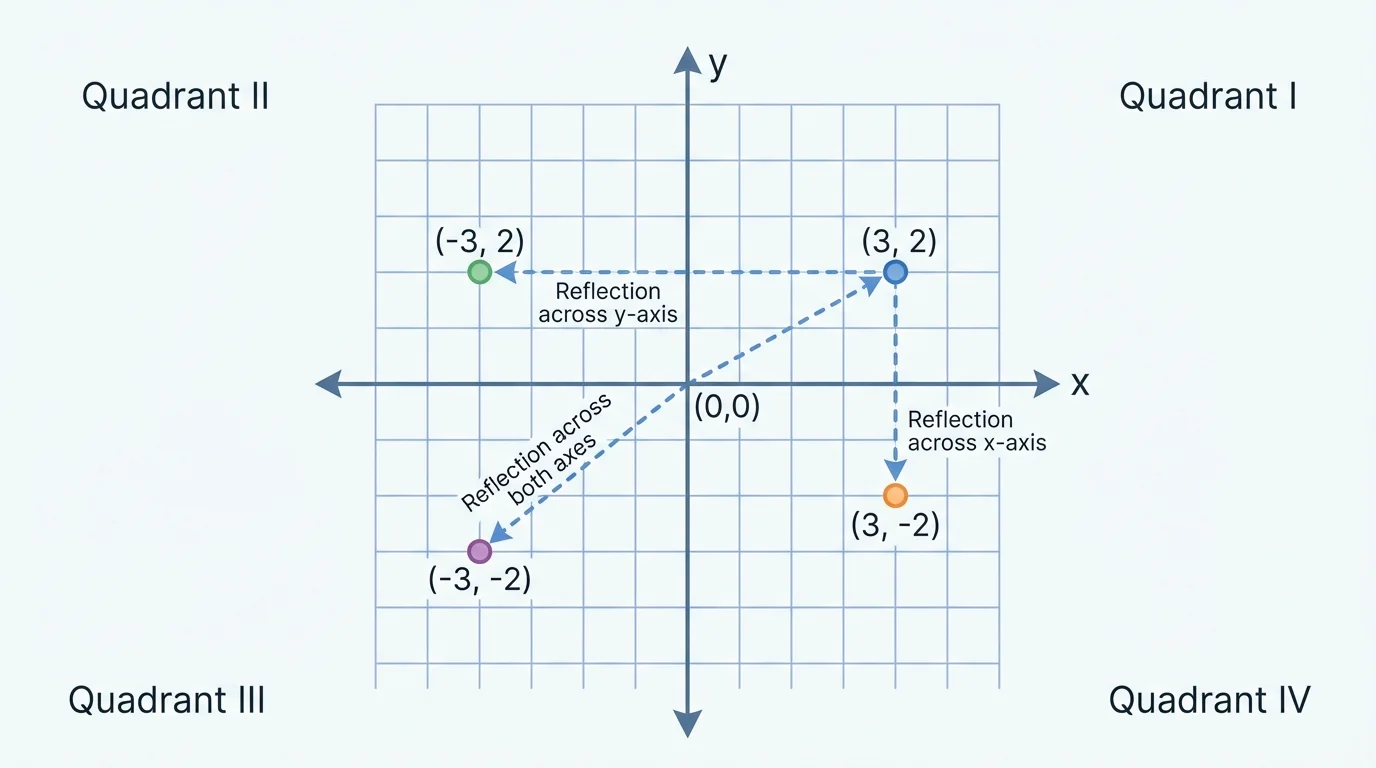
This is why (2, 7) and (-2, 7) line up horizontally. They share the same y value. And (2, 7) and (2, -7) line up vertically. They share the same x value.
Why reflections and sign changes match
The sign of a coordinate tells direction from 0 on that axis. A reflection across an axis keeps the distance the same but reverses the direction on one side. That is why reflecting across the y-axis changes only the sign of x, and reflecting across the x-axis changes only the sign of y.
Later, when you study geometry, these reflection patterns will help you understand symmetry and transformations. For now, they give you a powerful way to compare coordinates quickly.
Example 1: Identify the quadrant of (-6, 4)
Step 1: Look at the signs.
The x-coordinate is -6, which is negative. The y-coordinate is 4, which is positive.
Step 2: Match the sign pattern to a quadrant.
The sign pattern is (-, +).
Step 3: Name the quadrant.
Points with sign pattern (-, +) are in Quadrant II.
The point (-6, 4) is in Quadrant II.
Notice that you never had to draw the point. The signs gave enough information.
Example 2: Plot and describe (5, -3)
Step 1: Start at the origin (0, 0).
Step 2: Use the x-coordinate.
Since x = 5, move 5 units to the right.
Step 3: Use the y-coordinate.
Since y = -3, move 3 units down.
Step 4: Determine the quadrant.
The sign pattern is (+, -), so the point is in Quadrant IV.
The point (5, -3) is 5 units right and 3 units down from the origin, in Quadrant IV.
As you saw earlier in [Figure 2], switching only one sign would move the point into a different quadrant while keeping part of its location the same.
Example 3: Find the reflection of (3, -8) across the y-axis
Step 1: Recall the rule for reflection across the y-axis.
(x, y) becomes (-x, y).
Step 2: Change only the x-coordinate.
The opposite of 3 is -3. The y-coordinate stays -8.
Step 3: Write the reflected point.
The reflected point is (-3, -8).
The reflection of (3, -8) across the y-axis is (-3, -8).
This matches the idea in [Figure 3]: the point keeps the same vertical position but moves to the opposite side of the y-axis.
Example 4: Compare (-2, 6) and (-2, -6)
Step 1: Check what stays the same.
Both points have the same x-coordinate, -2.
Step 2: Check what changes.
The y-coordinate changes from 6 to -6.
Step 3: Interpret the sign change.
Changing only the y-coordinate means the points are reflections across the x-axis.
The points (-2, 6) and (-2, -6) are reflections across the x-axis.
One point is in Quadrant II and the other is in Quadrant III, but they are the same distance from the x-axis.
Not every point is in a quadrant. If x = 0, the point lies on the y-axis. For example, (0, 5) and (0, -2) are on the y-axis.
If y = 0, the point lies on the x-axis. For example, (4, 0) and (-7, 0) are on the x-axis.
If both coordinates are 0, the point is the origin: (0, 0). The origin is not in any quadrant.
This matters when naming locations. A point must have both coordinates nonzero to be inside a quadrant.
Coordinates are useful in many real situations. A city map may use a center point, and places east or west of that center can be thought of as positive or negative horizontal positions. Places north or south can be thought of as positive or negative vertical positions.
In a video game, a character might move from (4, 1) to (-4, 1). That change means the character crossed from one side of the screen to the other while staying at the same height. This is exactly like a reflection across the y-axis.
In science, elevation can be above or below sea level. A submarine and a helicopter might have positions that are similar in distance from sea level but on opposite sides of it. That idea is like positive and negative values on a coordinate system.
"The numbers do not just tell how far. They tell which way."
That idea is at the heart of signed coordinates. Distance alone is not enough. Direction matters too.
One common mistake is mixing up the order of coordinates. Remember: (x, y) means horizontal first, vertical second.
Another common mistake is forgetting that changing one sign changes the side of one axis only. If (5, 2) becomes (-5, 2), the point reflects across the y-axis, not the x-axis.
A third common mistake is saying a point on an axis is in a quadrant. It is not. Points on the x-axis or y-axis are on the boundary lines between quadrants.
Finally, do not assume that points with the same numbers are always in the same place. The signs matter. The points (3, 4), (-3, 4), (3, -4), and (-3, -4) all have the same distances from the axes, but they lie in four different parts of the plane, as you saw earlier in [Figure 2].
