How can someone walk only \(\dfrac{1}{2}\) mile in \(\dfrac{1}{4}\) hour, but somehow be moving at \(2\) miles per hour? That sounds strange at first, but it makes perfect sense once you understand unit rates. Unit rates help us turn a ratio into a comparison with one unit, so we can answer questions like "How fast?", "How much per hour?", or "How many square feet per minute?"
Rates appear everywhere: a cyclist rides \(\dfrac{3}{4}\) mile in \(\dfrac{1}{8}\) hour, a machine cuts \(\dfrac{5}{6}\) square meters of fabric in \(\dfrac{1}{3}\) minute, or a store sells \(\dfrac{2}{3}\) pound of nuts for \(\$4.50\). In each case, the basic ratio is useful, but the unit rate is often more useful because it tells us the amount for \(1\) unit of time, length, area, or cost.
When a ratio uses fractions, the math can look more advanced, but the idea stays simple: divide one quantity by the other. That is why a rate like \(\dfrac{1}{2}\) mile in \(\dfrac{1}{4}\) hour becomes the complex fraction \(\dfrac{\dfrac{1}{2}}{\dfrac{1}{4}}\). Once we evaluate it, we get the speed in miles per hour.
A ratio compares two quantities by division.
A rate is a ratio that compares quantities measured in different units, such as miles and hours.
A unit rate is a rate written with a denominator of \(1\) unit.
A complex fraction is a fraction that has a fraction in the numerator, denominator, or both.
Sometimes rates compare quantities measured in different units, such as miles per hour. Sometimes they compare quantities measured in like units, such as cups of water per cup of juice, or feet of fence per foot of border. The units tell you how to interpret the number.
A rate tells how one quantity changes compared to another. A unit rate tells how much of one quantity there is for exactly \(1\) of the other quantity.
For example, if a machine prints \(30\) pages in \(5\) minutes, the unit rate is \(6\) pages per minute because \(30 \div 5 = 6\). The same idea works when the numbers are fractions. If a bee flies \(\dfrac{3}{5}\) meter in \(\dfrac{1}{10}\) second, the unit rate is
\[\frac{\frac{3}{5}}{\frac{1}{10}} = \frac{3}{5} \times 10 = 6\]
So the bee flies \(6\) meters per second.
To divide by a fraction, multiply by its reciprocal. For example, \(\dfrac{2}{3} \div \dfrac{1}{4} = \dfrac{2}{3} \times 4 = \dfrac{8}{3}\).
[Figure 1] This skill depends on two ideas you already know: dividing fractions and keeping track of units. If the denominator is a fraction of an hour, then dividing by that denominator tells how much would happen in one full hour.
There is a clear process for solving these problems. First write the situation as a ratio. Then write it as a complex fraction. Next divide by the denominator quantity. Finally, simplify both the number and the units.
Suppose a sprinkler waters \(\dfrac{3}{8}\) of a lawn in \(\dfrac{1}{4}\) hour. The rate is \(\dfrac{\dfrac{3}{8}}{\dfrac{1}{4}}\) lawns per hour. Dividing by \(\dfrac{1}{4}\) means multiplying by \(4\): \(\dfrac{3}{8} \times 4 = \dfrac{12}{8} = \dfrac{3}{2}\). So the sprinkler waters \(\dfrac{3}{2}\) lawns per hour, or \(1\dfrac{1}{2}\) lawns per hour.
A helpful pattern is
\[\frac{a}{b} \div \frac{c}{d} = \frac{a}{b} \times \frac{d}{c}\]
But do not use the pattern without thinking about the meaning. The units matter just as much as the arithmetic.
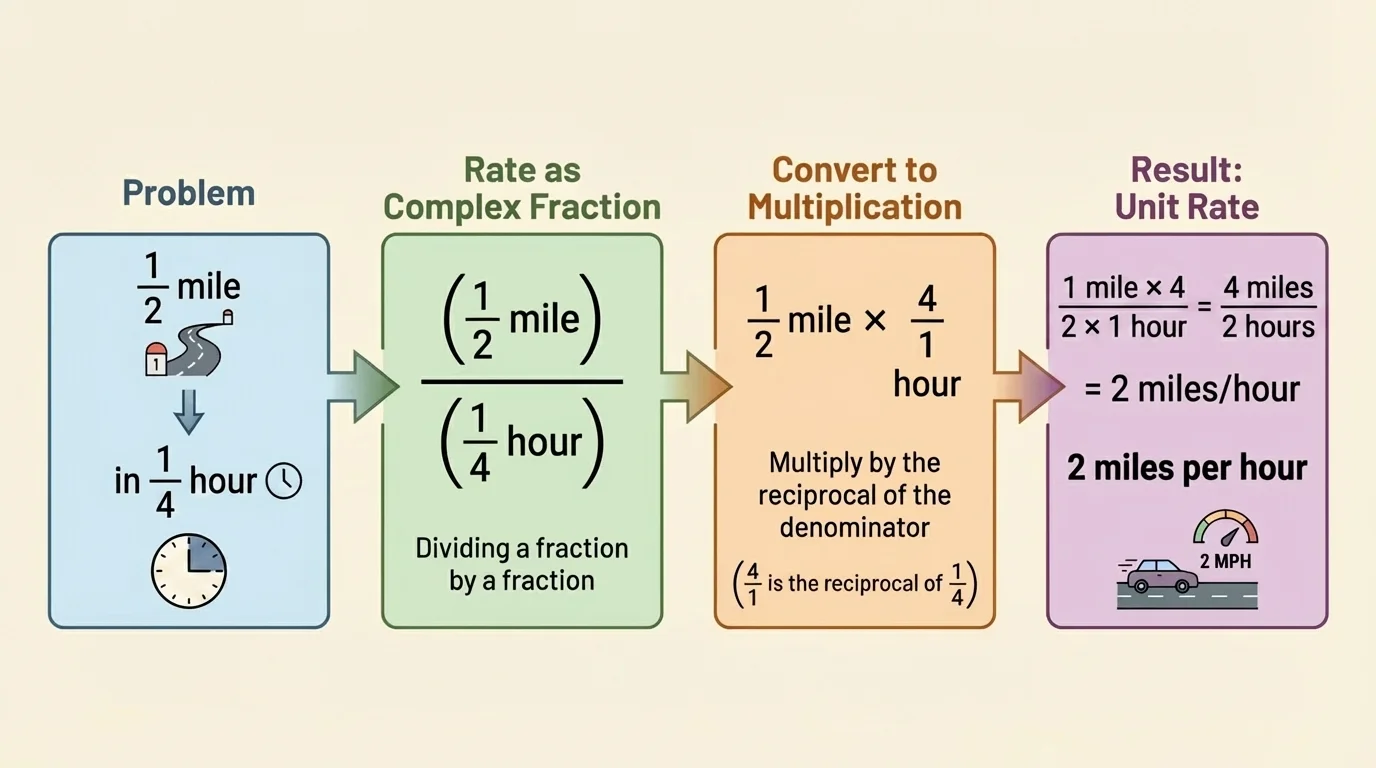
If the answer is larger than the original numerator quantity, that can still be correct. For example, traveling \(\dfrac{1}{2}\) mile in only \(\dfrac{1}{4}\) hour means the person would travel farther in a full hour. Because the time is small, the "per hour" rate becomes larger.
A walking situation is one of the most common ways to see this idea, and [Figure 2] illustrates how a short trip can scale to one full hour.
Worked example 1
A person walks \(\dfrac{1}{2}\) mile in each \(\dfrac{1}{4}\) hour. Find the unit rate in miles per hour.
Step 1: Write the rate as a complex fraction.
\[\frac{\frac{1}{2} \textrm{ mile}}{\frac{1}{4} \textrm{ hour}}\]
Step 2: Divide by the fraction in the denominator.
\(\dfrac{1}{2} \div \dfrac{1}{4} = \dfrac{1}{2} \times 4 = 2\)
Step 3: Attach the units.
The unit rate is \(2\) miles per hour.
Final answer: \(2\) miles per hour.
Notice what happened: \(\dfrac{1}{4}\) hour fits into \(1\) hour exactly \(4\) times. So if the person walks \(\dfrac{1}{2}\) mile in each quarter-hour, then in one full hour the person walks \(4 \times \dfrac{1}{2} = 2\) miles.
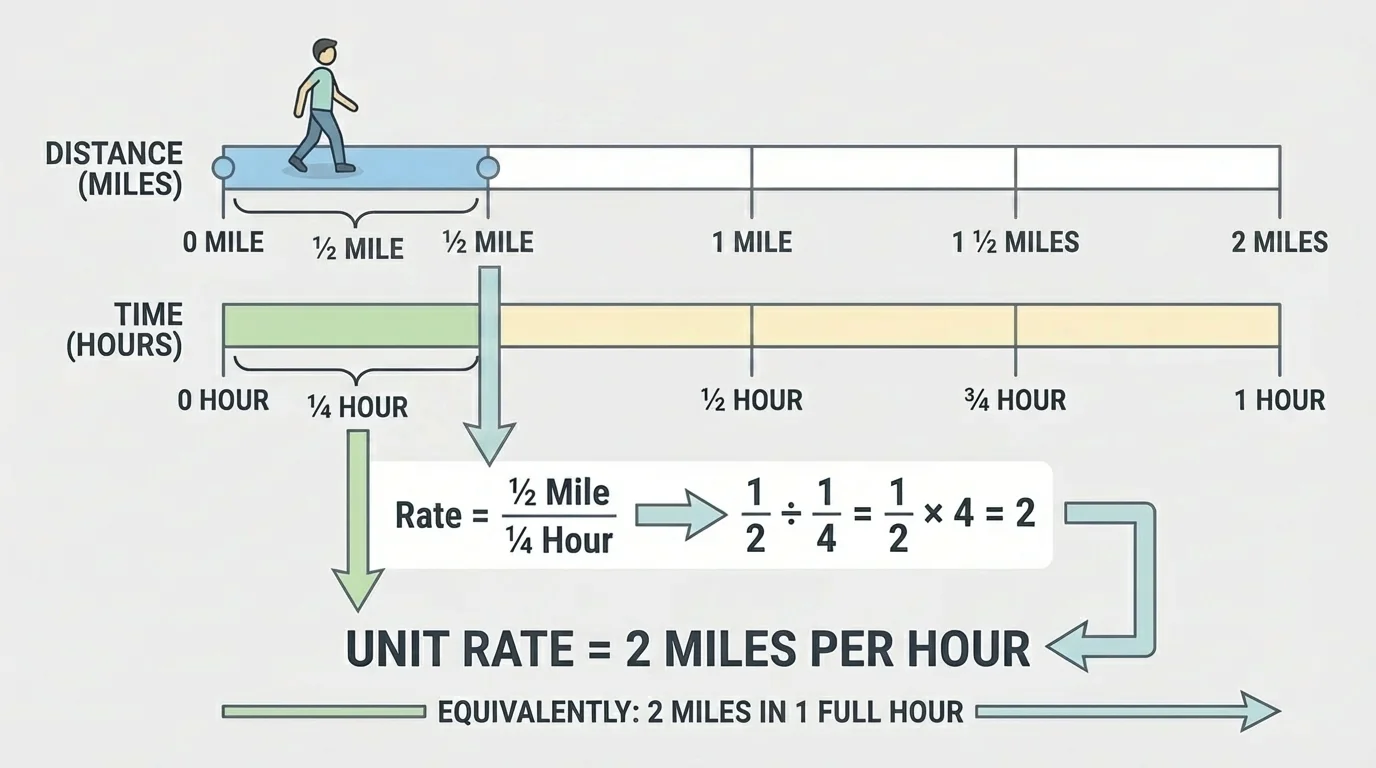
This scaling idea is often faster to picture than the fraction rule, but both methods give the same result. Later, when comparing speeds, the image of repeated equal time intervals can help you decide whether an answer is reasonable.
Unit rates are not only about speed. They also help with recipes, prices, and materials. In many real situations, the measured amounts are fractions because people do not always buy or use whole-number amounts.
Worked example 2
A baker uses \(\dfrac{3}{4}\) cup of sugar for \(\dfrac{1}{2}\) batch of muffins. How many cups of sugar are used per batch?
Step 1: Write the rate.
\[\frac{\frac{3}{4} \textrm{ cup}}{\frac{1}{2} \textrm{ batch}}\]
Step 2: Divide.
\(\dfrac{3}{4} \div \dfrac{1}{2} = \dfrac{3}{4} \times 2 = \dfrac{6}{4} = \dfrac{3}{2}\)
Step 3: Interpret the result.
\(\dfrac{3}{2}\) cup per batch is the same as \(1\dfrac{1}{2}\) cups per batch.
Final answer: \(1\dfrac{1}{2}\) cups of sugar per batch.
Here the denominator unit is "batch," so the answer tells how much sugar is needed for one batch. That is why the result is useful for planning ingredients.
Now consider money, where the numbers may be fractional in the measurement but not in the currency notation.
Worked example 3
\(\dfrac{3}{5}\) pound of trail mix costs \(\$4.20\). Find the cost per pound.
Step 1: Write the rate.
\[\frac{4.20 \textrm{ dollars}}{\frac{3}{5} \textrm{ pound}}\]
Step 2: Divide by \(\dfrac{3}{5}\).
\(4.20 \div \dfrac{3}{5} = 4.20 \times \dfrac{5}{3} = 7\)
Step 3: State the unit rate.
The cost is \(\$7\) per pound.
Final answer: \(\$7\) per pound.
A price per pound lets you compare deals even when the package sizes are different. Stores rely on unit rates for exactly this reason.
Rates can involve area too. When area appears, the unit is squared, such as square feet or square meters. These rates are common in painting, mowing, farming, and printing.
Worked example 4
A robot paints \(\dfrac{5}{6}\) square meters in \(\dfrac{1}{3}\) minute. How many square meters does it paint per minute?
Step 1: Write the complex fraction.
\[\frac{\frac{5}{6} \textrm{ square meters}}{\frac{1}{3} \textrm{ minute}}\]
Step 2: Divide.
\(\dfrac{5}{6} \div \dfrac{1}{3} = \dfrac{5}{6} \times 3 = \dfrac{15}{6} = \dfrac{5}{2}\)
Step 3: Write the answer with units.
The robot paints \(\dfrac{5}{2}\) square meters per minute, or \(2\dfrac{1}{2}\) square meters per minute.
Final answer: \(2\dfrac{1}{2}\) square meters per minute.
Here is a different kind of rate involving length and area.
Worked example 5
A gardener uses \(\dfrac{7}{8}\) yard of edging for \(\dfrac{1}{4}\) square yard of flower bed. Find the unit rate in yards of edging per square yard.
Step 1: Set up the rate.
\[\frac{\frac{7}{8} \textrm{ yard}}{\frac{1}{4} \textrm{ square yard}}\]
Step 2: Divide the fractions.
\(\dfrac{7}{8} \div \dfrac{1}{4} = \dfrac{7}{8} \times 4 = \dfrac{28}{8} = \dfrac{7}{2}\)
Step 3: Interpret the units.
The unit rate is \(\dfrac{7}{2}\) yards per square yard, or \(3\dfrac{1}{2}\) yards per square yard.
Final answer: \(3\dfrac{1}{2}\) yards of edging per square yard.
This kind of rate may feel unusual because one unit is length and the other is area. That is still allowed. A rate can compare different kinds of measurements as long as the comparison makes sense in the situation.
Some rates compare quantities with the same kind of unit, while others compare different kinds, as [Figure 3] shows. Understanding the units helps you understand what the rate means.
If both quantities are lengths, the result might tell how much one length changes compared to another. If one quantity is distance and the other is time, the result is speed. If one quantity is area and the other is time, the result tells how quickly a surface is covered.
| Situation | Rate | Meaning |
|---|---|---|
| \(\dfrac{1}{2}\) mile in \(\dfrac{1}{4}\) hour | \(2\) miles per hour | Speed |
| \(\dfrac{5}{6}\) square meter in \(\dfrac{1}{3}\) minute | \(\dfrac{5}{2}\) square meters per minute | Area covered over time |
| \(\dfrac{3}{4}\) cup for \(\dfrac{1}{2}\) batch | \(\dfrac{3}{2}\) cups per batch | Ingredient amount for one batch |
| \(\dfrac{7}{8}\) yard for \(\dfrac{1}{4}\) square yard | \(\dfrac{7}{2}\) yards per square yard | Length needed for each unit of area |
Table 1. Examples of unit rates with different kinds of units and meanings.
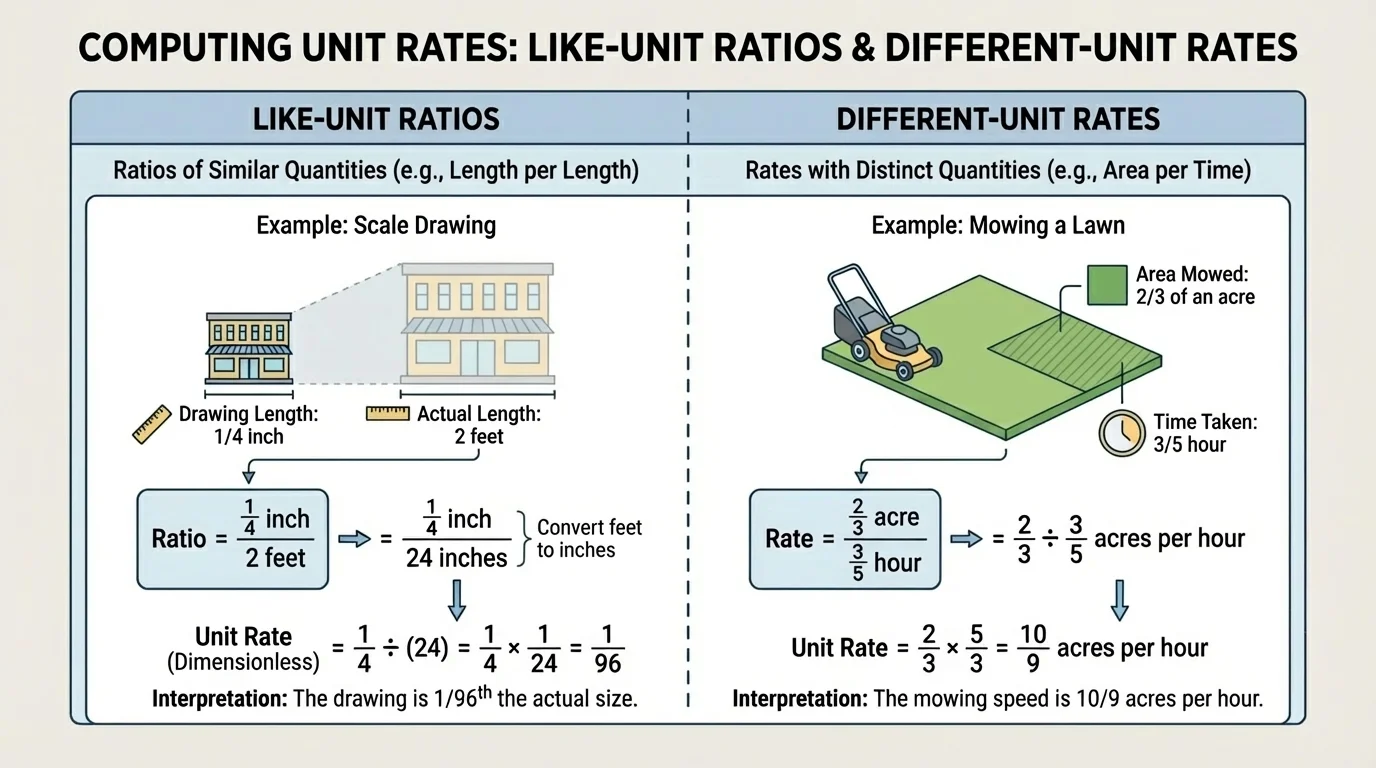
When you read a unit rate, always say the units aloud. For example, \(\dfrac{5}{2}\) square meters per minute means "two and one-half square meters for every one minute." Saying it this way prevents confusion.
Professional athletes, engineers, and scientists constantly use unit rates. A runner's pace, a printer's output, and a drone's survey coverage all depend on comparing one quantity to one unit of another quantity.
As you continue solving problems, the unit labels help remind you that the arithmetic answer alone is not enough; the units explain the real meaning.
One common mistake is reversing the ratio. Suppose a runner travels \(\dfrac{3}{4}\) mile in \(\dfrac{1}{6}\) hour. The correct rate is miles per hour:
\[\frac{\frac{3}{4}}{\frac{1}{6}} = \frac{3}{4} \times 6 = \frac{18}{4} = \frac{9}{2}\]
So the runner's speed is \(\dfrac{9}{2}\) miles per hour, or \(4\dfrac{1}{2}\) miles per hour. If you reverse the ratio, you would get hours per mile instead, which is a different measurement.
Another mistake is forgetting that dividing by a fraction makes the result larger when the fraction is less than \(1\). For example, \(\dfrac{2}{5} \div \dfrac{1}{10} = 4\), not \(\dfrac{2}{50}\). Division by a small fraction asks, "How many of those small pieces fit?"
A third mistake is dropping the units. An answer like \(\dfrac{7}{2}\) is incomplete unless you say whether it means miles per hour, cups per batch, or square meters per minute.
Unit rates help people make decisions. A shopper compares cost per ounce or cost per pound. A coach compares laps per minute or miles per hour. A landscaper compares square feet mowed per minute. A map reader may compare inches on a map to miles in real life.
Suppose two lawn mowers work at different speeds. Mower A cuts \(\dfrac{3}{4}\) of a yard in \(\dfrac{1}{2}\) hour, so its rate is \(\dfrac{3}{4} \div \dfrac{1}{2} = \dfrac{3}{2}\) yards per hour. Mower B cuts \(\dfrac{2}{3}\) of a yard in \(\dfrac{1}{4}\) hour, so its rate is \(\dfrac{2}{3} \div \dfrac{1}{4} = \dfrac{8}{3}\) yards per hour. Since \(\dfrac{8}{3} > \dfrac{3}{2}\), Mower B is faster.
In medicine, rates are used carefully when fluids or medicines are delivered over time. In engineering, rates can describe how quickly a machine drills, prints, or cools. In environmental science, rates describe how much rain falls per hour or how much land is covered by vegetation over time.
Why unit rates are so powerful
Different situations can only be compared fairly when they are written in the same unit. A unit rate acts like a common language. Once two rates are both written "per 1 unit," it becomes easy to see which is greater, smaller, faster, or more efficient.
This is why stores post unit prices and why scientists convert measurements to standard rates. The numbers become easier to compare when the denominator is \(1\).
When comparing two situations, find each unit rate first. Then compare the results.
Suppose one cyclist travels \(\dfrac{5}{8}\) mile in \(\dfrac{1}{10}\) hour and another travels \(\dfrac{3}{4}\) mile in \(\dfrac{1}{8}\) hour.
For the first cyclist, \(\dfrac{5}{8} \div \dfrac{1}{10} = \dfrac{50}{8} = \dfrac{25}{4} = 6\dfrac{1}{4}\) miles per hour.
For the second cyclist, \(\dfrac{3}{4} \div \dfrac{1}{8} = \dfrac{3}{4} \times 8 = 6\) miles per hour.
So the first cyclist is faster by \(\dfrac{1}{4}\) mile per hour.
Comparing unit rates works best when the units match. If one answer is in miles per hour and the other is in feet per second, convert the units before deciding which is greater.
"A good rate answer is not just a number; it is a number with meaning."
That meaning comes from the units and the context. A unit rate tells a story about how one quantity changes relative to another.
