A small change in an exponent can make a number grow very large or become very small. For example, \(10^6\) is \(1{,}000{,}000\), but \(10^{-6}\) is \(\dfrac{1}{1{,}000{,}000}\). That is one reason exponents are so powerful: they help us write very large and very small numbers efficiently, and they let us simplify expressions quickly when we know the rules.
Exponents are a compact way to show repeated multiplication. Instead of writing \(3 \cdot 3 \cdot 3 \cdot 3\), we can write \(3^4\). This shorter form is easier to read, easier to compare, and much easier to simplify when expressions become more complicated.
When two expressions have the same value, they are called equivalent expressions. For example, \(2^3\), \(2 \cdot 2 \cdot 2\), and \(8\) are all equivalent. In this topic, the goal is not only to calculate values but also to rewrite expressions in different equivalent forms by using exponent properties correctly.
You already know that multiplication and division are connected. Exponent rules build on that same idea because exponents represent repeated multiplication. If you can expand a power into repeated factors, you can often see why a rule works.
These rules matter in algebra, science, engineering, and technology. Computers store and process huge amounts of information, and scientists measure extremely small things like cells and atoms. Exponents help organize all of that.
A base is the number being multiplied, and an exponent tells how many times the base is used as a factor. As [Figure 1] shows, powers follow a pattern: when the exponent decreases by \(1\), the value is divided by the base.
For positive exponents, the meaning is straightforward: \(5^3 = 5 \cdot 5 \cdot 5 = 125\). In general, if \(n\) is a positive integer, then \(a^n\) means multiply \(a\) by itself \(n\) times.
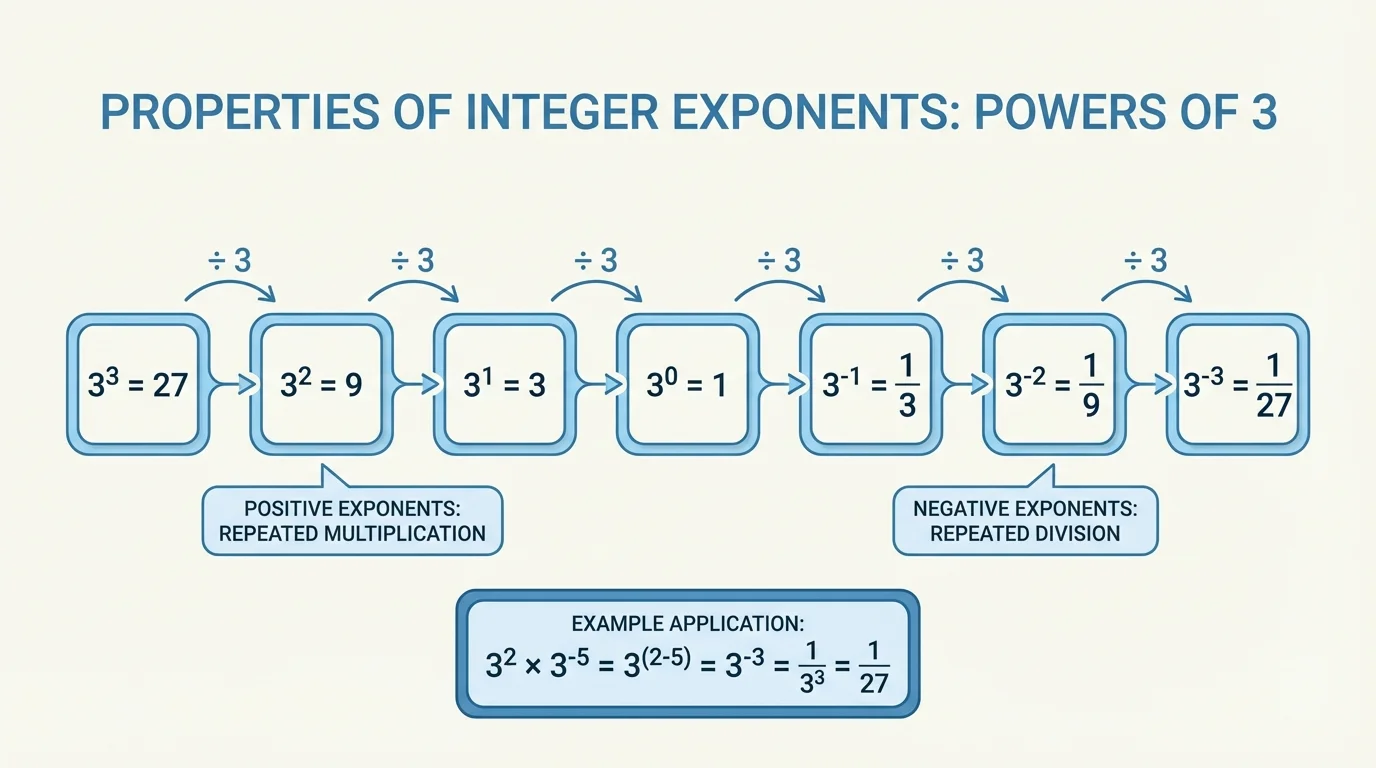
Zero exponents and negative exponents extend this pattern. Since \(3^2 = 9\), \(3^1 = 3\), and each step down divides by \(3\), the next value must be \(3^0 = 1\). One more step gives \(3^{-1} = \dfrac{1}{3}\), then \(3^{-2} = \dfrac{1}{9}\), and so on.
Positive exponent means repeated multiplication of the base.
Zero exponent means the value is \(1\) as long as the base is not \(0\): \(a^0 = 1\) for \(a \neq 0\).
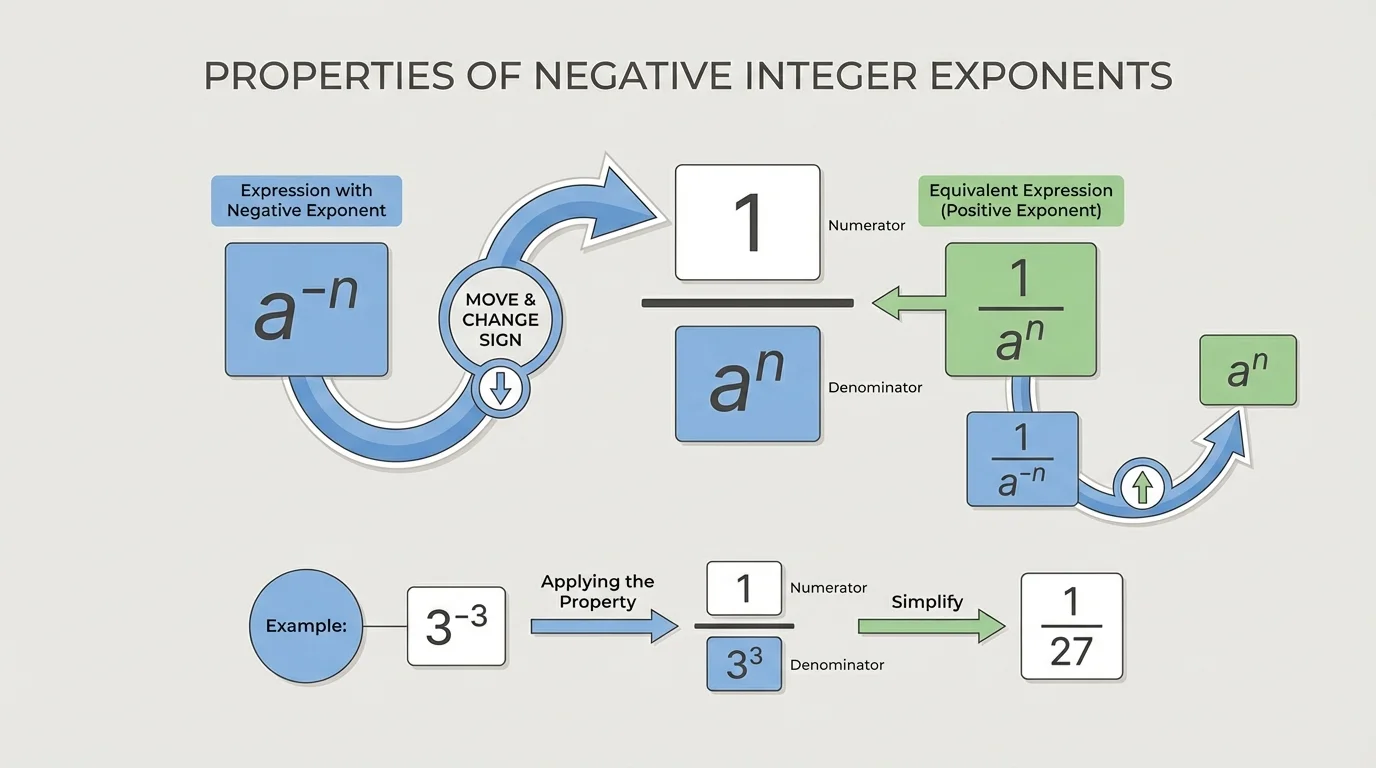
Negative exponent means the reciprocal of the corresponding positive power: \(a^{-n} = \dfrac{1}{a^n}\) for \(a \neq 0\).
It is important to notice that a negative exponent does not make the number negative. For example, \(2^{-3} = \dfrac{1}{2^3} = \dfrac{1}{8}\), which is positive. The negative sign in the exponent tells you to take a reciprocal.
The base also matters when negative numbers are involved. Compare \((-2)^4\) and \(-2^4\). In \((-2)^4\), the base is \(-2\), so \((-2)(-2)(-2)(-2) = 16\). But in \(-2^4\), the exponent applies only to \(2\), so it means \(-(2^4) = -16\).
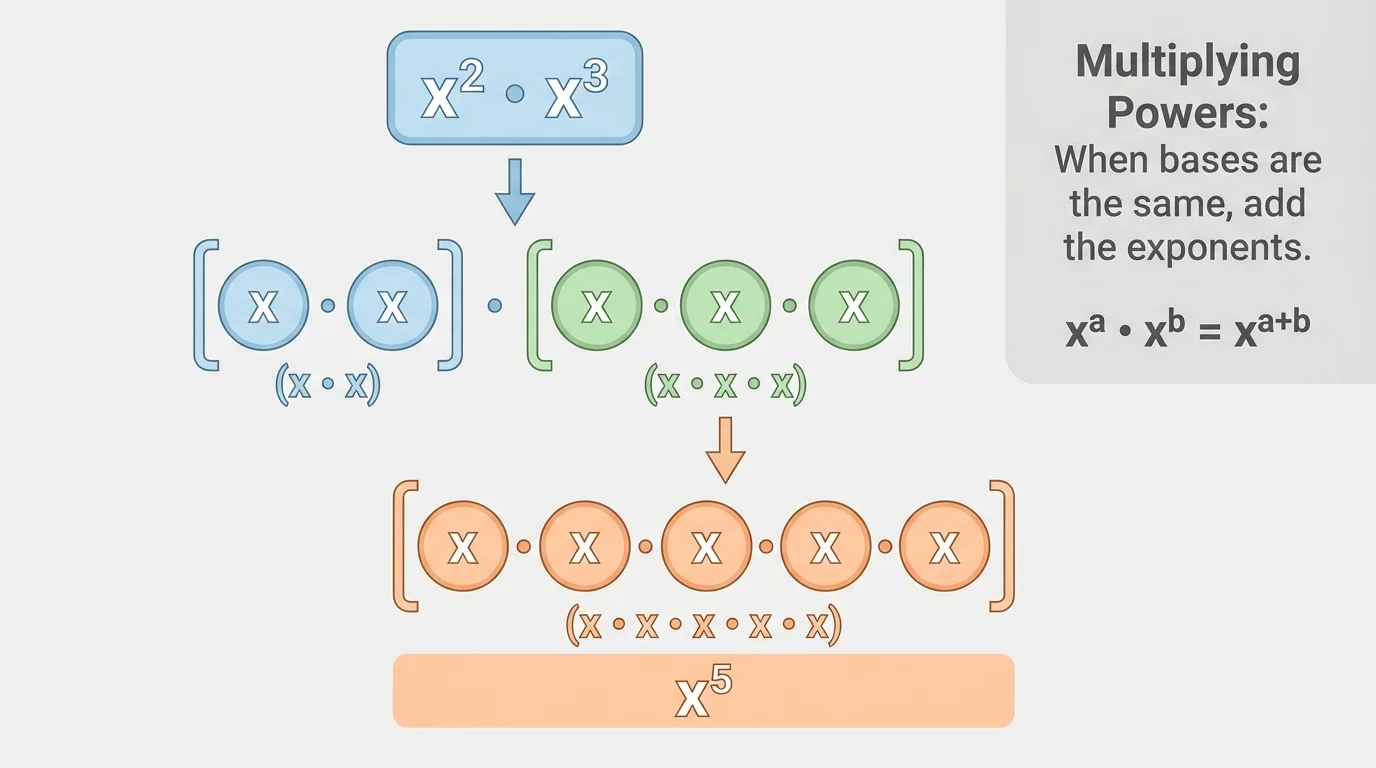
Exponent properties are not random tricks. They come from the meaning of repeated multiplication, and [Figure 2] illustrates this by showing how repeated factors combine when the bases match.
Product of powers: When multiplying powers with the same base, add the exponents. For any nonzero number \(a\) and integers \(m\) and \(n\),
\[a^m \cdot a^n = a^{m+n}\]
Example: \(2^3 \cdot 2^4 = 2^{3+4} = 2^7\). This works because \((2 \cdot 2 \cdot 2)(2 \cdot 2 \cdot 2 \cdot 2)\) is just seven factors of \(2\).
Quotient of powers: When dividing powers with the same base, subtract the exponents.
\[\frac{a^m}{a^n} = a^{m-n}\]
Example: \(\dfrac{5^6}{5^2} = 5^{6-2} = 5^4\). Four factors of \(5\) remain after two common factors cancel.
Power of a power: When raising a power to another power, multiply the exponents.
\[(a^m)^n = a^{mn}\]
Example: \((3^2)^4 = 3^{2 \cdot 4} = 3^8\). This works because \(3^2\) is being used as a factor four times.
Power of a product: When a product is raised to a power, apply the power to each factor.
\[(ab)^n = a^n b^n\]
Example: \((2 \cdot 5)^3 = 2^3 \cdot 5^3 = 8 \cdot 125 = 1{,}000\).
Power of a quotient: When a quotient is raised to a power, apply the power to the numerator and denominator.
\[\left(\frac{a}{b}\right)^n = \frac{a^n}{b^n}\]
Example: \(\left(\dfrac{2}{3}\right)^2 = \dfrac{2^2}{3^2} = \dfrac{4}{9}\).
| Property | Rule | Example |
|---|---|---|
| Product of powers | \(a^m \cdot a^n = a^{m+n}\) | \(4^2 \cdot 4^3 = 4^5\) |
| Quotient of powers | \(\dfrac{a^m}{a^n} = a^{m-n}\) | \(\dfrac{7^5}{7^2} = 7^3\) |
| Power of a power | \((a^m)^n = a^{mn}\) | \((2^3)^2 = 2^6\) |
| Power of a product | \((ab)^n = a^n b^n\) | \((3 \cdot 2)^2 = 3^2 \cdot 2^2\) |
| Power of a quotient | \(\left(\dfrac{a}{b}\right)^n = \dfrac{a^n}{b^n}\) | \(\left(\dfrac{5}{2}\right)^3 = \dfrac{5^3}{2^3}\) |
Table 1. The main properties of integer exponents with examples.
Negative exponents often feel strange at first, but they follow the same pattern as positive exponents. As [Figure 3] shows, a factor with a negative exponent can be rewritten on the other side of a fraction bar with a positive exponent.
Start with the quotient rule: \(\dfrac{a^3}{a^3} = a^{3-3} = a^0\). But any nonzero number divided by itself is \(1\). So \(a^0 = 1\), as long as \(a \neq 0\).
Now look at \(\dfrac{a^2}{a^5} = a^{2-5} = a^{-3}\). Using common factors, \(\dfrac{a^2}{a^5} = \dfrac{1}{a^3}\). So \(a^{-3} = \dfrac{1}{a^3}\).
Why negative exponents are useful
Negative exponents let mathematicians write expressions in a compact way and follow the same exponent rules in every situation. Instead of inventing a new rule for division by powers, we can keep one system: subtract exponents, then rewrite any negative exponent as a reciprocal.
Here are some examples:
\(10^{-2} = \dfrac{1}{10^2} = \dfrac{1}{100}\)
\(4^{-1} = \dfrac{1}{4}\)
\(\dfrac{1}{7^3} = 7^{-3}\)
Also notice a useful fraction idea: if a factor moves from the numerator to the denominator, or from the denominator to the numerator, its exponent changes sign. For example, \(\dfrac{2^3}{5^{-2}} = 2^3 \cdot 5^2\), because the factor \(5^{-2}\) in the denominator becomes \(5^2\) in the numerator.
The best way to learn exponent properties is to simplify carefully and justify each step with a rule.
Worked example 1
Simplify \(3^2 \cdot 3^{-5}\).
Step 1: Use the product of powers rule.
Because the base is the same, add the exponents: \(3^2 \cdot 3^{-5} = 3^{2+(-5)} = 3^{-3}\).
Step 2: Rewrite the negative exponent.
\(3^{-3} = \dfrac{1}{3^3}\).
Step 3: Evaluate if needed.
\(\dfrac{1}{3^3} = \dfrac{1}{27}\).
The simplified equivalent forms are \(3^{-3}\), \(\dfrac{1}{3^3}\), and \(\dfrac{1}{27}\).
This example is important because it shows that one expression can have several correct equivalent forms. Depending on the problem, you may stop at \(3^{-3}\) or rewrite it as \(\dfrac{1}{27}\).
Worked example 2
Simplify \(\dfrac{5^7}{5^3}\).
Step 1: Use the quotient of powers rule.
Subtract the exponents: \(\dfrac{5^7}{5^3} = 5^{7-3} = 5^4\).
Step 2: Evaluate if needed.
\(5^4 = 625\).
The expression simplifies to \(5^4\), or \(625\).
Notice that subtraction works only because the base stays the same. If the bases were different, this rule would not apply.
Worked example 3
Simplify \((2^3)^4\).
Step 1: Use the power of a power rule.
Multiply the exponents: \((2^3)^4 = 2^{3 \cdot 4} = 2^{12}\).
Step 2: Evaluate if needed.
\(2^{12} = 4{,}096\).
The simplified expression is \(2^{12}\), or \(4{,}096\).
Even though the exponents are multiplied here, that does not mean exponents are always multiplied. You multiply exponents only for a power raised to another power.
Worked example 4
Simplify \(\left(\dfrac{2}{3}\right)^{-2}\).
Step 1: Interpret the negative exponent.
A negative exponent means take the reciprocal: \(\left(\dfrac{2}{3}\right)^{-2} = \left(\dfrac{3}{2}\right)^2\).
Step 2: Apply the exponent.
\(\left(\dfrac{3}{2}\right)^2 = \dfrac{3^2}{2^2} = \dfrac{9}{4}\).
The simplified value is \(\dfrac{9}{4}\).
The flow in [Figure 3] matches this example: a negative exponent on a fraction flips the fraction and makes the exponent positive.
Worked example 5
Simplify \((4 \cdot 10^2)(3 \cdot 10^{-5})\).
Step 1: Multiply the numbers and the powers separately.
\((4 \cdot 10^2)(3 \cdot 10^{-5}) = (4 \cdot 3)(10^2 \cdot 10^{-5}) = 12 \cdot 10^{-3}\).
Step 2: Rewrite the negative exponent if desired.
\(12 \cdot 10^{-3} = 12 \cdot \dfrac{1}{10^3} = \dfrac{12}{1{,}000}\).
Step 3: Express as a decimal if desired.
\(\dfrac{12}{1{,}000} = 0.012\).
Equivalent forms are \(12 \cdot 10^{-3}\), \(\dfrac{12}{1{,}000}\), and \(0.012\).
One of the biggest mistakes is using exponent rules when the bases are different. For example, \(2^3 \cdot 3^3\) does not equal \(6^6\). Instead, use the power of a product in reverse: \(2^3 \cdot 3^3 = (2 \cdot 3)^3 = 6^3\).
Another common mistake is thinking \(a^m + a^n = a^{m+n}\). That rule is false for addition. For example, \(2^2 + 2^3 = 4 + 8 = 12\), but \(2^{2+3} = 2^5 = 32\). Exponent rules for adding or subtracting exponents apply to multiplication and division, not addition.
A third mistake is forgetting parentheses. As mentioned earlier, \((-2)^2 = 4\), but \(-2^2 = -4\). Parentheses tell you whether the negative sign is part of the base.
Students also sometimes think \(a^{-n} = -a^n\). That is not true. The correct meaning is \(a^{-n} = \dfrac{1}{a^n}\). For instance, \(3^{-2} = \dfrac{1}{9}\), not \(-9\).
Powers of \(10\) are used so often in science that entire measurement systems rely on them. Terms like kilometer, millimeter, and nanometer all connect to multiplying by powers of \(10\).
The repeated-factor idea from [Figure 2] helps explain why the rules only work in certain situations. If the factors do not match, you cannot combine exponents in the same simple way.
Exponents appear whenever quantities grow, shrink, or scale by repeated factors. In science, powers of \(10\) help describe huge distances in space and tiny measurements in biology. A bacterium might be measured in millionths of a meter, while distances between planets can involve enormous powers of \(10\).
Technology also uses exponents. Digital storage grows by repeated doubling in many systems, and computer processing often involves powers of \(2\). For example, \(2^{10} = 1{,}024\), which is very close to \(1{,}000\), so powers of \(2\) appear in memory sizes and data systems.
Geometry connects to exponents too. If the side length of a square is multiplied by \(3\), then its area is multiplied by \(3^2 = 9\). If the edge length of a cube is multiplied by \(2\), then its volume is multiplied by \(2^3 = 8\). Exponents help describe how changes in length affect area and volume.
The pattern of powers in [Figure 1] also explains scientific notation, where numbers are written using powers of \(10\). A value like \(4.2 \times 10^{-3}\) means \(4.2\) thousandths, or \(0.0042\).
When you simplify, it is smart to check whether two expressions really are equivalent. One way is to use exponent rules. Another way is to evaluate each expression and compare the results.
For example, are \(2^{-4}\) and \(\dfrac{1}{16}\) equivalent? Yes, because \(2^{-4} = \dfrac{1}{2^4} = \dfrac{1}{16}\).
Are \((3^2)^2\) and \(3^4\) equivalent? Yes, because \((3^2)^2 = 3^{2 \cdot 2} = 3^4\).
Are \(4^2 + 4^3\) and \(4^5\) equivalent? No. The first is \(16 + 64 = 80\), while the second is \(1{,}024\).
Equivalent expressions may look different but still represent the same number. This is a big idea in algebra. The more comfortable you become with rewriting powers, the easier later algebra will feel.
"A rule in mathematics is most powerful when you understand why it works."
That is especially true for exponents. If you remember that exponents describe repeated multiplication, the rules make more sense and are easier to apply correctly.
