A lot of formulas in geometry look mysterious at first. Why should a circle's area involve \(\pi r^2\)? Why does a pyramid use the same base-times-height idea as a prism, but then suddenly multiply by \(\dfrac{1}{3}\)? These formulas are not random. They come from patterns in how shapes can be compared, rearranged, and built from layers. Once you see the logic behind them, the formulas become much easier to remember and use.
In geometry, an informal argument is a convincing explanation that uses diagrams, comparisons, slicing, or rearranging shapes. It is not a fully rigorous proof, but it shows why a formula makes sense. This is especially useful for measurement formulas, because many of them come from simple ideas repeated over and over: walking around a boundary, covering a region, or stacking layers to fill space.
These arguments also reveal a big pattern: for many solids, volume depends on a base area and a height. That pattern helps connect circles, cylinders, pyramids, and cones into one coherent picture.
You already know that the area of a rectangle is \(A = lw\), and the volume of a rectangular prism is \(V = lwh\). Another way to write prism volume is \(V = Bh\), where \(B\) is the area of the base. This idea becomes the model for understanding cylinders, pyramids, and cones.
Before working with formulas, it helps to review the basic measurements used in circular and solid figures.
For a circle, the radius is the distance from the center to the circle, and the diameter is twice the radius, so \(d = 2r\). The circumference is the distance around the circle, while the area measures the amount of space inside it.
For a solid, the base area is the area of its base face, and the height is the perpendicular distance from the base to the opposite face or vertex. Volume measures how much three-dimensional space the solid contains.
Circumference is the distance around a circle.
Area is the amount of two-dimensional space inside a shape.
Volume is the amount of three-dimensional space inside a solid.
A useful number for circles is \(\pi\), which is the constant ratio of a circle's circumference to its diameter. In every circle, no matter how large or small, \(\dfrac{C}{d} = \pi\).
The formula for the circumference of a circle is
\(C = 2\pi r\)
An informal argument begins with the fact that all circles are similar. If one circle has twice the diameter of another, then every length around the circle also doubles. That means circumference must be proportional to diameter. So there must be some constant number \(k\) such that \(C = kd\).
Experiments with circles show that this constant is always the same number, \(\pi\). So \(C = \pi d\). Since \(d = 2r\), substitute to get
\[C = \pi(2r) = 2\pi r\]
This is an informal but powerful idea: the distance around a circle depends only on how wide the circle is, and the constant of proportionality is \(\pi\). If you have ever wrapped a string around a circular lid and then compared that string length to the lid's diameter, you have physically tested this relationship.
The number \(\pi\) is irrational, which means its decimal form never ends and never repeats. Even though it goes on forever, the same number appears in every circle.
It is also worth noticing that circumference is a linear measurement. If the radius doubles, the circumference doubles. That is different from area and volume, which change more dramatically when dimensions increase.
The area formula for a circle is
\(A = \pi r^2\)
One of the best informal arguments for this formula comes from cutting a circle into many narrow sectors, like slices of pizza. As [Figure 1] shows, if you rearrange those sectors by alternating them up and down, the new shape begins to look like a parallelogram or rectangle. The more sectors you cut, the closer the rearranged shape gets to a true rectangle.
In that rearranged shape, the height is about the radius, \(r\). The base is about half the circumference, because half the curved edges go on the bottom and half go on the top. Since the full circumference is \(2\pi r\), half of it is \(\pi r\).
So the area is approximately
\[A = (\textrm{base})(\textrm{height}) = (\pi r)(r) = \pi r^2\]
This argument is informal because the rearranged shape is not exactly a rectangle unless we imagine infinitely many tiny sectors. But it clearly explains where the formula comes from: the circle can be reorganized into a shape whose dimensions are tied to half the circumference and the radius.
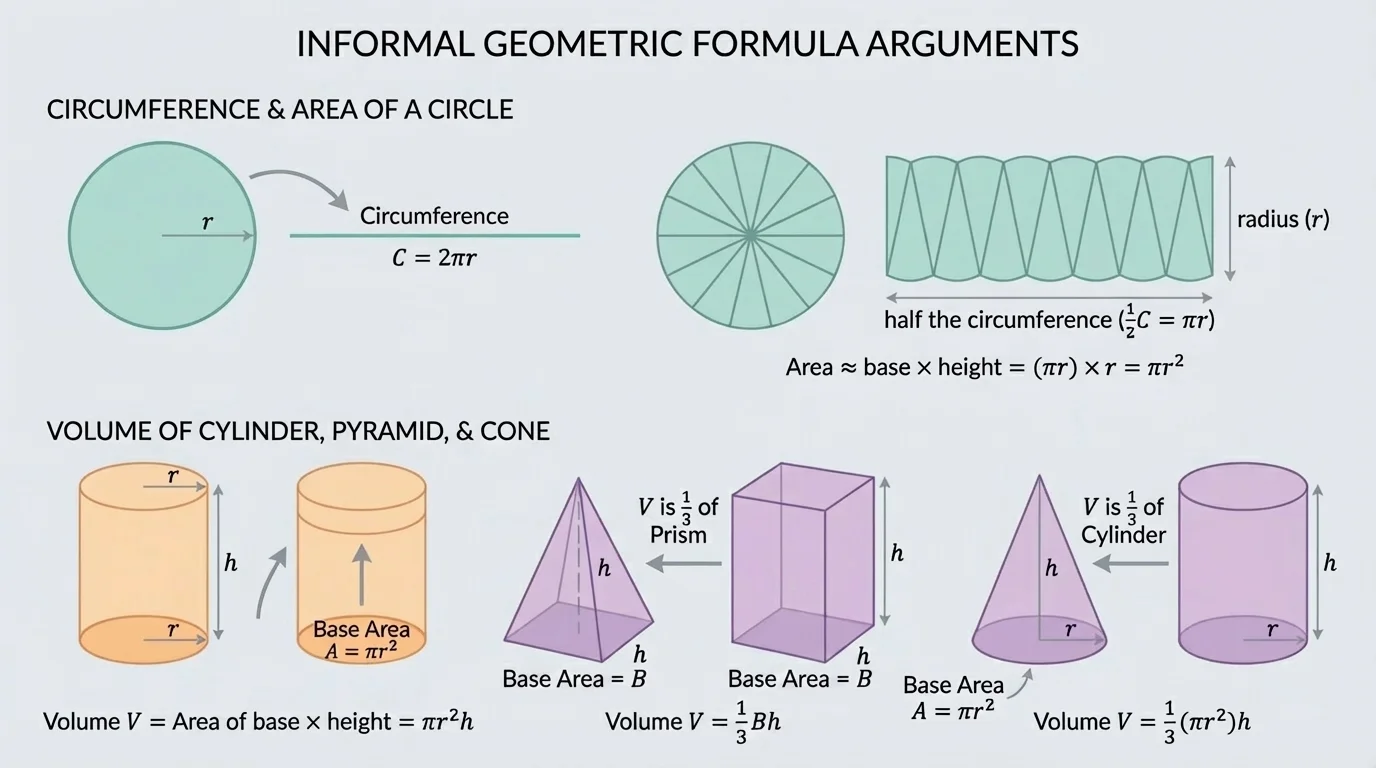
There is another intuitive way to think about the same formula. A circle grows outward from its center. If the radius gets larger, the area depends on how far the circle extends in two dimensions, which is why the radius is squared. The factor \(\pi\) appears because the shape is circular rather than square.
Later, when comparing formulas, it helps to remember the sector-rearrangement picture from [Figure 1], because it explains why area is connected to both the radius and the circumference.
A cylinder can be thought of as a stack of congruent circular layers, as [Figure 2] illustrates. Every layer has the same area, because each cross-section parallel to the base is the same circle.
If one thin layer has area \(B\), then stacking those layers through a height of \(h\) gives a volume equal to base area times height. This is exactly the same idea used for any prism.
So the volume of a cylinder is
\(V = Bh\)
Since the base is a circle of radius \(r\), the base area is \(B = \pi r^2\). Substituting gives
\[V = \pi r^2 h\]
This formula makes sense because the cylinder does not taper or narrow. Every slice has the same size, so volume builds at a constant rate as height increases. That is why multiplying one layer's area by the total height works so naturally.
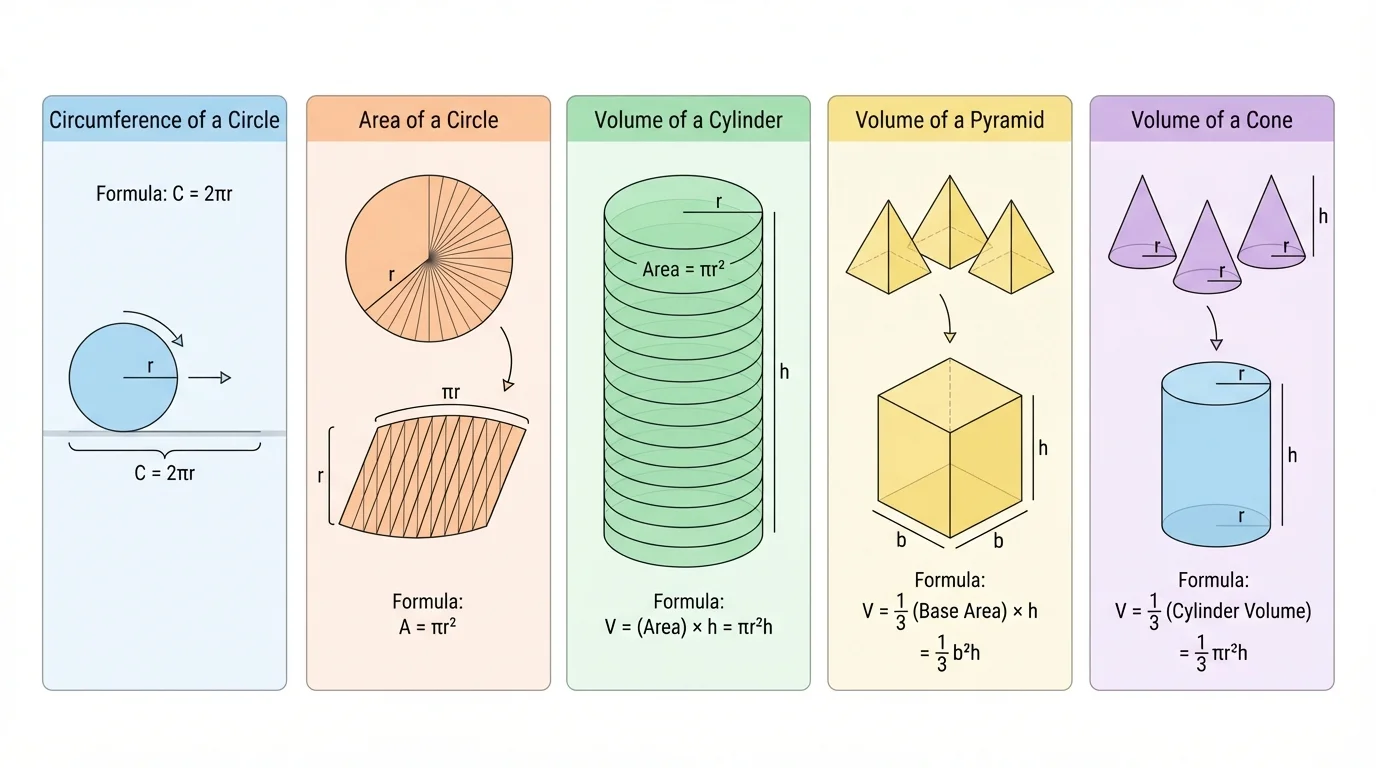
If the radius doubles, each circular layer becomes four times as large because area depends on \(r^2\). So the volume also becomes four times as large if the height stays the same. This shows how strongly area controls volume in circular solids.
Base-area times height
For prisms and cylinders, volume comes from stacking identical cross-sections. If each layer has area \(B\) and the layers extend through height \(h\), then the total volume is \(Bh\). This idea becomes the starting point for understanding why pyramids and cones use only one-third of that amount.
The stacked-layer model from [Figure 2] is also useful in science and engineering, where tanks, pipes, and columns are often modeled as cylinders.
A pyramid has a polygon base and triangular faces meeting at one vertex. Its volume formula is
\[V = \frac{1}{3}Bh\]
[Figure 3] To understand the factor of \(\dfrac{1}{3}\), compare a pyramid with a prism that has the same base area and the same height. The prism keeps the same cross-sectional area all the way up, but the pyramid gets narrower as you move toward the top.
One informal argument comes from comparing cross-sections of a pyramid and a prism with the same base area and height. The prism keeps full-size slices all the way up, while the pyramid's slices shrink as the height increases. This suggests that the pyramid occupies only a fraction of the prism-like space determined by the same base and height. More generally, geometry shows that a pyramid takes exactly one-third of the volume of a prism with equal base area and height.
So if the prism volume is \(Bh\), the pyramid volume must be
\[V = \frac{1}{3}Bh\]
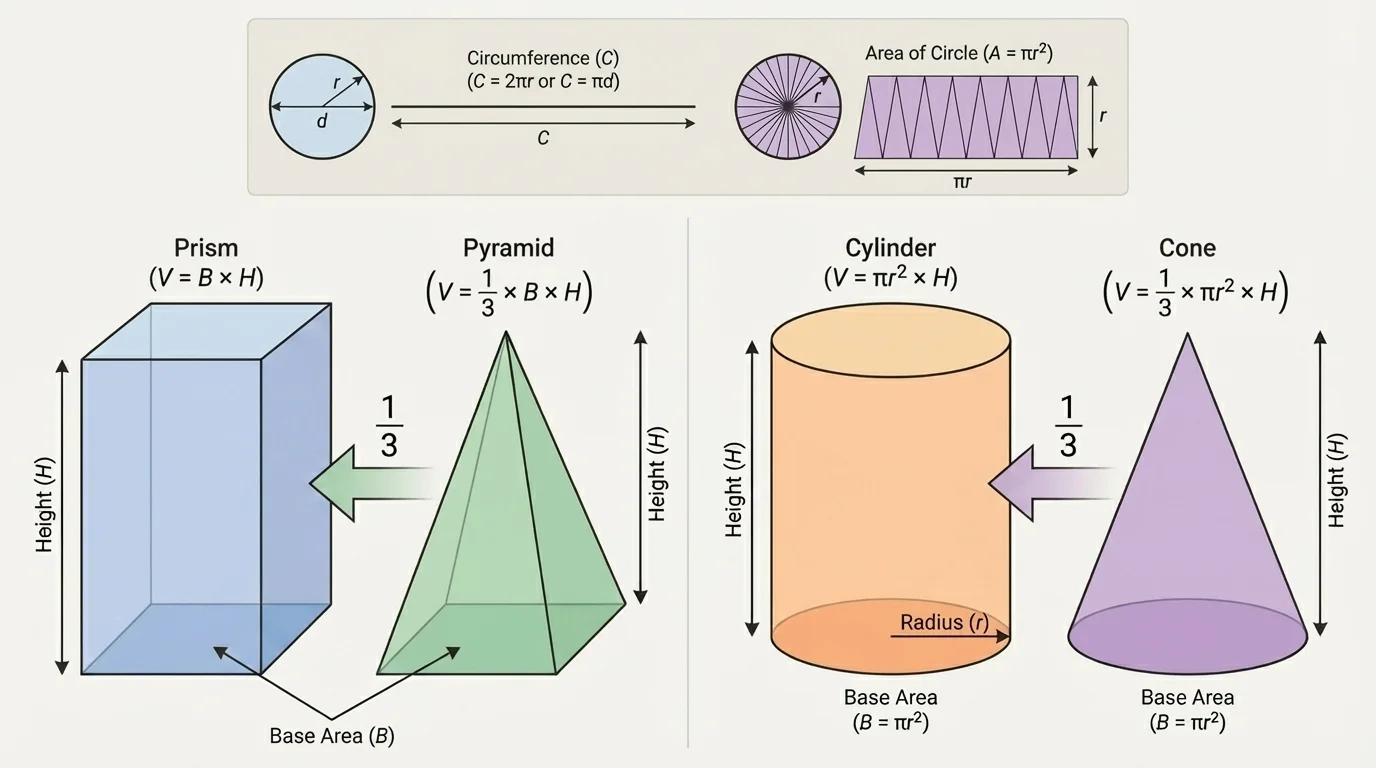
The factor \(\dfrac{1}{3}\) appears because the pyramid narrows steadily to a point. Unlike a prism or cylinder, it does not keep full-size cross-sections throughout its height. Much of the space near the top contains much smaller slices.
A cone is to a cylinder what a pyramid is to a prism. It has a circular base and narrows to a single vertex. Its volume formula is
\[V = \frac{1}{3}Bh\]
Since the base is a circle, \(B = \pi r^2\), so the cone formula becomes
\[V = \frac{1}{3}\pi r^2 h\]
An informal argument compares a cone and a cylinder with the same base radius and height. The cylinder has full-size circular cross-sections all the way up, while the cone's circular slices shrink steadily as they approach the tip. For that reason, the cone must have less volume than the cylinder.
Experiments with sand or water often demonstrate that it takes about three identical cones to fill one cylinder with the same base and height. That physical model strongly supports the formula \(V = \dfrac{1}{3}Bh\). The same one-third relationship seen for pyramids appears again here.
This parallel is important: a pyramid and a cone are both pointed solids, and both use one-third of the corresponding prism or cylinder volume.
The formulas are easier to remember when you see how they connect.
| Shape | Main measurement formula | Key idea behind it |
|---|---|---|
| Circle | \(C = 2\pi r\) | Circumference is proportional to diameter |
| Circle | \(A = \pi r^2\) | Rearranged sectors form an almost-rectangle |
| Cylinder | \(V = \pi r^2 h\) | Stack of equal circular layers |
| Pyramid | \(V = \dfrac{1}{3}Bh\) | One-third of a prism with same base and height |
| Cone | \(V = \dfrac{1}{3}\pi r^2 h\) | One-third of a cylinder with same base and height |
Table 1. A comparison of the main formulas and the informal ideas that justify them.
Notice the pattern: circles introduce \(\pi\), because they involve circular distance or area. Solids are built from base area and height. Pointed solids, like pyramids and cones, use the extra factor \(\dfrac{1}{3}\).
These examples show how the formulas are used once their meaning is understood.
Worked example 1
A circle has radius \(7 \textrm{ cm}\). Find its circumference and area.
Step 1: Use the circumference formula.
Substitute \(r = 7\) into \(C = 2\pi r\): \(C = 2\pi(7) = 14\pi\).
Step 2: Use the area formula.
Substitute \(r = 7\) into \(A = \pi r^2\): \(A = \pi(7^2) = 49\pi\).
The circle has circumference \(14\pi \textrm{ cm}\) and area \(49\pi \textrm{ cm}^2\).
Notice how circumference depends on one power of radius, while area depends on two. That difference reflects the difference between measuring a boundary and covering a region.
Worked example 2
A cylinder has radius \(3 \textrm{ m}\) and height \(10 \textrm{ m}\). Find its volume.
Step 1: Write the formula.
For a cylinder, \(V = \pi r^2 h\).
Step 2: Substitute the values.
\(V = \pi(3^2)(10) = \pi(9)(10) = 90\pi\).
Step 3: State the units.
Volume is measured in cubic units, so the answer is \(90\pi \textrm{ m}^3\).
The cylinder's volume is \(90\pi \textrm{ m}^3\).
This result matches the informal argument: the base area is \(9\pi\), and stacking that area through height \(10\) gives \(90\pi\).
Worked example 3
A square pyramid has base side length \(6 \textrm{ cm}\) and height \(9 \textrm{ cm}\). Find its volume.
Step 1: Find the base area.
The base is a square, so \(B = 6^2 = 36\).
Step 2: Use the pyramid formula.
\(V = \dfrac{1}{3}Bh = \dfrac{1}{3}(36)(9)\).
Step 3: Simplify.
\(\dfrac{1}{3}(36)(9) = 12 \cdot 9 = 108\).
The pyramid's volume is \(108 \textrm{ cm}^3\).
The one-third factor is the key difference between this calculation and the volume of a prism with the same base and height, which would be \(36 \cdot 9 = 324\).
Worked example 4
A cone has radius \(4 \textrm{ in}\) and height \(12 \textrm{ in}\). Find its volume.
Step 1: Write the formula.
For a cone, \(V = \dfrac{1}{3}\pi r^2 h\).
Step 2: Substitute.
\(V = \dfrac{1}{3}\pi(4^2)(12) = \dfrac{1}{3}\pi(16)(12)\).
Step 3: Simplify.
\(\dfrac{1}{3} \cdot 16 \cdot 12 = 64\), so \(V = 64\pi\).
The cone's volume is \(64\pi \textrm{ in}^3\).
Because the cone and cylinder formulas are so similar, many mistakes happen when students forget the factor \(\dfrac{1}{3}\). Keeping the cylinder-cone comparison in mind helps prevent that error.
These formulas are used constantly in architecture, manufacturing, and engineering. A circular running track, a storage tank, a silo, a funnel, and a pyramid-shaped roof all involve the same geometric ideas.
For example, if an engineer needs to know how much concrete is required for a cylindrical column, the volume formula \(V = \pi r^2 h\) gives the amount of material. If a designer is creating a conical hopper that feeds grain into a machine, \(V = \dfrac{1}{3}\pi r^2 h\) tells how much the hopper can hold.
Even area of a circle has practical value. Solar dishes, round tabletops, circular garden beds, and pipe openings all require circular area calculations. Circumference matters in motion and design, such as wheel rotation, belt lengths in machines, and circular fencing.
"Geometry is not just about shapes; it is about seeing structure in space."
Once you understand the structure, formulas stop being isolated facts. They become predictable results of a few big ideas: proportionality for circumference, rearrangement for area, and layered filling for volume.
One common mistake is confusing radius and diameter. Since \(d = 2r\), using the diameter in place of the radius can double or even quadruple an answer incorrectly, depending on the formula.
Another common mistake is mixing up circumference and area. Circumference measures distance around the edge, so its units are linear, such as centimeters. Area measures surface, so its units are square units, such as \(\textrm{cm}^2\). Volume uses cubic units, such as \(\textrm{cm}^3\).
Students also sometimes think the one-third factor in pyramids and cones is arbitrary. It is not. It reflects the fact that these solids narrow to a point, so they occupy only one-third of the volume of the matching prism or cylinder.
Finally, remember that formulas do not replace understanding. If you can explain why the circle sectors form an almost-rectangle, why a cylinder acts like stacked disks, and why a cone is one-third of a cylinder with the same base and height, then you truly understand the formulas instead of only memorizing them.
