A single sign change can completely change the solution to a problem. In engineering, finance, and science, solving an equation like \(3x-7=11\) tells you the exact value of an unknown, while solving an inequality like \(3x-7>11\) tells you a whole range of values that are allowed. That difference matters: one gives a target, the other gives a boundary. Learning to solve both accurately is one of the foundations of algebra.
A linear equation in one variable is an equation that can be written in a form equivalent to \(ax+b=c\), where \(x\) is the variable and \(a\), \(b\), and \(c\) are constants. The variable has exponent \(1\), so the equation is not quadratic, exponential, or more complicated.
A linear inequality in one variable is similar, but it uses an inequality symbol such as \(<\), \(>\), \(\le\), or \(\ge\). For example, \(2x+5\le17\) asks for all values of \(x\) that make the statement true.
A solution to an equation is any value of the variable that makes the equation true. A solution to an inequality is any value that makes the inequality true. An equation often has one solution, no solution, or infinitely many solutions. An inequality usually has a range of solutions.
Equation: a statement that two expressions are equal.
Inequality: a statement that compares two expressions using symbols such as \(<\), \(>\), \(\le\), or \(\ge\).
Equivalent equations or inequalities: different-looking statements that have exactly the same solution set.
The big idea is that algebraic solving is not guessing. It is a sequence of logical moves that produces an equivalent statement while making the variable easier to isolate.
When solving, we use operations that preserve truth. If two expressions are equal, adding the same number to both sides keeps them equal. The same is true for subtraction, multiplication by a nonzero number, and division by a nonzero number. These are the properties of equality.
For inequalities, the same basic idea works with one major warning. You may add or subtract the same number on both sides without changing the direction of the inequality. You may also multiply or divide by a positive number without changing the inequality sign. But if you multiply or divide by a negative number, you must reverse the inequality sign. For example, from \(-2x>6\), dividing by \(-2\) gives \(x<-3\), not \(x>-3\).
Before solving multi-step problems, remember three earlier skills: combine like terms, use the distributive property correctly, and keep track of negative signs. Many algebra errors happen before the actual solving step.
These rules are not random. They come from how numbers behave. For instance, multiplying by \(-1\) flips the order of numbers on the number line: if \(2<5\), then \(-2>-5\).
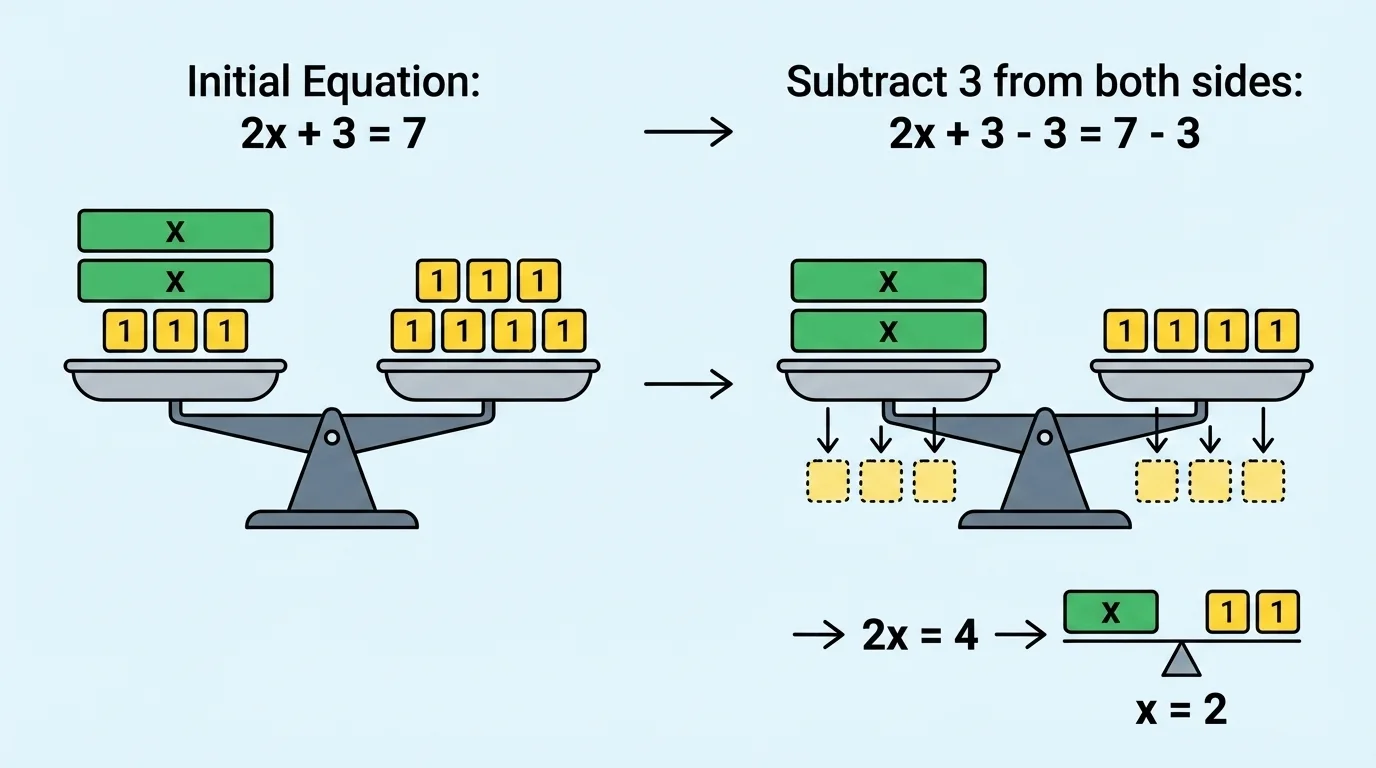
Solving a linear equation means isolating the variable while preserving equality, as [Figure 1] shows with a balance model. If both sides of an equation represent the same quantity, doing the same operation to both sides keeps the equation balanced.
A common strategy is to distribute if needed, combine like terms, move variable terms to one side, move constants to the other side, and then divide by the coefficient of the variable.
For example, to solve \(4x+9=25\), subtract \(9\) from both sides to get \(4x=16\), then divide by \(4\) to get \(x=4\). You can check by substitution: \(4(4)+9=16+9=25\), which is true.
Equations can become more interesting when variables appear on both sides. Consider \(5x-3=2x+12\). Subtract \(2x\) from both sides: \(3x-3=12\). Add \(3\): \(3x=15\). Divide by \(3\): \(x=5\).
Another frequent feature is distribution. In \(3(x-4)=2x+1\), first distribute: \(3x-12=2x+1\). Then subtract \(2x\): \(x-12=1\). Finally add \(12\): \(x=13\).
Worked example 1
Solve \(7x-5=23\).
Step 1: Add \(5\) to both sides.
\(7x-5+5=23+5\), so \(7x=28\).
Step 2: Divide both sides by \(7\).
\(x=4\).
Step 3: Check the solution.
Substitute \(x=4\): \(7(4)-5=28-5=23\).
The solution is \(\boxed{x=4}\).
Fractions do not change the logic, but they do require careful arithmetic. Often the easiest first move is to multiply both sides by the least common denominator.
Worked example 2
Solve \(\dfrac{x}{3}+\dfrac{1}{2}=\dfrac{5}{2}\).
Step 1: Multiply both sides by the least common denominator, which is \(6\).
\(6\left(\dfrac{x}{3}\right)+6\left(\dfrac{1}{2}\right)=6\left(\dfrac{5}{2}\right)\).
This simplifies to \(2x+3=15\).
Step 2: Subtract \(3\) from both sides.
\(2x=12\).
Step 3: Divide by \(2\).
\(x=6\).
The solution is \(\boxed{x=6}\).
As seen earlier in [Figure 1], each move in a solution process should act like removing or adding equal amounts on both sides of a balanced scale. That mental model helps prevent illegal shortcuts.
More complicated equations are still solved using the same small set of ideas. The challenge is organization, not new rules.
Worked example 3
Solve \(2(3x-4)-5=x+10\).
Step 1: Distribute.
\(6x-8-5=x+10\), so \(6x-13=x+10\).
Step 2: Move variable terms to one side.
Subtract \(x\) from both sides: \(5x-13=10\).
Step 3: Move constants to the other side.
Add \(13\): \(5x=23\).
Step 4: Divide by the coefficient.
\(x=\dfrac{23}{5}\).
The solution is \(\boxed{x=\dfrac{23}{5}}\).
Notice that the answer does not need to be an integer. Linear equations can have fractional or decimal solutions.
Many computer programs that simulate motion, economics, or electrical systems repeatedly solve linear equations. More advanced systems solve thousands or millions of them at once.
Checking matters, especially when distribution or fractions are involved. A correct check confirms both arithmetic and logic.
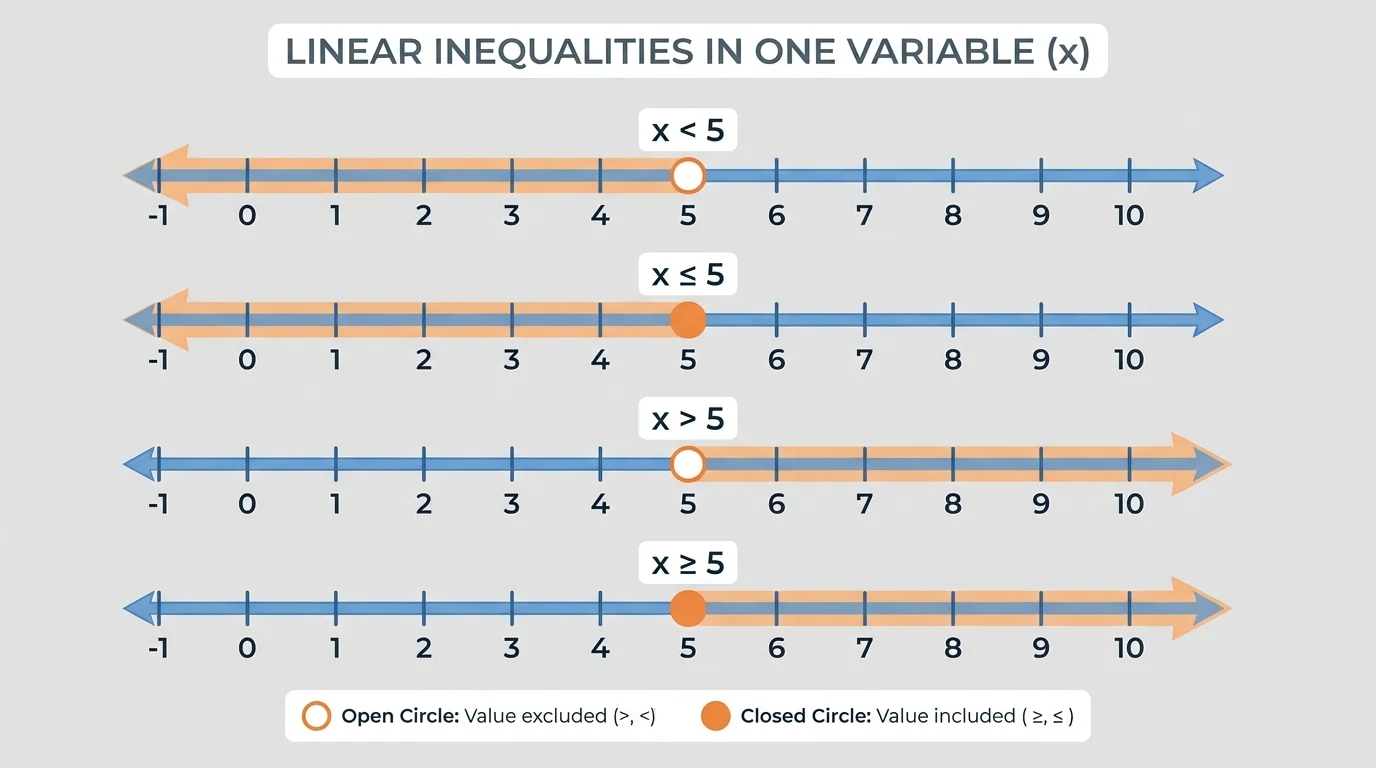
A linear inequality is solved much like a linear equation, but its solution is usually a set of numbers rather than one number. A number line picture, as [Figure 2] illustrates, helps show whether an endpoint is included and which direction the solutions extend.
For example, solve \(3x-4<11\). Add \(4\): \(3x<15\). Divide by \(3\): \(x<5\). This means every number less than \(5\) is a solution.
The symbol matters. If the inequality is \(x\le5\), then \(5\) itself is included. If it is \(x<5\), then \(5\) is not included.
The most important caution is the reversal rule. If you multiply or divide by a negative number, reverse the inequality sign. For example, solving \(-4x+1\ge13\) gives \(-4x\ge12\), and then dividing by \(-4\) gives \(x\le-3\).
This reversal is not optional. It reflects the fact that negative multiplication reverses order on the number line. Later, when solving formulas or literal inequalities, this same idea becomes even more important.
Worked example 4
Solve \(-2x+7>15\).
Step 1: Subtract \(7\) from both sides.
\(-2x>8\).
Step 2: Divide by \(-2\) and reverse the inequality sign.
\(x<-4\).
Step 3: Check with a test value.
Choose \(x=-5\), which is less than \(-4\). Then \(-2(-5)+7=17\), and \(17>15\) is true.
The solution set is \(\boxed{x<-4}\).
As shown on the number line in [Figure 2], an open circle is used for \(<\) or \(>\), and a closed circle is used for \(\le\) or \(\ge\).
Just like equations, inequalities may involve distribution and variables on both sides.
Worked example 5
Solve \(4(x-1)\le2x+10\).
Step 1: Distribute.
\(4x-4\le2x+10\).
Step 2: Move variable terms to one side.
Subtract \(2x\): \(2x-4\le10\).
Step 3: Move constants.
Add \(4\): \(2x\le14\).
Step 4: Divide by \(2\).
\(x\le7\).
The solution is \(\boxed{x\le7}\).
Sometimes every value works, and sometimes none do. For example, \(2x+3>2x-1\) becomes \(3>-1\), which is always true, so every real number is a solution. But \(5x+2<5x-4\) becomes \(2<-4\), which is never true, so there is no solution.
| Result after simplifying | Meaning | Conclusion |
|---|---|---|
| \(x=5\) | One exact value works | One solution |
| True statement such as \(4=4\) | All values satisfy the equation | Infinitely many solutions |
| False statement such as \(4=9\) | No value satisfies the equation | No solution |
| True inequality such as \(2<5\) | Every value satisfies the inequality | All real numbers |
| False inequality such as \(7\le1\) | No value satisfies the inequality | No solution |
Table 1. Common outcomes after simplifying linear equations and inequalities.
Algebra becomes more powerful when numbers are replaced by letters. In these problems, letters can represent any constants, often called coefficients or parameters. A general equation such as \(ax+b=c\) may look simple, but it contains many possible cases, as [Figure 3] makes clear.
If \(a\ne0\), solve exactly as usual: subtract \(b\) from both sides and divide by \(a\).
This gives the important general result:
\[x=\frac{c-b}{a}\]
provided that \(a\ne0\).
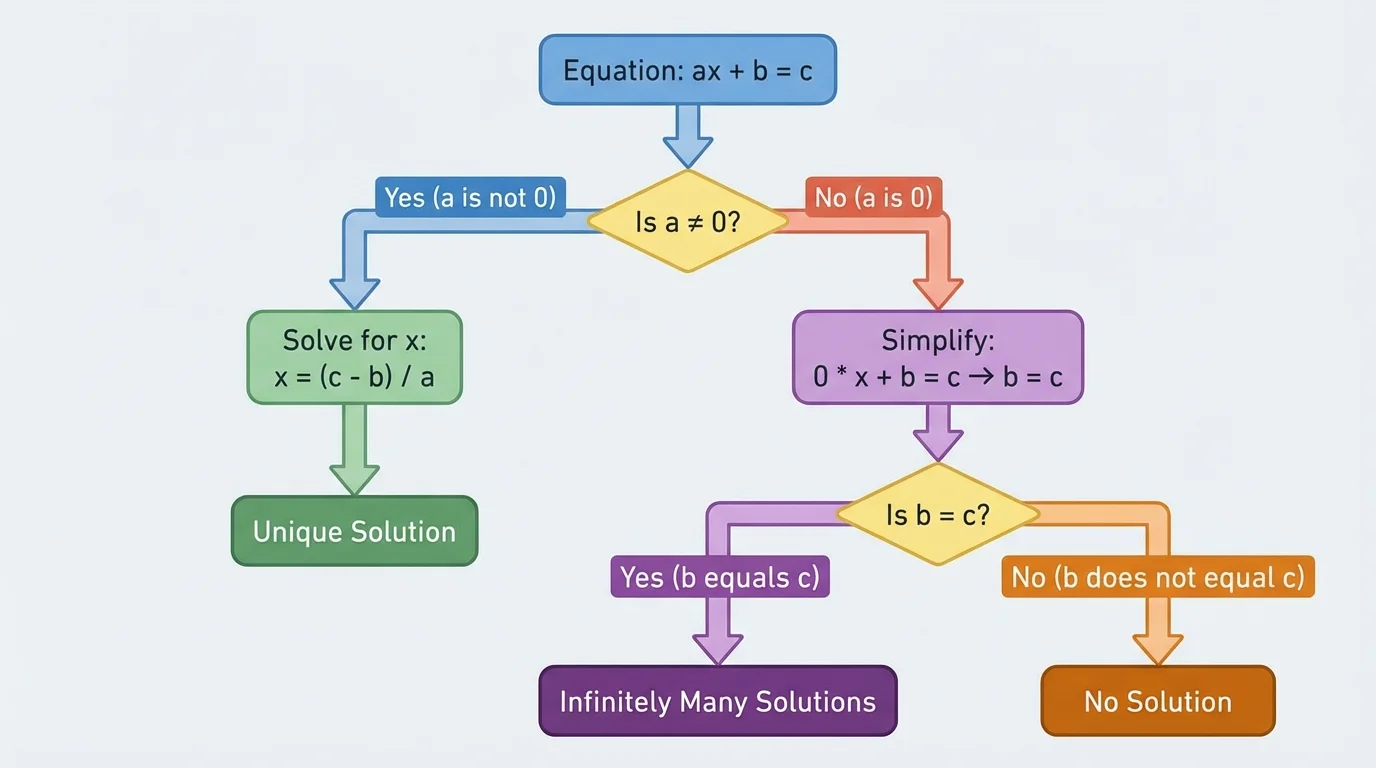
If \(a=0\), then the equation \(ax+b=c\) becomes \(b=c\). Now the variable disappears. If \(b=c\), the equation is true for every value of \(x\), so there are infinitely many solutions. If \(b\ne c\), the equation is false, so there is no solution.
Why literal coefficients matter
Using letters for coefficients lets one solution method describe an entire family of equations. This is essential in higher algebra, physics formulas, and geometry, where the relationship matters more than one specific set of numbers.
Consider \(mx+7=3\). If \(m\ne0\), then \(mx=-4\), so \(x=-\dfrac{4}{m}\). But if \(m=0\), the equation becomes \(7=3\), which is impossible. So the expression \(x=-\dfrac{4}{m}\) is valid only when \(m\ne0\).
Worked example 6
Solve \(ax-5=2a+1\) for \(x\).
Step 1: Add \(5\) to both sides.
\(ax=2a+6\).
Step 2: Divide by \(a\), assuming \(a\ne0\).
\(x=\dfrac{2a+6}{a}\).
Step 3: State the condition.
This solution requires \(a\ne0\). If \(a=0\), the original equation becomes \(-5=1\), which has no solution.
So the solution is \(\boxed{x=\dfrac{2a+6}{a}}\) for \(a\ne0\), and there is no solution when \(a=0\).
Looking back at [Figure 3], the key question in literal equations is often whether the coefficient of the variable can be zero. That one detail determines whether dividing is legal and whether the equation has one solution, none, or infinitely many.
One common error is forgetting to distribute to every term. For example, \(3(x-2)\) means \(3x-6\), not \(3x-2\).
Another common error is combining unlike terms. Expressions such as \(2x+5\) cannot be simplified to \(7x\) because \(2x\) and \(5\) are not like terms.
A third major error is failing to reverse an inequality sign after dividing by a negative number. In many incorrect solutions, every step looks reasonable until that one moment.
"Algebra is the art of doing the same thing to both sides, but knowing exactly when that changes the meaning."
Also watch for denominators. If an equation contains a variable in the denominator, there may be values that are not allowed. Even in simpler linear problems, division by zero is never permitted.
Linear equations and inequalities are not just classroom exercises. They describe thresholds, costs, and decisions.
Suppose a streaming service charges a basic fee of $8 plus $2 per movie. If the monthly total is $24, then the number of movies \(m\) satisfies \(8+2m=24\). Solving gives \(2m=16\), so \(m=8\).
Now suppose you want to spend no more than $30. Then the inequality is \(8+2m\le30\). Subtract \(8\): \(2m\le22\). Divide by \(2\): \(m\le11\). You can watch at most \(11\) movies.
Temperature safety limits also use inequalities. If a machine must stay below \(90\) degrees and its temperature is modeled by \(T=12t+30\), where \(t\) is time in hours, then the condition is \(12t+30<90\). Solving gives \(12t<60\), so \(t<5\). The machine can run for less than \(5\) hours before crossing the limit.
Worked example 7
A concert hall sells student tickets for $12 each and already collected $180 in fees. If the total revenue is at least $600, how many student tickets \(n\) must be sold?
Step 1: Write an inequality.
\(12n+180\ge600\).
Step 2: Subtract \(180\).
\(12n\ge420\).
Step 3: Divide by \(12\).
\(n\ge35\).
The solution is \(\boxed{n\ge35}\), so the hall must sell at least \(35\) student tickets.
These applications all rely on the same algebraic reasoning: represent the situation, preserve equivalence while solving, and interpret the answer in context.
