A GPS app, a radar screen, and the ripple from a dropped stone all have something in common: they are built on the idea of points that stay the same distance from a center. That simple idea creates one of the most important shapes in mathematics: the circle. In coordinate geometry, a circle is not just a picture; it is an equation you can derive, analyze, and transform. Once you understand where that equation comes from, geometry and algebra start working together in a powerful way.
A circle is the set of all points in a plane that are a fixed distance from one point called the center. That fixed distance is the radius. If the center is at the origin, then any point \( (x,y) \) on the circle must satisfy a distance relationship. If the center is not at the origin, the same idea still works, but we measure distance from a shifted point.
To turn this geometric description into an algebraic equation, we use distance in the coordinate plane. That distance comes from the Pythagorean Theorem, which connects horizontal change and vertical change to the straight-line distance between two points.
The Pythagorean Theorem says that for a right triangle with legs \(a\) and \(b\), and hypotenuse \(c\),
\(a^2+b^2=c^2\)
On the coordinate plane, horizontal and vertical distances form the legs of a right triangle, and the distance between points is the hypotenuse.
This is why circles and the Pythagorean Theorem are so closely connected. A circle is really a distance rule written in algebra.
Suppose a circle has center \((h,k)\) and radius \(r\). Any point \((x,y)\) on that circle is exactly \(r\) units from the center, as [Figure 1] shows through a right triangle built from horizontal and vertical distances.
The horizontal distance from \((h,k)\) to \((x,y)\) is \(x-h\). The vertical distance is \(y-k\). These distances can be positive or negative, but when we square them, the direction no longer matters.
Using the Pythagorean Theorem, we get
\[(x-h)^2+(y-k)^2=r^2\]
This is the standard form of a circle. It tells you immediately that the center is \((h,k)\) and the radius is \(r\).
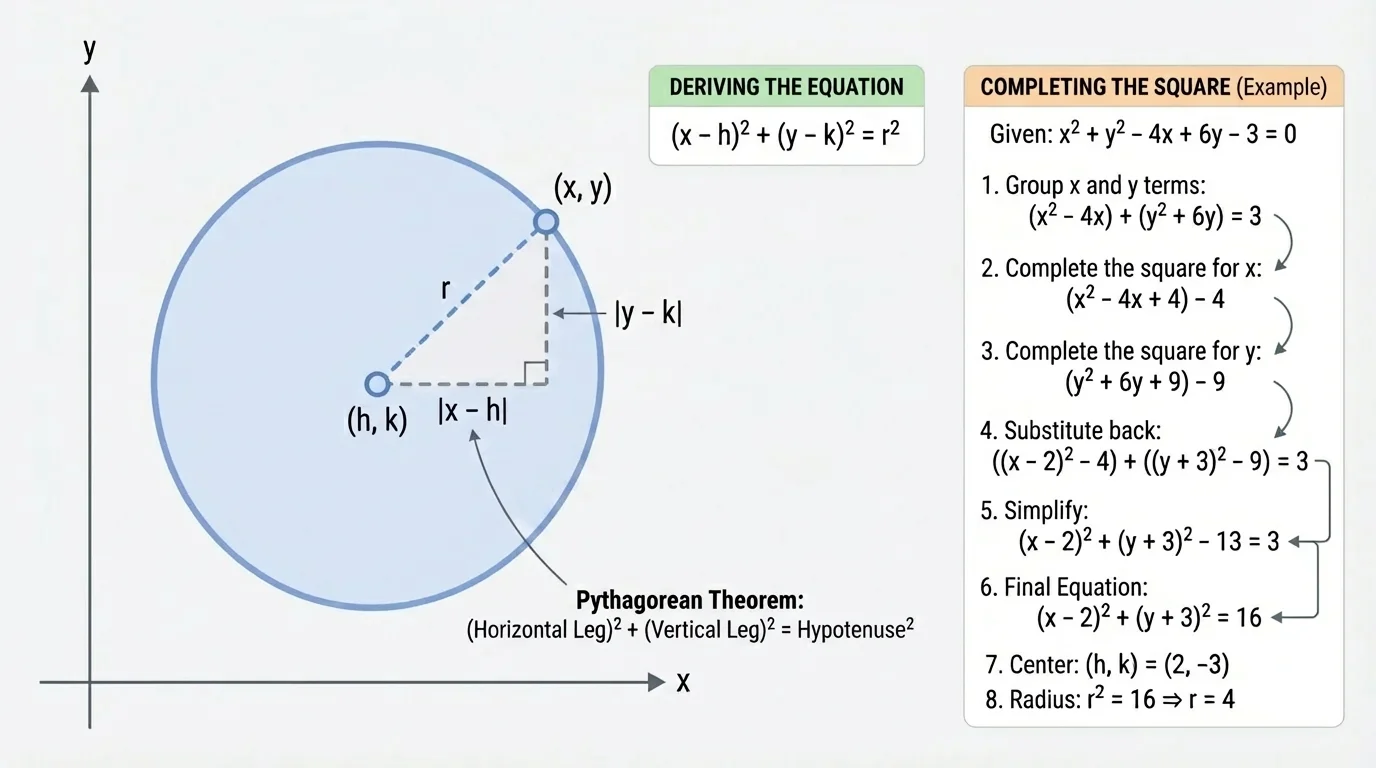
Notice what the equation means: every point \((x,y)\) whose horizontal and vertical distances from the center satisfy this equation lies on the circle. The equation does not describe just one point. It describes an entire set of points.
If the center is the origin, then \(h=0\) and \(k=0\). The equation becomes
\(x^2+y^2=r^2\)
This is the simplest circle equation. For example, \(x^2+y^2=25\) is a circle centered at \((0,0)\) with radius \(5\).
Center is the fixed point from which all points on the circle are the same distance.
Radius is that constant distance from the center to any point on the circle.
Standard form of a circle is the equation \((x-h)^2+(y-k)^2=r^2\), where \((h,k)\) is the center and \(r\) is the radius.
A useful detail is the sign pattern. In standard form, the values inside the parentheses are opposite the coordinates of the center. For example, \((x-4)^2+(y+1)^2=9\) has center \((4,-1)\), not \((-4,1)\).
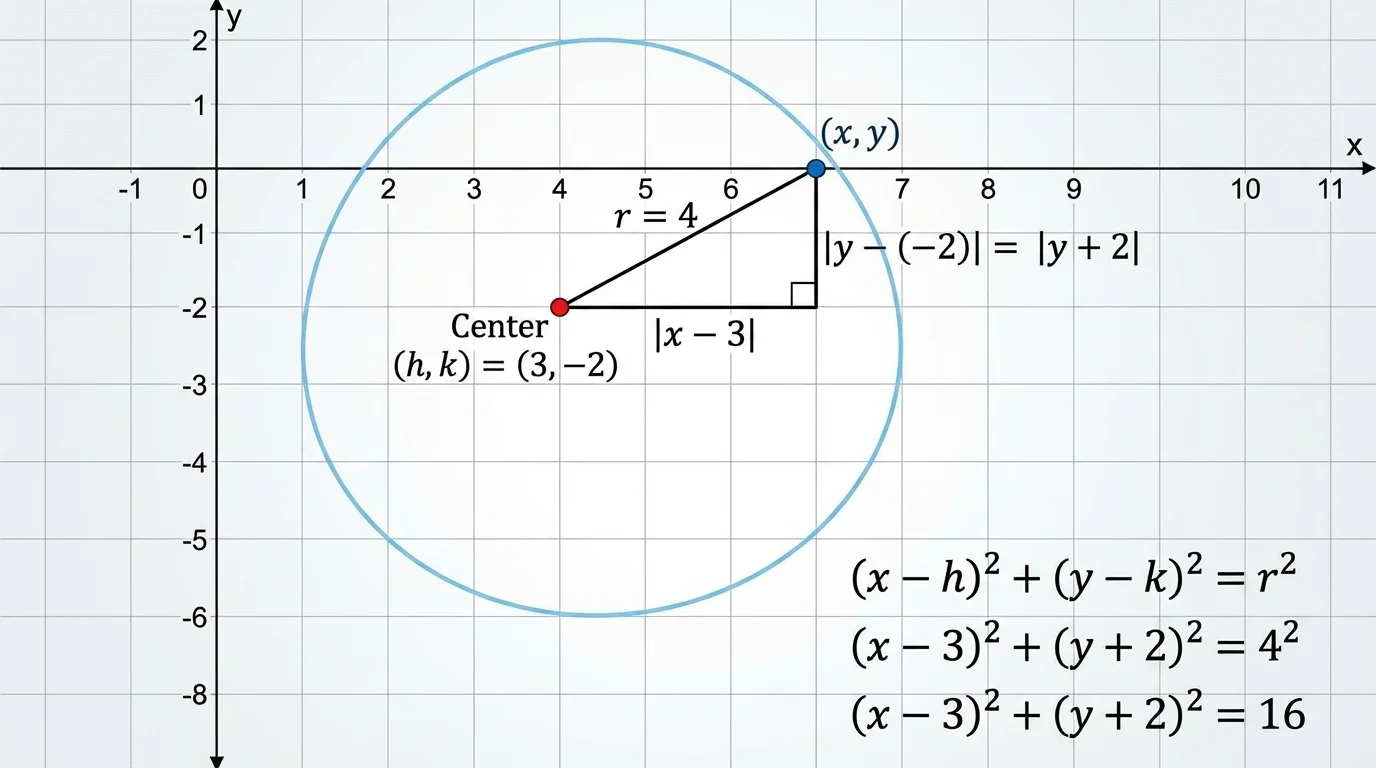
Once a circle is written in standard form, you can read its key features almost instantly, and [Figure 2] illustrates how the graph matches the equation.
For a circle written as \((x-h)^2+(y-k)^2=r^2\):
Be careful with signs. In the expression \((x+3)^2\), the center's \(x\)-coordinate is \(-3\). In \((y-7)^2\), the center's \(y\)-coordinate is \(7\).
Here are a few quick readings:
| Equation | Center | Radius |
|---|---|---|
| \((x-2)^2+(y-5)^2=16\) | \((2,5)\) | \(4\) |
| \((x+1)^2+(y-3)^2=49\) | \((-1,3)\) | \(7\) |
| \(x^2+(y+6)^2=1\) | \((0,-6)\) | \(1\) |
Table 1. Examples of circles in standard form with their centers and radii.
As seen earlier in [Figure 1], the equation comes from distances, so reading the center correctly is really about undoing the subtraction inside the parentheses.
Solved example 1
Find the center and radius of the circle \((x-6)^2+(y+4)^2=25\).
Step 1: Compare the equation to standard form.
Standard form is \((x-h)^2+(y-k)^2=r^2\).
Step 2: Identify the center.
From \((x-6)^2\), we get \(h=6\). From \((y+4)^2=(y-(-4))^2\), we get \(k=-4\).
Step 3: Identify the radius.
Since \(r^2=25\), then \(r=5\).
The center is \((6,-4)\) and the radius is \(5\).
You can also use standard form to decide whether a point lies on a circle. Substitute the point's coordinates into the equation. If the equation is true, the point is on the circle.
If you know the center and radius, writing the equation is direct: substitute those values into standard form.
Solved example 2
Write the equation of the circle with center \((3,-2)\) and radius \(4\).
Step 1: Start with standard form.
\[(x-h)^2+(y-k)^2=r^2\]
Step 2: Substitute the center and radius.
Here, \(h=3\), \(k=-2\), and \(r=4\). So \((x-3)^2+(y-(-2))^2=4^2\).
Step 3: Simplify.
\[(x-3)^2+(y+2)^2=16\]
The equation is \((x-3)^2+(y+2)^2=16\).
Sometimes the problem gives different geometric information. For example, a circle might have its center at the origin and pass through a known point. In that case, first find the radius by using distance.
Solved example 3
Write the equation of the circle centered at \((0,0)\) that passes through \((5,12)\).
Step 1: Find the radius.
The radius is the distance from \((0,0)\) to \((5,12)\): \(r^2=5^2+12^2=25+144=169\), so \(r=13\).
Step 2: Use standard form.
Since the center is \((0,0)\), the equation is \(x^2+y^2=r^2\).
Step 3: Substitute \(r^2=169\).
\(x^2+y^2=169\)
The equation is \(x^2+y^2=169\).
Another common situation is when the center is known and the circle passes through a point. Then you calculate \(r^2\) from the distance formula and substitute directly. This avoids unnecessary square roots if the problem only asks for the equation.
For instance, if the center is \((2,1)\) and the circle passes through \((6,4)\), then \(r^2=(6-2)^2+(4-1)^2=4^2+3^2=25\). The equation is \((x-2)^2+(y-1)^2=25\).
Not every circle equation begins in a friendly form. Sometimes the equation is expanded, hiding the center and radius. [Figure 3] shows how algebra can reveal the geometry by transforming a general equation into standard form.
A circle in general form often looks like
\[x^2+y^2+Dx+Ey+F=0\]
There are no \(xy\) terms in a circle equation, and the coefficients of \(x^2\) and \(y^2\) must match if the graph is really a circle.
To rewrite the equation in standard form, group the \(x\)-terms together and the \(y\)-terms together, move the constant if needed, and then complete the square for each variable.
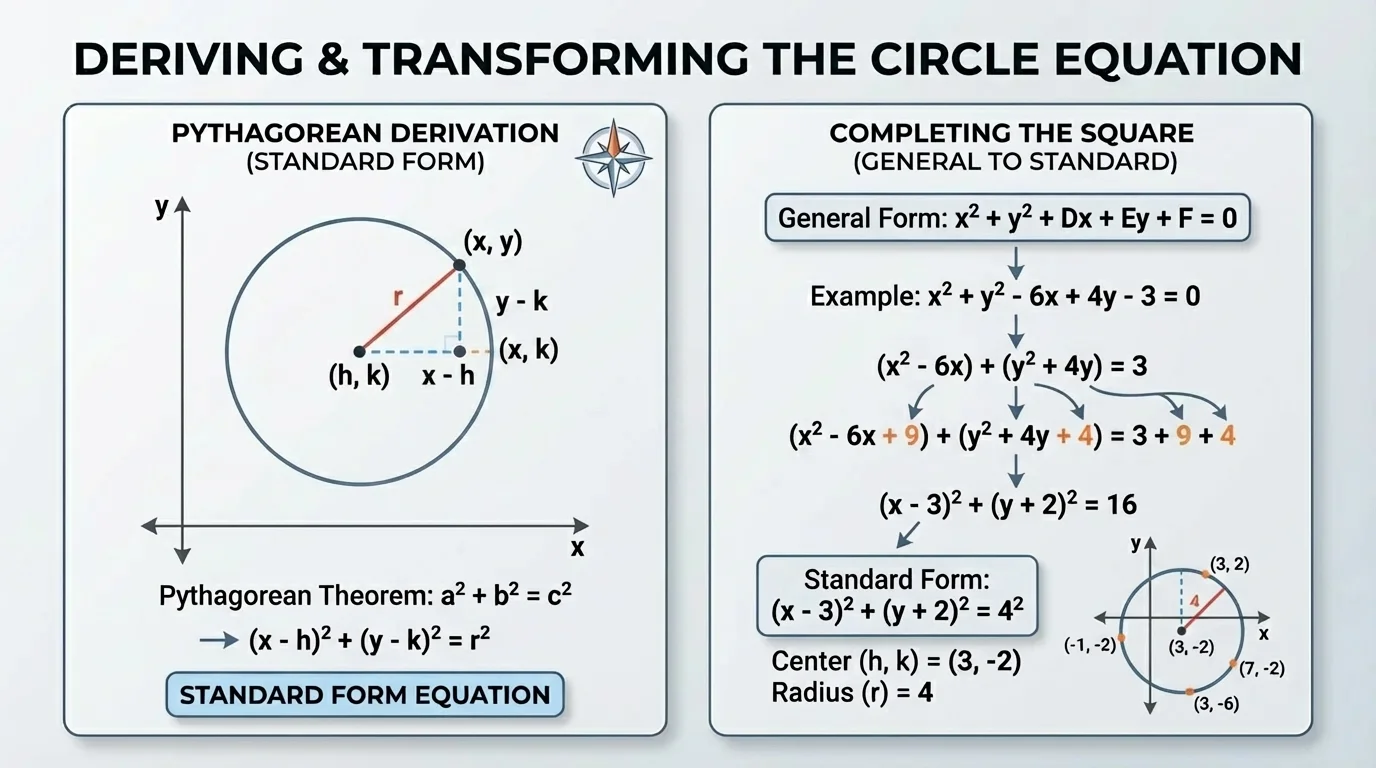
Completing the square means turning an expression like \(x^2+6x\) into part of a perfect-square trinomial. Take half of \(6\), which is \(3\), and square it to get \(9\). Then
\[x^2+6x+9=(x+3)^2\]
Likewise, \(y^2-8y+16=(y-4)^2\).
Why completing the square works
A perfect square trinomial has the pattern \(x^2+2ax+a^2=(x+a)^2\). When you add the square of half the linear coefficient, you create exactly that pattern. This is the algebraic move that uncovers the center of the circle.
Because you must keep the equation balanced, anything you add to one side must also be added to the other side, or added in matching amounts during regrouping.
Solved example 4
Find the center and radius of the circle \(x^2+y^2-6x+8y+9=0\).
Step 1: Group variable terms and move the constant.
\(x^2-6x+y^2+8y=-9\)
Step 2: Complete the square for each variable.
For \(x^2-6x\), half of \(-6\) is \(-3\), and \((-3)^2=9\).
For \(y^2+8y\), half of \(8\) is \(4\), and \(4^2=16\).
Add \(9\) and \(16\) to both sides: \(x^2-6x+9+y^2+8y+16=-9+9+16\).
Step 3: Rewrite as perfect squares.
\((x-3)^2+(y+4)^2=16\)
Step 4: Read the center and radius.
The center is \((3,-4)\) and the radius is \(4\).
The circle has center \((3,-4)\) and radius \(4\).
Notice that the right side became \(16\), so the radius is \(\sqrt{16}=4\). The sign inside \((y+4)^2\) still means the \(y\)-coordinate of the center is \(-4\).
Solved example 5
Rewrite \(x^2+y^2+2x-10y-7=0\) in standard form, then find the center and radius.
Step 1: Move the constant.
\(x^2+2x+y^2-10y=7\)
Step 2: Complete the square.
For \(x^2+2x\), half of \(2\) is \(1\), and \(1^2=1\).
For \(y^2-10y\), half of \(-10\) is \(-5\), and \((-5)^2=25\).
Add both values: \(x^2+2x+1+y^2-10y+25=7+1+25\).
Step 3: Rewrite.
\((x+1)^2+(y-5)^2=33\)
Step 4: Read the features.
The center is \((-1,5)\), and the radius is \(\sqrt{33}\).
Standard form is \((x+1)^2+(y-5)^2=33\), with center \((-1,5)\) and radius \(\sqrt{33}\).
As the transformation in [Figure 3] makes clear, the point of completing the square is not just algebraic rearrangement; it exposes the hidden geometric information.
Not every equation that looks similar to a circle equation represents a real circle. After rewriting in standard form, check the value on the right side.
For example, \((x-2)^2+(y+1)^2=-4\) has no real solution, so it does not graph as a real circle.
Here are some common mistakes to avoid:
Engineers often prefer equations in standard form because the center and radius can be read immediately. That makes it easier to model circular motion, sensor ranges, and safety zones on a coordinate grid.
A quick self-check is always helpful. If you think the center is \((h,k)\), substitute it into the expression on the left side of standard form, \((x-h)^2+(y-k)^2\). You should get \(0\), because the center is \(0\) units from itself. Then moving \(r\) units horizontally or vertically from the center should produce a point on the circle.
Circle equations are more than classroom exercises. They are used whenever a fixed distance from a point matters.
In navigation and location technology, a signal tower can be modeled as the center of a circle, and the signal's maximum reach is the radius. Every point that receives the signal lies on or inside a circle centered at the tower. If two towers cover an area, their circle equations help identify overlap zones.
In sports analytics, a coach might model a practice zone around a player or a target region around a basket. Coordinates allow analysts to measure whether shots are taken within a certain radius from a key point.
In manufacturing and design, machines that cut circular parts must follow equations that represent precise radii around a center point. Even a small error in identifying the center can shift the entire design.
Medicine also uses circular models. In imaging and scanning, devices rotate around a central point, and circular equations help describe slices, paths, and coverage areas. The same geometric thinking appears in radar, sonar, and wireless communication.
These applications all rely on the same core idea we saw in [Figure 2] and [Figure 1]: a circle is the set of points at a constant distance from a center, and algebra gives that idea a precise equation.
"Geometry is the art of correct reasoning from incorrectly drawn figures."
— Popular mathematical saying
When you derive a circle equation from geometry, you are doing exactly that kind of reasoning: the graph suggests the shape, but the equation gives the exact truth. And when you complete the square, you reverse the process, uncovering the geometry hidden inside algebra.
