A quadratic can look less transparent in standard form, but in factored form it suddenly reveals one of its most important features: where its graph meets the \(x\)-axis. If a function models the height of a launched object, the profit from selling a product, or the area of a shape, those zeros can mark moments when height becomes \(0\), profit is zero, or a dimension stops making sense. Factoring is not just rewriting; it is revealing structure.
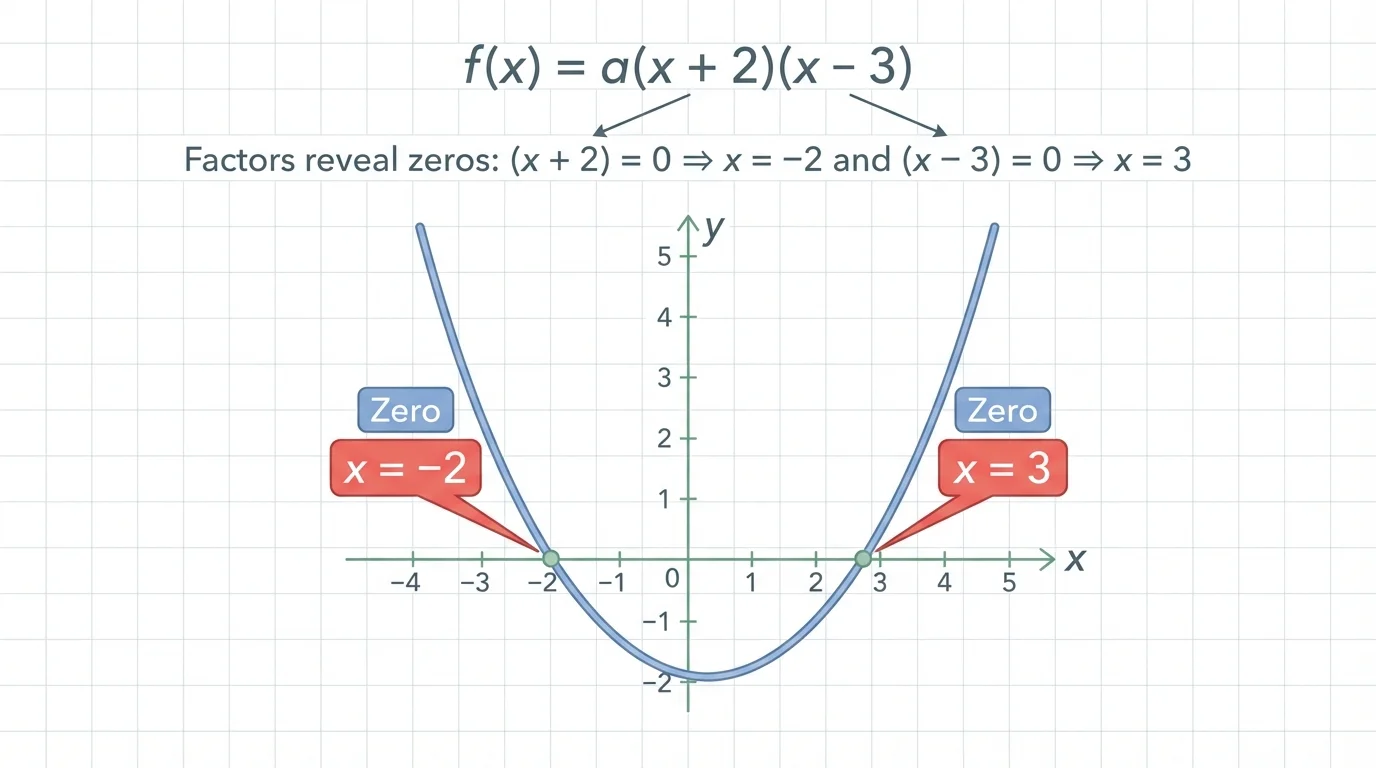
Suppose a quadratic function is written as \(f(x) = x^2 - x - 6\). At first glance, you can tell it is a parabola, but the zeros are not immediately obvious. If you rewrite it as \(f(x) = (x-3)(x+2)\), the zeros appear right away: \(x = 3\) and \(x = -2\). That happens because a product equals \(0\) only when at least one factor is \(0\). This connection between factors and zeros, shown in [Figure 1], helps explain how the graph's \(x\)-intercepts match the function's zeros.
On a graph, the zeros of a function are the \(x\)-values where the graph crosses or touches the \(x\)-axis. In algebra, they are the values of \(x\) that make \(f(x) = 0\). Writing a quadratic in an equivalent factored form reveals those values directly, which is why factoring is such a powerful tool.
A quadratic expression is a polynomial of degree \(2\), usually written in standard form as \(ax^2 + bx + c\), where \(a \ne 0\).
Factored form is a product form such as \(a(x-r_1)(x-r_2)\).
A zero, or root, is a value of \(x\) for which the function equals \(0\).
For a quadratic function written as \(f(x) = a(x-r_1)(x-r_2)\), the zeros are \(x = r_1\) and \(x = r_2\). To see why, set the function equal to \(0\): \(a(x-r_1)(x-r_2)=0\). Since \(a \ne 0\), the product is \(0\) only if \(x-r_1=0\) or \(x-r_2=0\).
Most quadratics are first given in standard form, \(ax^2 + bx + c\). Factoring rewrites that expression as a product. Because the two forms are equivalent, they define the same function and the same graph. The difference is that each form highlights different features. Standard form makes it easy to identify the leading coefficient and constant term. Factored form makes the zeros visible.
Here is the core pattern:
If \(f(x) = a(x-r_1)(x-r_2)\), then the zeros are \(r_1\) and \(r_2\).
Notice the sign carefully. In the factor \((x-5)\), the zero is \(x = 5\). In the factor \((x+4)\), the zero is \(x = -4\). The sign in the factor is the opposite of the zero.
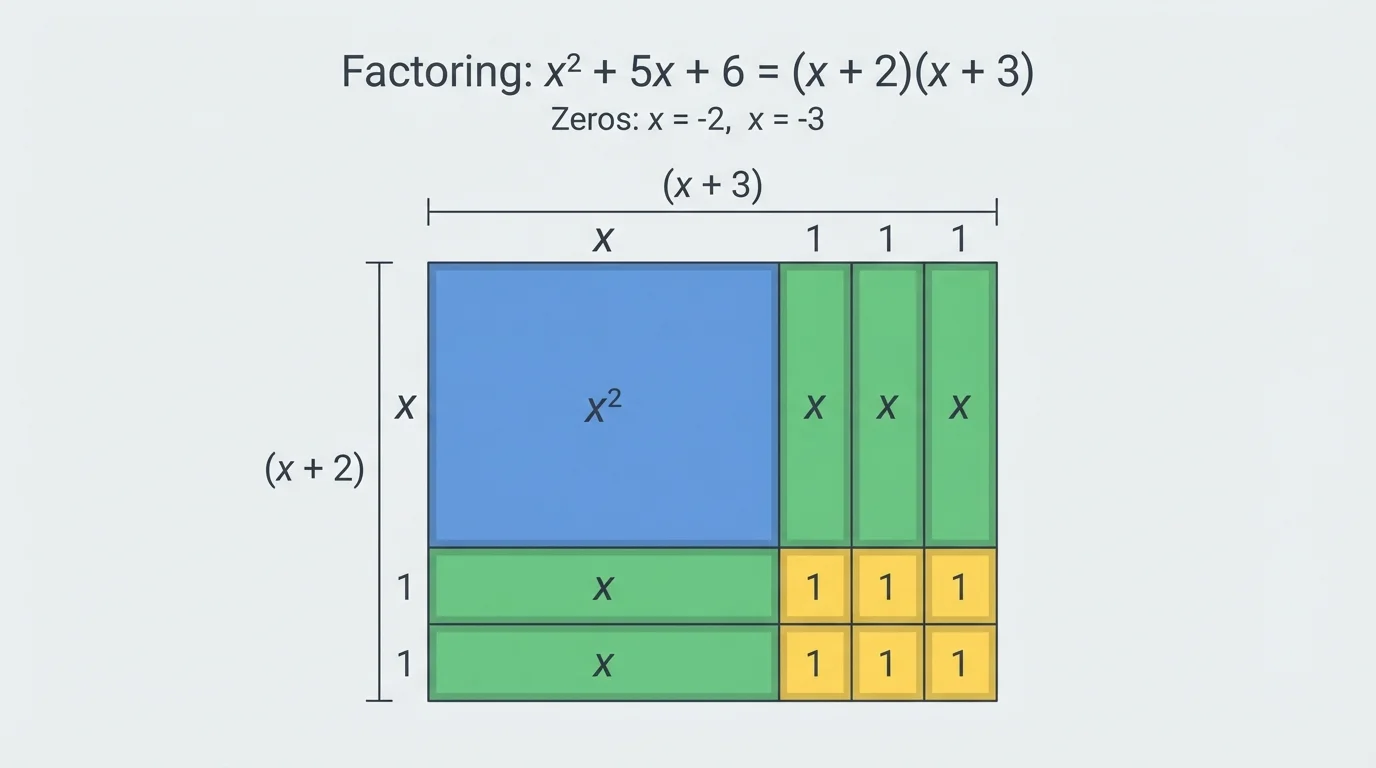
Before factoring quadratics, remember how to multiply binomials. For example, \((x+2)(x+3) = x^2 + 5x + 6\). Factoring reverses that process.
That idea of reversing multiplication is easier to picture when you think of area. An expression like \(x^2 + 5x + 6\) can be decomposed into parts that fit into a rectangle with side lengths \(x+2\) and \(x+3\), as [Figure 2] shows. The side lengths correspond to the factors, and the inside pieces correspond to the expanded terms.
There is not just one factoring situation. Different quadratics call for different strategies, but the goal is always the same: rewrite the expression as a product.
First, look for a greatest common factor. If every term shares a factor, pull it out before doing anything else. For example, \(2x^2 - 8x = 2x(x-4)\). If you skip this step, the factorization is incomplete and the zeros may be hidden.
For trinomials with leading coefficient \(1\), such as \(x^2 + bx + c\), find two numbers that multiply to \(c\) and add to \(b\). For \(x^2 + 7x + 12\), the numbers are \(3\) and \(4\), so \(x^2 + 7x + 12 = (x+3)(x+4)\).
The same search works with negative constants. For \(x^2 - x - 12\), you need numbers whose product is \(-12\) and whose sum is \(-1\). Those numbers are \(-4\) and \(3\), so \(x^2 - x - 12 = (x-4)(x+3)\).
For trinomials with leading coefficient not equal to \(1\), such as \(ax^2 + bx + c\) with \(a \ne 1\), a useful method is the AC method. Multiply \(a\) and \(c\), then find two numbers that multiply to \(ac\) and add to \(b\). After that, split the middle term and factor by grouping.
Special patterns also matter. A difference of squares has the form \(u^2 - v^2\) and factors as \((u-v)(u+v)\). A perfect-square trinomial has the form \(u^2 + 2uv + v^2\) or \(u^2 - 2uv + v^2\), and factors as \((u+v)^2\) or \((u-v)^2\).
Why factors reveal zeros
The reason factoring helps solve equations is the zero-product property: if \(ab=0\), then \(a=0\) or \(b=0\). Once a quadratic is written as a product, each factor can be set equal to \(0\). That turns one quadratic equation into two much simpler linear equations.
A factorization must always be checked. If you think \(x^2 + 5x + 6 = (x+2)(x+3)\), multiply back: \((x+2)(x+3) = x^2 + 3x + 2x + 6 = x^2 + 5x + 6\). The match confirms the factorization is correct.
Example 1: Factor a simple trinomial and find the zeros
Factor \(x^2 + x - 12\) and identify the zeros of the function \(f(x) = x^2 + x - 12\).
Step 1: Find two numbers that multiply to \(-12\) and add to \(1\).
The numbers are \(4\) and \(-3\), because \(4 \cdot (-3) = -12\) and \(4 + (-3) = 1\).
Step 2: Write the factors.
\[x^2 + x - 12 = (x+4)(x-3)\]
Step 3: Set each factor equal to \(0\).
From \(x+4=0\), we get \(x=-4\). From \(x-3=0\), we get \(x=3\).
The zeros are \(-4\) and \(3\).
This example shows the most basic case: a trinomial with leading coefficient \(1\). Once factored, the zeros are read directly from the factors.
Example 2: Factor out the greatest common factor first
Factor \(3x^2 - 15x\) and find the zeros of \(g(x) = 3x^2 - 15x\).
Step 1: Identify the greatest common factor.
Both terms share \(3x\).
Step 2: Factor it out.
\[3x^2 - 15x = 3x(x-5)\]
Step 3: Use the factors to find the zeros.
Set \(3x(x-5)=0\). Then \(3x=0\) or \(x-5=0\). This gives \(x=0\) or \(x=5\).
The zeros are \(0\) and \(5\).
Notice that the constant factor \(3\) does not create a new zero. Only factors containing \(x\) can produce values of \(x\) that make the function equal to \(0\).
Example 3: Factor a quadratic with leading coefficient not equal to \(1\)
Factor \(2x^2 + 7x + 3\) and find the zeros.
Step 1: Multiply the first and last coefficients.
\(a \cdot c = 2 \cdot 3 = 6\).
Step 2: Find two numbers that multiply to \(6\) and add to \(7\).
The numbers are \(6\) and \(1\).
Step 3: Split the middle term.
\(2x^2 + 7x + 3 = 2x^2 + 6x + x + 3\).
Step 4: Factor by grouping.
\(2x^2 + 6x + x + 3 = 2x(x+3) + 1(x+3) = (2x+1)(x+3)\).
Step 5: Find the zeros.
From \(2x+1=0\), we get \(x=-\dfrac{1}{2}\). From \(x+3=0\), we get \(x=-3\).
\[2x^2 + 7x + 3 = (2x+1)(x+3)\] The zeros are \(-\dfrac{1}{2}\) and \(-3\).
This method works because splitting the middle term creates a grouping structure that can be factored into two binomials.
Example 4: Use a special pattern
Factor \(x^2 - 16\) and find the zeros.
Step 1: Recognize the pattern.
This is a difference of squares: \(x^2 - 4^2\).
Step 2: Apply the pattern.
\[x^2 - 16 = (x-4)(x+4)\]
Step 3: Find the zeros.
Set each factor equal to \(0\): \(x-4=0\) gives \(x=4\), and \(x+4=0\) gives \(x=-4\).
The zeros are \(4\) and \(-4\).
Special patterns save time and help you recognize structure quickly instead of searching randomly for factor pairs.
A quadratic does not always have two different zeros. Sometimes the same zero appears twice. For example, \(f(x) = (x-2)^2\) has a repeated zero at \(x=2\). As shown in [Figure 3], the parabola touches the \(x\)-axis and turns around there instead of crossing it.
If you expand \((x-2)^2\), you get \(x^2 - 4x + 4\). Setting the factored form equal to \(0\) gives \((x-2)(x-2)=0\), so the only zero is \(x=2\), counted twice. This is sometimes described as a zero of multiplicity \(2\).
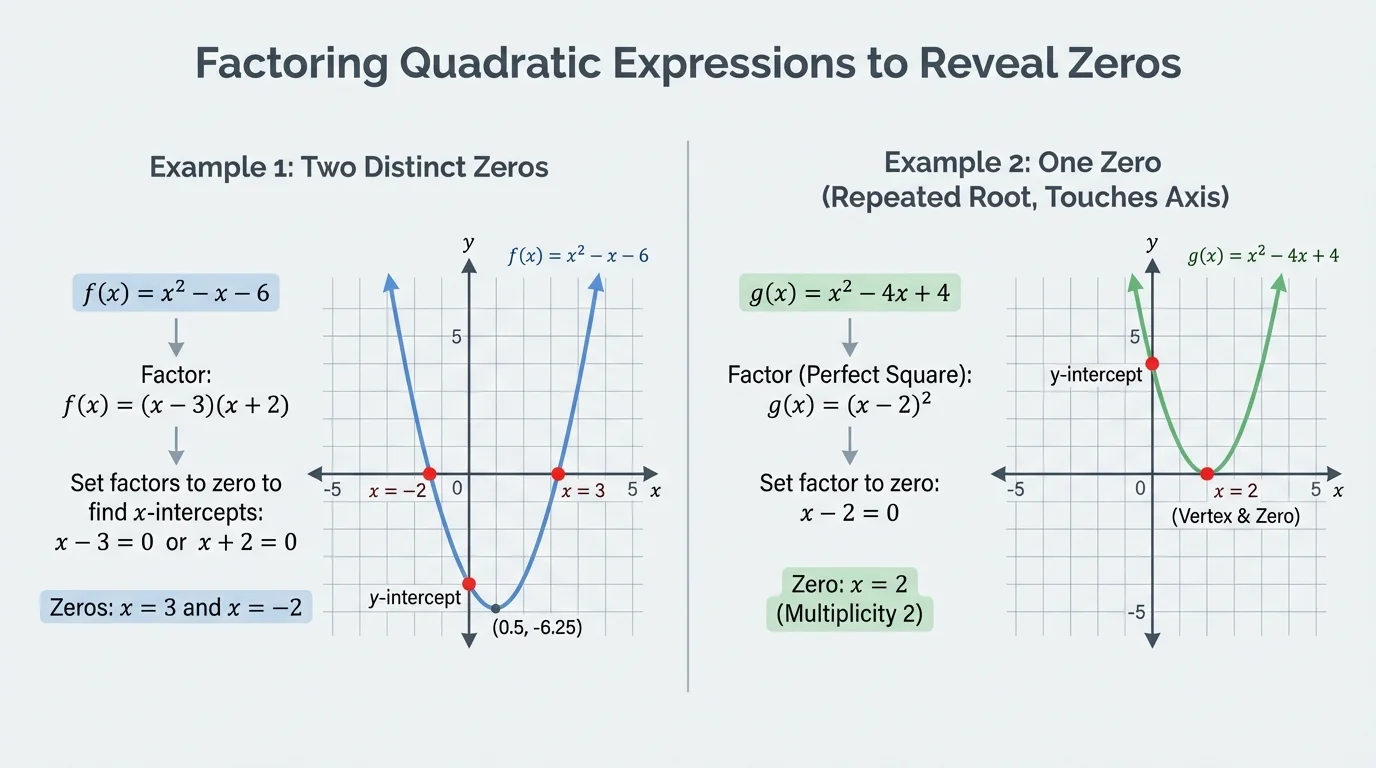
That repeated factor changes the graph's behavior. Earlier, in [Figure 1], the graph crosses the axis at two different zeros. Here, the double factor makes the graph bounce off the axis at a single point.
Not every quadratic factors nicely using integers. For example, \(x^2 + x + 1\) does not factor over the integers. That means factoring is not always the best or only method for finding zeros. In other cases, the quadratic formula or completing the square may be necessary.
Still, when a quadratic does factor, factored form is one of the clearest ways to reveal its properties. It shows the zeros immediately and helps explain the graph. This is why rewriting expressions into equivalent forms is such an important algebra skill: the form you choose determines what you can see quickly.
Engineers and physicists often choose different algebraic forms of the same equation depending on what they need to read from it quickly. One form may make intercepts obvious, while another makes a maximum or minimum easier to find.
So factoring is not a trick to memorize. It is part of a broader mathematical habit: rewrite an expression so that important features become visible.
Suppose the height of a ball above the ground is modeled by \(h(t) = -5t^2 + 15t\), where \(t\) is time in seconds. Factoring gives \(h(t) = -5t(t-3)\). The zeros are \(t=0\) and \(t=3\). That means the ball is on the ground at the start and returns to the ground after \(3\) seconds. The factored form turns a messy-looking expression into a meaningful story.
In design and manufacturing, area relationships also lead to quadratic expressions. Suppose a rectangular garden has width \(x+2\) and length \(x+7\). Its area is \((x+2)(x+7)=x^2+9x+14\). If you are given the expanded expression and factor it, you recover the dimensions. The structural view shown earlier in [Figure 2] is exactly the same idea used in reverse.
Example 5: Interpret zeros in context
A company's profit is modeled by \(P(n) = n^2 - 11n + 24\), where \(n\) is the number of items sold in hundreds. Find the break-even points.
Step 1: Factor the expression.
Find two numbers that multiply to \(24\) and add to \(-11\). They are \(-3\) and \(-8\).
\[P(n) = (n-3)(n-8)\]
Step 2: Set profit equal to \(0\).
\((n-3)(n-8)=0\)
Step 3: Solve for \(n\).
\(n=3\) or \(n=8\).
The company breaks even when it sells \(300\) items or \(800\) items.
In context, zeros are often called break-even points, landing times, or boundary values. Factoring helps connect algebra to what those values mean in the real world.
Forgetting the greatest common factor. For \(4x^2 - 12x\), writing \((x-3)(4x)\) is awkward and incomplete. The clean factorization is \(4x(x-3)\).
Mixing up signs. If the factor is \((x+5)\), the zero is \(-5\), not \(5\). Always set the factor equal to \(0\) to avoid sign errors.
Stopping after factoring. If the goal is to reveal zeros, factoring is only part of the job. You must also solve the equations that come from the factors.
Not checking the factorization. Expand the factors and compare with the original expression. A quick check can catch many mistakes.
| Quadratic form | Possible factor form | How zeros are found |
|---|---|---|
| \(x^2 + 5x + 6\) | \((x+2)(x+3)\) | Set \(x+2=0\) or \(x+3=0\) |
| \(2x^2 + 7x + 3\) | \((2x+1)(x+3)\) | Set \(2x+1=0\) or \(x+3=0\) |
| \(x^2 - 4x + 4\) | \((x-2)^2\) | Repeated zero at \(x=2\) |
| \(x^2 - 16\) | \((x-4)(x+4)\) | Set \(x-4=0\) or \(x+4=0\) |
Table 1. Examples of quadratic expressions, their factored forms, and how the zeros are obtained from the factors.
When you become fluent with factoring, you start to see hidden structure more quickly. A quadratic in standard form may look like a single object, but factored form reveals it as a product, and that product tells you where the function is zero.
