Phone battery charging, a video going viral, earthquake intensity, the acidity of a solution, and the spread of a disease can all be described by the same surprising idea: very fast growth often needs a completely different kind of operation to "undo" it. Addition is undone by subtraction. Multiplication is undone by division. But what undoes repeated multiplication, such as powers like \(2^5\) or \(10^3\)? The answer is the logarithm, one of the most powerful ideas in algebra.
To understand logarithms well, it helps to see them not as a separate topic but as a natural extension of inverse operations. Just as subtraction reverses addition and square roots reverse squaring, logarithms reverse exponentiation. This connection matters in algebra because many functions are built by reversing or transforming existing ones. When you understand how exponential and logarithmic functions are linked, you can solve equations that would otherwise seem impossible.
Exponential functions show up whenever a quantity changes by a constant factor instead of a constant amount. If a population doubles, if money grows by a fixed percentage, or if a radioactive substance decays by half, the model is exponential. But if you are asked how long it takes to reach a certain amount, the unknown is no longer the output; it is the exponent. That is exactly when logarithms become useful.
This makes logarithms more than just a new notation. They answer questions like: "What power of \(2\) gives \(64\)?" or "How many years does it take for an investment to triple?" or "What exponent makes \(10\) become \(500\)?" These are inverse-function questions.
Recall that an inverse operation reverses the effect of another operation. For example, if \(x + 7 = 12\), subtraction undoes addition. If \(x^2 = 49\), taking a square root undoes squaring. Logarithms play this same role for exponents.
Because inverse relationships are central in algebra, the study of logarithms belongs naturally with function building. We start with an exponential function and construct a new function that reverses it.
An exponential function has a variable in the exponent. A common form is
\(f(x) = b^x\)
where \(b\) is the base, with \(b > 0\) and \(b \ne 1\). For example, \(2^x\), \(3^x\), and \(10^x\) are exponential functions. In each case, the input \(x\) tells you which power of the base to use.
For instance, if \(f(x) = 2^x\), then \(f(3) = 2^3 = 8\), and \(f(-2) = 2^{-2} = \dfrac{1}{4}\). Exponential functions grow quickly when the base is greater than \(1\), and they decay when the base is between \(0\) and \(1\).
Notice the structure: the base is fixed, and the exponent changes. This is different from a power function like \(x^2\), where the exponent is fixed and the base changes. That distinction matters because logarithms undo expressions of the form \(b^x\), not general powers like \(x^2\).
Exponential function: a function of the form \(f(x) = b^x\), where \(b > 0\) and \(b \ne 1\).
Inverse function: a function that reverses another function's input-output process.
Logarithm: the exponent to which a base must be raised to produce a given number.
That last definition is the key. A logarithm is not mainly "a button on a calculator." It is an answer to an exponent question.
Suppose you know that \(2^5 = 32\). The logarithmic form of the same statement is
\[\log_2(32) = 5\]
This reads: "the logarithm of \(32\) to base \(2\) is \(5\)." In other words, \(5\) is the exponent to which base \(2\) must be raised to produce \(32\).
The general relationship is
\[a^b = c \iff \log_a(c) = b\]
Here, \(a\) is the base, \(b\) is the exponent, and \(c\) is the result. Logarithms are defined only when the argument is positive, so in \(\log_a(c)\), the value \(c\) must satisfy \(c > 0\).
Two especially common logarithms are common logarithm, written \(\log(x)\), which means base \(10\), and natural logarithm, written \(\ln(x)\), which means base \(e\), where \(e\) is approximately \(2.718\).
Earthquake magnitude scales and the \(\textrm{pH}\) scale in chemistry are logarithmic. That is why a small change in the number can represent a huge change in actual intensity or concentration.
Because logarithms tell us an exponent, they are ideal for solving equations where the variable appears in the exponent.
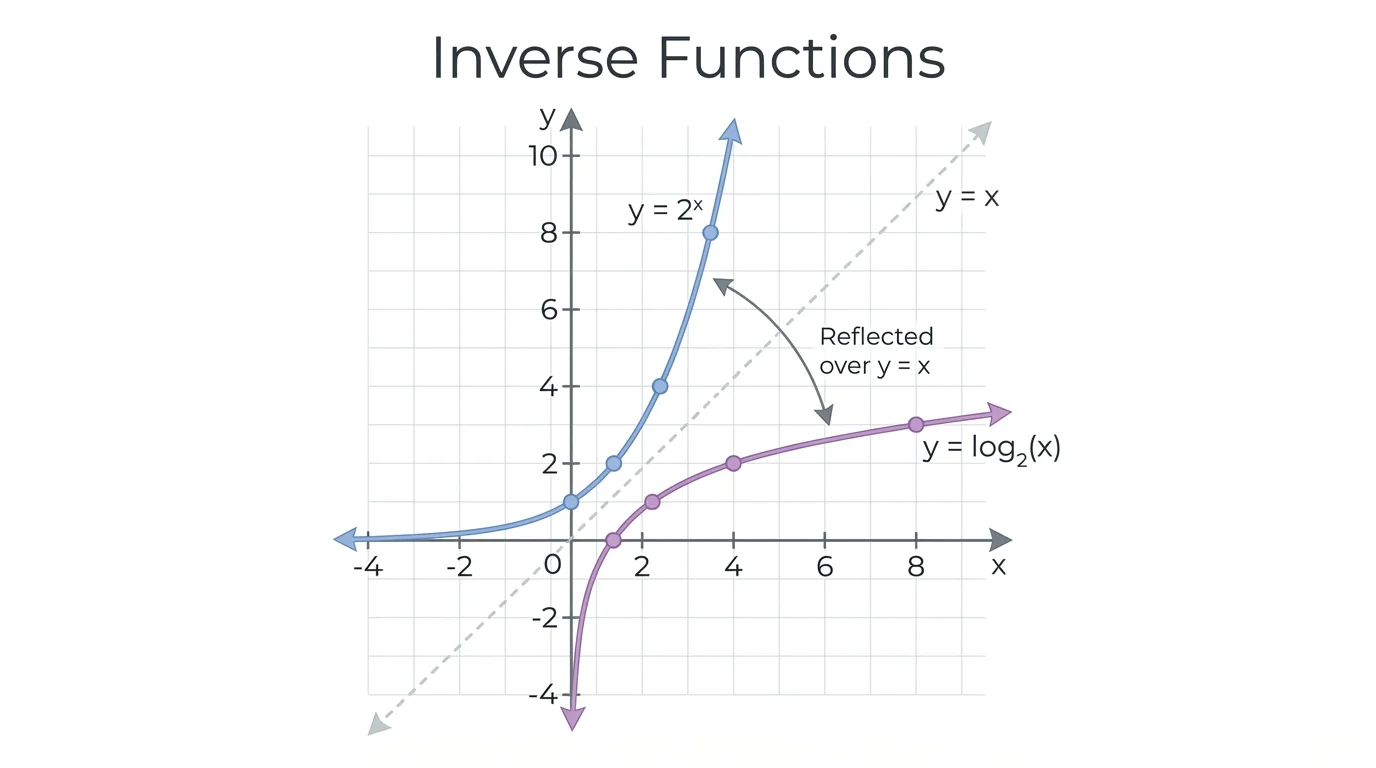
If \(f(x) = 2^x\), then its inverse function is \(f^{-1}(x) = \log_2(x)\). These functions undo each other, and [Figure 1] shows that their graphs are reflections across the line \(y = x\). This reflection is a visual clue that one function reverses the other.
For inverse functions, the input and output switch roles. Since \(2^3 = 8\), it follows that \(\log_2(8) = 3\). A point \((3, 8)\) on the graph of \(y = 2^x\) becomes the point \((8, 3)\) on the graph of \(y = \log_2(x)\).
The domain and range also swap. For \(y = 2^x\), the domain is all real numbers and the range is \((0, \infty)\). For \(y = \log_2(x)\), the domain is \((0, \infty)\) and the range is all real numbers. That domain restriction makes sense because you cannot ask for the logarithm of a nonpositive number in the real number system.
You can also see the inverse relationship through composition:
\[\log_b(b^x) = x\]
and
\[b^{\log_b(x)} = x\]
These identities say that applying an exponential function and then its matching logarithm brings you back to where you started, and vice versa. Later, when solving equations, this idea becomes a shortcut.
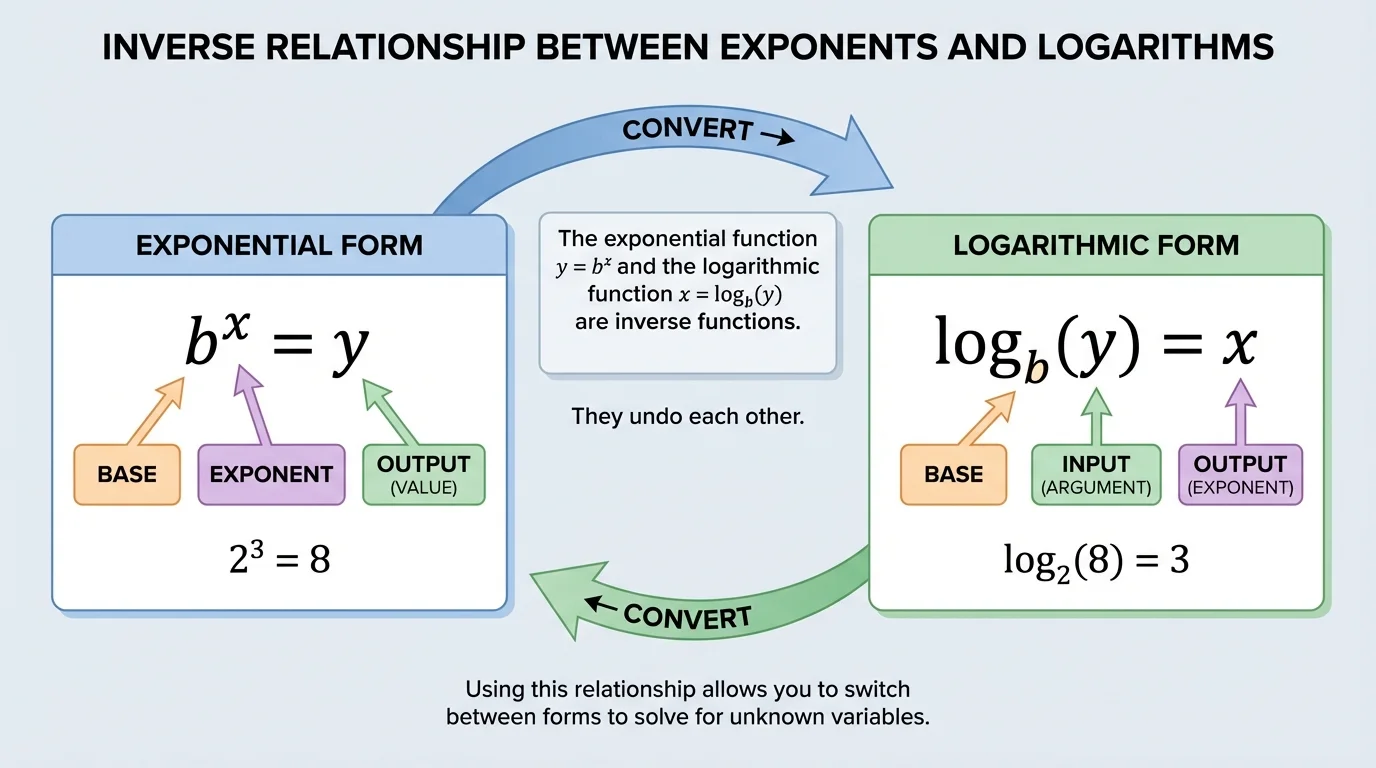
One of the most important skills is translating between exponential and logarithmic form. The same relationship can be written in two equivalent ways, and [Figure 2] organizes how the base, exponent, and result match in each form.
If you can move comfortably between these forms, many problems become much simpler. The structure is always the same:
\[a^b = c \iff \log_a(c) = b\]
Keep track of what each number does. The base stays the base, the result becomes the argument of the logarithm, and the exponent becomes the value of the logarithm.
Solved example 1
Rewrite \(3^4 = 81\) in logarithmic form.
Step 1: Identify the base, exponent, and result.
The base is \(3\), the exponent is \(4\), and the result is \(81\).
Step 2: Place them into logarithmic form.
\(\log_3(81) = 4\)
The equivalent logarithmic statement is \[\log_3(81) = 4\]
Now reverse the process. If you see a logarithmic expression, ask: "What exponent does this represent?"
Solved example 2
Rewrite \(\log_5(125) = 3\) in exponential form.
Step 1: Identify the base and value.
The base is \(5\), the result is \(125\), and the logarithm equals \(3\), which is the exponent.
Step 2: Write the equivalent exponential equation.
\(5^3 = 125\)
The equivalent exponential equation is \(5^3 = 125\)
This conversion skill is often the fastest way to evaluate simple logarithms mentally. For example, \(\log_2(16) = 4\) because \(2^4 = 16\), and \(\log_{10}(1000) = 3\) because \(10^3 = 1000\).
Some exponential equations can be solved by rewriting both sides with the same base. For example, if \(4^x = 64\), write both numbers as powers of \(2\): \(4 = 2^2\) and \(64 = 2^6\). Then \((2^2)^x = 2^6\), so \(2^{2x} = 2^6\), which means \(2x = 6\) and therefore \(x = 3\).
But not every equation works so neatly. If the variable is in the exponent and the two sides cannot be rewritten with a common base easily, logarithms let us solve it.
Solved example 3
Solve \(2^x = 20\).
Step 1: Recognize that the variable is in the exponent.
This means we need an inverse operation for exponentiation, which is a logarithm.
Step 2: Apply a logarithm to both sides.
Using the common logarithm, \(\log(2^x) = \log(20)\).
Step 3: Use the power property.
\(x\log(2) = \log(20)\)
Step 4: Solve for \(x\).
\(x = \dfrac{\log(20)}{\log(2)}\)
So the exact solution is \[x = \frac{\log(20)}{\log(2)}\] and the approximate value is \(x \approx 4.322\).
This method works with any logarithm base as long as you use the same base on both sides. You could also write \(x = \log_2(20)\), which directly expresses the exponent you are looking for.
As we saw from the inverse relationship in [Figure 1], solving \(2^x = 20\) means finding the input of the logarithmic inverse when the output of the exponential function is \(20\).
When solving a logarithmic equation, one common strategy is to rewrite it in exponential form. For example, if \(\log_3(x) = 4\), then \(x = 3^4 = 81\).
Sometimes the equation contains more than one logarithm. Then you may need logarithm properties before rewriting the equation.
Solved example 4
Solve \(\log_2(x) + \log_2(x - 2) = 3\).
Step 1: Use the product property.
\(\log_2(x(x - 2)) = 3\)
Step 2: Rewrite in exponential form.
\(x(x - 2) = 2^3 = 8\)
Step 3: Solve the quadratic equation.
\(x^2 - 2x = 8\), so \(x^2 - 2x - 8 = 0\).
Factor: \((x - 4)(x + 2) = 0\)
Possible solutions are \(x = 4\) or \(x = -2\).
Step 4: Check for valid logarithm inputs.
For \(\log_2(x)\) and \(\log_2(x - 2)\), we need \(x > 0\) and \(x - 2 > 0\), so \(x > 2\).
Thus \(x = -2\) is invalid.
The solution is \(x = 4\)
Checking is essential in logarithmic equations because algebraic steps can produce values outside the domain. A number may solve the transformed equation but still make a logarithm undefined.
Logarithm properties let us rewrite and simplify expressions. They are especially useful in solving equations and analyzing functions.
The main properties are:
\[\log_b(MN) = \log_b(M) + \log_b(N)\]
\[\log_b\left(\frac{M}{N}\right) = \log_b(M) - \log_b(N)\]
\[\log_b(M^p) = p\log_b(M)\]
These hold when \(M > 0\), \(N > 0\), and \(b > 0\) with \(b \ne 1\).
A very common mistake is trying to apply logarithm properties to sums, such as claiming \(\log_b(M + N) = \log_b(M) + \log_b(N)\). That is false. Logarithms turn multiplication into addition, not addition into addition.
| Expression | Correct rewrite | Reason |
|---|---|---|
| \(\log_b(MN)\) | \(\log_b(M) + \log_b(N)\) | Product property |
| \(\log_b\left(\dfrac{M}{N}\right)\) | \(\log_b(M) - \log_b(N)\) | Quotient property |
| \(\log_b(M^p)\) | \(p\log_b(M)\) | Power property |
| \(\log_b(M + N)\) | No simple split rule | Not a logarithm property |
Table 1. Core logarithm properties and one common non-example.
These properties are connected to exponent rules. That is another sign of the deep relationship between exponents and logarithms: logarithm properties come from how exponents behave.
Why the power property makes sense
If \(M = b^k\), then \(M^p = (b^k)^p = b^{kp}\). Taking \(\log_b\) of both sides gives \(\log_b(M^p) = kp = p\log_b(M)\). The logarithm "pulls down" the exponent because it is designed to read exponents.
Another useful formula is the change of base formula:
\[\log_b(x) = \frac{\log(x)}{\log(b)} = \frac{\ln(x)}{\ln(b)}\]
This formula lets you evaluate logarithms of any base using a calculator that has only \(\log\) or \(\ln\).
When algebra asks you to build new functions from existing ones, logarithmic and exponential functions are excellent examples. You can start with the parent exponential function \(y = 2^x\) and create its inverse \(y = \log_2(x)\). Then you can transform that inverse with shifts, stretches, and reflections. [Figure 3] displays how a transformed logarithmic graph keeps its overall shape while changing position.
For example, compare \(y = \log_2(x)\) with \(y = \log_2(x - 3) + 1\). The expression \(x - 3\) shifts the graph right by \(3\), and the \(+1\) shifts it up by \(1\). The vertical asymptote moves from \(x = 0\) to \(x = 3\), because the input to the logarithm must stay positive.
This asymptote is important because for \(y = \log_2(x - 3) + 1\), the domain is \(x > 3\). Unlike many polynomial functions, logarithmic functions are strongly constrained by input restrictions.
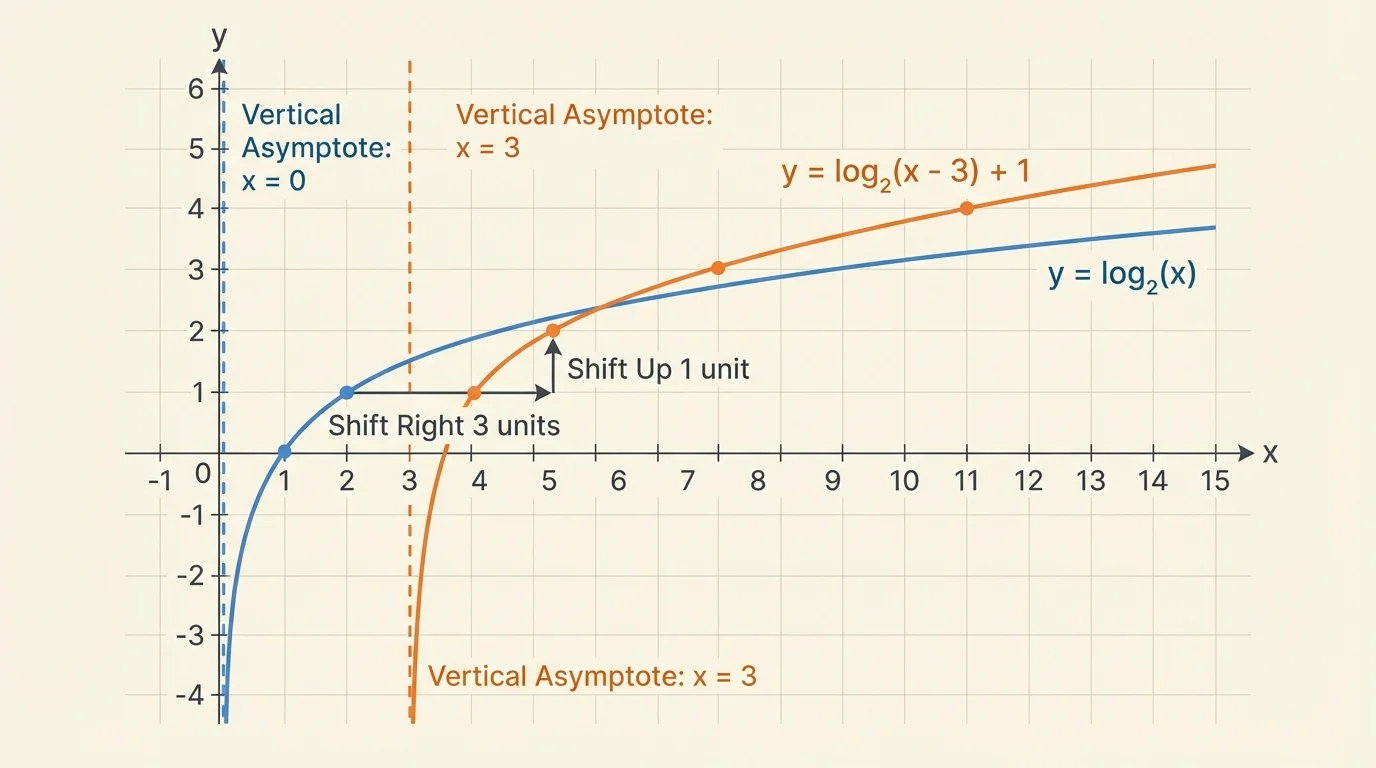
You can also transform exponential functions. If \(y = 2^x\), then \(y = 2^{x-3} + 1\) shifts right by \(3\) and up by \(1\). Since inverse functions reflect across \(y = x\), the transformed exponential and transformed logarithmic functions still maintain a close relationship, as the reflection idea from [Figure 1] suggests.
Understanding these transformations helps you build functions that model real situations. A horizontal shift can represent a delayed start, and a vertical shift can represent a baseline amount already present.
In finance, exponential functions model compound growth. If an investment grows according to \(A = P(1 + r)^t\), then asking for the amount after \(t\) years uses exponents. Asking how long it takes to reach a target amount requires logarithms.
Solved example 5
An investment of $1,000 grows at \(5\%\) per year. How long does it take to reach $2,000 if interest is compounded annually?
Step 1: Write the exponential model.
\(2000 = 1000(1.05)^t\)
Step 2: Simplify.
Divide both sides by \(1000\): \(2 = (1.05)^t\).
Step 3: Take logarithms.
\(\log(2) = \log((1.05)^t) = t\log(1.05)\)
Step 4: Solve for \(t\).
\(t = \dfrac{\log(2)}{\log(1.05)}\)
The time is \[t = \frac{\log(2)}{\log(1.05)} \approx 14.21\] so it takes about \(14.2\) years.
In chemistry, the \(\textrm{pH}\) scale is logarithmic: \(\textrm{pH} = -\log[\textrm{H}^+]\). A difference of \(1\) in \(\textrm{pH}\) means a tenfold change in hydrogen ion concentration. In earth science, earthquake magnitude scales are also logarithmic, so an earthquake of magnitude \(7\) is much more intense than one of magnitude \(6\), not just a little stronger.
In computer science and data science, logarithms appear in algorithms, information measures, and scales where quantities grow by repeated doubling. For example, if storage capacity doubles repeatedly, the number of doublings needed to reach a target is a logarithmic question.
One mistake is forgetting that logarithms require positive inputs. Expressions like \(\log(-5)\) and \(\log(0)\) are undefined in the real numbers.
Another mistake is mixing up base and argument. In \(\log_3(81) = 4\), the base is \(3\), not \(81\). The number \(81\) is the result that comes from raising \(3\) to a power.
Students also sometimes think \(\log_b(x)\) means division. It does not. It names an exponent. Likewise, \(\ln(x)\) is just a logarithm with base \(e\), not a completely different kind of operation.
Finally, when solving equations, always check whether your answer makes every logarithm valid. In logarithmic equations, an algebraically correct step can still lead to an extraneous solution.
"A logarithm is simply an exponent in disguise."
That idea is the thread connecting every skill in this topic. When you rewrite, solve, transform, or model, you are really tracking how exponents and logarithms reverse each other.
The most useful way to think about logarithms is not as isolated formulas but as inverse functions built from exponential functions. If exponential growth answers "What output do I get from this input?", then logarithms answer "What input produced this output?" This is why they are so valuable in function building.
When you see an equation like \(b^x = y\), the logarithm gives the missing exponent: \(x = \log_b(y)\). When you see \(y = \log_b(x)\), you should mentally hear the question, "To what power must \(b\) be raised to get \(x\)?" That mental translation is the foundation of fluency.
The graph relationships, especially the reflection shown in [Figure 1] and the transformation behavior in [Figure 3], help connect algebraic rules to function behavior. Seeing logarithms as inverses makes the formulas more logical, the equations easier to solve, and the real-world models much more meaningful.
