Suppose a recipe needs \(\dfrac{3}{4}\) cup of milk already in the bowl, but the measuring cup says there are \(2\) cups total after you pour more in. How much milk did you add? Or suppose \(4\) identical packs of markers cost $6 total. How much does one pack cost? Questions like these are solved with equations. An equation is like a puzzle with a missing piece, and algebra gives us a smart way to find that missing piece.
Many everyday situations involve an unknown amount. You may know the total and one part, so you need to find the missing part. Or you may know a total made from equal groups, so you need to find the amount in one group. Algebra helps us represent those situations clearly.
When we use a letter such as \(x\), we are not making the problem harder. We are giving the unknown a name so we can reason about it. Once the equation is written, we use operations we already know to solve it.
You already know how addition, subtraction, multiplication, and division are related. Addition and subtraction are inverse operations, and multiplication and division are inverse operations. These relationships are the key to solving equations.
In this topic, we focus on equations of two forms:
\(x + p = q\)
and
\(px = q\)
Here, \(p\), \(q\), and \(x\) are all nonnegative rational numbers. That means they can be whole numbers, fractions, or decimals, and they are not negative.
A variable is a letter that stands for an unknown number. In this lesson, the variable is usually \(x\).
An equation is a math sentence showing that two expressions are equal. The equal sign means "has the same value as." For example, \(x + \dfrac{1}{2} = 3\) says that the value of \(x + \dfrac{1}{2}\) is the same as \(3\).
Nonnegative rational numbers are numbers that are \(0\) or greater and can be written as fractions. Whole numbers such as \(5\), fractions such as \(\dfrac{3}{4}\), and decimals such as \(1.2\) are all examples.
A solution to an equation is a value of the variable that makes the equation true. If \(x = 2\) in the equation \(x + 5 = 7\), then the equation becomes \(2 + 5 = 7\), which is true. So \(2\) is the solution.
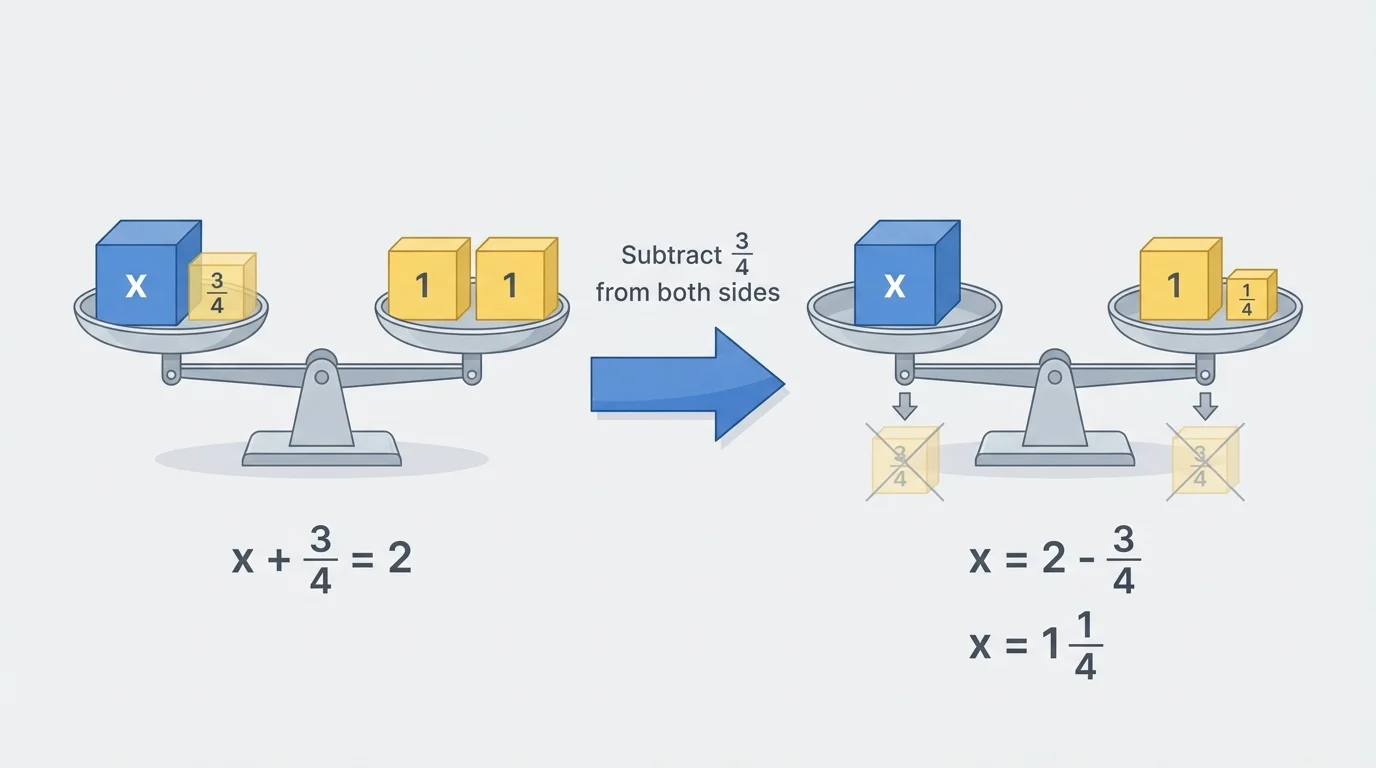
In an equation of the form \(x + p = q\), the unknown number has \(p\) added to it. To find \(x\), we use the inverse operation of addition, which is subtraction. The equation stays balanced when we subtract the same amount from both sides, as [Figure 1] shows.
If \(x + p = q\), then subtract \(p\) from both sides:
\[x + p - p = q - p\]
This simplifies to
\(x = q - p\)
So the rule is simple: to solve \(x + p = q\), subtract the added amount from the total.
This works for whole numbers, fractions, and decimals. The method does not change. Only the arithmetic changes.
After solving, always check. Substitute your answer back into the original equation. If both sides are equal, your solution is correct. This checking step is especially useful with fractions and decimals.
Worked example 1
Solve \(x + 7 = 19\).
Step 1: Identify what is happening to \(x\).
The number \(7\) is added to \(x\).
Step 2: Use the inverse operation.
Subtract \(7\) from both sides: \(x + 7 - 7 = 19 - 7\).
Step 3: Simplify.
\(x = 12\).
Step 4: Check.
Substitute \(x = 12\): \(12 + 7 = 19\). This is true.
The solution is \(\boxed{12}\).
Now look at a fraction example. If \(x + \dfrac{2}{5} = \dfrac{9}{5}\), then subtract \(\dfrac{2}{5}\) from both sides. We get \(x = \dfrac{9}{5} - \dfrac{2}{5} = \dfrac{7}{5}\). Since \(\dfrac{7}{5} + \dfrac{2}{5} = \dfrac{9}{5}\), the solution is correct.
Decimals work the same way. If \(x + 1.8 = 4.3\), then \(x = 4.3 - 1.8 = 2.5\).
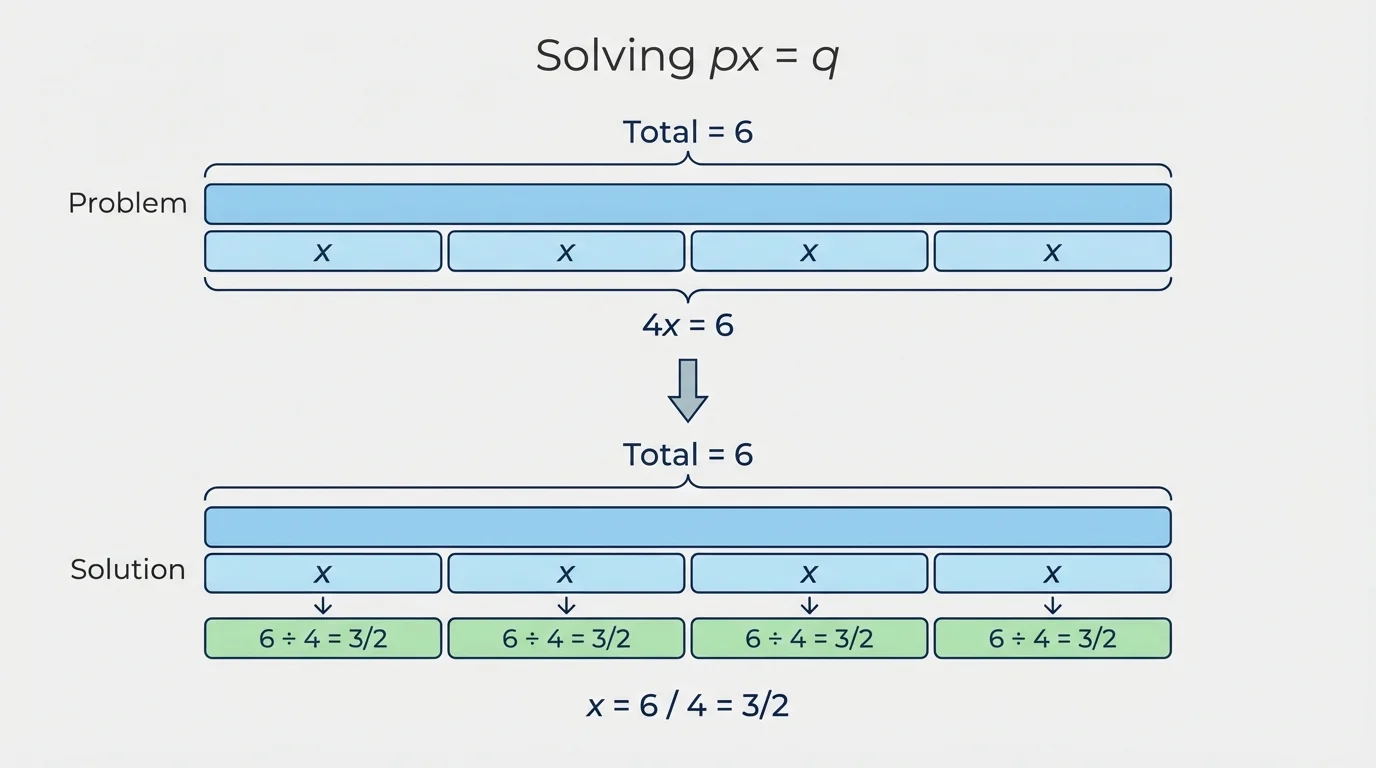
In an equation of the form \(px = q\), the variable is multiplied by \(p\). To solve, use division, because division undoes multiplication. You can think of \(px\) as \(p\) equal groups of size \(x\), as [Figure 2] illustrates.
If \(px = q\), divide both sides by \(p\):
\[\frac{px}{p} = \frac{q}{p}\]
This simplifies to
\[x = \frac{q}{p}\]
So the rule is: to solve \(px = q\), divide the total by the number multiplying the variable.
This makes sense in real life. If \(4x = 20\), then \(4\) equal groups total \(20\), so one group must be \(20 \div 4 = 5\).
Be careful when \(p\) is a fraction or decimal. The idea stays the same: divide by the number attached to \(x\).
Why division solves multiplication equations
Multiplication combines equal groups. If \(3x = 12\), then \(12\) is split into \(3\) equal parts. Each part is \(4\), so \(x = 4\). Solving \(px = q\) means finding the size of one equal group.
For example, if \(\dfrac{1}{2}x = 3\), then divide both sides by \(\dfrac{1}{2}\). Since dividing by \(\dfrac{1}{2}\) is the same as multiplying by \(2\), we get \(x = 6\). Check: \(\dfrac{1}{2} \cdot 6 = 3\).
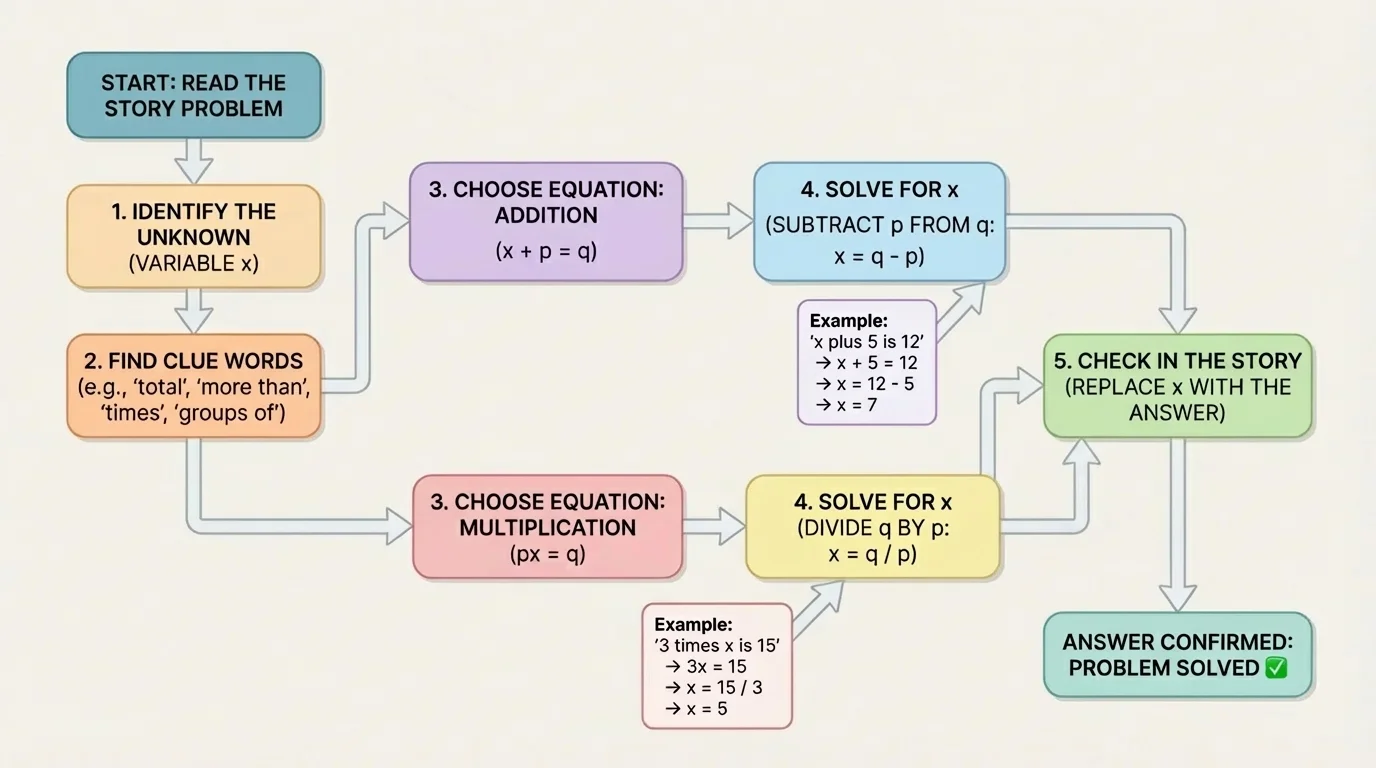
Word problems can seem harder because the math is hidden inside sentences. A clear process helps, and [Figure 3] lays out that process step by step. First, decide what the unknown is. Next, look for clues that tell whether the situation uses addition or multiplication.
Clue words for addition situations include more than, added to, increased by, and total when one part and the sum are known. Clue words for multiplication situations include each, equal groups, times, and per group.
After writing the equation, solve it using the correct inverse operation. Then check whether your answer makes sense in the story.
For example, "A notebook and a $2.50 cover together cost $6.75. How much does the notebook cost?" can be written as \(x + 2.50 = 6.75\). The cover cost is added to the notebook cost to make the total.
Another example is "Three equal bags of marbles contain \(4.5\) pounds altogether. How much does each bag weigh?" This becomes \(3x = 4.5\).
Let's work through several examples carefully. Notice how the same ideas appear again and again, even when the numbers look different.
Worked example 2
Solve \(x + \dfrac{3}{8} = 1\dfrac{1}{8}\).
Step 1: Rewrite the mixed number as an improper fraction.
\(1\dfrac{1}{8} = \dfrac{9}{8}\).
Step 2: Subtract \(\dfrac{3}{8}\) from both sides.
\(x = \dfrac{9}{8} - \dfrac{3}{8}\).
Step 3: Simplify.
\(x = \dfrac{6}{8} = \dfrac{3}{4}\).
Step 4: Check.
\(\dfrac{3}{4} + \dfrac{3}{8} = \dfrac{6}{8} + \dfrac{3}{8} = \dfrac{9}{8}\), which is \(1\dfrac{1}{8}\).
The solution is \(\boxed{\dfrac{3}{4}}\).
This example shows that fraction equations follow the same structure as whole-number equations. We still undo addition by subtracting.
Worked example 3
Solve \(5x = 12.5\).
Step 1: Identify the operation on \(x\).
\(x\) is multiplied by \(5\).
Step 2: Undo the multiplication.
Divide both sides by \(5\): \(x = 12.5 \div 5\).
Step 3: Compute.
\(x = 2.5\).
Step 4: Check.
\(5 \cdot 2.5 = 12.5\).
The solution is \(\boxed{2.5}\).
Notice that decimals do not change the logic. We still divide because multiplication is being undone.
Worked example 4
A gym sells \(8\) identical day passes for $14 total. Write and solve an equation to find the cost of one pass.
Step 1: Choose a variable.
Let \(x\) be the cost of one pass.
Step 2: Write an equation.
The cost of \(8\) identical passes is $14 total, so \(8x = 14\).
Step 3: Solve.
Divide both sides by \(8\): \(x = 14 \div 8 = \dfrac{14}{8} = \dfrac{7}{4} = 1.75\).
Step 4: Interpret the answer.
One pass costs $1.75.
Step 5: Check.
\(8 \cdot 1.75 = 14\).
The cost of one pass is $1.75.
Real-world equations often need a final sentence in words. The math answer is important, but so is explaining what it means in the situation.
Worked example 5
A rope is \(5.6\) meters long after a piece of length \(1.9\) meters is attached. What was the original length?
Step 1: Define the unknown.
Let \(x\) be the original length of the rope.
Step 2: Write the equation.
Original length plus attached piece equals total length: \(x + 1.9 = 5.6\).
Step 3: Solve.
\(x = 5.6 - 1.9 = 3.7\).
Step 4: Check.
\(3.7 + 1.9 = 5.6\).
The original rope length is \(\boxed{3.7 \textrm{ m}}\).
One common mistake is using the wrong inverse operation. In \(x + p = q\), subtract \(p\). In \(px = q\), divide by \(p\). Looking at the operation attached to \(x\) helps you choose correctly.
Another mistake is forgetting that the same operation must be done to both sides of the equation. The balance idea from [Figure 1] is useful here. If you change only one side, the equation is no longer balanced.
Students also sometimes stop without checking. But checking can catch errors quickly. If your answer does not make the original equation true, something went wrong.
Professional scientists, engineers, and game designers all solve equations regularly. Even simple equations are powerful because they model real situations with precision.
When fractions appear, work carefully with common denominators if needed. When decimals appear, line up place values when subtracting or divide carefully when solving multiplication equations.
Equations of the form \(x + p = q\) often appear when you know the total and one part. For example, if a backpack weighs \(6.2\) pounds with a lunch box inside, and the lunch box weighs \(1.4\) pounds, then the backpack alone weighs \(x\) pounds, where \(x + 1.4 = 6.2\).
Equations of the form \(px = q\) appear when equal groups make a total. If \(6\) bottles hold \(9\) liters altogether, and each bottle holds \(x\) liters, then \(6x = 9\). This equal-groups idea is the same one shown earlier in [Figure 2].
Recipes use both forms. A sauce might need an extra \(\dfrac{1}{3}\) cup of water to reach a total of \(1\dfrac{1}{2}\) cups, giving \(x + \dfrac{1}{3} = 1\dfrac{1}{2}\). Or \(3\) equal servings might use \(\dfrac{9}{4}\) cups of rice total, giving \(3x = \dfrac{9}{4}\).
Distance problems can also fit these forms. If you walked \(x\) miles and then another \(2.5\) miles for a total of \(7\) miles, the equation is \(x + 2.5 = 7\). If \(4\) equal laps total \(3\) miles, then \(4x = 3\).
It helps to compare the two forms side by side.
| Equation form | What is happening to \(x\) | How to solve | Example |
|---|---|---|---|
| \(x + p = q\) | A number is added to \(x\) | Subtract \(p\) from both sides | \(x + 4 = 11\) |
| \(px = q\) | \(x\) is multiplied by \(p\) | Divide both sides by \(p\) | \(3x = 12\) |
Table 1. Comparison of the two equation types and the inverse operation used to solve each one.
If a problem gives a total and one added part, think addition equation. If it gives equal groups and a total, think multiplication equation.
Sometimes students feel comfortable with whole numbers but nervous about fractions and decimals. The important idea is that the structure of the equation does not change. Whether the equation is \(x + 5 = 8\), \(x + 0.7 = 2.1\), or \(x + \dfrac{2}{3} = \dfrac{5}{3}\), you still solve by subtracting.
Likewise, whether the equation is \(4x = 20\), \(0.5x = 3\), or \(\dfrac{3}{4}x = 6\), you still solve by dividing by the number multiplying \(x\).
Following the flow from [Figure 3] can help when a story problem feels confusing: identify the unknown, choose the equation type, solve, and check. One careful step at a time is better than rushing.
"An equation is a balance, and solving it means keeping that balance while uncovering the unknown."
As you become more comfortable, you will notice that many word problems are really about parts and totals or equal groups and totals. Those two ideas lead naturally to the two equation forms you have learned here.
