A rotating bicycle wheel, the sweep of a radar antenna, the motion of a Ferris wheel car, and the oscillation of sound waves all involve angles that keep changing long after a single triangle is drawn. Trigonometry becomes far more powerful when angles are not limited to acute triangles but are treated as real numbers that describe motion around a circle. The unit circle makes that extension possible.
Many students first meet trigonometric functions through right triangles. In that setting, for an acute angle \(\theta\), sine, cosine, and tangent are defined by side ratios:
\[\sin \theta = \frac{\textrm{opposite}}{\textrm{hypotenuse}}, \quad \cos \theta = \frac{\textrm{adjacent}}{\textrm{hypotenuse}}, \quad \tan \theta = \frac{\textrm{opposite}}{\textrm{adjacent}}\]
These definitions work well for angles between \(0\) and \(\dfrac{\pi}{2}\), or \(0^\circ\) and \(90^\circ\). But they immediately run into a problem: what should \(\sin \pi\) mean? What about \(\cos\left(-\dfrac{\pi}{3}\right)\) or \(\tan\left(\dfrac{7\pi}{4}\right)\)? Those are not acute angles in right triangles, yet they appear everywhere in higher mathematics, physics, and engineering.
To extend trigonometric functions to real numbers, we need a definition that does not depend on a triangle having one acute angle. The coordinate plane provides exactly that setting.
From earlier work, a point in the coordinate plane is written as \((x,y)\). The \(x\)-coordinate tells horizontal position, and the \(y\)-coordinate tells vertical position. The distance from the origin to a point \((x,y)\) is related by \(x^2 + y^2 = r^2\).
When we place a circle of radius \(1\) at the origin, every point on that circle satisfies a simple equation, and every angle in standard position meets the circle at exactly one point. That is the key idea behind extending the domain of trigonometric functions.
The coordinate plane lets us connect geometry and algebra, and [Figure 1] shows the crucial setup: a circle centered at the origin with radius \(1\), a ray starting on the positive \(x\)-axis, and a point reached by rotating that ray. This circle is called the unit circle because its radius is exactly \(1\).
The equation of the unit circle is
\[x^2 + y^2 = 1\]
because every point \((x,y)\) on the circle is exactly \(1\) unit from the origin.
An angle is usually placed in standard position: its vertex is at the origin, and its initial side lies along the positive \(x\)-axis. The angle is measured by rotating from that initial side to a terminal side.
To extend trig functions to all real numbers, we use radian measure. One radian is the angle that cuts off an arc whose length equals the radius. On the unit circle, where the radius is \(1\), the arc length and the radian measure are numerically the same. So if an angle measures \(t\) radians, then traveling an arc length of \(t\) around the unit circle lands at the corresponding point.
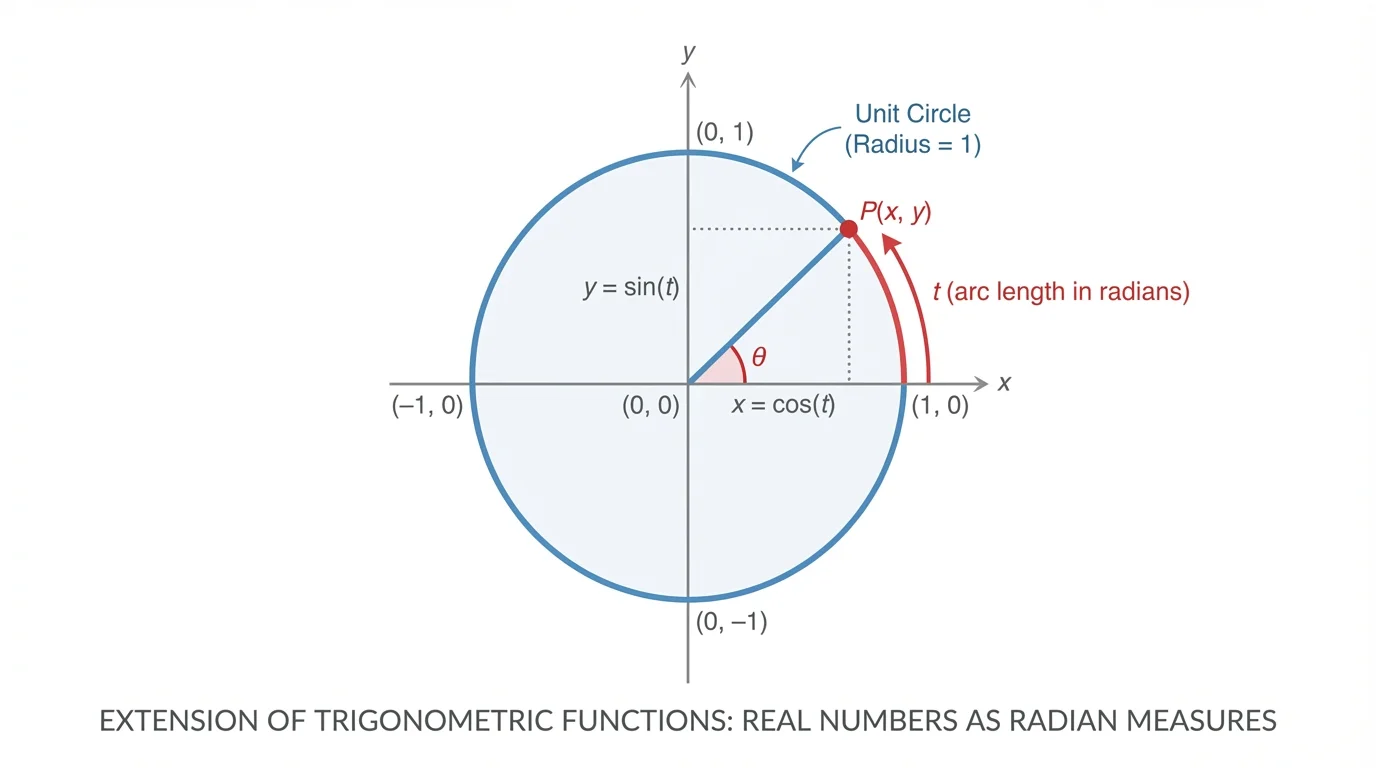
This is why every real number \(t\) can be interpreted as an angle measure: move a distance \(t\) along the unit circle. If \(t>0\), move counterclockwise. If \(t<0\), move clockwise. Since there is no limit to how far you can travel, trigonometric functions naturally extend to all real numbers, not just a limited range of angles.
Unit circle: the circle centered at the origin with radius \(1\).
Radian: a unit of angle measure based on arc length; on the unit circle, the radian measure equals the length of the intercepted arc.
Standard position: an angle whose vertex is at the origin and whose initial side lies on the positive \(x\)-axis.
A full revolution around the circle has circumference \(2\pi\), so one complete turn corresponds to \(2\pi\) radians. Half a turn is \(\pi\), a quarter turn is \(\dfrac{\pi}{2}\), and so on. That connection makes radians especially natural when studying circular motion.
Now suppose a real number \(t\) represents a radian measure. Starting from the point \((1,0)\), move counterclockwise if \(t\) is positive or clockwise if \(t\) is negative until you reach a point \((x,y)\) on the unit circle. Then the trigonometric functions are defined by the coordinates of that point:
\[\cos t = x, \quad \sin t = y\]
Since tangent is the ratio of sine to cosine, we define
\[\tan t = \frac{\sin t}{\cos t} = \frac{y}{x}\]
provided that \(x \ne 0\). When \(x=0\), tangent is undefined because division by zero is undefined.
Why these definitions match triangle trig
For an acute angle in the first quadrant, draw the perpendicular from the point \((x,y)\) on the unit circle to the \(x\)-axis. This forms a right triangle with hypotenuse \(1\). In that triangle, \(\cos t = \dfrac{x}{1} = x\) and \(\sin t = \dfrac{y}{1} = y\). So the unit-circle definitions agree exactly with the right-triangle definitions when both apply.
This agreement is important. We are not replacing earlier trigonometric definitions with a different idea; we are extending them. The unit circle keeps the familiar meaning for acute angles and extends it to every real number.
Because the radius is \(1\), the coordinates themselves are the sine and cosine values. That simple fact is one reason the unit circle is such a central object in mathematics.
Positive angles are measured counterclockwise from the positive \(x\)-axis, while negative angles are measured clockwise. So \(\dfrac{\pi}{2}\) lands at the top of the circle, \(\pi\) lands at the left side, \(\dfrac{3\pi}{2}\) lands at the bottom, and \(2\pi\) returns to the starting point \((1,0)\).
For negative values, \(-\dfrac{\pi}{2}\) lands at the bottom of the circle, because it represents a quarter-turn clockwise. This means there is nothing unusual about negative angle measures: they simply describe direction of rotation.
Interpreting a real number as distance traveled around the unit circle is what makes the domain extension so natural. The real line and circular motion become linked. Every real number gives a location on the circle, and every location gives trigonometric values.
As [Figure 2] illustrates, the signs of \(x\) and \(y\) change from quadrant to quadrant. Since cosine is the \(x\)-coordinate and sine is the \(y\)-coordinate, the signs of trig functions follow directly from the coordinates.
Here is the sign pattern:
| Quadrant | Range of angles | Sign of \(\cos t\) | Sign of \(\sin t\) | Sign of \(\tan t\) |
|---|---|---|---|---|
| I | \(0 < t < \dfrac{\pi}{2}\) | positive | positive | positive |
| II | \(\dfrac{\pi}{2} < t < \pi\) | negative | positive | negative |
| III | \(\pi < t < \dfrac{3\pi}{2}\) | negative | negative | positive |
| IV | \(\dfrac{3\pi}{2} < t < 2\pi\) | positive | negative | negative |
Table 1. Sign patterns of sine, cosine, and tangent in the four quadrants.
This means that once you know where the terminal side lies, you can often determine the sign of a trigonometric function immediately. For example, if \(t\) is in Quadrant II, then \(\sin t\) must be positive and \(\cos t\) must be negative.
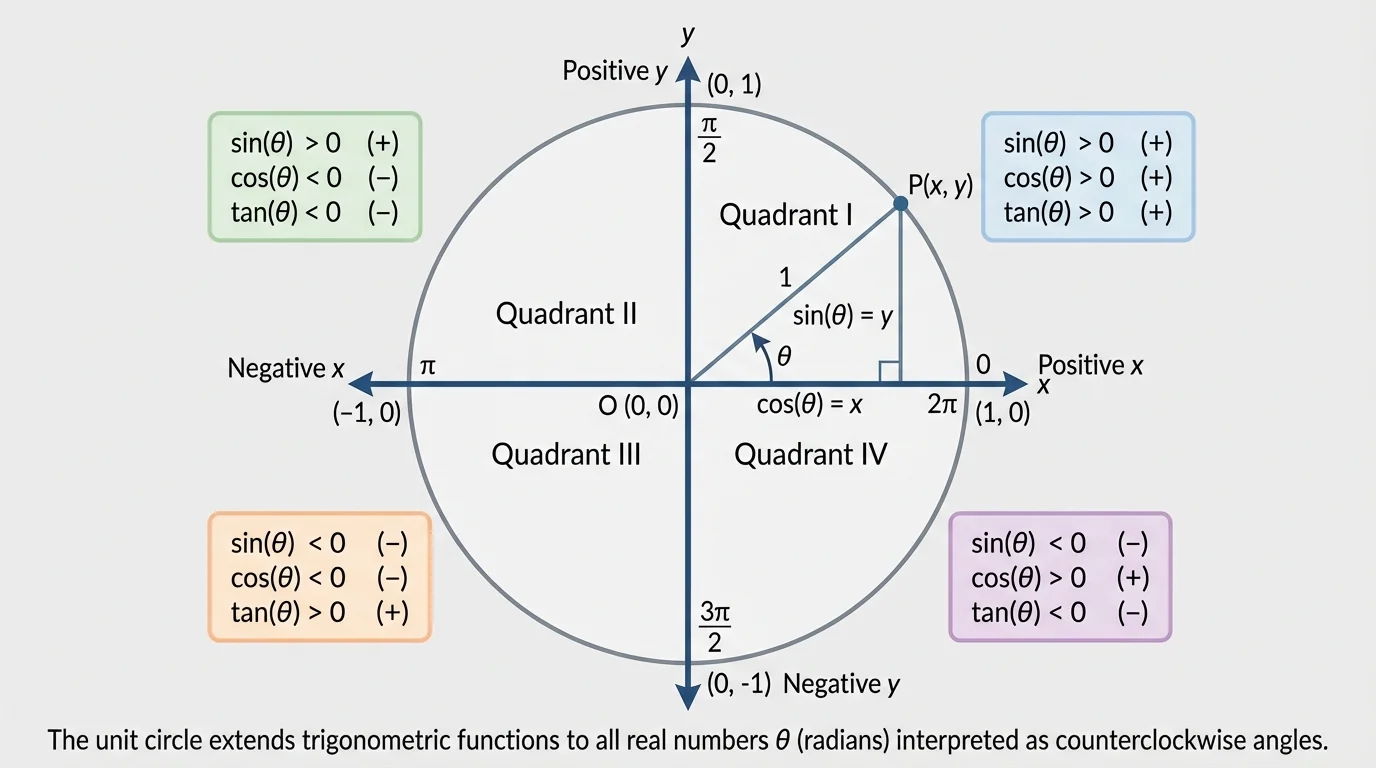
The coordinate view also explains why some values are zero. At the point \((1,0)\), the \(y\)-coordinate is \(0\), so \(\sin 0 = 0\). At the point \((0,1)\), the \(x\)-coordinate is \(0\), so \(\cos\left(\dfrac{\pi}{2}\right)=0\), and therefore \(\tan\left(\dfrac{\pi}{2}\right)\) is undefined.
Later, when you graph trigonometric functions, these coordinate signs help explain the shape of the graphs. The unit circle is not just a geometry tool; it is also the source of the algebraic behavior of trig functions.
One of the most remarkable features of circular motion is repetition. After one full turn, you return to the same point. As [Figure 3] shows, angles such as \(\dfrac{\pi}{3}\), \(\dfrac{7\pi}{3}\), and \(-\dfrac{5\pi}{3}\) all end at the same terminal point. Angles that share a terminal side are called coterminal angles.
Since one full turn is \(2\pi\), any two coterminal angles differ by an integer multiple of \(2\pi\):
\[t \textrm{ and } t + 2\pi k \textrm{ are coterminal for any integer } k\]
This leads to the periodic nature of sine and cosine:
\[\sin(t+2\pi)=\sin t, \quad \cos(t+2\pi)=\cos t\]
and tangent repeats every \(\pi\):
\[\tan(t+\pi)=\tan t\]
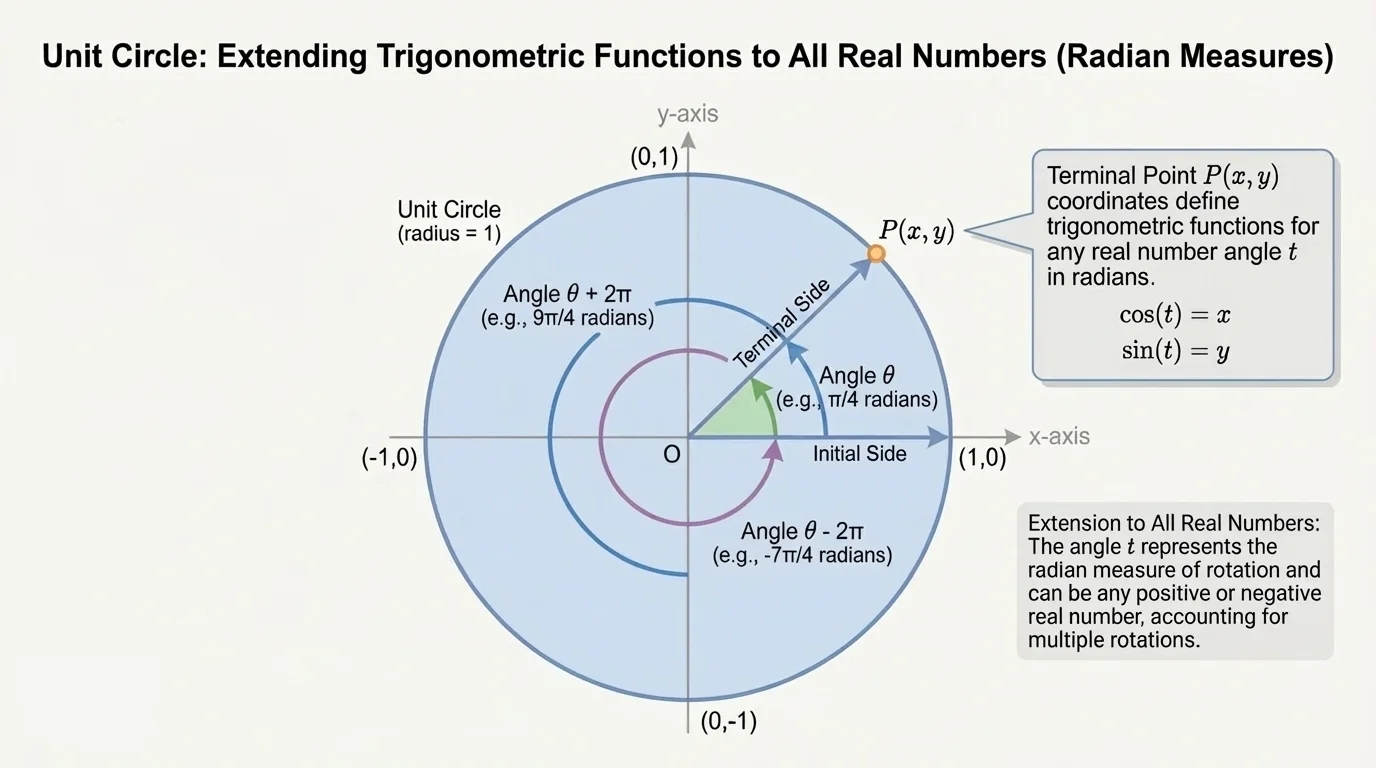
Periodicity is essential in applications involving repeated motion, such as sound waves, pendulums, and rotating machines. The values recur because the same point on the unit circle is visited again and again.
Some angles occur so often that their exact trig values should be recognized quickly. These come from familiar geometric shapes, especially the \(45\)-\(45\)-\(90\) and \(30\)-\(60\)-\(90\) triangles, then are extended around the whole circle by symmetry and sign patterns from [Figure 2].
The most common special-angle values on the unit circle are shown below.
| Angle \(t\) | Point on unit circle | \(\cos t\) | \(\sin t\) | \(\tan t\) |
|---|---|---|---|---|
| \(0\) | \((1,0)\) | \(1\) | \(0\) | \(0\) |
| \(\dfrac{\pi}{6}\) | \(\left(\dfrac{\sqrt{3}}{2},\dfrac{1}{2}\right)\) | \(\dfrac{\sqrt{3}}{2}\) | \(\dfrac{1}{2}\) | \(\dfrac{\sqrt{3}}{3}\) |
| \(\dfrac{\pi}{4}\) | \(\left(\dfrac{\sqrt{2}}{2},\dfrac{\sqrt{2}}{2}\right)\) | \(\dfrac{\sqrt{2}}{2}\) | \(\dfrac{\sqrt{2}}{2}\) | \(1\) |
| \(\dfrac{\pi}{3}\) | \(\left(\dfrac{1}{2},\dfrac{\sqrt{3}}{2}\right)\) | \(\dfrac{1}{2}\) | \(\dfrac{\sqrt{3}}{2}\) | \(\sqrt{3}\) |
| \(\dfrac{\pi}{2}\) | \((0,1)\) | \(0\) | \(1\) | \(\textrm{undefined}\) |
Table 2. Exact trigonometric values for common special angles in the first quadrant and on the axes.
Once these first-quadrant values are known, the rest can be found by using the same reference angle with the correct signs. For instance, \(\dfrac{5\pi}{6}\) has reference angle \(\dfrac{\pi}{6}\) and lies in Quadrant II, so cosine is negative and sine is positive:
\[\cos\left(\frac{5\pi}{6}\right)=-\frac{\sqrt{3}}{2}, \quad \sin\left(\frac{5\pi}{6}\right)=\frac{1}{2}\]
Worked examples show how the unit circle turns geometric ideas into precise function values.
Example 1: Find \(\sin\left(\dfrac{7\pi}{6}\right)\) and \(\cos\left(\dfrac{7\pi}{6}\right)\)
Step 1: Locate the angle.
The angle \(\dfrac{7\pi}{6}=\pi+\dfrac{\pi}{6}\), so it lies in Quadrant III.
Step 2: Identify the reference angle.
The reference angle is \(\dfrac{\pi}{6}\).
Step 3: Use first-quadrant values and quadrant signs.
For \(\dfrac{\pi}{6}\), the coordinates are \(\left(\dfrac{\sqrt{3}}{2},\dfrac{1}{2}\right)\). In Quadrant III, both coordinates are negative, so the point becomes \(\left(-\dfrac{\sqrt{3}}{2},-\dfrac{1}{2}\right)\).
Step 4: Read off sine and cosine.
\[\cos\left(\frac{7\pi}{6}\right)=-\frac{\sqrt{3}}{2}, \quad \sin\left(\frac{7\pi}{6}\right)=-\frac{1}{2}\]
The unit-circle coordinates give the answer directly.
This example shows how reference angles simplify calculations. You do not need a new triangle for every angle; you use one known angle and adjust the signs.
Example 2: Find a positive and a negative coterminal angle for \(\dfrac{11\pi}{6}\)
Step 1: Use multiples of \(2\pi\).
Coterminal angles differ by \(2\pi\). Since \(2\pi=\dfrac{12\pi}{6}\), add or subtract \(\dfrac{12\pi}{6}\).
Step 2: Find a positive coterminal angle.
Add \(\dfrac{12\pi}{6}\): \(\dfrac{11\pi}{6}+\dfrac{12\pi}{6}=\dfrac{23\pi}{6}\).
Step 3: Find a negative coterminal angle.
Subtract \(\dfrac{12\pi}{6}\): \(\dfrac{11\pi}{6}-\dfrac{12\pi}{6}=-\dfrac{\pi}{6}\).
Step 4: State the result.
\[\frac{23\pi}{6} \textrm{ and } -\frac{\pi}{6} \textrm{ are coterminal with } \frac{11\pi}{6}\]
Because all three angles end at the same point, they have the same sine and cosine values. This repeating pattern is exactly what [Figure 3] emphasizes.
Example 3: Evaluate \(\tan\left(\dfrac{\pi}{2}\right)\)
Step 1: Find the point on the unit circle.
The angle \(\dfrac{\pi}{2}\) lands at the top of the circle, at \((0,1)\).
Step 2: Use the tangent definition.
\(\tan t = \dfrac{y}{x}\), so here \(\tan\left(\dfrac{\pi}{2}\right)=\dfrac{1}{0}\).
Step 3: Interpret the result.
Division by \(0\) is undefined.
Step 4: State the answer.
\[\tan\left(\frac{\pi}{2}\right) \textrm{ is undefined}\]
This is why tangent has breaks in its graph whenever cosine equals \(0\).
Undefined tangent values are not mistakes. They reflect a real structural fact: at some points on the circle, the \(x\)-coordinate is zero, so the ratio \(\dfrac{y}{x}\) cannot be computed.
Example 4: Evaluate \(\cos(-\dfrac{\pi}{3})\)
Step 1: Interpret the negative angle.
The angle \(-\dfrac{\pi}{3}\) means rotate clockwise by \(\dfrac{\pi}{3}\).
Step 2: Find the terminal point.
A clockwise rotation of \(\dfrac{\pi}{3}\) lands in Quadrant IV. The reference angle is \(\dfrac{\pi}{3}\), whose first-quadrant coordinates are \(\left(\dfrac{1}{2},\dfrac{\sqrt{3}}{2}\right)\).
Step 3: Adjust the sign.
In Quadrant IV, \(x\) is positive and \(y\) is negative, so the point is \(\left(\dfrac{1}{2},-\dfrac{\sqrt{3}}{2}\right)\).
Step 4: Read off cosine.
\[\cos\left(-\frac{\pi}{3}\right)=\frac{1}{2}\]
Negative angles often feel unfamiliar at first, but the unit circle handles them smoothly: just move clockwise instead of counterclockwise.
The unit circle is not just an abstract diagram. It is the foundation for modeling repeated motion. A point moving around a circle produces changing \(x\)- and \(y\)-coordinates, which are exactly cosine and sine. That connection drives many real systems.
In physics, circular motion and waves are closely related. If a point moves around a circle at constant speed, its horizontal and vertical positions vary sinusoidally. This helps model alternating current in electricity, sound vibrations, and the motion of springs.
In engineering, rotating parts such as gears, turbines, and motors are analyzed using angles measured in radians. Since angles may exceed one full turn many times, the extension of trig functions to all real numbers is necessary, not optional.
In navigation and robotics, direction changes are often tracked continuously. A robot arm may rotate through angles larger than \(2\pi\), and software still needs the correct sine and cosine values to compute position. The repeating structure from the unit circle makes those calculations efficient.
Modern digital music and communication systems rely heavily on sine and cosine waves. The same trigonometric functions defined by a point moving on the unit circle help represent sound, radio signals, and image data.
Even when a problem does not mention a circle directly, the unit circle may be working behind the scenes. Graphs of trig functions, harmonic motion, signal processing, and seasonal models all depend on the same ideas developed here.
The unit circle also reveals several fundamental facts. Since every point \((x,y)\) on the unit circle satisfies \(x^2+y^2=1\), and since \(x=\cos t\) and \(y=\sin t\), we get the identity
\[\sin^2 t + \cos^2 t = 1\]
This identity is one of the most important relationships in trigonometry. It comes directly from the geometry of the unit circle.
Another useful fact is symmetry. Reflections across axes and the origin create relationships among trig values. For example, because reflecting across the \(x\)-axis changes the sign of \(y\) but not \(x\), we get
\[\cos(-t)=\cos t, \quad \sin(-t)=-\sin t\]
These patterns become easier to understand when you picture the coordinates on the circle, especially the sign changes across quadrants shown in [Figure 2].
