A surprising idea in mathematics is that some relationships can be run backward exactly, almost like rewinding a video without losing any information. If a machine turns an input \(x\) into an output \(f(x)\), then an inverse function takes that output and recovers the original input. Being able to read values of an inverse from a graph or table is powerful because it lets you work backward without always finding a formula first.
If a function \(f\) has an inverse, written \(f^{-1}\), then the inverse undoes what the original function does. In other words, if \(f(a)=b\), then \(f^{-1}(b)=a\). The input and output switch roles.
That means the ordered pair \((a,b)\) on the graph of \(f\) becomes the ordered pair \((b,a)\) on the graph of \(f^{-1}\). This simple switch is the key to reading inverse values from both tables and graphs.
Inverse function: An inverse function reverses a function's action. If \(f(x)=y\), then \(f^{-1}(y)=x\).
One-to-one function: A function in which different inputs give different outputs. Only one-to-one functions have inverse functions that are also functions.
You can think of it as a question reversal. The function \(f\) answers, "What output comes from this input?" The inverse answers, "What input produced this output?"
For example, if \(f(3)=11\), then \(f^{-1}(11)=3\). Notice that the numbers are the same, but their roles are reversed.
A function does not automatically have an inverse function. For an inverse to be a function, the original function must be one-to-one. On a graph, this means each output comes from only one input.
As [Figure 1] shows, the horizontal line test says that if any horizontal line crosses the graph more than once, then the function is not one-to-one. If it is not one-to-one, then its inverse would assign one input to multiple outputs, so the inverse would not be a function.
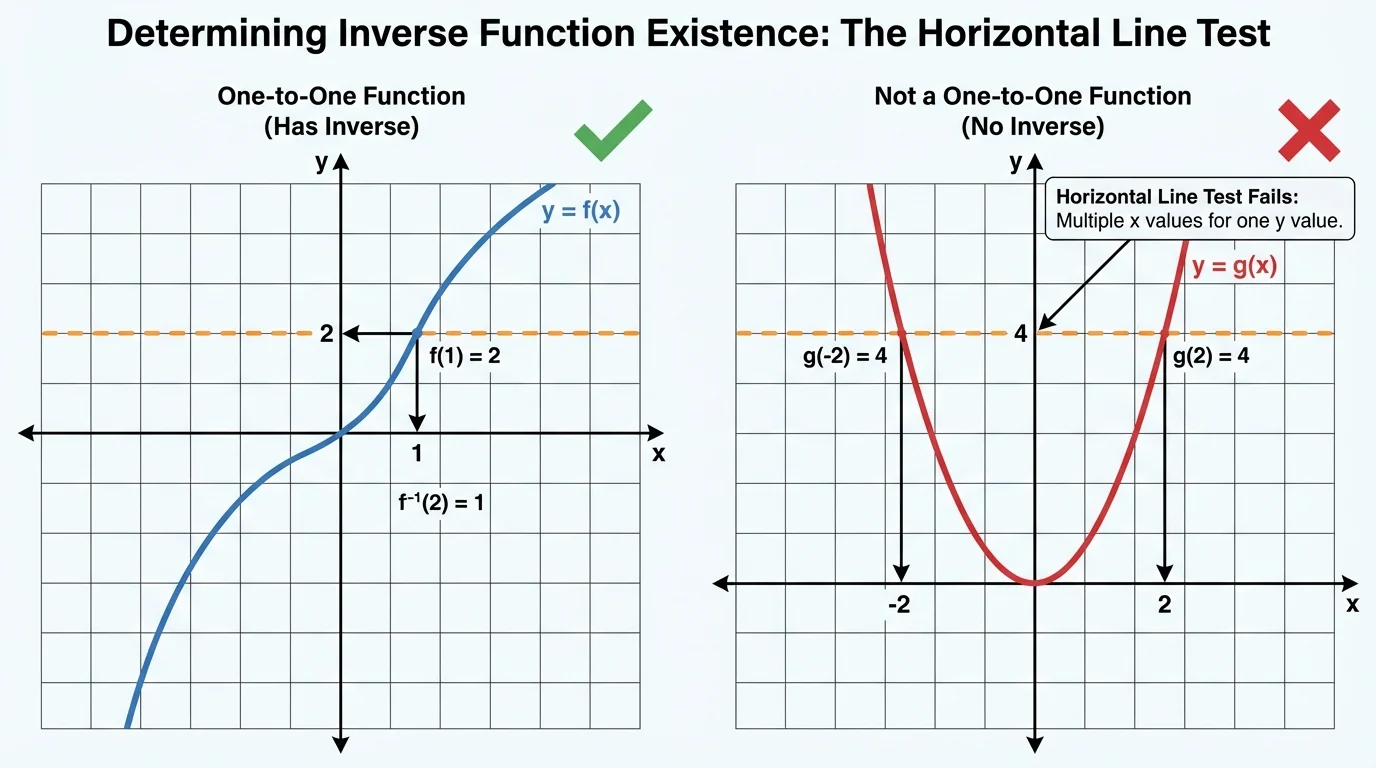
An increasing line such as \(y=2x+1\) is one-to-one, so it has an inverse function. A parabola such as \(y=x^2\), if its domain is all real numbers, is not one-to-one because both \(x=2\) and \(x=-2\) give the same output \(4\).
This matters when reading inverse values. If a function does not have an inverse function, then asking for a value like \(f^{-1}(4)\) may not make sense as a single function value.
To read a function value like \(f(5)\), find the output when the input is \(5\). To read an inverse value like \(f^{-1}(5)\), reverse the question: find the input whose output is \(5\).
Another important fact is that the domain and range switch for inverses. The domain of \(f\) becomes the range of \(f^{-1}\), and the range of \(f\) becomes the domain of \(f^{-1}\).
Tables are often the clearest place to see inverse relationships because the values in the \(x\)-column and \(y\)-column switch places.
As [Figure 2] shows, suppose a table for \(f\) includes the ordered pairs \((1,4)\), \((3,7)\), \((5,10)\), and \((8,13)\). Then the inverse table would include \((4,1)\), \((7,3)\), \((10,5)\), and \((13,8)\).
So if you want \(f^{-1}(7)\), do not look for input \(7\) in the original table. Instead, look for output \(7\). Since \(f(3)=7\), it follows that \(f^{-1}(7)=3\).
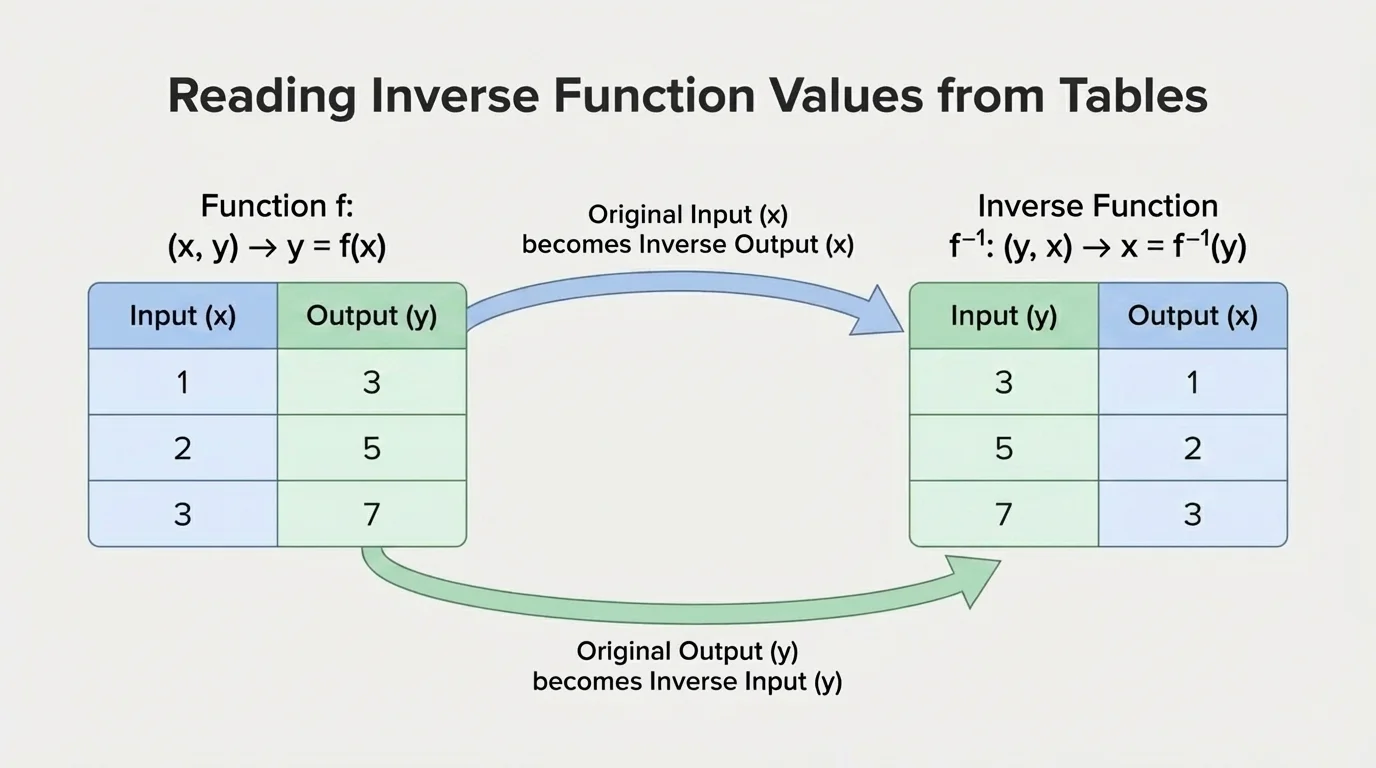
This is one of the most common places students make mistakes. They see \(f^{-1}(7)\) and search for \(x=7\), but inverse notation means you are reversing the function, not just evaluating the original function at \(7\).
Whenever you read from a table, ask yourself: "Which input gave this output?" That question leads directly to the inverse value.
Solved Example 1: Reading an inverse value from a table
A function \(g\) is given by the table of values:
| \(x\) | \(g(x)\) |
|---|---|
| \(2\) | \(9\) |
| \(4\) | \(12\) |
| \(7\) | \(18\) |
| \(10\) | \(25\) |
Table 1. Values of the function \(g\).
Find \(g^{-1}(18)\).
Step 1: Interpret the inverse notation.
\(g^{-1}(18)\) means: what input of \(g\) gives the output \(18\)?
Step 2: Search the output column.
In the table, \(g(7)=18\).
Step 3: Reverse the pair.
Since \(g(7)=18\), we have \(g^{-1}(18)=7\).
The answer is \[g^{-1}(18)=7\]
The same method works even if the table is not in order. The position in the table does not matter; only the matching input-output pair matters.
As with [Figure 2], mentally swapping the columns is often enough to read the inverse value quickly.
Graphs reveal inverse functions visually. The graph of a function and the graph of its inverse are reflections across the line reflection across the line \(y=x\).
As [Figure 3] shows, if the point \((2,5)\) lies on the graph of \(f\), then the point \((5,2)\) lies on the graph of \(f^{-1}\). That is because \(f(2)=5\) means \(f^{-1}(5)=2\).
So to read an inverse value from the graph of \(f\), you do not always need the graph of \(f^{-1}\) drawn separately. You can read the original graph, identify a point, and switch the coordinates.
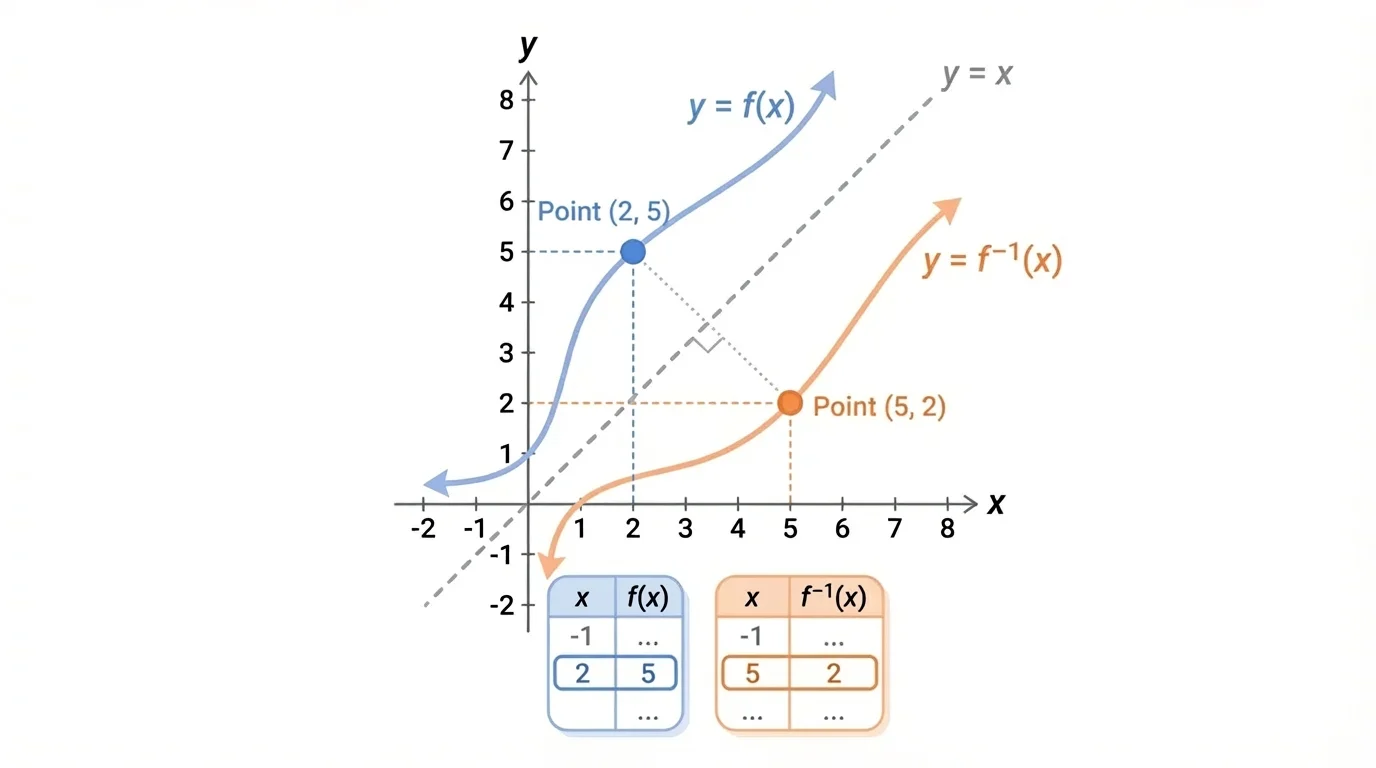
For instance, if the graph of \(f\) passes through \((4,9)\), then \(f(4)=9\), so \(f^{-1}(9)=4\). The inverse value comes from reversing the ordered pair.
If the graph of \(f^{-1}\) is given directly, then reading \(f^{-1}(9)\) works the same way you read any function value: locate input \(9\) on the horizontal axis and read the corresponding output.
How graph reading and table reading match
A table lists ordered pairs directly, while a graph shows them as points. In both cases, finding an inverse value means reversing the pair \((x,y)\) to \((y,x)\). The graph adds one more visual idea: the original and inverse graphs mirror each other across the line \(y=x\).
This visual symmetry can help you check your reasoning. If a point and its reversed point are not mirror images across \(y=x\), then something is wrong.
The best way to become confident is to see the reasoning step by step in several forms.
Solved Example 2: Reading an inverse value from a graph of the original function
A point on the graph of \(h\) is \((6,-1)\). Find \(h^{-1}(-1)\).
Step 1: Interpret the given point.
The point \((6,-1)\) means \(h(6)=-1\).
Step 2: Use the inverse relationship.
If \(h(6)=-1\), then the inverse reverses the input and output.
Step 3: Write the inverse value.
Therefore, \(h^{-1}(-1)=6\).
The answer is \[h^{-1}(-1)=6\]
Notice that the input to the inverse, \(-1\), was the output of the original function. That reversal is the whole idea.
Now consider a graph where you may need to estimate a point rather than read an exact grid intersection. The same logic still works, but your answer may be approximate.
Solved Example 3: Reading from the graph of the inverse itself
The graph of \(p^{-1}\) contains the point \((8,3)\). What does this tell you about \(p(3)\)?
Step 1: Interpret the inverse point.
The point \((8,3)\) on \(p^{-1}\) means \(p^{-1}(8)=3\).
Step 2: Reverse the statement.
If \(p^{-1}(8)=3\), then \(p(3)=8\).
Step 3: State the related function value.
So the original function satisfies \(p(3)=8\).
The answer is \(p(3)=8\)
This example shows that information can move in either direction. A point on \(f\) gives a point on \(f^{-1}\), and a point on \(f^{-1}\) gives a point on \(f\).
Solved Example 4: Using a table with negative and fractional outputs
A function \(q\) is described by the pairs \((-2,1.5)\), \((0,2)\), \((3,4.5)\), and \((5,8)\). Find \(q^{-1}(4.5)\).
Step 1: Look for the output \(4.5\).
From the list of pairs, \(q(3)=4.5\).
Step 2: Reverse the relationship.
If \(q(3)=4.5\), then \(q^{-1}(4.5)=3\).
Step 3: Write the result clearly.
The inverse value is \(3\).
The answer is \[q^{-1}(4.5)=3\]
Inverse reading works with positive numbers, negative numbers, fractions, and decimals. The type of number does not change the method.
One of the biggest mistakes is confusing \(f^{-1}(x)\) with \(\dfrac{1}{f(x)}\). These are completely different ideas. The notation \(f^{-1}(x)\) means the inverse function value, not the reciprocal.
Another mistake is forgetting that the inverse question starts with an output of the original function. For example, to find \(f^{-1}(12)\), you search for where \(f(x)=12\), not where \(x=12\).
A third mistake is ignoring whether the function really has an inverse. As seen earlier in [Figure 1], if the graph fails the horizontal line test, then the inverse is not a function unless the domain is restricted.
Many functions that are not one-to-one on their full domains can still have inverses if their domains are restricted. For example, \(y=x^2\) does not have an inverse function for all real \(x\), but if \(x\ge 0\), its inverse is \(y=\sqrt{x}\).
Sometimes a graph or table does not contain the exact value you need. In that case, you may have to estimate from the graph, but only if the graph gives enough information. If the needed output never appears in the table, then the inverse value cannot be read from that table alone.
Also keep the domain and range switch in mind. If \(12\) is not in the range of \(f\), then \(f^{-1}(12)\) is not defined.
Inverse functions appear whenever a process can be reversed. In science, engineering, and technology, it is common to measure an output and then work backward to determine the input. That reverse interpretation is exactly what inverse functions do.
As [Figure 4] shows, suppose a function converts Celsius to Fahrenheit. If \(F(C)=\dfrac{9}{5}C+32\), then the inverse takes a Fahrenheit temperature and returns the Celsius value. Reading the inverse means asking which Celsius temperature produced a given Fahrenheit reading.
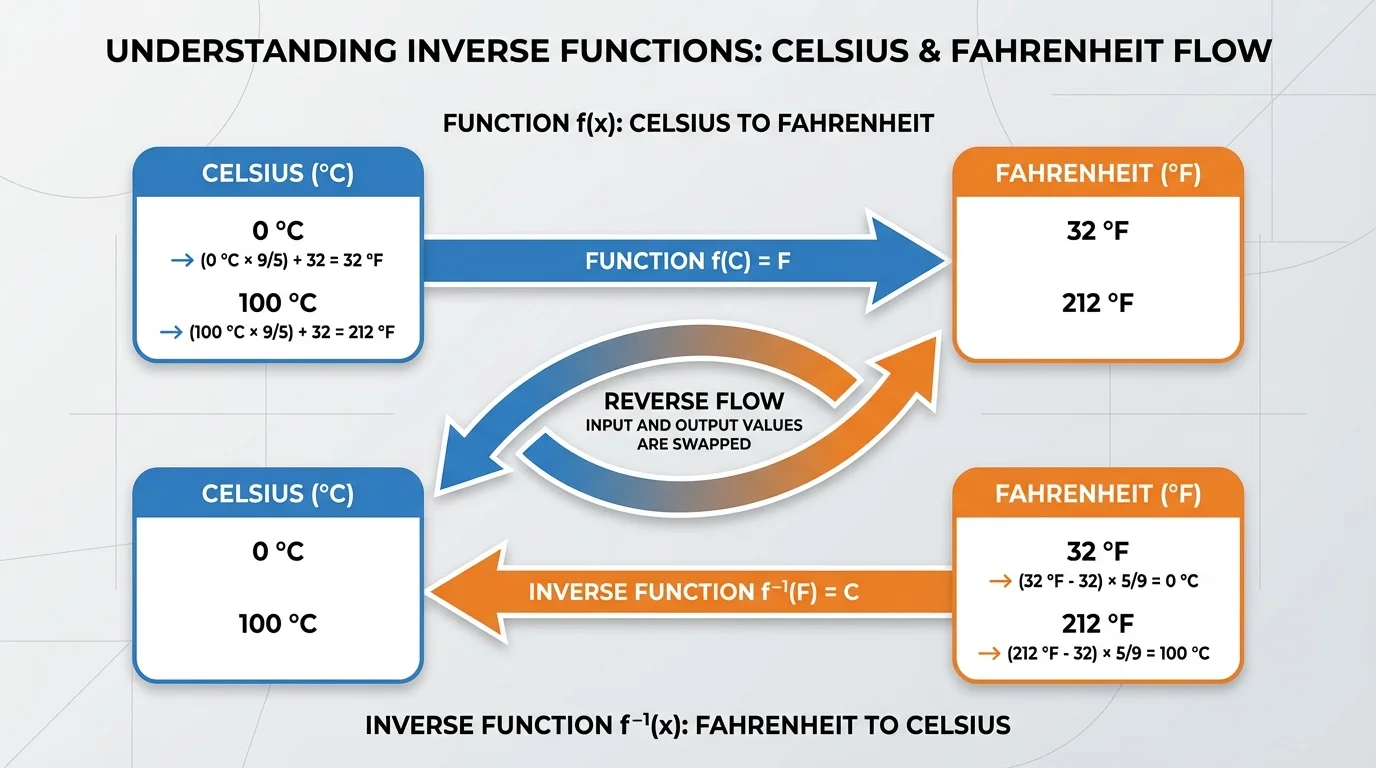
Calibration works the same way. A sensor may convert pressure, light, or voltage into a numerical reading. If the function is one-to-one, then the inverse lets engineers take the reading and recover the original physical quantity.
Economics provides another example. A pricing model might give cost as a function of quantity. The inverse, when it exists, tells you what quantity corresponds to a given cost. Businesses often think in both directions: from production to price and from target price back to production.
Even online maps rely on inverse thinking. A model may give travel time from distance and average speed, while a reverse calculation can infer a distance from a known time. Although not every relationship is a function in both directions, when it is one-to-one, the inverse gives a precise reversal.
As with the temperature conversion in [Figure 4], the practical question often starts with an observed output. The inverse answers the hidden-input question.
When you see an inverse value, pause and translate the notation into words. For \(f^{-1}(a)\), ask: "What input of \(f\) gives output \(a\)?" That single sentence prevents many errors.
On a table, search the output column and read off the matching input. On a graph of the original function, find a point whose \(y\)-value is the given number and then use its \(x\)-value as the inverse output. On a graph of the inverse, just read the graph normally.
The reflection idea from [Figure 3] is especially useful for checking answers. If \(f(2)=7\), then the inverse must satisfy \(f^{-1}(7)=2\), and the points \((2,7)\) and \((7,2)\) should reflect across \(y=x\).
These strategies make inverse values much less mysterious. Instead of memorizing separate rules for tables and graphs, you can use one central idea: inverse functions reverse input and output.
