Have you ever followed directions like "mix the dry ingredients first, then double the recipe" or "add the scores from two games, then multiply by the number of teams"? Those directions are really a math plan. In mathematics, we can record that plan with symbols and numbers. A short expression can hold a lot of meaning, even before we calculate anything.
Math is not only about getting answers. It is also about showing how numbers are connected. When we write a calculation as an expression, we are recording the steps in a clear and organized way. This helps us read math, explain math, and understand what a calculation means.
For example, the words "add the numbers \(8\) and \(7\), then multiply by \(2\)" can be written as \(2 \times (8 + 7)\). That expression tells us exactly what to do. It says to find \(8 + 7\) first, and then multiply that result by \(2\).
You already know the four operations: addition, subtraction, multiplication, and division. You also know that symbols like \(+\), \(-\), \(\times\), and \(\div\) represent those operations. Now you are using those operations to write and read whole calculation plans.
Expressions are useful because they let us focus on meaning. Sometimes we want to understand a calculation without carrying it out yet. That skill is called interpretation, and it is a big part of mathematical thinking.
A numerical expression is a group of numbers and operation symbols that shows a calculation. It does not include an equals sign. For example, \(6 + 4\), \(5 \times 9\), and \((12 - 3) \div 3\) are all numerical expressions.
Numerical expression means a math phrase made of numbers and operation symbols that shows a calculation.
Interpret means to explain what an expression tells us to do or what it means, without needing to compute the answer.
Parentheses are grouping symbols that show which part of an expression should be done first.
An equation is different. An equation has an equals sign, such as \(6 + 4 = 10\). In this lesson, the main focus is on expressions like \(6 + 4\), not equations.
Notice how an expression can be short, but still full of information. The expression \((15 + 5) \times 3\) tells us that one sum is being multiplied by \(3\). We can talk about what it means even if we never evaluate it.
Word descriptions often use special operation words. Learning these words helps you turn words into symbols and symbols back into words.
Here are some common matches:
| Word or phrase | Operation | Example |
|---|---|---|
| sum, add, plus | Addition | \(8 + 5\) |
| difference, subtract, minus | Subtraction | \(8 - 5\) |
| product, times, multiply | Multiplication | \(8 \times 5\) |
| quotient, divide | Division | \(8 \div 5\) |
| then | Next step | Do one operation, then another |
| the quantity | Grouped part | \(3 \times (8 + 5)\) |
Table 1. Common operation words and the math symbols they often represent.
Words like then are especially important. They tell you the order of the steps. If the words say "add first, then multiply," the expression should show that order clearly.
Sometimes the same numbers appear in two different expressions, but the meaning changes because the grouping changes. As [Figure 1] shows, grouping tells us which numbers belong together as one part of the calculation.
Compare these two expressions:
\(2 \times (8 + 7)\)
and
\((2 \times 8) + 7\)
These are not the same. In the first expression, you add \(8\) and \(7\) first, then multiply the result by \(2\). In the second expression, you multiply \(2\) and \(8\) first, then add \(7\). Parentheses help us see the intended plan.
Another way to think about parentheses is that they make a small group inside the larger expression. That group acts like one unit. When you see \((8 + 7)\), you should read it as "the quantity \(8 + 7\)."
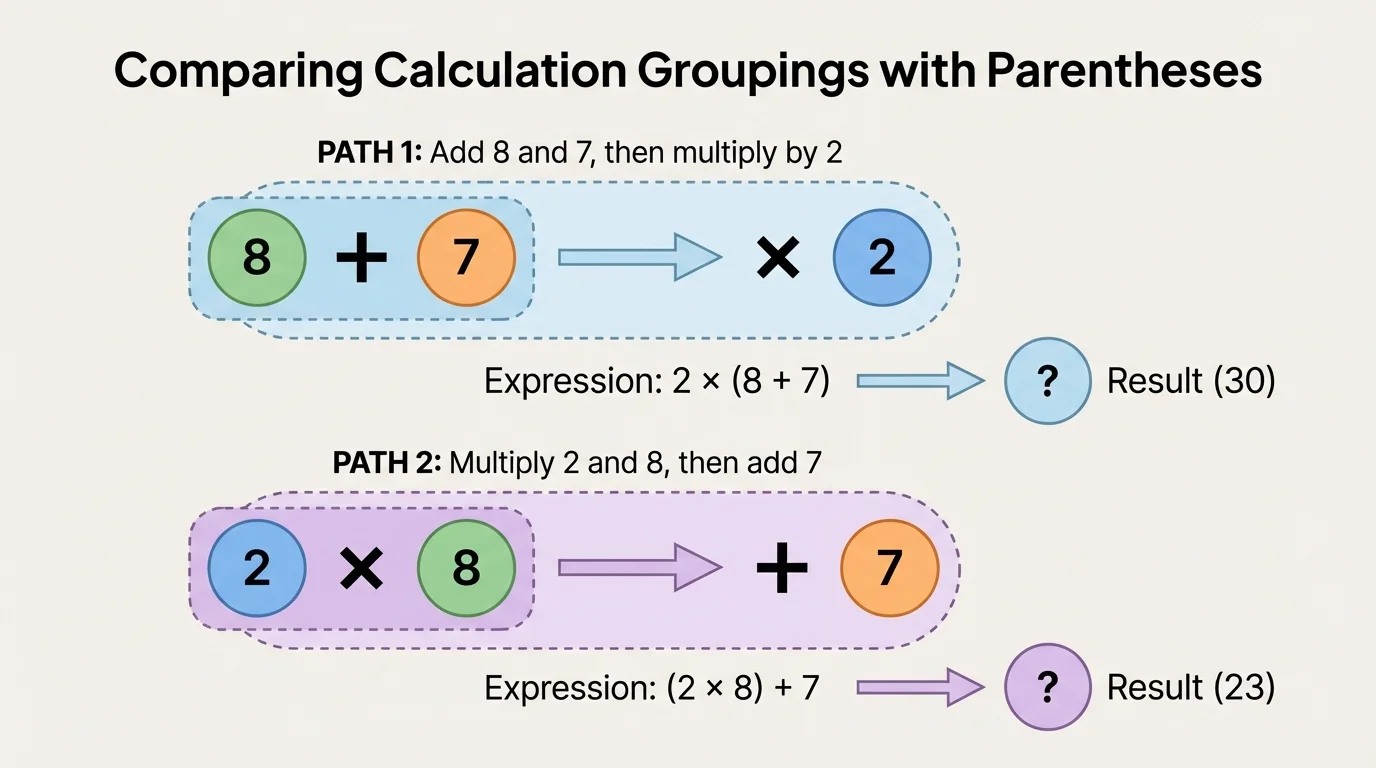
Later, when you compare expressions, remembering this grouped structure matters a lot. The arrangement of symbols is not decoration. It is part of the meaning of the expression.
Even adults can misread expressions if they ignore grouping symbols. A pair of parentheses can completely change the meaning of a calculation, just like punctuation can change the meaning of a sentence.
That is why mathematicians are careful writers. A well-written expression tells the story of the calculation in the correct order.
As [Figure 2] illustrates, when you turn words into symbols, read the phrase slowly and look for the actions in order. As [Figure 2] illustrates, it helps to break a sentence into smaller action parts before writing the whole expression.
Take the phrase "add \(8\) and \(7\), then multiply by \(2\)." The first action is to add \(8\) and \(7\), so we start with \((8 + 7)\). The next action is to multiply that result by \(2\), so we write:
\[2 \times (8 + 7)\]
Now look at the phrase "multiply \(6\) by the sum of \(4\) and \(9\)." The words "sum of \(4\) and \(9\)" mean \((4 + 9)\). Then multiply by \(6\):
\[6 \times (4 + 9)\]
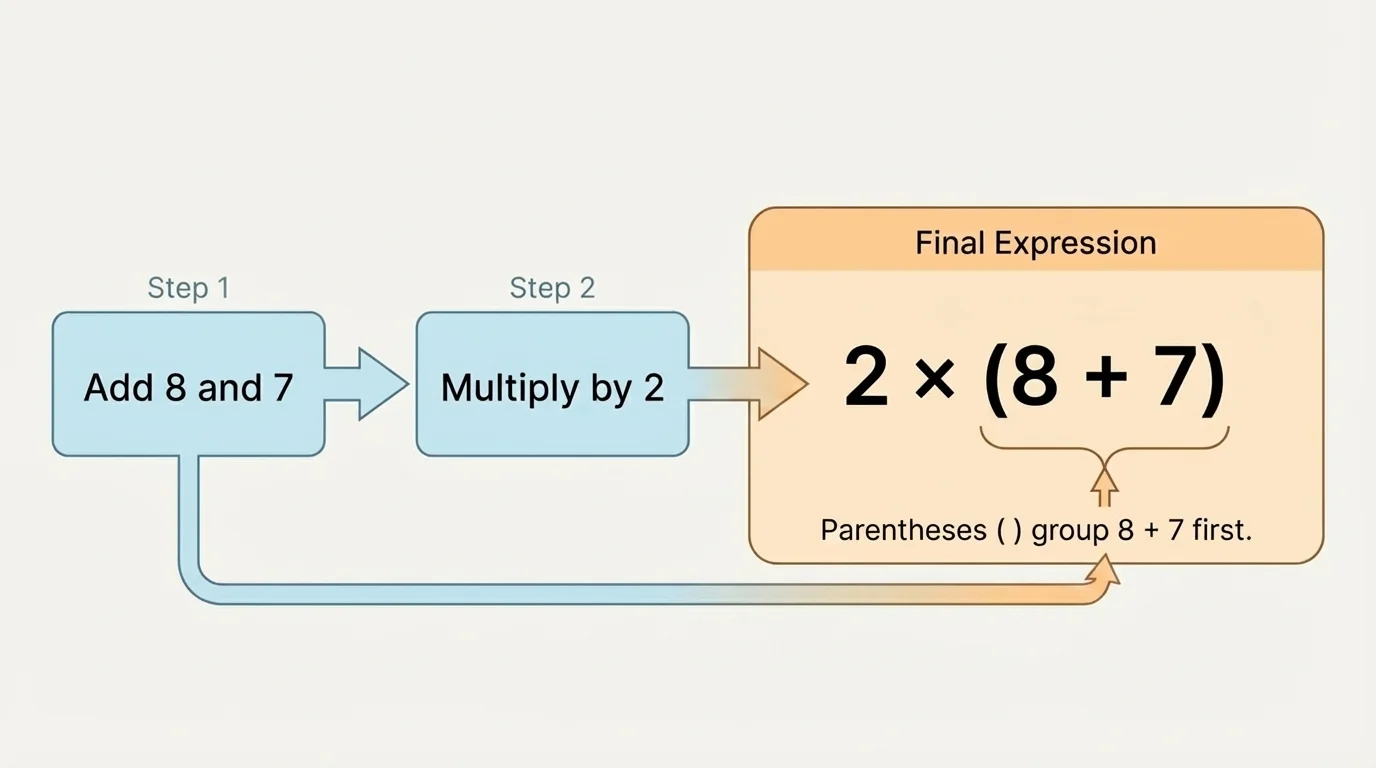
If the words describe a grouped amount, use parentheses. If the words give two separate operations in sequence, the expression should show that sequence clearly.
Try reading carefully for clue words like sum, difference, product, quotient, and the quantity. Those words often tell you where parentheses belong.
Sometimes the most important math skill is not computing an answer but explaining what an expression means. In expressions with multiplication, this can help us compare sizes quickly. As [Figure 3] shows, multiplication can represent equal groups of the same amount, even if that amount has not been calculated yet.
Consider the expression \(3 \times (18{,}932 + 921)\). You do not need to find \(18{,}932 + 921\) first. You can still say what the expression means: it is three times as large as the quantity \((18{,}932 + 921)\). It describes three equal groups of that same sum.
This kind of interpretation is powerful. You are looking at the structure of the expression. The part inside parentheses is one quantity. Multiplying by \(3\) means taking that quantity three times.
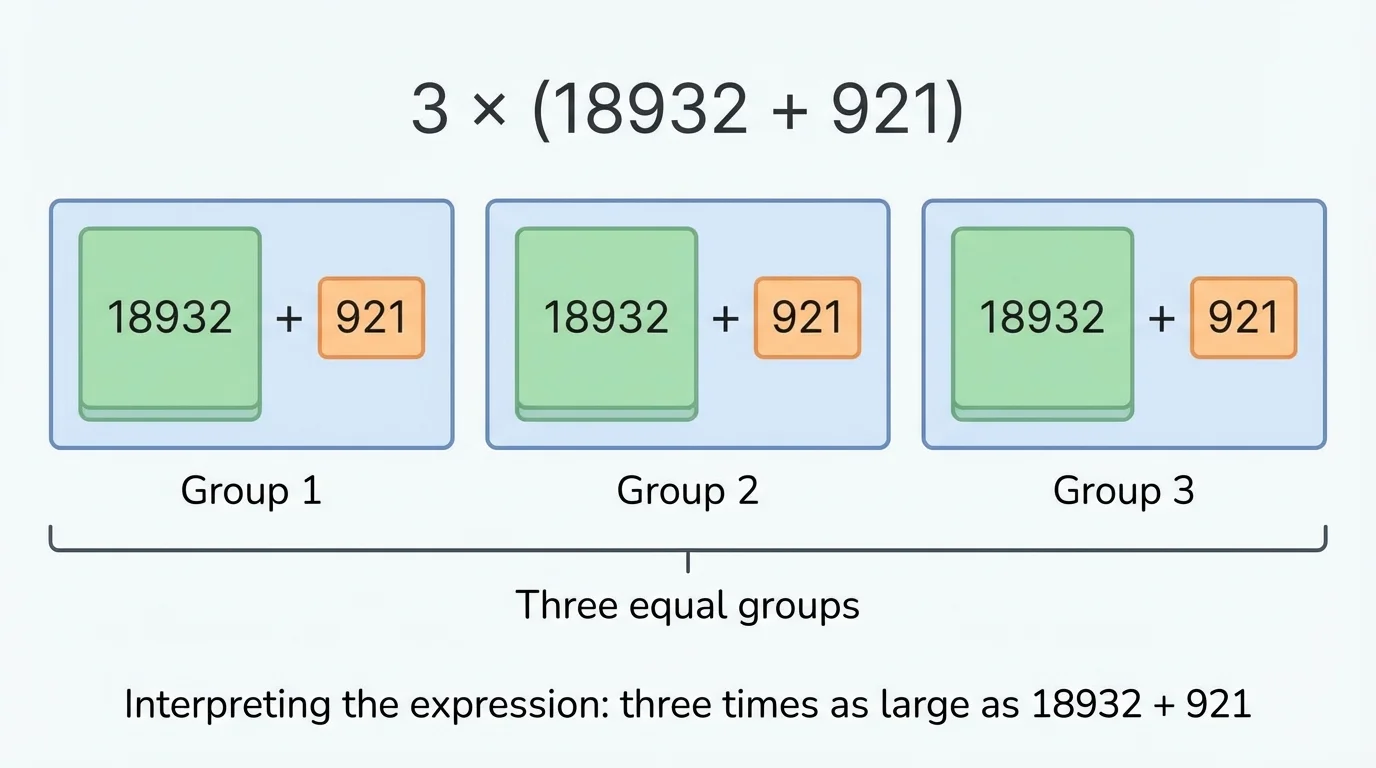
You can also interpret \(5 \times (40 - 12)\) without evaluating it. It means five groups of the difference between \(40\) and \(12\). It is five times as large as \((40 - 12)\).
Looking at structure means paying attention to how an expression is built. In \(3 \times (18{,}932 + 921)\), the quantity inside the parentheses is one whole part, and the multiplication tells how many copies of that part there are. Understanding structure helps you explain expressions clearly without doing every calculation.
This is a key idea in algebraic thinking. You are learning to see the parts of a calculation and describe how they work together.
Multiplication can mean repeated addition, equal groups, or scaling. In this lesson, scaling is especially important. If one amount is \((18 + 2)\), then \(4 \times (18 + 2)\) is four times that amount.
This means the expression is larger because it contains multiple copies of the same quantity. We can say:
\(4 \times (18 + 2)\) is four times as large as \((18 + 2)\).
We can also say:
\(2 \times (50 - 8)\) is twice the quantity \((50 - 8)\).
Notice that none of these statements require computing the value inside the parentheses. We are describing relationships, not just answers. This connects back to [Figure 3], which displays a grouped amount being repeated as equal copies.
Worked examples help show how to move from words to expressions and from expressions to meaning.
Worked example 1
Write an expression for "add \(12\) and \(5\), then multiply by \(4\)."
Step 1: Find the first action.
The phrase says to add \(12\) and \(5\) first, so write \((12 + 5)\).
Step 2: Find the next action.
Then multiply that sum by \(4\), so place \(4\) outside the parentheses.
Step 3: Write the complete expression.
\[4 \times (12 + 5)\]
The expression records the calculation in the correct order.
The parentheses matter because they show that the addition happens before the multiplication.
Worked example 2
Write an expression for "subtract \(9\) from \(30\), then divide by \(3\)."
Step 1: Identify the subtraction.
"Subtract \(9\) from \(30\)" means \((30 - 9)\).
Step 2: Identify the next operation.
Then divide that result by \(3\).
Step 3: Write the expression.
\[(30 - 9) \div 3\]
This expression means the difference of \(30\) and \(9\), divided by \(3\).
Notice that "subtract \(9\) from \(30\)" is not the same as \(9 - 30\). The order of the numbers matters in subtraction.
Worked example 3
Interpret the expression \(5 \times (200 + 16)\) without evaluating it.
Step 1: Look at the grouped part.
The expression \((200 + 16)\) is one quantity.
Step 2: Look at the multiplication.
Multiplying by \(5\) means five equal groups of that quantity.
Step 3: State the meaning.
\[5 \times (200 + 16)\]
means five times as large as \((200 + 16)\), or five groups of the sum of \(200\) and \(16\).
You can interpret the expression clearly without finding the exact value.
That is exactly the kind of thinking mathematicians use when they study how expressions are built.
Worked example 4
Interpret the expression \((40 \div 5) + 7\).
Step 1: Find the first grouped operation.
The expression \((40 \div 5)\) means the quotient of \(40\) and \(5\).
Step 2: Look at what happens next.
Then \(7\) is added to that quotient.
Step 3: State the meaning in words.
\[(40 \div 5) + 7\]
means divide \(40\) by \(5\), then add \(7\).
This expression has two operations, and the grouping shows the order.
One common mistake is ignoring the order given in words. For example, "add \(8\) and \(7\), then multiply by \(2\)" should be \(2 \times (8 + 7)\), not \((2 \times 8) + 7\). The two expressions tell different stories.
Another mistake is reversing subtraction or division. "Subtract \(4\) from \(15\)" means \(15 - 4\), not \(4 - 15\). "Divide \(24\) by \(6\)" means \(24 \div 6\), not \(6 \div 24\).
A third mistake is thinking every expression must be evaluated right away. Often, the goal is only to write the expression correctly or explain its meaning. You can understand the structure without computing the result.
Expressions are everywhere in daily life. Suppose a sports club scores \(18\) points in the first half and \(12\) points in the second half for each game. Over \(4\) games, the total points can be written as \(4 \times (18 + 12)\). This expression shows four games, each with the same two-half total.
In shopping, if one pack contains \(6\) markers and \(2\) erasers, and you buy \(3\) identical packs, you can describe the number of items as \(3 \times (6 + 2)\). You know it means three groups of the same pack contents.
In baking, if one batch uses \(2\) cups of flour and \(1\) cup of sugar, then making \(5\) batches can be written as \(5 \times (2 + 1)\) if you are counting total cups of those ingredients together. The grouped amount represents one batch.
These examples show why expressions are useful. They record a repeated plan. That is the same idea we saw earlier in [Figure 2], where words are turned into a clear mathematical structure.
You can understand expressions even better by comparing words, symbols, and meanings side by side.
| Word description | Expression | Meaning |
|---|---|---|
| Add \(8\) and \(7\), then multiply by \(2\) | \(2 \times (8 + 7)\) | Twice the sum of \(8\) and \(7\) |
| Subtract \(5\) from \(21\), then divide by \(4\) | \((21 - 5) \div 4\) | The difference of \(21\) and \(5\), divided by \(4\) |
| Multiply \(3\) by the sum of \(18{,}932\) and \(921\) | \(3 \times (18{,}932 + 921)\) | Three times the quantity \((18{,}932 + 921)\) |
| Add \(10\) to the quotient of \(36\) and \(6\) | \((36 \div 6) + 10\) | The quotient of \(36\) and \(6\), then add \(10\) |
Table 2. Comparisons among word descriptions, numerical expressions, and interpretations.
Looking across these forms helps you see that mathematical symbols are another way of writing instructions and relationships.
When you read an expression, ask yourself two questions: What part is grouped together? and What operation happens to that group? Those questions make interpretation much easier.
"An expression is a plan for a calculation."
That idea is worth remembering. A numerical expression is not just a string of symbols. It is a map of the operations and the order in which they act.
