When roads cross, when a carpenter checks a corner, or when a camera tilts on a tripod, angles quietly control the shape of what we see. A tiny mistake in angle measure can make a wall lean, a ramp miss its target, or a drawing look wrong. That is why geometry is not just about shapes on paper. It is also about noticing relationships and using them to figure out missing information.
In this topic, you will use facts about angle pairs to find unknown measures. Sometimes one angle fact is enough. Other times, you must connect two ideas in a row. That is what makes a problem multi-step: one angle helps you find another, and that second result helps you finish the problem.
Many angle problems are really puzzles with built-in rules. If you know that a right angle measures \(90^\circ\), a straight angle measures \(180^\circ\), and opposite angles formed by intersecting lines are equal, then a diagram starts to reveal its hidden numbers. Instead of guessing, you can reason.
For grade-level geometry, the goal is to find unknown angle measures, not to solve complicated algebra expressions. So the equations in this lesson stay simple, such as \(x + 27 = 90\) or \(x = 118\). The important skill is recognizing which angle relationship fits the figure.
A right angle measures \(90^\circ\), and a straight angle measures \(180^\circ\). Also, angle measure tells how much a figure turns, not how long the sides are.
If two angles look close together, that does not automatically tell you their relationship. You must check the geometry. Do they share a side? Do they form a right angle? Do they make a straight line? Are they opposite each other at an intersection? These details matter.
Four angle relationships appear again and again in geometry, and the comparison in [Figure 1] helps you see how they differ. Learning to tell them apart is the first big step toward solving unknown-angle problems correctly.
Complementary angles are two angles whose measures add to \(90^\circ\).
Supplementary angles are two angles whose measures add to \(180^\circ\).
Vertical angles are opposite angles formed when two lines intersect. Vertical angles always have the same measure.
Adjacent angles are two angles that share a common vertex and a common side, with no overlap.
A pair of adjacent angles can also be complementary or supplementary, but not always. For example, two adjacent angles inside a right angle are complementary because together they make \(90^\circ\). Two adjacent angles that form a straight line are supplementary because together they make \(180^\circ\).
Vertical angles are different from adjacent angles. Vertical angles are across from each other, not next to each other. They do not share a side, but they are equal because intersecting lines create matching opposite angles.
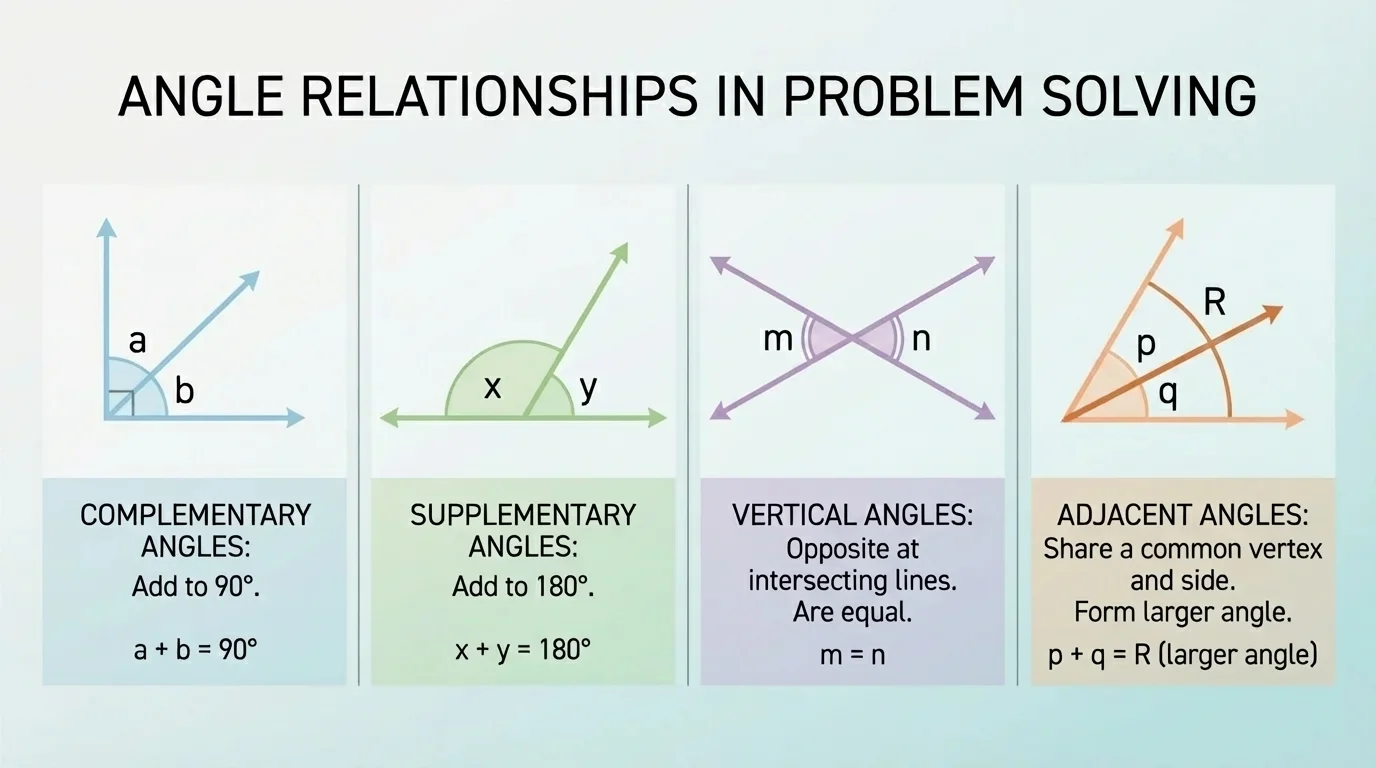
One useful idea is that a single pair of angles can belong to more than one category only if the geometry supports it. For instance, two angles may be adjacent and supplementary at the same time if they form a straight line. But two vertical angles are never adjacent because they are opposite each other.
| Angle relationship | What to look for | Key fact |
|---|---|---|
| Complementary | Angles that make a right angle | Their sum is \(90^\circ\) |
| Supplementary | Angles that make a straight angle | Their sum is \(180^\circ\) |
| Vertical | Opposite angles at an intersection | Their measures are equal |
| Adjacent | Angles next to each other sharing a side | They touch but do not overlap |
Table 1. Key features of the four main angle relationships used in unknown-angle problems.
To solve a problem, move slowly and organize what the diagram tells you. Start by looking for special structures: a right angle, a straight line, or two intersecting lines. These structures often reveal whether angles are complementary, supplementary, or vertical.
A reliable problem-solving method
Step 1: Identify the angle relationship shown in the figure.
Step 2: Write a simple equation using the correct total or equality.
Step 3: Solve for the unknown angle measure.
Step 4: Check the answer in the original figure to be sure it fits the angle facts.
For example, if two angles form a right angle and one is \(35^\circ\), then the equation is \(x + 35 = 90\). If two angles form a straight line and one is \(124^\circ\), then the equation is \(x + 124 = 180\). If two vertical angles face each other, then the equation may simply be \(x = 72\) if the opposite angle is \(72^\circ\).
Multi-step problems often work like this: first use one relationship to find an unknown angle, then use that result in a second relationship. The drawing may seem busy, but each step usually depends on one simple fact.
Architects and engineers use angle relationships constantly. A beam that is supposed to meet a support at a right angle must really create \(90^\circ\), or the whole structure may be off.
As you read a figure, it helps to label known angle measures clearly and write small notes such as "vertical angles" or "supplementary." That keeps your reasoning organized and prevents mixing up angle pairs.
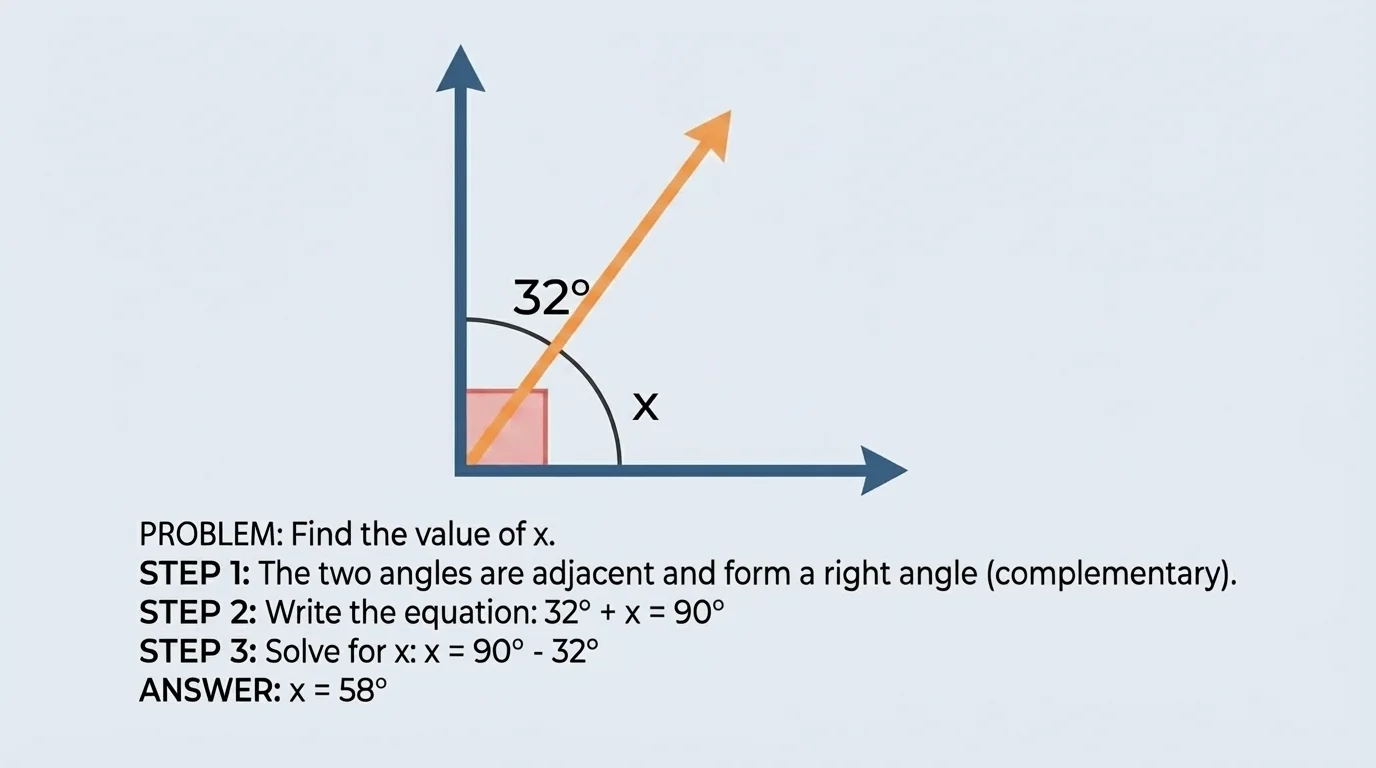
[Figure 2] A ray inside a right angle splits it into two smaller angles. This setup creates two adjacent angles, one measuring \(32^\circ\) and the other measuring \(x\). Because they fill the right angle together, they are complementary.
This is a good first example because one pair of angles is described in two ways at once: the angles are adjacent because they share a side, and they are complementary because together they form \(90^\circ\).
Worked example 1
Find the value of \(x\).
Step 1: Use the right-angle fact.
The two angles add to \(90^\circ\), so write \(x + 32 = 90\).
Step 2: Solve the equation.
Subtract \(32\) from both sides: \(x = 58\).
Step 3: Check.
Since \(58 + 32 = 90\), the answer is correct.
The unknown angle measure is:
\[x = 58^\circ\]
This example shows an important idea: adjacent angles are not automatically supplementary. You must look at the whole shape they create. Here they make a right angle, not a straight line.
If the known angle had been larger, such as \(64^\circ\), the same method would still work: \(x + 64 = 90\), so \(x = 26\). The relationship stays the same even though the numbers change.
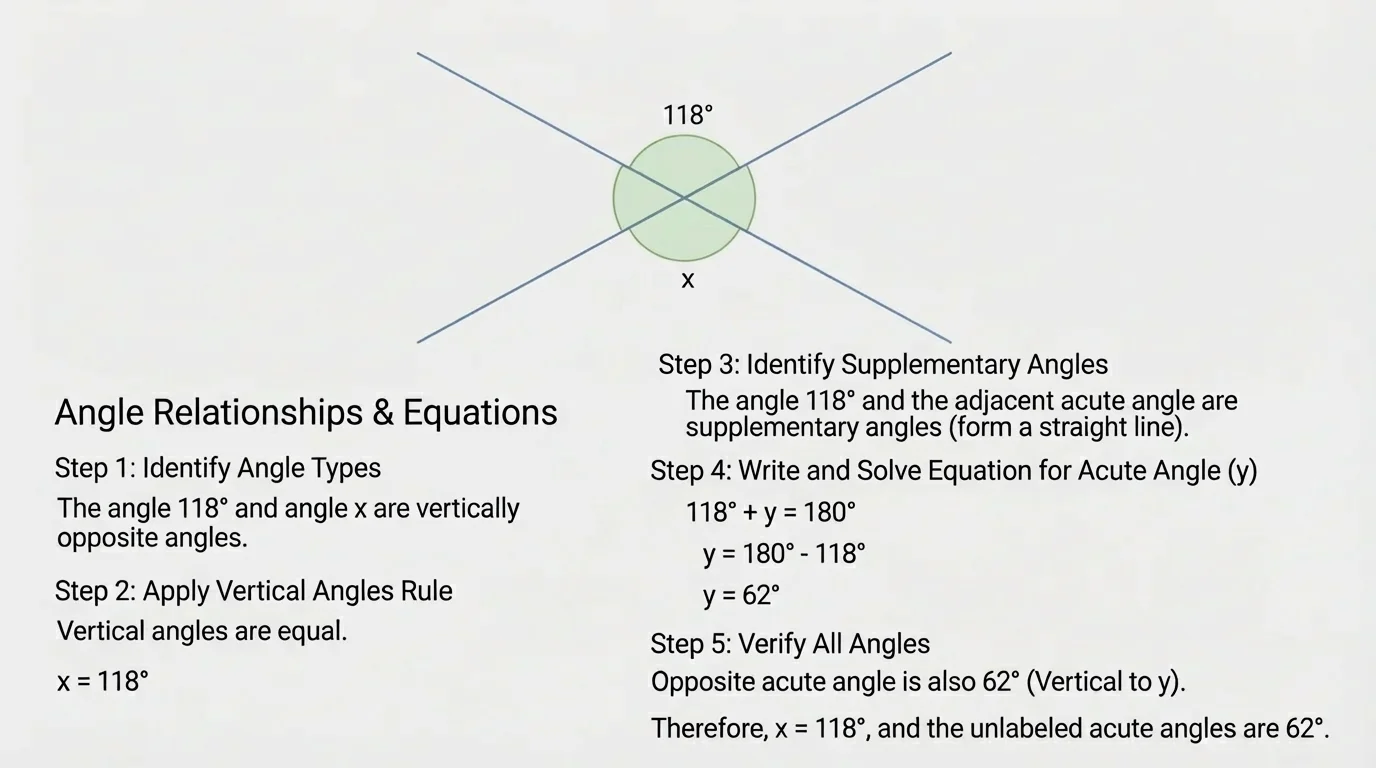
[Figure 3] At an intersection of two lines, one angle measures \(118^\circ\). The angle directly opposite it is labeled \(x\). Opposite angles at an intersection are called vertical angles, and they have the same measure.
At the same intersection, each angle next to \(118^\circ\) forms a straight line with it, so those neighboring angles are supplementary to \(118^\circ\). This lets one drawing produce more than one fact.
Worked example 2
Find the value of \(x\).
Step 1: Identify the relationship.
The angle labeled \(x\) is opposite the \(118^\circ\) angle, so the two are vertical angles.
Step 2: Use the vertical-angle fact.
Vertical angles are equal, so \(x = 118\).
Step 3: Check with the surrounding angles.
Any angle next to \(118^\circ\) must measure \(62^\circ\) because \(118 + 62 = 180\). That confirms the intersection makes sense.
The unknown angle measure is:
\[x = 118^\circ\]
This problem is simple, but it also teaches a larger pattern. Once one angle at an intersection is known, all four angle measures can be found: the opposite angle matches it, and the two adjacent angles each add with it to make \(180^\circ\).
As you continue solving, remember that vertical angles are equal because of the way lines intersect, not because they merely "look opposite." Geometry depends on the structure in the figure.
Now consider a more involved diagram. Two lines intersect. One angle measures \(47^\circ\). The angle adjacent to it on the same straight line is labeled \(y\). The angle vertical to \(y\) is labeled \(x\). This problem takes more than one step because you must first find \(y\), then use that result to find \(x\).
Worked example 3
Find the values of \(y\) and \(x\).
Step 1: Find \(y\) using a straight line.
The angles \(47^\circ\) and \(y\) are supplementary, so \(y + 47 = 180\).
Subtract \(47\): \(y = 133\).
Step 2: Find \(x\) using vertical angles.
The angle labeled \(x\) is vertical to \(y\), so \(x = y\).
Since \(y = 133\), we get \(x = 133\).
Step 3: Check the full intersection.
The four angles should alternate between \(47^\circ\) and \(133^\circ\). That works because \(47 + 133 = 180\).
The unknown angle measures are:
\[y = 133^\circ\quad \textrm{and} \quad x = 133^\circ\]
This is the heart of a multi-step problem: one angle relationship leads to another. You do not need difficult algebra. You just need to notice which fact comes first.
Another similar problem might begin with a right angle instead of a straight line. For instance, if a right angle is split into \(61^\circ\) and \(z\), then \(z = 29^\circ\). If another angle is vertical to \(z\), then that angle is also \(29^\circ\).
One common mistake is to confuse supplementary angles with complementary angles. The numbers to remember are simple: complementary angles add to \(90^\circ\), and supplementary angles add to \(180^\circ\). Mixing these totals gives a wrong answer even if the subtraction is done correctly.
Another mistake is thinking that all adjacent angles are equal. That is not true. Adjacent angles only have to share a side and a vertex. Their measures can be different. Equality happens only when a specific reason exists, such as vertical angles or a symmetry that is actually shown.
Questions to ask yourself when a figure looks confusing
Do these angles form a right angle? Do they form a straight line? Are they opposite at an intersection? Do they share a side? Asking these questions helps you choose the correct relationship before writing any equation.
A third mistake is skipping the check. If you find an angle measure of \(146^\circ\) inside a right angle, something is wrong because a right angle is only \(90^\circ\). Estimating first can protect you from errors.
As we saw earlier in [Figure 1], the same picture can help separate ideas that students often mix up. Vertical angles are opposite; adjacent angles are next to each other. Complementary and supplementary describe sums, while adjacent and vertical describe positions.
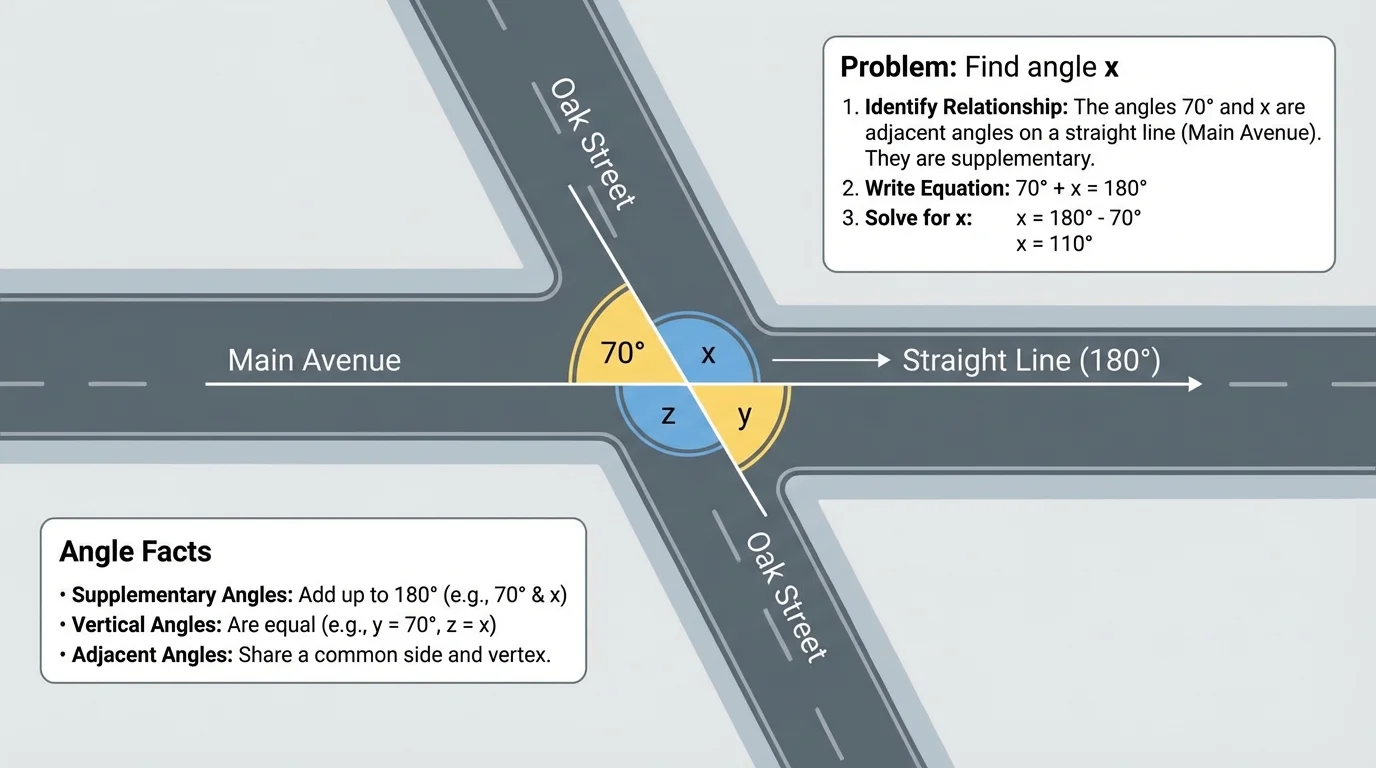
Street intersections, building frames, and machine parts all depend on angle relationships. [Figure 4] shows a road-crossing view that matches the same geometry used in class diagrams. If one corner angle at a crossing is known, traffic engineers can determine the others. In construction, if one support beam meets another at a known angle, workers can use supplementary or complementary relationships to check the remaining angles.
Inside a room, corners are usually right angles. If a shelf bracket splits a corner into two pieces and one piece measures \(41^\circ\), then the other must be \(49^\circ\). On a roof frame, beams crossing can create vertical angles, which helps builders confirm that parts line up as intended.
Sports also use angle thinking. A basketball backboard corner is designed to be square, and training equipment often relies on right angles. Camera tripods, folding ladders, and opening doors all create angle situations where a missing measure can be found from a known one.
Even maps and city plans use geometry. When streets meet, planners care about how sharply they intersect. The same supplementary relationships from classroom figures can help describe turning angles and corner layouts.
Surveyors and designers often work from a few measured angles and then calculate the rest. Geometry saves time because not every angle needs to be measured directly.
When you apply geometry to the real world, the drawing may look different from a textbook diagram, but the angle facts remain the same. A roof corner, a signpost, and a crossing path can all be solved with the same rules.
Good geometers do not stop when they get a number. They ask whether the number fits the figure. If the angle is part of a right angle, the total must be \(90^\circ\). If it sits on a straight line with another angle, the total must be \(180^\circ\). If it is vertical to a known angle, the two measures must match.
For example, suppose you found \(x = 72^\circ\) in a complementary-angle problem where the other angle is \(18^\circ\). A quick check gives \(72 + 18 = 90\), so that works. In a supplementary-angle problem with a neighboring angle of \(108^\circ\), a result of \(72^\circ\) also works because \(72 + 108 = 180\).
Checking is especially helpful in multi-step problems. In Worked Example 3, the final pattern around the intersection alternates between two values. That repeating pattern is exactly what intersecting lines should create, so it confirms the solution.
"In geometry, seeing the relationship is often the real solution."
Once you recognize the structure of a figure, simple equations become powerful tools. A right angle suggests \(90^\circ\), a straight line suggests \(180^\circ\), and intersecting lines suggest equal vertical angles. Those clues turn a picture into a solvable problem.
