A builder checks whether a corner is truly square, a phone screen is measured diagonally, and a rescue ladder must safely reach a window. These situations all rely on the same geometric idea: in a right triangle, the lengths of the sides are connected in a powerful and exact way. That relationship is called the Pythagorean Theorem, and it is one of the most famous results in mathematics because it turns shape into calculation.
A right triangle has one angle that measures exactly \(90^\circ\). In a right triangle, the two sides that form the right angle are called the legs, and the side across from the right angle is the hypotenuse, as shown in [Figure 1]. The hypotenuse is always the longest side of the triangle.
When we talk about the Pythagorean Theorem, we also need to understand squaring. To square a number means to multiply it by itself. For example, \(3^2 = 9\), \(5^2 = 25\), and \(10^2 = 100\). In geometry, squaring a side length connects to the area of a square built on that side.
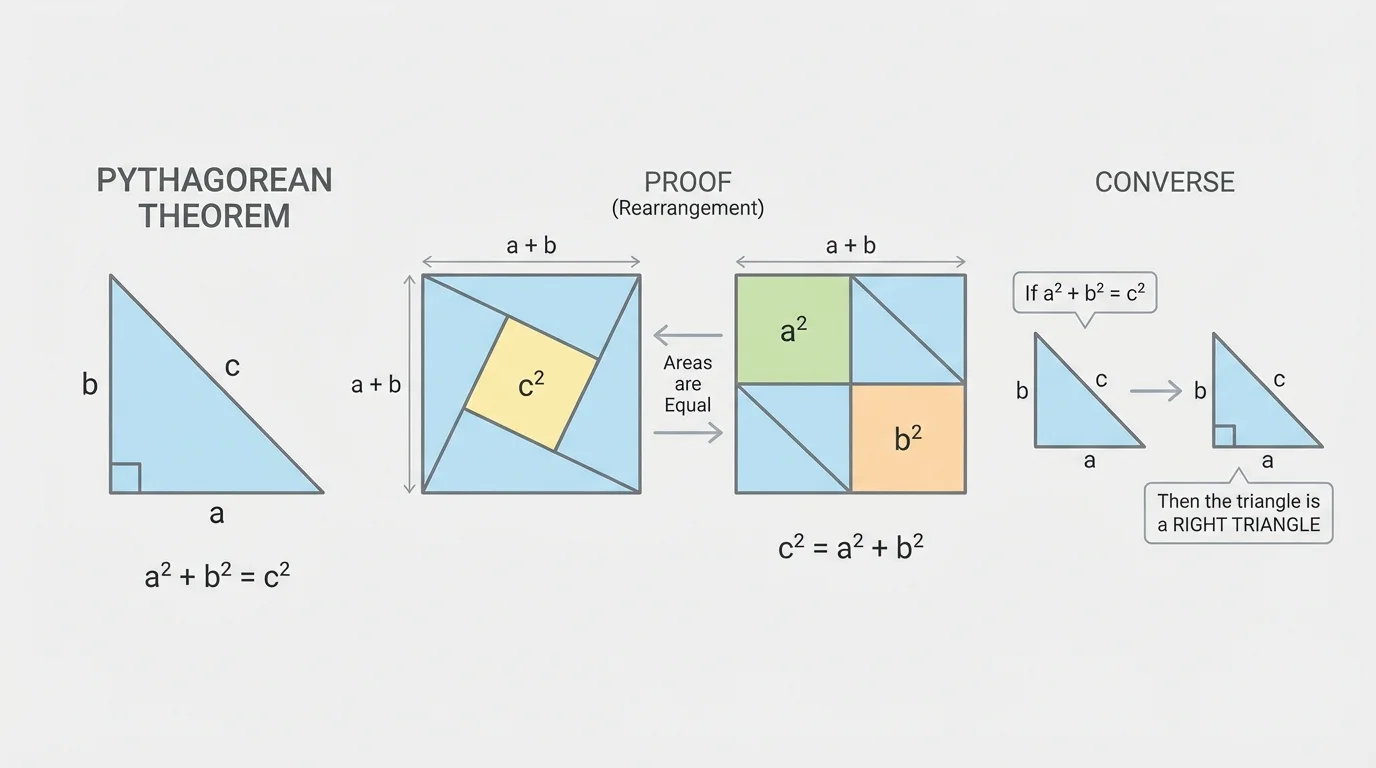
Area of a square is found by multiplying side length by side length. So a square with side length \(a\) has area \(a^2\), a square with side length \(b\) has area \(b^2\), and a square with side length \(c\) has area \(c^2\).
This idea of area is the key to understanding why the theorem works. The theorem is not just a rule to memorize; it comes from a relationship between squares built on the sides of a right triangle.
The Pythagorean Theorem says that for any right triangle with legs \(a\) and \(b\), and hypotenuse \(c\),
\[a^2 + b^2 = c^2\]
This means the sum of the areas of the squares on the two legs equals the area of the square on the hypotenuse. If the legs are \(3\) and \(4\), then \(3^2 + 4^2 = 9 + 16 = 25\), so \(c^2 = 25\) and \(c = 5\).
Notice the order matters. The side labeled \(c\) must be the hypotenuse, the side opposite the right angle. If you use the wrong side for \(c\), the equation will not represent the triangle correctly. Looking back at [Figure 1], the location of the hypotenuse is just as important as its length.
Legs are the two sides that form the right angle in a right triangle.
Hypotenuse is the side opposite the right angle, and it is always the longest side.
Square of a number means the product of the number with itself, such as \(7^2 = 49\).
The theorem only applies directly to right triangles. If a triangle is not a right triangle, you cannot assume that \(a^2 + b^2 = c^2\). Later, the converse will help us test whether a triangle is right.
[Figure 2] One of the clearest proofs uses area. Start with four identical right triangles, each with legs \(a\) and \(b\) and hypotenuse \(c\). Arrange them inside a large square so that their hypotenuses form the sides of a smaller square in the center.
The large outer square has side length \(a+b\), so its area is \((a+b)^2\). Inside it are four right triangles and one central square. Each triangle has area \(\dfrac{1}{2}ab\), so the total area of the four triangles is \(4 \cdot \dfrac{1}{2}ab = 2ab\). The center square has side length \(c\), so its area is \(c^2\).
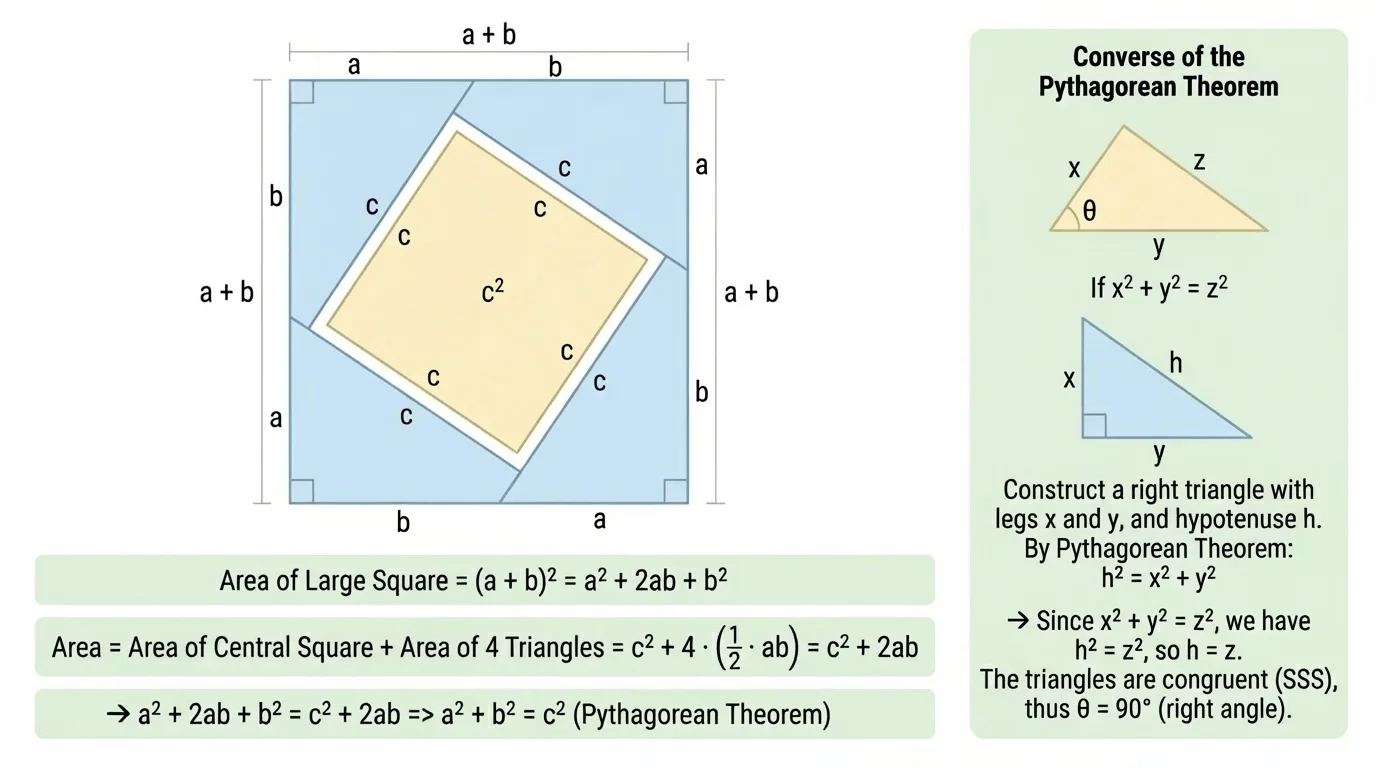
Now write the area of the large square in two ways. First, using its side length:
\((a+b)^2\)
Second, using the pieces inside it:
\(2ab + c^2\)
Since these represent the same large square, they must be equal:
\[(a+b)^2 = 2ab + c^2\]
Expand the left side:
\[a^2 + 2ab + b^2 = 2ab + c^2\]
Subtract \(2ab\) from both sides:
\[a^2 + b^2 = c^2\]
That is exactly the Pythagorean Theorem. The proof works because the same total area is being counted in two correct ways. This is a great example of how geometry and algebra work together.
Why the proof is convincing
The proof does not depend on a special triangle like \(3\)-\(4\)-\(5\). It works for any right triangle with legs \(a\) and \(b\) and hypotenuse \(c\). Because the argument uses area and rearrangement, it shows that the theorem is always true, not just true for one example.
Another important idea is that the theorem is about areas of squares, not just side lengths by themselves. The exponents matter. It is not true that \(a + b = c\); the correct relationship is between \(a^2\), \(b^2\), and \(c^2\).
Once the theorem is understood, it becomes a powerful tool for solving problems. If two side lengths of a right triangle are known, the third can be found by substituting into \(a^2 + b^2 = c^2\).
Solved example 1: Find the hypotenuse
A right triangle has legs \(6\) and \(8\). Find the hypotenuse.
Step 1: Write the theorem.
\(a^2 + b^2 = c^2\)
Step 2: Substitute the known side lengths.
\(6^2 + 8^2 = c^2\)
Step 3: Square the numbers and add.
\(36 + 64 = c^2\), so \(100 = c^2\)
Step 4: Take the square root.
\(c = 10\)
The hypotenuse is \(10\).
Notice that the answer is larger than both legs, which makes sense because the hypotenuse must be the longest side.
Solved example 2: Find a missing leg
A right triangle has hypotenuse \(13\) and one leg \(5\). Find the other leg.
Step 1: Write the theorem.
\(a^2 + b^2 = c^2\)
Step 2: Let the missing leg be \(x\), and substitute.
\(5^2 + x^2 = 13^2\)
Step 3: Compute the squares.
\(25 + x^2 = 169\)
Step 4: Subtract \(25\) from both sides.
\(x^2 = 144\)
Step 5: Take the square root.
\(x = 12\)
The missing leg is \(12\).
When solving for a missing leg, the hypotenuse stays alone on one side because it is the side represented by \(c\).
The converse of a statement switches the hypothesis and conclusion. For the Pythagorean Theorem, the converse says: if the side lengths of a triangle satisfy
\[a^2 + b^2 = c^2\]
where \(c\) is the longest side, then the triangle is a right triangle.
This is extremely useful because sometimes you know the three side lengths of a triangle but do not know its angles. Instead of measuring angles, you can square the two shorter sides, add them, and compare the result with the square of the longest side.
Converse means a statement formed by reversing another statement. In geometry, a theorem and its converse are not automatically both true, so each one must be justified.
For the Pythagorean relationship, both the theorem and its converse are true. That is why the result is so powerful: it can be used in two directions.
Solved example 3: Use the converse to classify a triangle
A triangle has side lengths \(7\), \(24\), and \(25\). Determine whether it is a right triangle.
Step 1: Identify the longest side.
The longest side is \(25\), so this must be \(c\).
Step 2: Compute the squares of the shorter sides.
\(7^2 = 49\) and \(24^2 = 576\)
Step 3: Add them.
\(49 + 576 = 625\)
Step 4: Compare with the square of the longest side.
\(25^2 = 625\)
Step 5: Make the conclusion.
Since \(7^2 + 24^2 = 25^2\), the triangle is a right triangle.
The triangle is a right triangle.
If the equality does not work, the triangle is not a right triangle. The converse gives a test, not a guess.
This comparison reveals even more. Suppose \(c\) is the longest side of a triangle.
If \(a^2 + b^2 = c^2\), the triangle is right.
If \(a^2 + b^2 > c^2\), the triangle is acute.
If \(a^2 + b^2 < c^2\), the triangle is obtuse.
This works because the side lengths reveal information about the angle opposite the longest side. The right-triangle case is exactly the middle case. This idea extends the theorem into a broader way of classifying triangles.
| Comparison | Triangle type |
|---|---|
| \(a^2 + b^2 = c^2\) | Right triangle |
| \(a^2 + b^2 > c^2\) | Acute triangle |
| \(a^2 + b^2 < c^2\) | Obtuse triangle |
Table 1. How comparing \(a^2 + b^2\) to \(c^2\) helps classify a triangle by its angles.
This classification is useful in geometry, design, and engineering because it tells whether a corner is square, sharper than square, or wider than square.
A Pythagorean triple is a set of three whole numbers that satisfy the theorem. Some well-known examples are \((3,4,5)\), \((5,12,13)\), and \((8,15,17)\).
If you multiply every number in a triple by the same factor, you get another triple. For example, doubling \((3,4,5)\) gives \((6,8,10)\). This works because
\[(2 \cdot 3)^2 + (2 \cdot 4)^2 = (2 \cdot 5)^2\]
Builders have used the \(3\)-\(4\)-\(5\) triangle for centuries to create right angles in construction. If one side is measured \(3\) units, another \(4\) units, and the diagonal between them is \(5\) units, the corner is a right angle.
More than 300 different proofs of the Pythagorean Theorem have been discovered. That is one reason mathematicians love it: one simple statement can be proven in many beautiful ways.
Seeing patterns like these can make calculations faster. For instance, if you recognize \(9\), \(12\), and \(15\), you might notice they are all \(3\) times \((3,4,5)\).
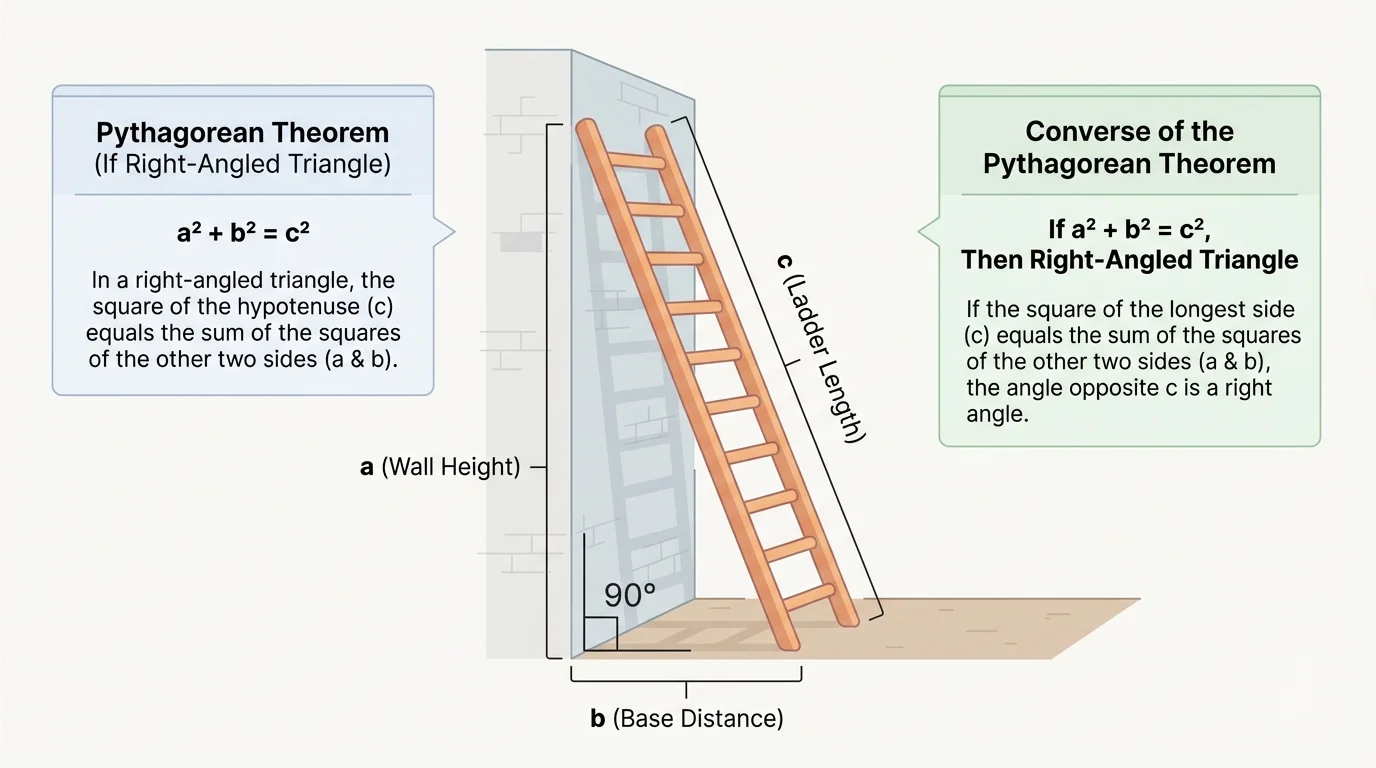
[Figure 3] The theorem appears in construction, architecture, navigation, computer graphics, and sports. A ladder against a wall creates a right triangle with the wall and the ground. If the ladder length and the distance from the wall are known, the height it reaches can be calculated.
Real-world example: Ladder safety
A ladder is \(10\) feet long and its base is \(6\) feet from the wall. How high does it reach?
Step 1: Identify the sides.
The hypotenuse is \(10\), one leg is \(6\), and the other leg is the height \(h\).
Step 2: Substitute into the theorem.
\(6^2 + h^2 = 10^2\)
Step 3: Solve.
\(36 + h^2 = 100\), so \(h^2 = 64\), and \(h = 8\)
The ladder reaches \(8\) feet up the wall.
On a coordinate grid, the theorem also gives the distance between two points when the horizontal and vertical changes are known. If one point is moved \(5\) units right and \(12\) units up from another, the straight-line distance is \(13\) units because \(5^2 + 12^2 = 13^2\).
In technology, pixels on a screen form horizontal and vertical lengths, while the screen size is measured along the diagonal. In map design and robotics, shortest-path calculations often depend on the same right-triangle relationship. The ladder model in [Figure 3] represents many of these situations: two perpendicular directions and one direct diagonal path.
One common mistake is choosing the wrong side for \(c\). Always identify the longest side first, and make sure it is opposite the right angle if the triangle is known to be right.
Another common mistake is stopping at \(c^2 = 49\) and forgetting to take the square root. If \(c^2 = 49\), then \(c = 7\), not \(49\).
Students also sometimes use the theorem on any triangle. The theorem itself only applies to right triangles. If you are given three side lengths and want to know whether the triangle is right, that is when you use the converse.
The area proof from earlier, especially the arrangement in [Figure 2], helps prevent memorization without understanding. It reminds us that the theorem is built on geometric reasoning, not just a formula to plug into.
"The theorem is not just about triangles; it is about how shape, area, and algebra connect."
That connection is what makes the theorem so important. It links measurement, proof, and problem-solving in one elegant idea.
