A video game score, a shopping total, and the number of seats in rows of a theater can all be described with expressions. An important idea is that one expression can be understood in more than one useful way. For example, in \(2(8+7)\), the part \((8+7)\) is both a sum and a single grouped unit. Learning to see expressions this way helps you read algebra like a mathematician.
An expression is a mathematical phrase made of numbers, variables, and operations. Expressions do not have an equals sign. For example, \(3x+5\), \(12-4\), and \(6(y+2)\) are all expressions.
An equation is different because it has an equals sign, such as \(3x+5=20\). In this lesson, the focus is on expressions and the parts inside them.
Expression means a mathematical phrase made of numbers, variables, and operation signs.
Variable means a letter that stands for a number.
Parentheses show that parts of an expression are grouped together.
When you read an expression, you are looking at how its parts are connected. Sometimes the whole expression is a sum. Sometimes it is a product. Sometimes one part inside it is itself another expression.
Mathematicians use special words to describe parts of expressions clearly. As [Figure 1] shows, these words help you explain what you see.
A sum is an addition expression. In an expression such as \(9+4\), the whole expression is a sum.
A term is one part of a sum or difference. In \(x+7\), the terms are \(x\) and \(7\). In \(3a+5b+2\), the terms are \(3a\), \(5b\), and \(2\).
A product is a multiplication expression. In \(4 \,\cdot\, 6\), the whole expression is a product. In algebra, multiplication is often written without the multiplication sign, so \(4x\) also means a product.
A factor is one part of a product. In \(4x\), the factors are \(4\) and \(x\). In \((y+3)5\), the factors are \((y+3)\) and \(5\).
A quotient is a division expression. In \(18 \div 3\), the whole expression is a quotient. In fraction form, \(\dfrac{18}{3}\) is also a quotient.
A coefficient is the numerical factor of a term with a variable. In \(7x\), the coefficient is \(7\). In \(-3y\), the coefficient is \(-3\). In \(x\), the coefficient is understood to be \(1\).
These words let you describe an expression exactly. Instead of saying "that part next to the letter," you can say "the coefficient" or "one of the factors."
The whole expression is usually named by its outermost operation. This means you look at the operation that connects the biggest parts of the expression, not just the operation you notice first inside parentheses.
For example, consider \(4(2+3)\). Inside the parentheses, \(2+3\) is a sum. But the whole expression \(4(2+3)\) is a product because \(4\) is multiplied by the grouped quantity \((2+3)\).
Now consider \(6x+9\). The whole expression is a sum because the outermost operation is addition. Its terms are \(6x\) and \(9\). Inside the term \(6x\), there is a product of the factors \(6\) and \(x\).
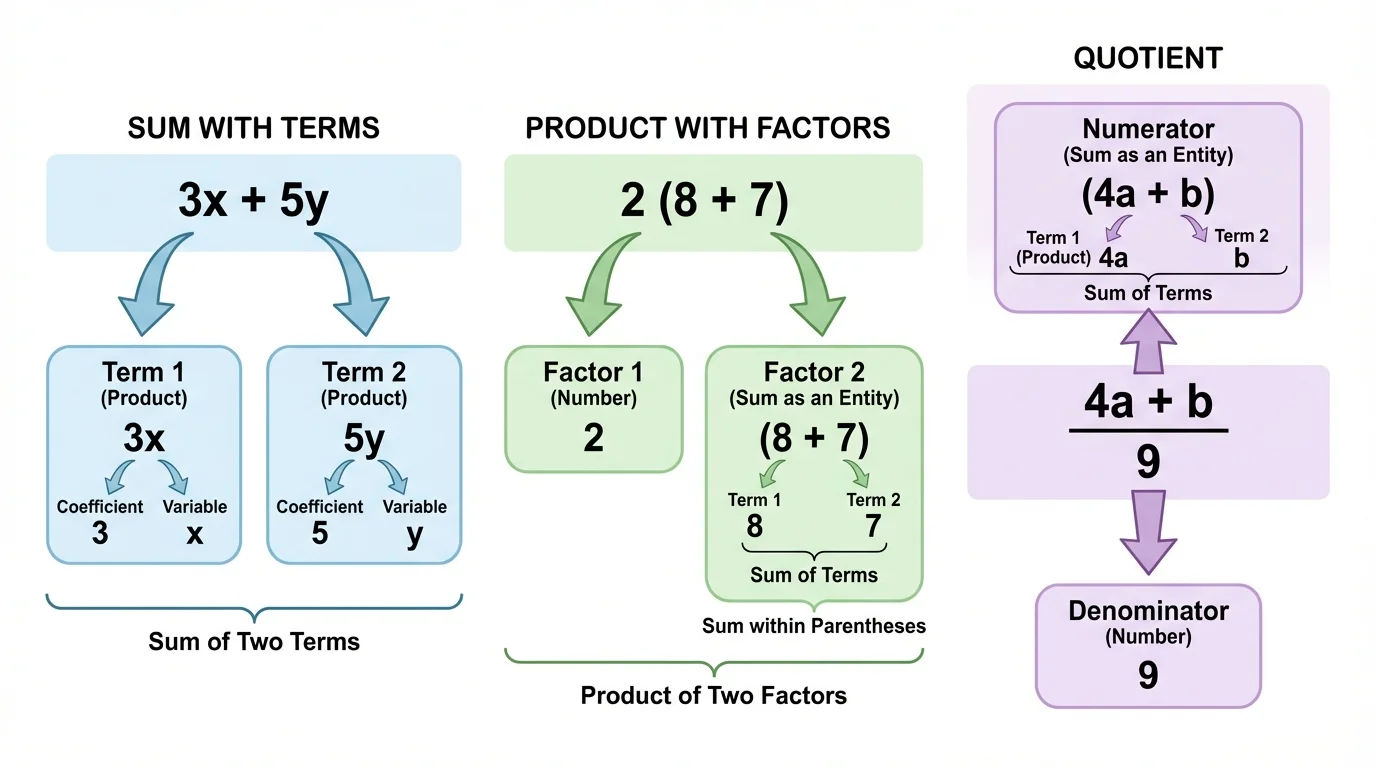
This is an important idea: one expression can be described in more than one correct way, depending on which part you are discussing. In \(6x+9\), the whole expression is a sum, but one term inside it is the product \(6x\).
Look at these examples:
One of the most useful algebra skills is treating a grouped part of an expression as one unit. This is sometimes called viewing part of the expression as a single entity.
Take the expression \(2(8+7)\). As [Figure 2] shows, you can describe it in two ways. First, \((8+7)\) is a sum with terms \(8\) and \(7\). Second, the whole expression \(2(8+7)\) is a product with two factors: \(2\) and \((8+7)\).
Parentheses are what make this possible. They keep the numbers \(8\) and \(7\) together so that the entire group can act like one factor.
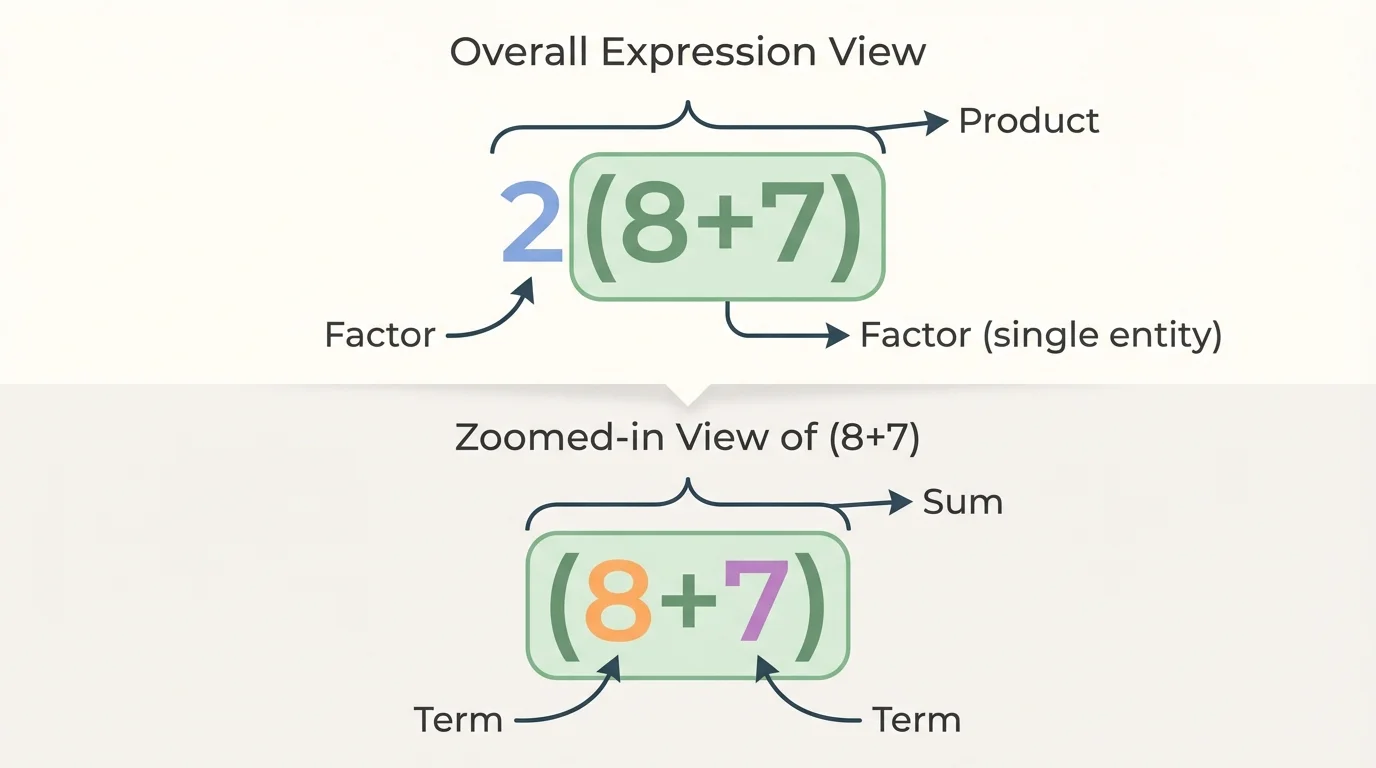
This idea appears all the time with variables. In \(3(x+5)\), the whole expression is a product of the factors \(3\) and \((x+5)\). At the same time, \((x+5)\) is a sum with terms \(x\) and \(5\).
Here is another example: \(\dfrac{y+1}{2}\). The whole expression is a quotient. But the numerator \((y+1)\) is itself a sum. So one part of an expression can have its own internal structure.
One expression, many descriptions
Expressions are built in layers. The whole expression has a main operation, but parts inside it can also be sums, products, or quotients. Good algebra students learn to zoom out to describe the whole expression and zoom in to describe the parts.
This "zoom out, zoom in" habit is powerful. As seen earlier in [Figure 1], the outside operation names the whole expression. Then, when needed, you can look inside one term or one factor and name the smaller parts too.
Let's practice reading expressions carefully and naming their parts with correct mathematical language.
Worked example 1
Describe the expression \(5x+12\).
Step 1: Find the outermost operation.
The expression \(5x+12\) is split into two main parts by addition.
Step 2: Name the whole expression.
Because the outermost operation is addition, the whole expression is a sum.
Step 3: Name the terms.
The terms are \(5x\) and \(12\).
Step 4: Describe a term more closely.
The term \(5x\) is a product of the factors \(5\) and \(x\). Its coefficient is \(5\).
The expression \(5x+12\) is a sum with terms \(5x\) and \(12\), and \(5x\) is a product.
Notice that the same expression can use more than one vocabulary word correctly, depending on whether you are describing the whole expression or a part of it.
Worked example 2
Describe the expression \(4(a+3)\).
Step 1: Look at the outside operation.
The number \(4\) is multiplying the grouped expression \((a+3)\).
Step 2: Name the whole expression.
The whole expression is a product.
Step 3: Name the factors.
The factors are \(4\) and \((a+3)\).
Step 4: Look inside the grouped factor.
The expression \((a+3)\) is a sum with terms \(a\) and \(3\).
The expression \(4(a+3)\) is a product of two factors, and one factor is itself a sum.
This is exactly the kind of thinking illustrated by the expression \(2(8+7)\). The grouped part stays together as one factor, even though it contains two terms inside.
Worked example 3
Describe the expression \(\dfrac{2x+6}{3}\).
Step 1: Find the main operation.
The whole expression is a division expression, written as a fraction.
Step 2: Name the whole expression.
The whole expression is a quotient.
Step 3: Describe the numerator.
The numerator \(2x+6\) is a sum with terms \(2x\) and \(6\).
Step 4: Describe one term in the numerator.
The term \(2x\) is a product of the factors \(2\) and \(x\). The coefficient is \(2\).
The expression \(\dfrac{2x+6}{3}\) is a quotient, and its numerator is a sum.
These examples show how expressions have layers. The outside tells you what the whole expression is, and the inside tells you more about its parts.
From arithmetic, you already know that addition, subtraction, multiplication, and division connect numbers in different ways. Algebra keeps those same operations, but now variables and grouped expressions can be parts too.
Here are a few more quick descriptions:
One common mistake is calling parts of a product "terms." Terms belong to sums and differences, not products. In \(4x\), the parts \(4\) and \(x\) are factors, not terms.
Another common mistake is naming the whole expression by something happening inside parentheses. In \(6(a+2)\), students sometimes say the whole expression is a sum because they see \(a+2\). But the whole expression is a product, because \(6\) is multiplied by the entire group.
A third mistake is forgetting coefficients of \(1\) or \(-1\). In \(x\), the coefficient is \(1\). In \(-y\), the coefficient is \(-1\).
Also be careful with subtraction. In \(x-5\), you can think of the terms as \(x\) and \(-5\). That helps you keep the idea of terms consistent.
Grouped expressions often represent equal bundles or repeated groups in real life. This is one reason it is so helpful to view part of an expression as one entity.
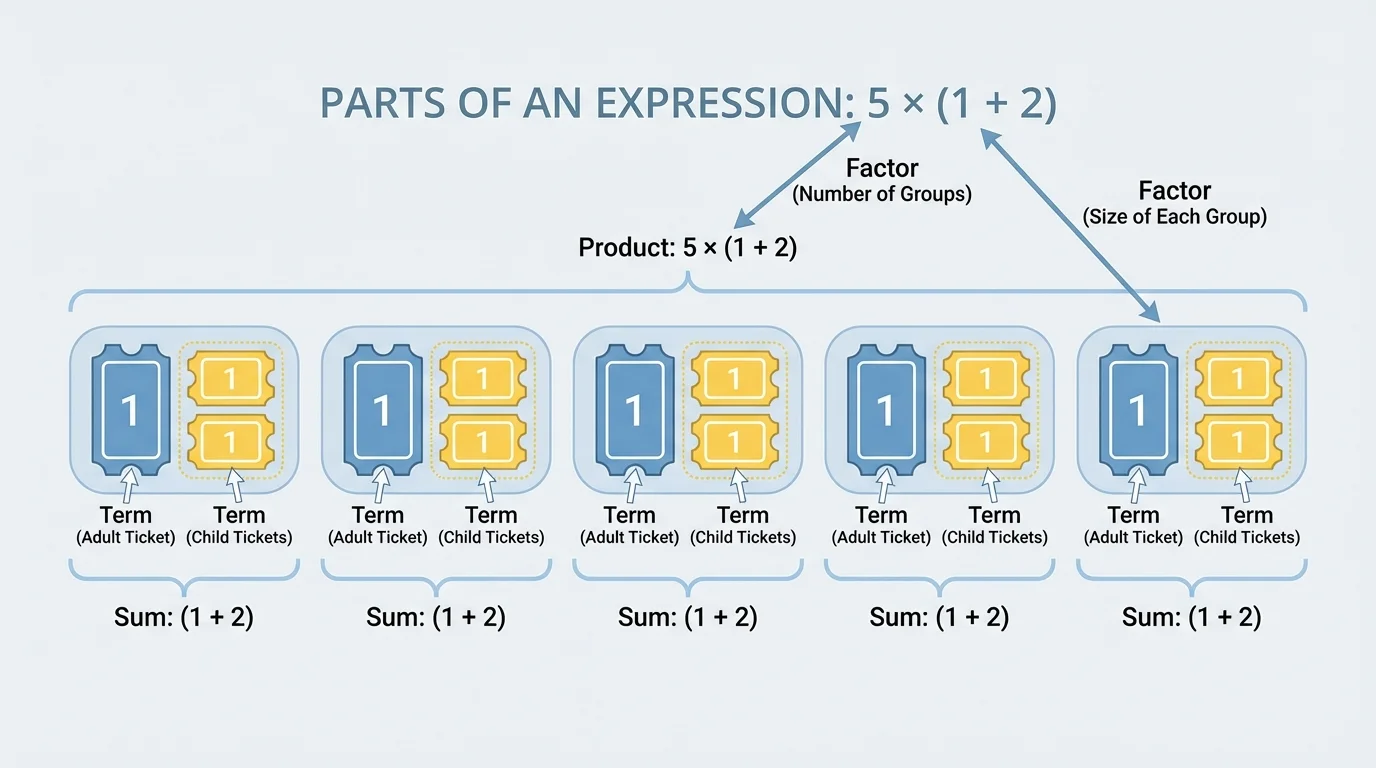
Suppose one snack pack has \(2\) granola bars and \(1\) juice box. As [Figure 3] shows, if there are \(5\) identical packs, the total number of items can be represented by \(5(2+1)\). The grouped part \((2+1)\) represents one complete pack, and the \(5\) tells how many equal packs there are.
Ticket sales work the same way. If one family bundle includes \(a\) adult tickets and \(2\) child tickets, then \(5(a+2)\) describes five identical bundles.
Area models also use grouping. A rectangle with side lengths \(3\) and \((x+4)\) has area \(3(x+4)\). The side length \((x+4)\) is one whole measure, even though it can be thought of as two parts added together.
Later, when you learn to expand expressions, this grouped thinking will become even more important. The repeated bundles match the way multiplication works with grouped quantities.
Some expressions have several layers, but the same rules still work.
In \(2x+3y+7\), the whole expression is a sum with three terms: \(2x\), \(3y\), and \(7\). The terms \(2x\) and \(3y\) are each products, with coefficients \(2\) and \(3\).
In \(8(m+n)\), the whole expression is a product. Its factors are \(8\) and \((m+n)\). Inside the grouped factor, \((m+n)\) is a sum with terms \(m\) and \(n\).
In \(\dfrac{4(a+b)}{5}\), the whole expression is a quotient. The numerator \(4(a+b)\) is a product. The grouped part \((a+b)\) is a sum. This single expression includes a quotient, a product, and a sum.
That layered structure is one of the most interesting features of algebra. Expressions are built from smaller expressions, and every layer can be named.
| Expression | Whole Expression | Important Parts |
|---|---|---|
| \(3x+4\) | sum | terms: \(3x\), \(4\); coefficient: \(3\) |
| \(6y\) | product | factors: \(6\), \(y\); coefficient: \(6\) |
| \(2(a+5)\) | product | factors: \(2\), \((a+5)\); inside sum: \(a\), \(5\) |
| \(\dfrac{x+1}{4}\) | quotient | numerator is sum: \(x\), \(1\) |
Table 1. Examples showing how to name whole expressions and their important parts.
When you read algebra carefully, ask two questions: What is the whole expression? What are the important parts inside it? Those two questions help you use precise mathematical language.
Algebra becomes much easier when you treat a long grouped expression as one object. Mathematicians do this constantly because it helps them notice structure instead of getting lost in details.
For example, in \(7(r+9)\), you do not need to focus first on the inside addition. You can first say the whole thing is a product of two factors. Then you can zoom in and say one factor is the sum \((r+9)\).
