A camera zoom can make a city skyline look larger without changing its shape, but something subtle happens to straight edges in the image. Some lines seem to stay exactly where they are, while others shift to new positions without turning. That is not a trick of photography; it is a deep geometric fact. A dilation can leave one line unchanged and send another to a parallel line, depending entirely on whether the line passes through the center of dilation.
Dilations are one of the basic similarity transformations in geometry. They change size but preserve shape. Architects use scale drawings, mapmakers use enlargements and reductions, and computer graphics constantly resize images. Understanding what happens to lines under dilation helps explain why similar figures keep corresponding angles equal and why their side lengths stay in proportion.
For lines, the rule is elegant: if a line passes through the center of dilation, the image lies on the same line. If a line does not pass through the center, its image is a different line, but it is parallel to the original. This idea is central to understanding similarity in a precise geometric way.
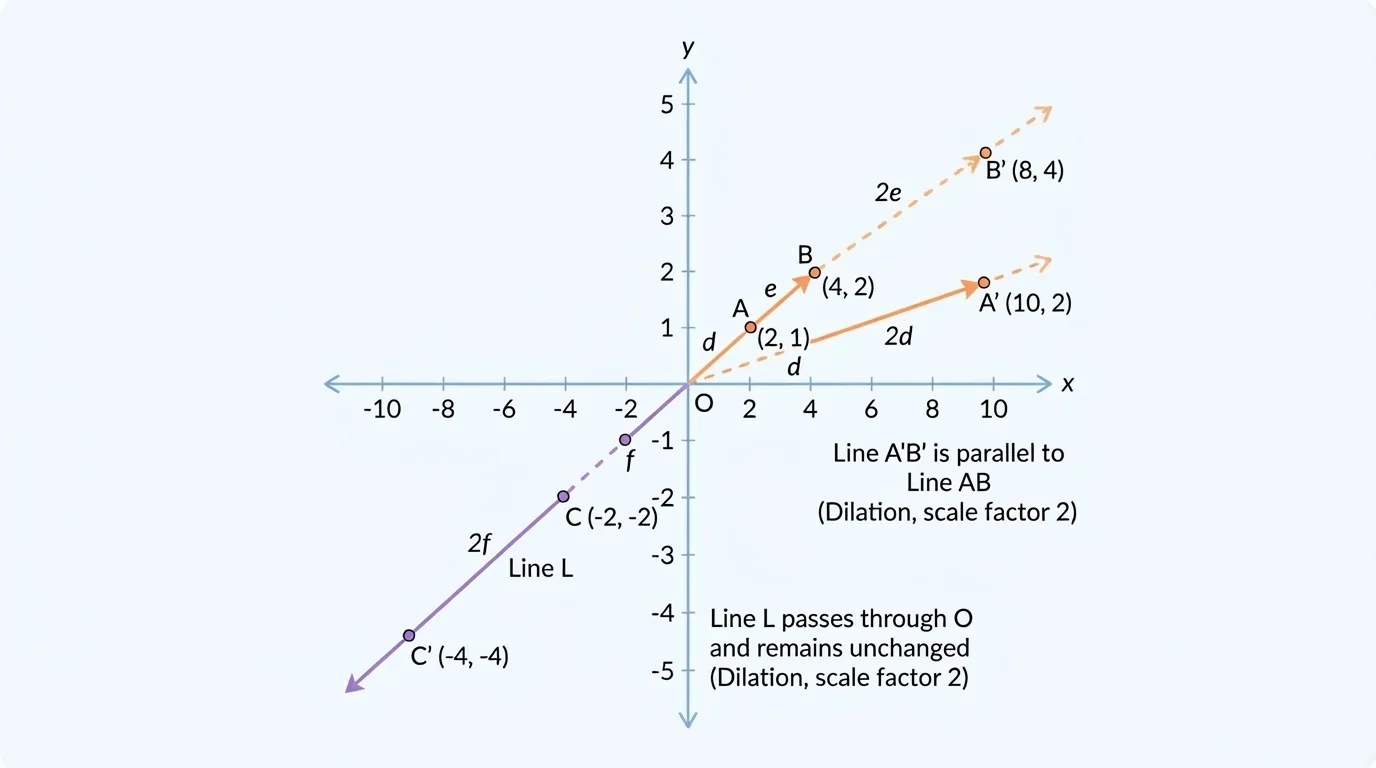
[Figure 1] A dilation is a transformation determined by a center and a scale factor. If the center is a point \(O\) and the scale factor is \(k\), then each point \(P\) moves to a point \(P'\) on the ray from \(O\) through \(P\), and the distance from the center changes according to \(OP' = k(OP)\).
If \(k > 1\), the image is an enlargement. If \(0 < k < 1\), the image is a reduction. For example, if \(k = 2\), every distance from the center doubles. If \(k = \dfrac{1}{2}\), every distance from the center is cut in half.
Center of dilation is the fixed point from which distances are measured during a dilation.
Scale factor is the number \(k\) that multiplies each distance from the center.
Image is the new figure produced by the transformation.
One important detail is that a dilation does not usually keep every point in the same place. The only point that must remain fixed is the center itself when \(k \neq 0\). So when we say a line is unchanged, we do not mean every point on it stays still. We mean the image points still lie on that same line.
[Figure 2] There are exactly two main cases for a line under dilation. Suppose a dilation has center \(O\) and scale factor \(k\).
If a line \(\ell\) passes through \(O\), then its image is the same line \(\ell\). If a line \(m\) does not pass through \(O\), then its image is a line \(m'\) parallel to \(m\).
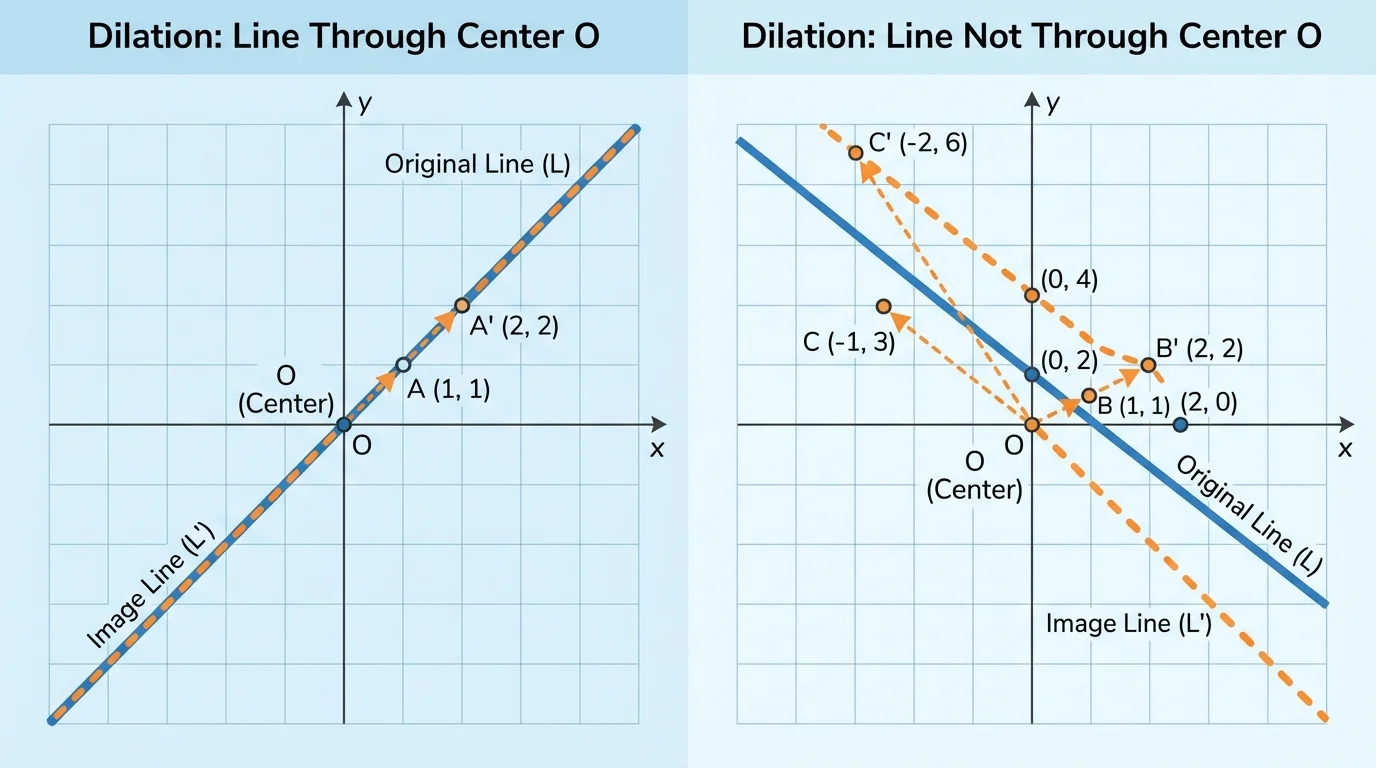
This result is one of the experimental properties students often verify by drawing several points on a line, dilating them from a chosen center, and then checking where the images land. But the result is not just experimental; it follows from geometric reasoning.
The two-case principle
A dilation organizes the plane around its center. Any point and its image stay on one ray from the center. Because of that, a line through the center is made of rays that remain on the same line, while a line away from the center shifts to a new position with the same direction. That is why one case is unchanged and the other is parallel.
Take a line \(\ell\) that passes through the center \(O\). Choose any point \(P\) on \(\ell\). Under dilation, the image point \(P'\) must lie on the ray from \(O\) through \(P\). But that ray is part of the same straight line \(\ell\), because both \(O\) and \(P\) lie on \(\ell\).
So every point of \(\ell\) maps to another point on \(\ell\). That means the image of the entire line is still \(\ell\). The line itself is unchanged, even though most of its points move unless \(k = 1\).
For instance, imagine the line \(y = 2x\) and a dilation centered at the origin. A point such as \((1,2)\) might move to \((2,4)\) if \(k=2\), or to \(\left(\dfrac{1}{2},1\right)\) if \(k=\dfrac{1}{2}\). Either way, the image point still satisfies \(y = 2x\), so the line remains the same line.
Now take a line \(m\) that does not pass through the center \(O\). Pick two different points \(A\) and \(B\) on \(m\). Their images are \(A'\) and \(B'\). Because dilation multiplies distances from the center by the same factor, triangles formed with the center are similar.
Specifically, triangles \(\triangle OAB\) and \(\triangle OA'B'\) are similar, with corresponding side lengths in the ratio \(k:1\). Similar triangles preserve angle measures, so the angle between \(OA\) and \(AB\) equals the angle between \(OA'\) and \(A'B'\). That means segment \(A'B'\) has the same direction as segment \(AB\).
Since \(A\) and \(B\) were any two points on line \(m\), the image line through \(A'\) and \(B'\) has the same direction as \(m\). Therefore the image is parallel to the original line. Because \(m\) does not pass through the center, the image cannot be the same line, so it must be a distinct parallel line.
Parallel lines have the same direction and, in coordinate geometry, the same slope when the slopes are defined. Similar triangles have equal corresponding angles and proportional corresponding side lengths.
This is one of the most powerful links between transformations and similarity. A dilation does not bend or rotate a line; it either keeps it on itself or slides it to a parallel position.
[Figure 3] Algebra gives a fast way to verify the geometry. For a dilation centered at the origin with scale factor \(k\), a point \((x,y)\) maps to \((kx,ky)\).
Suppose a line has equation \(y = mx + b\).
If \(b = 0\), the line is \(y = mx\), which passes through the origin. Under dilation, \((x,y) \mapsto (kx,ky)\). Since \(y = mx\), we get \(ky = m(kx)\), so the image point still satisfies \(y = mx\) in the new coordinates. The line is unchanged.
If \(b \neq 0\), the line does not pass through the origin. Let the image coordinates be \((x',y') = (kx,ky)\). Then \(x = \dfrac{x'}{k}\) and \(y = \dfrac{y'}{k}\). Substitute into \(y = mx + b\): \(\dfrac{y'}{k} = m\dfrac{x'}{k} + b\). Multiply by \(k\): \(y' = mx' + kb\).
The slope stays \(m\), but the intercept changes from \(b\) to \(kb\). Same slope means parallel lines. Different intercept means a different line.
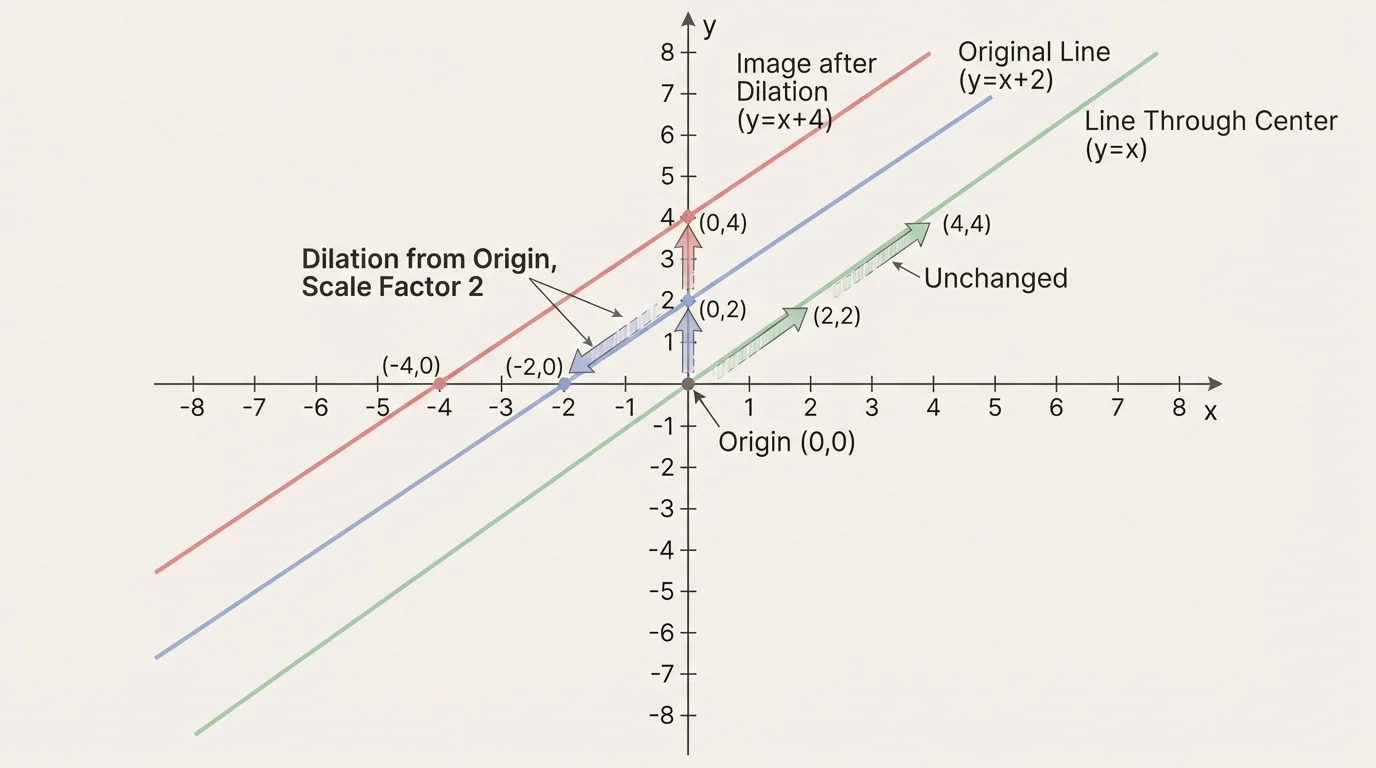
So a dilation centered at the origin transforms \(y = mx + b\) into \(y = mx + kb\). This is a compact algebraic proof of the geometric rule. Notice how the graph keeps the steepness of the line the same while shifting its position.
The ideas become clearer when you track actual points and equations.
Worked example 1
A dilation has center at the origin and scale factor \(k = 3\). What is the image of the line \(y = -2x\)?
Step 1: Identify whether the line passes through the center.
The center is the origin \((0,0)\). Since the equation is \(y = -2x\), the line passes through \((0,0)\).
Step 2: Apply the dilation idea.
A line through the center of dilation remains the same line.
Step 3: Confirm with a point.
The point \((1,-2)\) maps to \((3,-6)\). This image point still satisfies \(y = -2x\), because \(-6 = -2(3)\).
The image is \(y = -2x\).
This example shows the difference between an unchanged line and unchanged points. The point \((1,-2)\) moved, but the image still lies on the same line.
Worked example 2
A dilation has center at the origin and scale factor \(k = 2\). Find the image of the line \(y = x + 2\).
Step 1: Check whether the line passes through the center.
Substitute \(x = 0\): then \(y = 2\). The line does not pass through \((0,0)\).
Step 2: Use the coordinate rule.
For a line \(y = mx + b\), the image under a dilation centered at the origin is \(y = mx + kb\).
Here \(m = 1\), \(b = 2\), and \(k = 2\).
Step 3: Substitute the values.
The new equation is \(y = x + 2(2) = x + 4\).
Step 4: Interpret the result.
The original line \(y = x + 2\) and the image line \(y = x + 4\) both have slope \(1\), so they are parallel.
The image is \(y = x + 4\).
The graph in Figure 3 matches this result exactly: same slope, different intercept.
Worked example 3
A dilation has center \(C(1,1)\) and scale factor \(k = 2\). Determine the image of the line \(x = 3\).
Step 1: Decide whether the line passes through the center.
The line \(x = 3\) contains points such as \((3,0)\), \((3,1)\), and \((3,5)\). The center \((1,1)\) is not on this line, so the image should be a parallel line.
Step 2: Dilate two points on the line.
Use \((3,1)\) and \((3,3)\).
From center \((1,1)\), the vector to \((3,1)\) is \((2,0)\). After dilation by \(2\), it becomes \((4,0)\), so the image point is \((5,1)\).
From center \((1,1)\), the vector to \((3,3)\) is \((2,2)\). After dilation by \(2\), it becomes \((4,4)\), so the image point is \((5,5)\).
Step 3: Find the image line.
Both image points have \(x = 5\), so the image line is vertical with equation \(x = 5\).
The image is \(x = 5\).
This example shows that the rule works for centers other than the origin. The original vertical line becomes another vertical line, so the image is parallel.
Worked example 4
A dilation has center \(C(-2,1)\) and scale factor \(k = \dfrac{1}{2}\). A line passes through \(C\) and the point \((4,5)\). What happens to the line?
Step 1: Identify the key fact.
The line passes through the center of dilation.
Step 2: Apply the line rule.
Any line through the center remains the same line under dilation.
Step 3: Verify with the given point.
The vector from \((-2,1)\) to \((4,5)\) is \((6,4)\). After scaling by \(\dfrac{1}{2}\), it becomes \((3,2)\). The image point is \((1,3)\), which lies on the same line through \((-2,1)\).
The image is the same line through \((-2,1)\) and \((4,5)\).
The line behavior does not depend on whether the dilation is an enlargement or a reduction. If \(k > 1\), points move farther from the center. If \(0 < k < 1\), points move closer. In both cases, a line through the center stays on itself, and a line not through the center maps to a parallel line.
As an extension, some courses also discuss negative scale factors such as \(k = -2\). Then image points lie on the line through the center and original point, but on the opposite side of the center. Even then, the same line rule still works: lines through the center remain the same line, and lines not through the center map to parallel lines.
| Scale factor | Effect on distances from center | Effect on a line through center | Effect on a line not through center |
|---|---|---|---|
| \(k > 1\) | Enlarges | Same line | Parallel line |
| \(0 < k < 1\) | Reduces | Same line | Parallel line |
| \(k = 1\) | No change | Same line | Same line |
| \(k < 0\) | Scales and reverses through center | Same line | Parallel line |
Table 1. How different scale factors affect distances and the images of lines under dilation.
One common mistake is saying that if a line is unchanged, then every point on it is unchanged. That is false unless \(k = 1\). Usually the points move along the line, but the set of all image points is still the same line.
Another mistake is thinking that a line not through the center might rotate. A dilation does not rotate lines. It preserves their direction, which is why the image is parallel. If the center is not on the line, the new line shifts position but keeps the same slope.
A third mistake is checking only one point. To determine the image of an entire line, you need a line-based argument: either the line contains the center, or it does not. Coordinates and slopes can verify the result, but the geometric reason comes from how all points move along rays from the center, as shown in Figure 1.
In projective geometry, parallel lines are sometimes treated as meeting at a point at infinity. Dilations fit beautifully into that larger picture because they preserve direction, which is exactly why non-central lines map to parallel lines.
Scale drawings in engineering depend on this property. Suppose a blueprint is enlarged from a chosen reference point. Structural beams drawn as straight segments keep their directions. A beam line through the reference point stays on the same line, while a beam line elsewhere shifts to a parallel position. That makes designs easier to compare across scales.
Digital graphics use coordinate scaling in nearly the same way. When software enlarges part of an image from a fixed center, straight edges remain straight. Edges passing through the center align with themselves, while other edges move to parallel positions. This is one reason geometric transformations are so important in image processing and computer-aided design.
Maps and aerial imagery also rely on this idea. If a region is resized about a chosen center, roads that do not pass through that center appear in parallel positions after the scale change. Geometry explains what your eyes notice long before algebra writes it down.
"Geometry is not only about shapes; it is about the rules that stay true when shapes change."
That is exactly what dilation reveals. Size changes, positions may shift, but the relationship between the center and a line determines a predictable outcome every time.
