A powerful idea in algebra is that a complicated expression does not have to be read one symbol at a time. In many cases, the fastest way to understand it is to notice its structure. A long expression can act like a machine built from smaller machines. If you can identify one meaningful part and treat it as a whole, the entire expression suddenly becomes easier to read, explain, and use.
That skill matters far beyond math class. Scientists interpret formulas by recognizing repeated factors. Economists read growth formulas by focusing on rates and time. Engineers look at a term and ask, "Which part changes, and which part stays fixed?" Algebra gives you the same tool: instead of getting lost in the symbols, you look for meaningful units.
To interpret an expression means to explain what its parts represent and how those parts work together. Sometimes an expression is simple, such as \(3x\), which means three groups of \(x\). But often expressions are more complicated, such as \(P(1+r)^n\). Rather than reading every symbol separately, you can understand it as the product of \(P\) and one whole factor, \((1+r)^n\).
This idea is called seeing structure in an expression. Structure means the arrangement of parts and the relationships among them. When you notice structure, you can identify a group such as \((x+4)\), \((2a-1)^2\), or \(7(3m+n)\) and think of that entire group as a single object. That does not change the algebra. It changes how clearly you understand it.
Earlier algebra work prepared you for this idea. You already know that parentheses group terms, exponents show repeated multiplication, and multiplication can apply to an entire quantity. Here, the goal is not just to simplify expressions, but to explain what grouped parts mean.
For example, in \(4(x+3)\), the expression \((x+3)\) can be viewed as one quantity. Then the whole expression means four times that quantity. In \((2t-5)^2\), the quantity \((2t-5)\) is multiplied by itself. In \(a(b+c+d)\), the quantity \((b+c+d)\) is one factor, and \(a\) scales the entire sum.
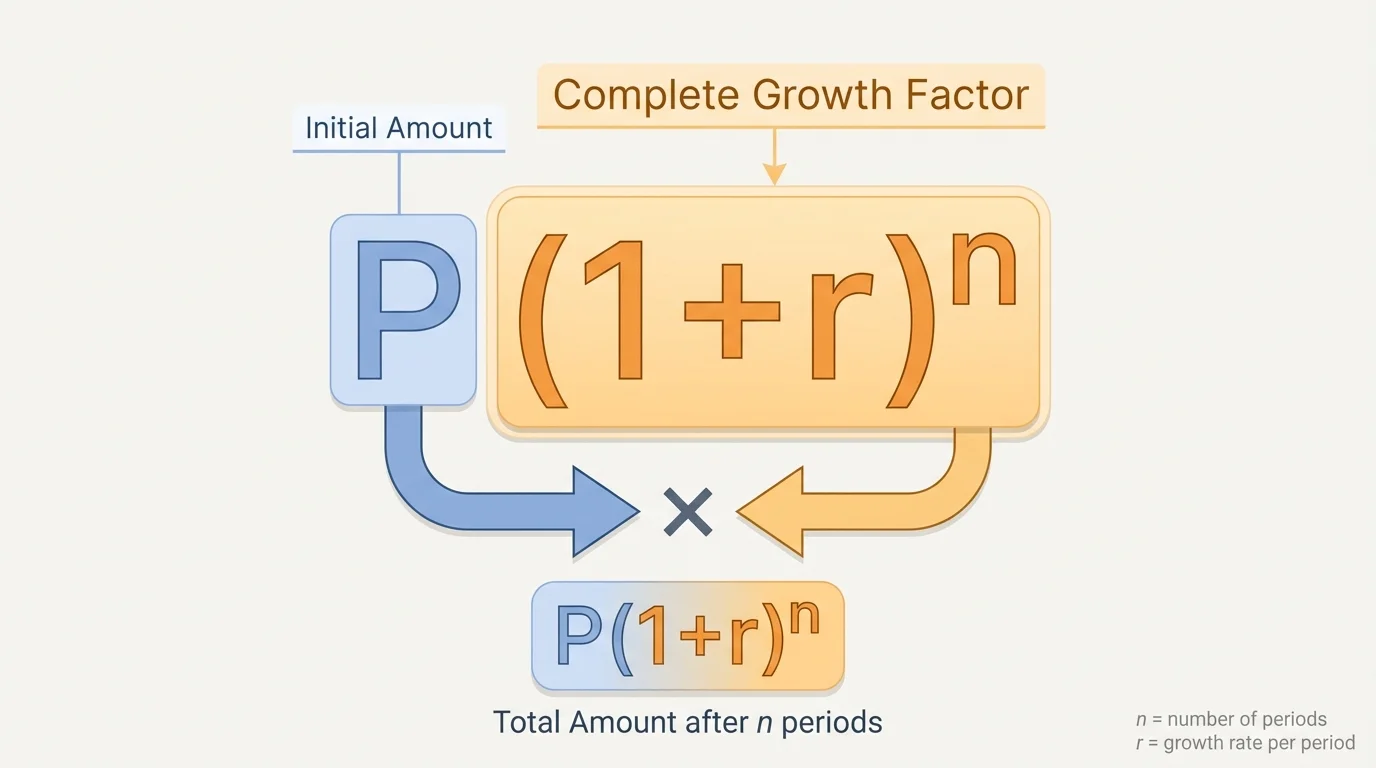
[Figure 1] One of the most important examples involves factors. In \(P(1+r)^n\), you can think of \((1+r)^n\) as one complete factor. Then the expression means: start with \(P\), and multiply it by the factor \((1+r)^n\). The key idea is that this factor does not depend on \(P\); it depends on \(r\) and \(n\).
This way of thinking is extremely useful. If \(P\) is the initial amount in an investment, \(r\) is the growth rate per period, and \(n\) is the number of periods, then \((1+r)^n\) represents the total growth multiplier after \(n\) periods. The whole expression does not just mean "a messy product." It means "initial amount times total growth factor."
You can use the same approach with many expressions. In \(6(y-1)^3\), the quantity \((y-1)\) is one expression, and \((y-1)^3\) means that quantity multiplied by itself three times. Then \(6(y-1)^3\) means six times that cube. In \(2(x^2+5)\), the quantity \((x^2+5)\) is one expression being doubled.
Sometimes students think "single entity" means the grouped part must be simple. It does not. A single entity can be complicated. The point is not that it is short. The point is that it functions as one unit within the larger expression.
Single entity means a part of an expression that you temporarily treat as one whole quantity in order to understand how the larger expression is built.
Coefficient is the numerical factor multiplying a variable or expression.
Exponent tells how many times a quantity is used as a factor in repeated multiplication.
For example, if \(u = x-4\), then \(5(x-4)^2\) can be thought of as \(5u^2\). You are not changing the expression permanently; you are using a helpful lens. This lens lets you notice that the expression is "five times the square of a quantity."
Algebra becomes more meaningful when expressions represent real quantities. The same symbols can mean very different things depending on context. Interpreting structure means connecting the grouped parts to the situation being described.
Suppose a theater charges \(\$12\) per ticket and a one-time service fee of \(\$4\) per online order. The expression \(12t + 4\) represents the total cost for \(t\) tickets. Here, \(12t\) is the ticket cost, and \(+4\) is the fixed fee. Now compare that with \(4(12t+1)\). The structure is different, so the meaning is different. This second expression means four times the quantity \((12t+1)\), not the ticket cost plus a fixed fee of \(\$4\).
Context also helps with expressions such as \(A = s^2\). If \(s\) is the side length of a square, then \(s^2\) means the area of the square. If the expression is \(3s^2\), it means three times that area. Again, the important skill is to identify the whole quantity first and then explain how the rest of the expression acts on it.
Expressions tell stories through their structure. A product often represents scaling, a sum often represents combining quantities, and a power often represents repeated multiplication or growth. When you identify a grouped part first, you can describe the story the expression tells instead of reading it as a string of symbols.
Take \(2(lw + lh + wh)\) in geometry. If \(l\), \(w\), and \(h\) represent the dimensions of a rectangular prism, then \((lw + lh + wh)\) is one sum of pairwise products. Multiplying that sum by \(2\) gives the surface area. Seeing the sum as one quantity makes the formula much easier to interpret.
When you read an expression, look for grouped units. Several patterns appear again and again in algebra: a number times a quantity, a power of a quantity, a sum inside parentheses, and one entire expression used as part of another expression.
[Figure 2] Here are some common structures and how to interpret them.
| Expression | Single entity to notice | Interpretation |
|---|---|---|
| \(7(x+2)\) | \((x+2)\) | Seven times the quantity \((x+2)\) |
| \((3m-1)^2\) | \((3m-1)\) | The square of the quantity \((3m-1)\) |
| \(a(b+c)\) | \((b+c)\) | \(a\) multiplied by the sum \((b+c)\) |
| \(k - 5(x-4)\) | \((x-4)\) | \(k\) minus five times the quantity \((x-4)\) |
| \(M(1-r)^t\) | \((1-r)^t\) | \(M\) multiplied by a decay factor depending on \(r\) and \(t\) |
Table 1. Common expression structures and how to interpret grouped parts as single entities.
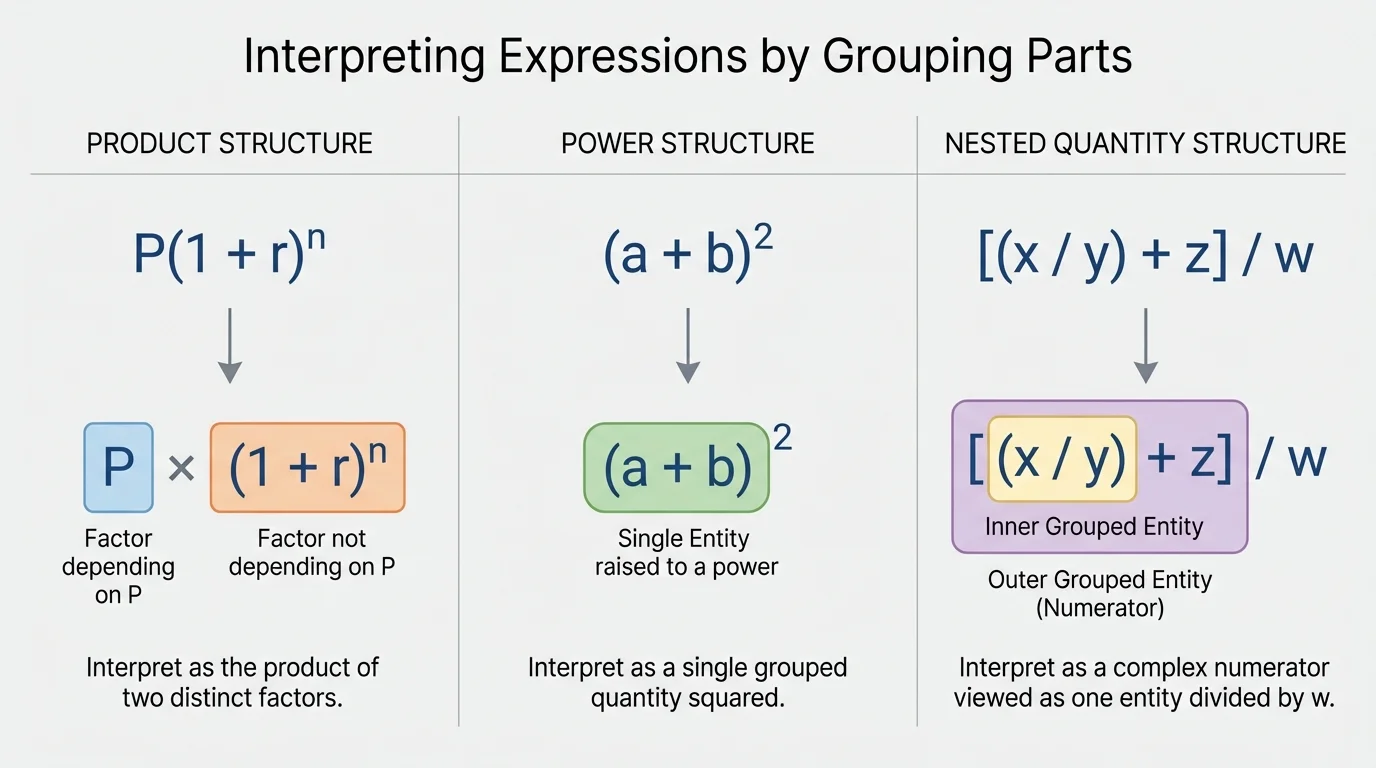
Notice that the grouped part is not always in parentheses only because of addition or subtraction. A power such as \((x+1)^5\) treats \((x+1)\) as one repeated factor. A coefficient such as \(9(x^2-4x+7)\) tells you that the entire trinomial is being multiplied by \(9\). A leading negative sign, as in \(-(2y-3)\), means the opposite of the entire quantity \((2y-3)\).
Also pay attention to whether a factor depends on a variable. In \(P(1+r)^n\), the factor \((1+r)^n\) does not depend on \(P\). In \(x(x+5)\), the factor \((x+5)\) does depend on \(x\). That distinction matters when you are explaining how the expression behaves.
In advanced mathematics and science, experts constantly rename complicated pieces of formulas so they can think more clearly. A physicist might let a long expression equal one new symbol temporarily, not because the original formula changes, but because structure becomes easier to see.
Seeing structure also helps you avoid careless mistakes. If you recognize \(4(x-3)^2\) as four times a square, you are less likely to confuse it with \((4x-3)^2\), which is a completely different expression.
The best way to learn this skill is to translate expressions into words carefully and identify the single entity that matters most in each case.
Worked example 1
Interpret \(P(1+r)^n\) in context if \(P\) is an initial investment, \(r\) is the interest rate per period, and \(n\) is the number of periods.
Step 1: Identify the main factors.
The expression has two factors: \(P\) and \((1+r)^n\).
Step 2: Treat \((1+r)^n\) as one quantity.
This quantity represents the total growth multiplier after \(n\) periods of repeated growth by factor \((1+r)\).
Step 3: State the interpretation in words.
The expression means the initial investment multiplied by the total growth factor after \(n\) periods.
So \(P(1+r)^n\) represents the final amount after compound growth.
Notice how much clearer that is than trying to explain each symbol separately without grouping. The grouped factor carries the main meaning.
Worked example 2
Interpret \(5(x-2)^2\).
Step 1: Identify the single entity.
The quantity \((x-2)\) is one entity.
Step 2: Interpret the exponent.
\((x-2)^2\) means the square of the quantity \((x-2)\).
Step 3: Interpret the coefficient.
The \(5\) means five times that squared quantity.
The expression means five times the square of the difference between \(x\) and \(2\).
That wording is more precise than saying "five x minus two squared," which can be ambiguous and mathematically misleading.
Worked example 3
Interpret \(3a(2b+c)\).
Step 1: Identify the grouped sum.
\((2b+c)\) is one quantity made from two terms.
Step 2: Identify the other factor.
\(3a\) multiplies the entire quantity \((2b+c)\).
Step 3: State the meaning.
The expression means the product of \(3\), \(a\), and the quantity \((2b+c)\).
If \((2b+c)\) represented the cost of one package, then \(3a(2b+c)\) could represent the cost of \(3a\) such packages.
In this example, the grouped part is not raised to a power, but it still acts as one unit in the larger product.
Worked example 4
A rectangular garden has length \((x+4)\) meters and width \((x-1)\) meters. Interpret the area expression \((x+4)(x-1)\).
Step 1: Recall the area formula.
Area equals length times width.
Step 2: Identify the two quantities.
The two factors are \((x+4)\) and \((x-1)\).
Step 3: Interpret in context.
The expression means the product of the garden's length and width.
So \((x+4)(x-1)\) represents the area of the garden, not just an abstract product of binomials.
Two expressions can be equivalent expressions, meaning they have the same value for all allowable values of the variables, but they may reveal different information. For instance, \(3(x+5)\) and \(3x+15\) are equivalent. However, they do not emphasize the same structure.
The form \(3(x+5)\) highlights multiplication of an entire quantity by \(3\). The form \(3x+15\) highlights two separate terms being added. If a context involves "three groups of \((x+5)\)," the first form is more informative. If a context involves a variable part \(3x\) plus a fixed amount \(15\), the second form may be more useful.
This is why algebra is not only about simplifying. Sometimes you keep an expression in a particular form because that form reveals its meaning better. As we saw earlier in [Figure 1], keeping \(P(1+r)^n\) grouped makes the growth factor visible. Expanding that expression would usually hide the meaning rather than clarify it.
Different forms highlight different ideas. Factored form often shows multiplication and grouped quantities. Expanded form often shows how terms combine. Exponent form often shows repeated multiplication or repeated growth. Good algebra students choose the form that best matches the question they are trying to answer.
Another example is \((x-3)^2\) versus \(x^2-6x+9\). These are equivalent, but \((x-3)^2\) clearly shows a square of one quantity. If a problem asks you to interpret structure, the grouped form is often the better starting point.
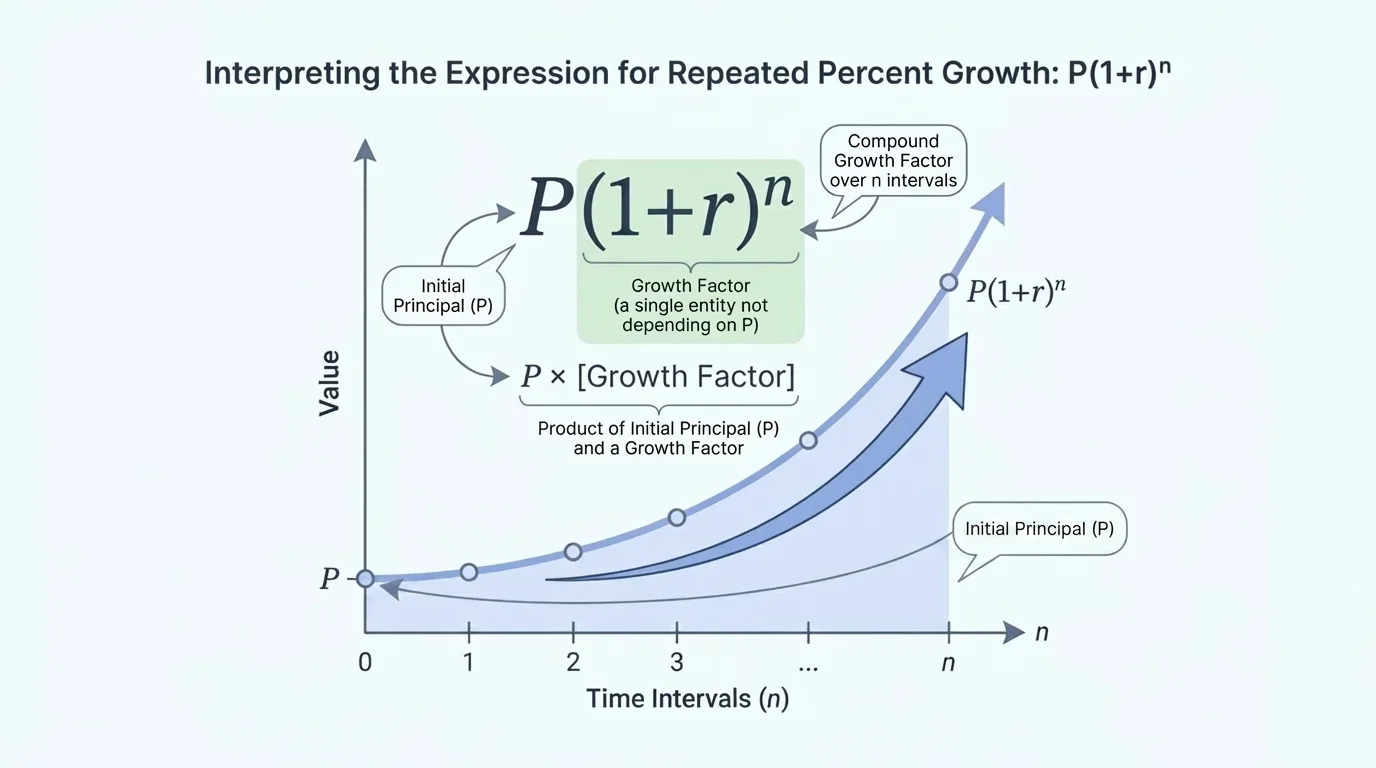
Repeated growth in finance is one of the clearest applications of this topic. The expression \(P(1+r)^n\) shows that money grows by multiplying by the same factor again and again. The factor \((1+r)^n\) is meaningful as one unit because it captures the entire effect of repeated percent increase over time.
[Figure 3] Population models often use a similar idea. If a population starts at \(P\) and grows by rate \(r\) each year for \(t\) years, the expression \(P(1+r)^t\) gives the final population. In contrast, for decay, a model such as \(M(1-r)^t\) describes repeated decrease. The grouped factor still acts as one complete multiplier.
In geometry, formulas often contain grouped units with direct physical meaning. For a circle, \(A = \pi r^2\). Here, \(r^2\) means the square of the radius, and multiplying by \(\pi\) gives the area. You can view \(r^2\) as one quantity within the larger formula.
In business, expressions such as \(c(n+f)\) may represent cost per item \(c\) multiplied by a grouped quantity \((n+f)\), where \(n\) is the number of products and \(f\) is extra units due to waste, spoilage, or setup. Treating \((n+f)\) as one quantity can make planning and interpretation much clearer.
Even in science, formulas often involve a variable multiplied by an entire factor that depends on different variables. Looking back at [Figure 2], this is why it helps to recognize not just symbols but roles: one part may be an initial quantity, while another part is the full adjustment factor.
A common mistake is to rush into expanding or distributing before understanding the expression. If you immediately expand \((x+2)^3\), you may miss the fact that the expression represents a cube of one quantity. Interpreting comes before manipulating.
Another mistake is reading an exponent as applying only to the nearest symbol instead of the entire grouped quantity. In \((a+b)^2\), the exponent applies to \((a+b)\), not just to \(b\). Parentheses tell you what acts as one entity.
Students also sometimes ignore which variables a factor depends on. In \(P(1+r)^n\), the expression \((1+r)^n\) changes if \(r\) or \(n\) changes, but not if only \(P\) changes. That means \(P\) scales the final amount directly, while the other factor controls the growth pattern.
Worked example 5
Explain the difference in meaning between \(2x+5\) and \(2(x+5)\).
Step 1: Read \(2x+5\) by structure.
This means a variable amount \(2x\) plus a fixed amount \(5\).
Step 2: Read \(2(x+5)\) by structure.
This means two times the entire quantity \((x+5)\).
Step 3: Compare.
Although \(2(x+5) = 2x+10\), it is not equivalent to \(2x+5\). The parentheses change the structure and therefore the meaning.
Structure is not decoration. It determines interpretation.
A useful strategy is to ask three questions whenever you see a complicated expression: What is the whole quantity here? What operation is being done to that quantity? What does that operation mean in this context?
Interpreting structure is one of the habits that makes algebra feel less mechanical and more intelligent. Instead of seeing expressions as random collections of symbols, you begin to see them as organized objects. That shift makes later topics, from quadratic functions to exponential models, much more manageable.
Whenever you meet an expression with parentheses, powers, or repeated factors, pause before simplifying. Ask whether some part of the expression should be viewed as a single entity. Often, that one decision reveals the meaning of the entire expression.
This habit becomes especially valuable in higher-level work. Whether you are studying finance, science, engineering, or statistics, formulas become easier to understand when you can name the important grouped quantities and explain how they interact.
