A strange thing about equations is that two expressions can look completely different and still mean exactly the same thing. Even stranger, some equations have exactly one solution, some have no solution at all, and some are true for every value of the variable. That may sound surprising at first, but once you learn how to simplify equations step by step, the mystery disappears.
When you solve an equation, you are really asking, "What value makes both sides equal?" In algebra, an important goal is not just finding a solution, but understanding what kind of solution the equation has. An equation in one variable can end in one of three ways: a specific value of the variable, a statement that is always true, or a statement that is never true.
Linear equations appear in many real situations. If two phone plans cost the same amount after a certain number of months, you can find when they are equal by using a linear equation. If a ticket price and a fixed service fee create the same total as another pricing rule, you can model that too. Solving equations helps you decide whether there is one solution, no solution, or infinitely many solutions.
These ideas also sharpen logical thinking, as [Figure 1] helps illustrate. Each time you simplify an equation, you must keep it equivalent to the original. That means the new equation has exactly the same solution set as the old one.
To solve equations well, remember earlier skills: combine like terms, use the distributive property, and perform the same operation on both sides of an equation. If \(3x+5=17\), subtracting \(5\) from both sides keeps the equation balanced, giving \(3x=12\).
Those basic skills are the tools you use over and over. The difference now is that you will pay attention not only to the steps, but also to what the final simplified equation tells you.
A linear equation in one variable is an equation that can be written so the variable has exponent \(1\) and appears in no products with itself, no square roots, and no denominators involving the variable. Examples include \(2x+7=19\), \(5(x-1)=3x+9\), and \(4-2x=10+x\).
The phrase "in one variable" means there is only one unknown, such as \(x\). A variable is a symbol that stands for a number. In this lesson, that number might be one special value, every value, or no value.
Equivalent equations are equations that have the same solution set.
Solution means a value of the variable that makes the equation true.
Solution set is the collection of all solutions to an equation.
For example, \(2x+6=14\), \(2x=8\), and \(x=4\) are all equivalent equations because they are true for the same value, \(x=4\).
Every linear equation in one variable eventually simplifies to one of three endings: \(x=a\), \(a=a\), or \(a=b\) where \(a\) and \(b\) are different numbers. These final forms tell you immediately whether the equation has one solution, infinitely many solutions, or no solution.
If you end with \(x=a\), then the equation has one solution. For instance, if your work leads to \(x=5\), then only \(5\) makes the original equation true.
If you end with \(a=a\), such as \(4=4\) or \(0=0\), then the equation has infinitely many solutions. That means every value of \(x\) makes the original equation true, because the variable terms canceled and left a true statement.
If you end with \(a=b\) where \(a\neq b\), such as \(3=9\), then the equation has no solution. The variable terms canceled and left a false statement, so no value of \(x\) can make the equation true.
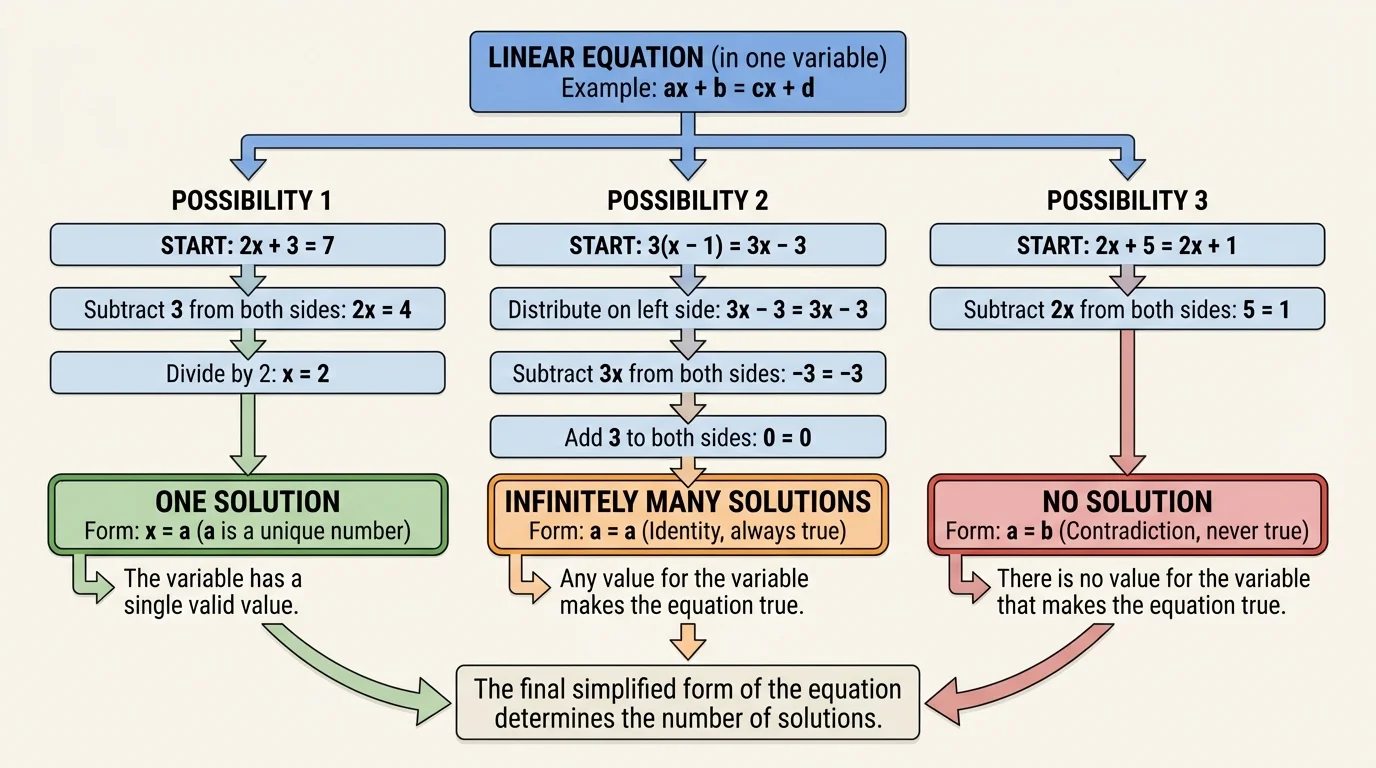
These three outcomes cover every possible case for a linear equation in one variable. There is no fourth option. Later, when you solve more complicated equations, you can still use this idea as a guide: simplify until the structure becomes clear.
A transformation is a change that rewrites an equation in a simpler but equivalent form. Solving by successively transforming means doing one valid algebra step at a time until the result is easy to interpret.
Common transformations include distributing, combining like terms, adding or subtracting the same amount on both sides, and multiplying or dividing both sides by the same nonzero number. Each step must preserve equality.
Why the same operation on both sides works
An equation is like a balance. If both sides are equal and you subtract \(3\) from one side, you must subtract \(3\) from the other side too, or the balance is broken. The same idea works for addition, multiplication, and division by a nonzero number.
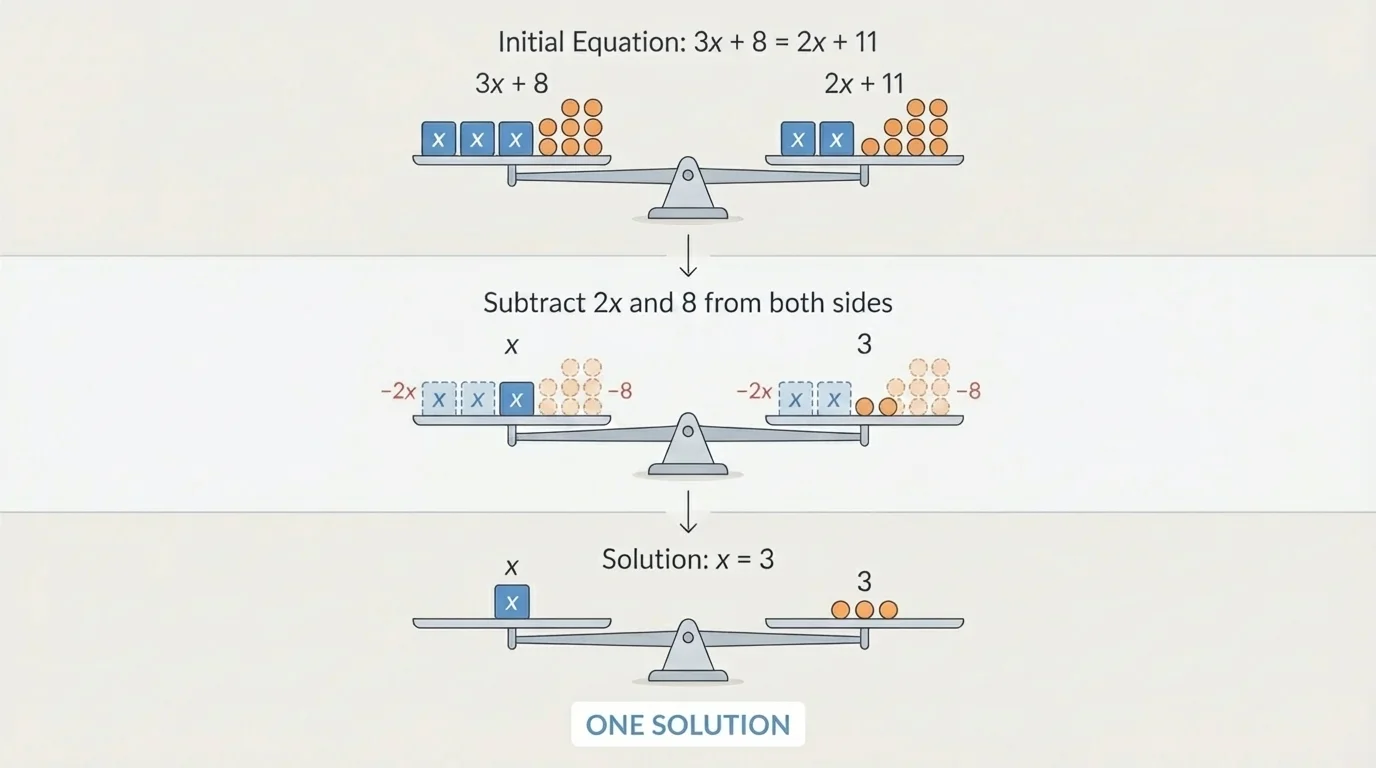
A good strategy is to simplify each side first, then move variable terms to one side and constants to the other, as [Figure 2] illustrates with a balance model. Finally, isolate the variable if possible. If the variable disappears, check whether the remaining statement is true or false.
Keeping both sides equal matters all the way through. Each legal step keeps the original equation and the new equation equivalent.
Solve \(3x+8=20\).
Worked example 1
Step 1: Isolate the variable term.
Subtract \(8\) from both sides: \(3x+8-8=20-8\), so \(3x=12\).
Step 2: Solve for \(x\).
Divide both sides by \(3\): \(\dfrac{3x}{3}=\dfrac{12}{3}\), so \(x=4\).
Step 3: Interpret the result.
The equation is now in the form \(x=a\), so it has exactly one solution.
\(x=4\)
Check by substitution: replacing \(x\) with \(4\) gives \(3(4)+8=12+8=20\). Since both sides are equal, the solution is correct.
Notice that this example never caused the variable terms to cancel completely. The work naturally led to one specific value.
Now solve \(4(x+2)=4x+8\).
Worked example 2
Step 1: Distribute on the left side.
\(4(x+2)=4x+8\) becomes \(4x+8=4x+8\).
Step 2: Subtract \(4x\) from both sides.
\(4x+8-4x=4x+8-4x\), so \(8=8\).
Step 3: Interpret the result.
The equation is now in the form \(a=a\). This is always true, so every value of \(x\) works.
The equation has infinitely many solutions.
You can test this with different numbers. If \(x=0\), then both sides equal \(8\). If \(x=5\), then both sides equal \(28\). That is a strong sign that the original equation represents the same expression on both sides.
Equations with infinitely many solutions often come from simplifying two sides that are really identical, just written differently.
Now solve \(2(x+3)=2x+11\).
Worked example 3
Step 1: Distribute on the left side.
\(2(x+3)=2x+11\) becomes \(2x+6=2x+11\).
Step 2: Subtract \(2x\) from both sides.
\(2x+6-2x=2x+11-2x\), so \(6=11\).
Step 3: Interpret the result.
The equation is now in the form \(a=b\) where \(a\neq b\). Since \(6=11\) is false, no value of \(x\) can make the original equation true.
The equation has no solution.
This result may feel surprising, but it makes sense. The variable parts on both sides were equal, yet the constant parts were different. No number can fix that mismatch.
It helps to compare the three endings side by side. Once you know what the final simplified form means, you can classify an equation quickly and confidently.
| Final form | Meaning | Number of solutions | Example |
|---|---|---|---|
| \(x=a\) | One specific value works | One solution | \(x=7\) |
| \(a=a\) | True statement | Infinitely many solutions | \(5=5\) |
| \(a=b\), \(a\neq b\) | False statement | No solution | \(2=9\) |
Table 1. The three possible final forms for a linear equation in one variable.
As we saw earlier in [Figure 1], the key is not how the equation starts, but how it ends after valid simplifications. Complicated equations still fit into one of these three patterns.
One common mistake is forgetting to distribute correctly. For example, \(3(x-2)\) becomes \(3x-6\), not \(3x-2\). A small distribution error can completely change the solution type.
Another mistake is combining unlike terms. In \(2x+5\), you cannot combine \(2x\) and \(5\) because one has a variable and the other does not. But in \(2x+7x\), you can combine to get \(9x\).
Some equations look as if they should have a single numerical solution, but after the variable terms cancel, they reveal either a contradiction or an identity. This is one reason algebra teaches more than calculation: it teaches you to notice structure.
Checking matters. If you think an equation has one solution, substitute the value back into the original equation. If you think it has no solution or infinitely many solutions, try a few values to see whether the equation is always false or always true.
Linear equations are not just school exercises. In cost comparisons, the equation you write may match once, never match, or describe the same rule in two different ways. The algebra tells you which situation you are dealing with.
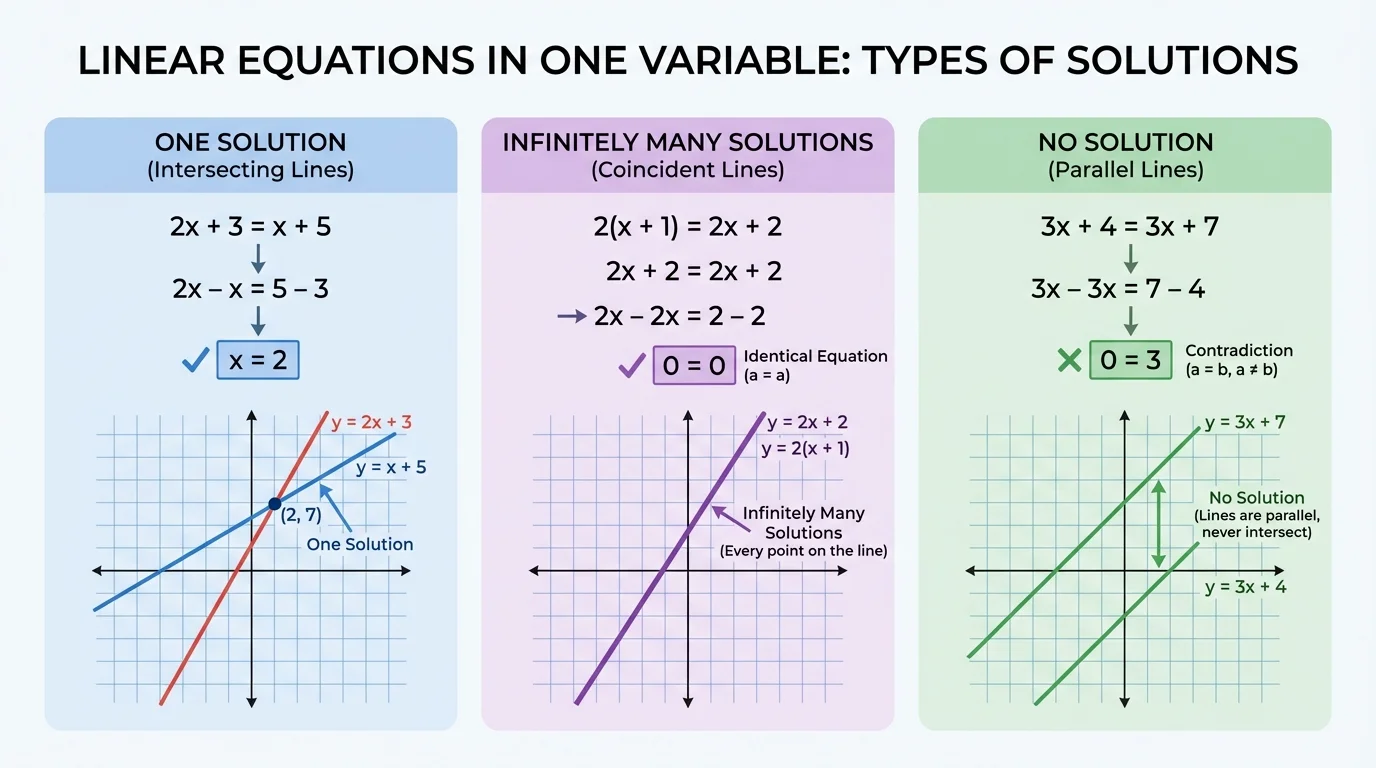
Suppose Plan A costs \(\$10\) plus \(\$5\) per month, and Plan B costs \(\$25\) plus \(\$2\) per month, as [Figure 3] shows on a graph. If \(m\) is the number of months, then setting the costs equal gives \(10+5m=25+2m\). Solving gives \(3m=15\), so \(m=5\). The plans cost the same after \(5\) months, so this situation has one solution.
Now suppose two companies use exactly the same pricing rule, but one writes it as \(3(m+4)\) and the other writes it as \(3m+12\). Setting them equal gives \(3(m+4)=3m+12\), which simplifies to \(3m+12=3m+12\), then \(12=12\). Every value of \(m\) works, so the plans always match.
For a no-solution situation, imagine one company charges \(\$4\) per ticket plus a \(\$6\) fee, while another charges \(\$4\) per ticket plus a \(\$10\) fee. Setting totals equal gives \(4t+6=4t+10\). Subtracting \(4t\) from both sides leaves \(6=10\), which is impossible. Since the per-ticket rates are the same but the fixed fees are different, the totals never match.
Much later, when you graph linear equations, you will see that one solution means lines intersect once, no solution means lines are parallel, and infinitely many solutions means both equations describe the same line. That connection matches what you already know from algebra and makes that relationship visible.
Students should be ready for equations with variables on both sides, parentheses, and fractions. The same ideas still work: simplify carefully and watch the final form.
Worked example 4
Solve \(7x-4=3x+12\).
Step 1: Move variable terms to one side.
Subtract \(3x\) from both sides: \(7x-3x-4=12\), so \(4x-4=12\).
Step 2: Move constants to the other side.
Add \(4\) to both sides: \(4x=16\).
Step 3: Divide by \(4\).
\(x=4\).
\(x=4\)
Here the variable appears on both sides at the start, but the equation still leads to one solution.
Consider a fraction example: \(\dfrac{x}{3}+2=5\). Subtract \(2\) from both sides to get \(\dfrac{x}{3}=3\). Multiply both sides by \(3\), and you get \(x=9\). Fractions do not change the logic; they only require careful arithmetic.
Worked example 5
Determine the number of solutions for \(5(x-1)+3=5x-2\).
Step 1: Distribute and simplify.
\(5(x-1)+3=5x-2\) becomes \(5x-5+3=5x-2\), so \(5x-2=5x-2\).
Step 2: Remove the variable terms.
Subtract \(5x\) from both sides: \(-2=-2\).
Step 3: Interpret.
The final equation is true, so there are infinitely many solutions.
Now look at another variation: \(6(2x+1)=12x+9\). Distribute to get \(12x+6=12x+9\). Subtract \(12x\) from both sides to get \(6=9\). Since that is false, the equation has no solution.
These examples show that the form of the equation may change, but the three final possibilities do not.
When solving any linear equation in one variable, a steady process helps. First, simplify each side by distributing and combining like terms. Next, move variable terms and constants so the equation becomes easier to read. Finally, decide what the last simplified statement means.
If you reach \(x=a\), stop and check by substitution. If you reach \(a=a\), recognize infinitely many solutions. If you reach \(a=b\) with different numbers, recognize no solution. That classification is just as important as the algebraic work itself.
