A single zero can make a huge difference. Compare \(6\), \(60\), \(600\), and \(6{,}000\). Each time you multiply by \(10\), the value becomes ten times larger. That same pattern works with decimals too: \(0.6\), \(6\), and \(60\) are connected by the same idea. Once you understand place value, these patterns stop feeling like tricks and start making perfect sense.
Our number system is based on groups of ten. That is why multiplying and dividing by \(10\), \(100\), and \(1{,}000\) creates very clear patterns. In this lesson, you will see how zeros appear in products, how the decimal point seems to move, and how exponents help us write powers of \(10\) in a short and powerful way.
Every digit in a number has a value based on its place. A place-value chart makes this easy to see, as [Figure 1] shows. In the number \(345\), the digit \(3\) means \(3\) hundreds, the digit \(4\) means \(4\) tens, and the digit \(5\) means \(5\) ones.
When you multiply a number by \(10\), each digit shifts to a place that is worth ten times as much. When you divide by \(10\), each digit shifts to a place that is worth one-tenth as much. This is the real reason the decimal point seems to move. The digits are changing places in the place-value system.
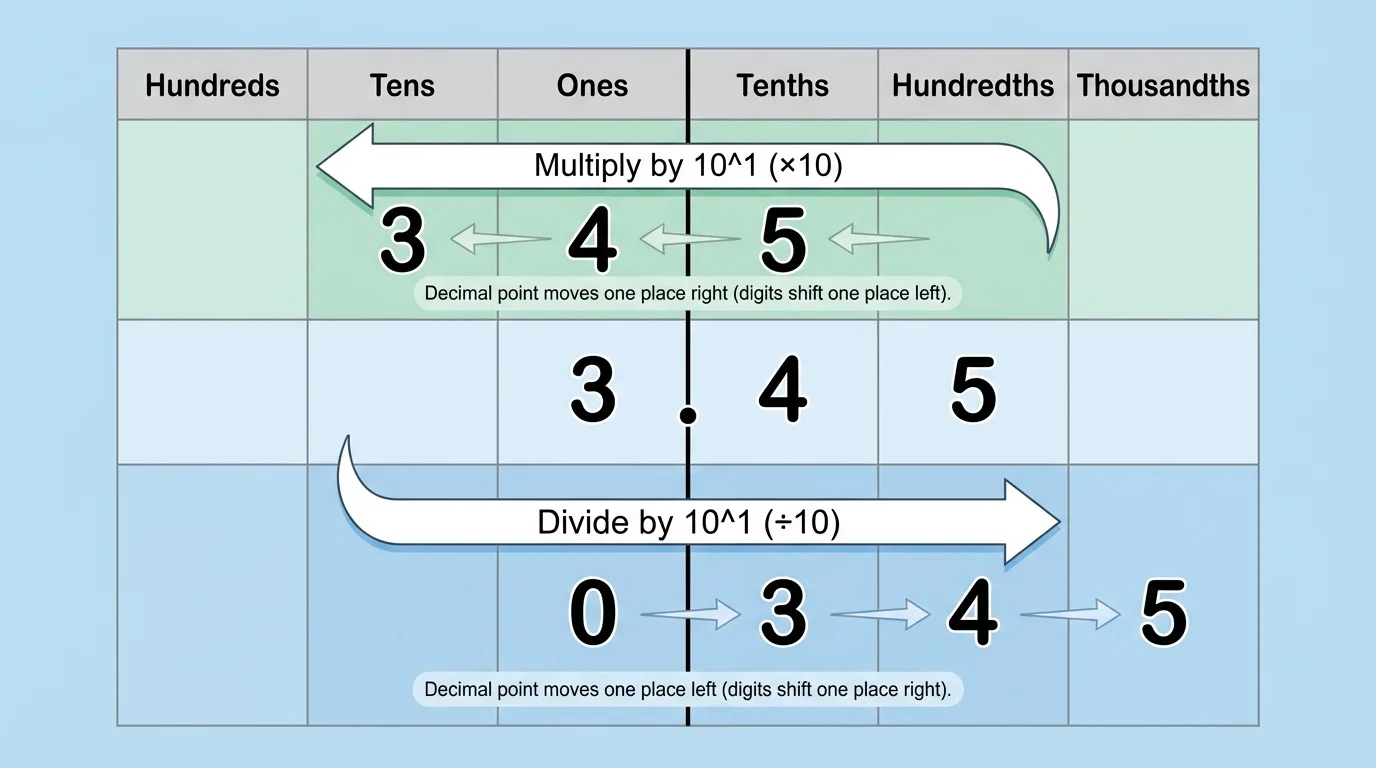
For example, start with \(3.45\). If you multiply by \(10\), you get \(34.5\). The \(3\) moves from the ones place to the tens place, the \(4\) moves from the tenths place to the ones place, and the \(5\) moves from the hundredths place to the tenths place.
If you divide \(3.45\) by \(10\), you get \(0.345\). Each digit moves one place to the right. Later, when you work with larger powers of \(10\), the same idea continues: multiplying by \(100\) shifts digits two places left, and dividing by \(100\) shifts digits two places right.
You already know that in base ten, each place is worth ten times the place to its right. The tens place is \(10\) times the ones place, and the ones place is \(10\) times the tenths place.
This base-ten pattern is the foundation for everything in this topic. If you keep focusing on place value, the rules for zeros and decimal points become much easier to understand.
A power of 10 is a number like \(10\), \(100\), or \(1{,}000\). These numbers can be written using a whole-number exponent, as [Figure 2] helps show. The exponent tells how many times \(10\) is used as a factor.
The pattern of powers of \(10\) is easy to spot. Here are some examples:
\(10^1 = 10\)
\(10^2 = 10 \times 10 = 100\)
\(10^3 = 10 \times 10 \times 10 = 1{,}000\)
\(10^4 = 10 \times 10 \times 10 \times 10 = 10{,}000\)
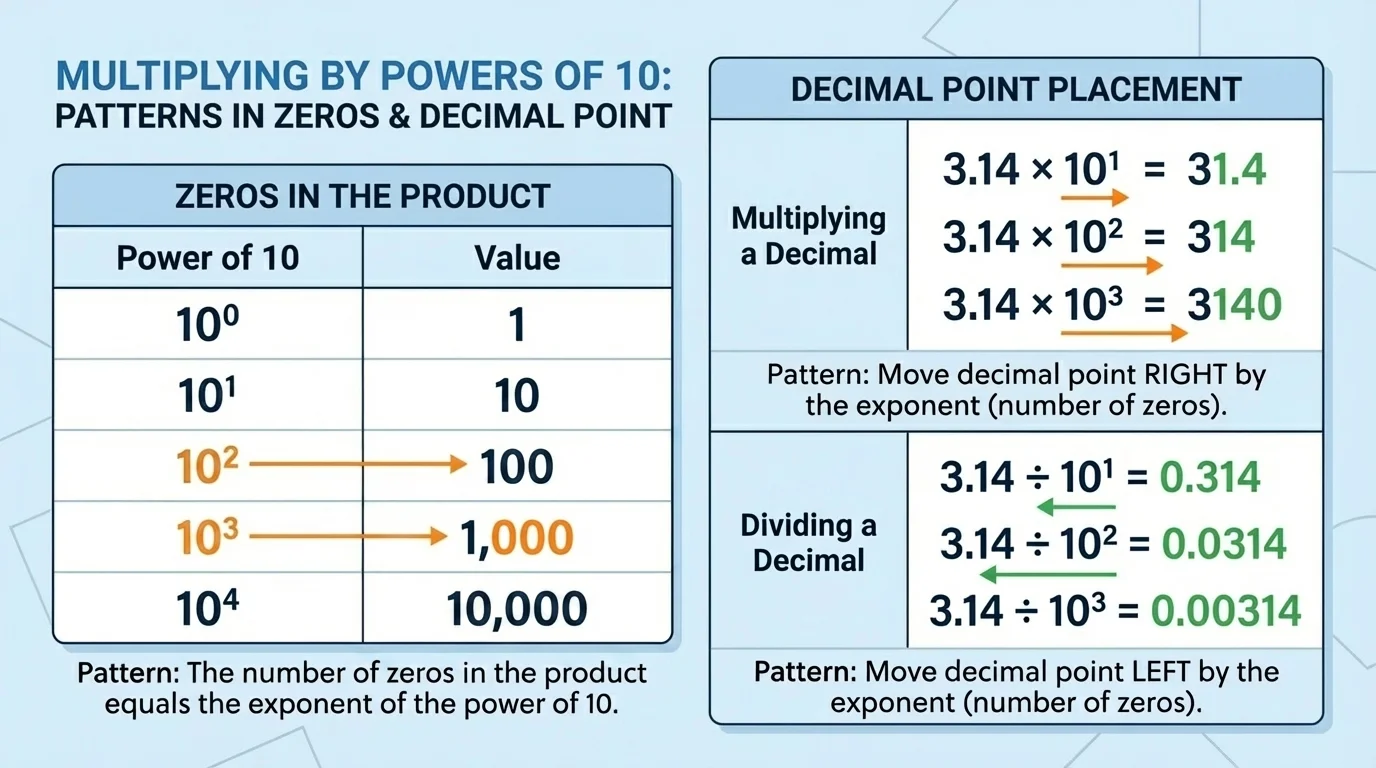
Notice the pattern: the value of \(10^n\) has \(n\) zeros when \(n\) is a whole number greater than \(0\). So \(10^2\) has \(2\) zeros, and \(10^3\) has \(3\) zeros.
Power of 10 means a number written as \(10^n\), where \(n\) is a whole number exponent. The exponent tells how many factors of \(10\) are multiplied together.
Exponent is the small raised number that tells how many times a factor is used in repeated multiplication.
Exponents are useful because they save space and show patterns clearly. Instead of writing \(10 \times 10 \times 10\), you can write \(10^3\). This shorter form helps when comparing how many places digits shift.
Now let's connect powers of \(10\) to multiplication. When you multiply a whole number by \(10\), \(100\), or \(1{,}000\), you often see zeros appear at the end of the product. This happens because the digits move to places with greater value.
Look at these examples:
\(7 \times 10 = 70\)
\(7 \times 100 = 700\)
\(7 \times 1{,}000 = 7{,}000\)
Each time, the number of zeros in the power of \(10\) matches the number of places the digit shifts left. Since \(100 = 10^2\), multiplying by \(100\) shifts digits two places left. Since \(1{,}000 = 10^3\), multiplying by \(1{,}000\) shifts digits three places left.
For whole numbers, students often say, "just add zeros." That shortcut works in many cases, but the real reason is place value. For example:
\(34 \times 10 = 340\)
\(34 \times 100 = 3{,}400\)
\(34 \times 1{,}000 = 34{,}000\)
The digits \(3\) and \(4\) do not change. Their places change. The \(3\) moves from tens to hundreds, then to thousands, then to ten-thousands as the multiplier grows.
Why zeros appear
Zeros often appear because there are empty places after the digits shift left. Those empty places are filled with zeros. So in \(34 \times 100 = 3{,}400\), the digits move two places left, and the two empty places on the right are filled with zeros.
This idea also explains why multiplying by \(10^n\) shifts digits left by \(n\) places. The exponent tells exactly how many places to shift.
Decimals follow the same place-value rules as whole numbers. The shifts are easier to compare in [Figure 3], where one decimal number is multiplied by different powers of \(10\). When you multiply a decimal by \(10\), each digit moves one place left. Multiplying by \(100\) moves each digit two places left. Multiplying by \(1{,}000\) moves each digit three places left.
Here are some examples:
\(4.8 \times 10 = 48\)
\(4.8 \times 100 = 480\)
\(0.63 \times 10 = 6.3\)
\(0.63 \times 100 = 63\)
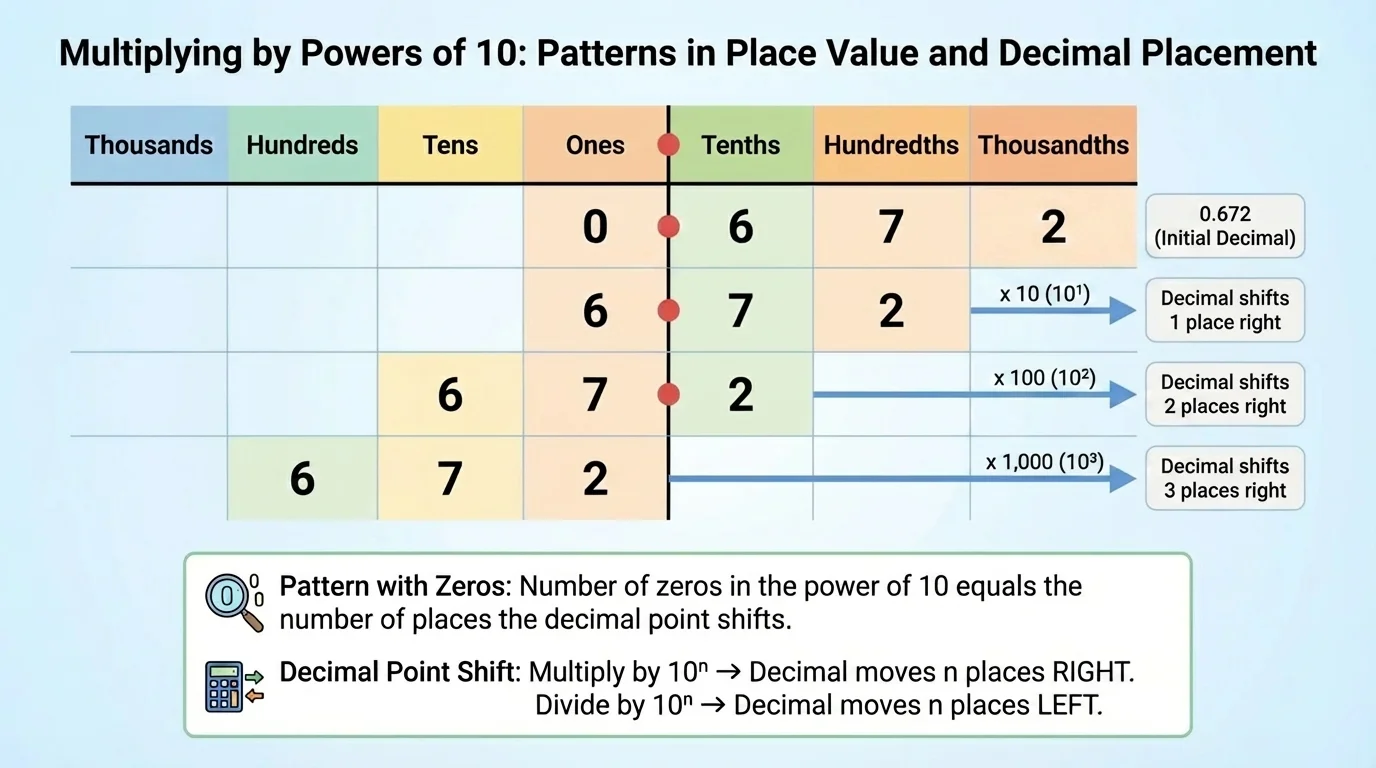
You may hear people say, "move the decimal point to the right." That description can help, but it is better to think carefully: the digits are moving left into places worth more. The decimal point itself stays in the same position in the place-value chart. As we saw earlier in [Figure 1], the chart shows digit movement more accurately than the shortcut phrase does.
If there are not enough digits, you can add zeros as placeholders. For example:
\(5.2 \times 100 = 520\)
You can think of \(5.2\) as \(5.20\). Then shifting two places left gives \(520\).
The same base-ten pattern is used in metric measurement. For example, changing meters to centimeters involves multiplying by \(100\), because one meter is \(100\) centimeters.
This is why powers of \(10\) are so useful in science and measurement. They match the structure of our number system.
Division by powers of \(10\) makes numbers smaller because each digit moves to a place worth less. As [Figure 4] shows, dividing by \(10\) moves each digit one place right, dividing by \(100\) moves each digit two places right, and dividing by \(1{,}000\) moves each digit three places right.
Look at these examples:
\(56 \div 10 = 5.6\)
\(56 \div 100 = 0.56\)
\(7.2 \div 10 = 0.72\)
\(7.2 \div 100 = 0.072\)
Sometimes placeholder zeros are needed. For example, \(52 \div 1{,}000\) means shifting the digits three places right. Since \(52\) has only two digits, zeros help fill the empty places:
\[52 \div 1{,}000 = 0.052\]
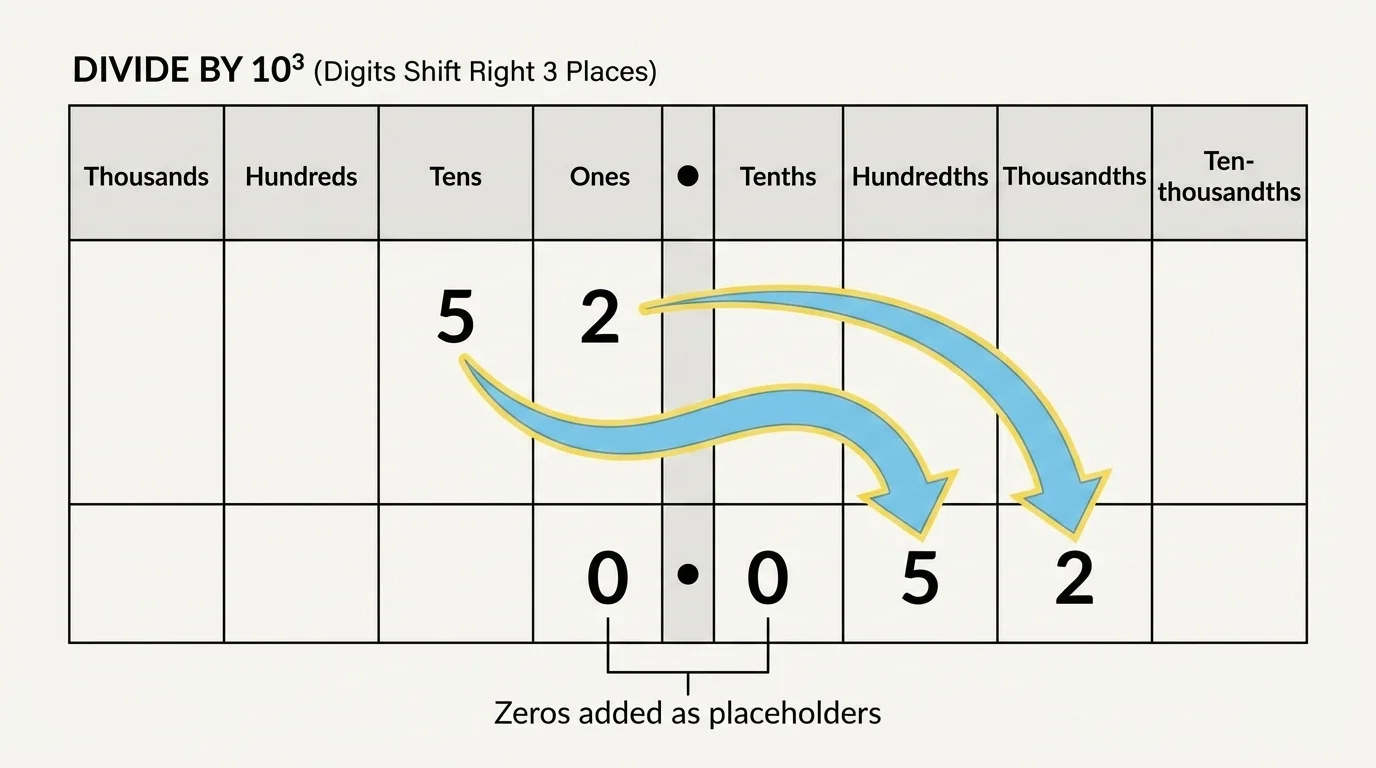
This use of zeros is important. The zeros do not change the value; they simply hold places so the decimal number is written correctly.
Later, when you compare multiplication and division, keep this in mind: multiplying by a power of \(10\) makes digits shift left, while dividing by a power of \(10\) makes digits shift right. The exponent tells how many places to shift.
Let's work through several examples step by step.
Worked example 1
Find \(46 \times 10^2\).
Step 1: Rewrite the power of \(10\).
\(10^2 = 100\)
Step 2: Multiply by \(100\).
\(46 \times 100\) shifts the digits in \(46\) two places left.
Step 3: Write the product.
\[46 \times 10^2 = 46 \times 100 = 4{,}600\]
The product has two zeros because multiplying by \(100\) creates two empty places on the right.
This example shows how the exponent tells the number of places to shift. Since the exponent is \(2\), the digits shift two places left.
Worked example 2
Find \(0.37 \times 10^3\).
Step 1: Rewrite the power of \(10\).
\(10^3 = 1{,}000\)
Step 2: Shift digits three places left.
Starting with \(0.37\), move the digits \(3\) and \(7\) three places to places with greater value.
Step 3: Use a placeholder zero if needed.
\(0.37 = 0.370\), so after shifting three places left, the result is \(370\).
Step 4: Write the answer.
\[0.37 \times 10^3 = 370\]
As shown earlier in [Figure 3], multiplying by \(1{,}000\) shifts digits three places left.
Notice that a number less than \(1\) can become a whole number when multiplied by a large enough power of \(10\).
Worked example 3
Find \(8.945 \div 10^2\).
Step 1: Rewrite the power of \(10\).
\(10^2 = 100\)
Step 2: Divide by \(100\).
Dividing by \(100\) shifts each digit two places right.
Step 3: Write the result.
\[8.945 \div 10^2 = 8.945 \div 100 = 0.08945\]
The quotient is smaller because division moves digits to places worth less.
This pattern matches what we saw with \(56 \div 100 = 0.56\), only now the number has more decimal digits.
Worked example 4
Find \(3{,}205 \times 10\).
Step 1: Identify the shift.
Multiplying by \(10\) means shifting digits one place left.
Step 2: Shift all digits.
The digits \(3\), \(2\), \(0\), and \(5\) each move one place left.
Step 3: Fill the empty ones place with zero.
\[3{,}205 \times 10 = 32{,}050\]
Even though there is already a zero inside the number, the rule is still about place value, not about counting existing zeros.
These examples show that the same pattern works whether the number is a whole number or a decimal.
One common mistake is using the shortcut "add zeros" without thinking. For example, some students might think \(4.6 \times 100 = 4.600\). But \(4.600\) is the same as \(4.6\), so that cannot be right. The correct answer is \(460\), because the digits shift two places left.
Another mistake is moving the decimal point the wrong way. When multiplying by a power of \(10\), the number gets larger, so digits shift left. When dividing by a power of \(10\), the number gets smaller, so digits shift right.
A third mistake is forgetting placeholder zeros. For example, \(6 \div 100 = 0.06\), not \(0.6\). You need two places to the right because you are dividing by \(100 = 10^2\).
A reliable check
Ask whether the answer should be larger or smaller. If you multiply by \(10\), \(100\), or \(1{,}000\), the answer must be larger. If you divide by those numbers, the answer must be smaller. This quick check helps catch decimal mistakes.
That simple estimate is powerful. If your multiplication answer gets smaller, or your division answer gets larger, something has gone wrong.
Powers of \(10\) appear in everyday life. In measurement, one meter equals \(100\) centimeters, so changing meters to centimeters means multiplying by \(100\). For example, \(2.5\) meters is \(250\) centimeters because \(2.5 \times 100 = 250\).
Money also uses decimal place value. A dollar has \(100\) cents. So \(\$3.45\) is the same as \(345\) cents. That means multiplying by \(100\) can help connect dollars and cents.
In science and technology, data and measurements are often scaled by powers of \(10\). Even when students are not using very large numbers yet, the same pattern helps them read measurements, convert units, and understand how ten times bigger or ten times smaller really works.
Think about a race distance. If a runner travels \(0.8\) kilometers, that is \(800\) meters because \(0.8 \times 1{,}000 = 800\). This is another place-value shift, just like in the examples above.
The table below compares multiplication and division by powers of \(10\).
| Operation | Effect on Digits | Example |
|---|---|---|
| Multiply by \(10 = 10^1\) | Shift \(1\) place left | \(5.4 \times 10 = 54\) |
| Multiply by \(100 = 10^2\) | Shift \(2\) places left | \(5.4 \times 100 = 540\) |
| Multiply by \(1{,}000 = 10^3\) | Shift \(3\) places left | \(5.4 \times 1{,}000 = 5{,}400\) |
| Divide by \(10 = 10^1\) | Shift \(1\) place right | \(5.4 \div 10 = 0.54\) |
| Divide by \(100 = 10^2\) | Shift \(2\) places right | \(5.4 \div 100 = 0.054\) |
| Divide by \(1{,}000 = 10^3\) | Shift \(3\) places right | \(5.4 \div 1{,}000 = 0.0054\) |
Table 1. Patterns of digit shifts when multiplying or dividing by powers of ten.
As the table shows, the exponent matches the number of places shifted. This is why exponents are so helpful: \(10^1\), \(10^2\), and \(10^3\) tell you immediately whether to shift \(1\), \(2\), or \(3\) places.
Earlier, [Figure 4] showed how placeholder zeros matter during division, and that same idea helps explain the table entries with small decimals like \(0.0054\). The zeros are not extra value; they keep the places correct.
When you understand these patterns, you are not memorizing separate rules. You are using one big idea again and again: in base ten, every place is ten times the value of the place to its right.
