A ball launched into the air, the shape of a satellite dish, and the design of a bridge arch can all be modeled using the same kind of algebra: the quadratic equation. What makes quadratics fascinating is that one equation can sometimes be solved in seconds by inspection, while another requires a careful procedure such as completing the square or using the quadratic formula. Learning to recognize the form of the equation is what turns a long problem into a manageable one.
A quadratic equation is an equation in one variable whose highest exponent is \(2\). A common form is
\[ax^2 + bx + c = 0\]
where \(a\), \(b\), and \(c\) are real numbers and \(a \ne 0\). The values of \(x\) that make the equation true are called its solutions, or roots. Because the variable is squared, quadratics often have two solutions, one solution, or no real solutions.
Standard form of a quadratic equation is \(ax^2 + bx + c = 0\), where \(a \ne 0\).
Solutions or roots are the values of \(x\) that satisfy the equation.
Complex numbers extend the real numbers by including \(i\), where \(i^2 = -1\).
Different quadratic equations invite different methods. Some are already in a form where you can solve by inspection. Some can be rewritten so that taking square roots works immediately. Others factor nicely. And some do not factor over the integers, so completing the square or using the quadratic formula is the better choice.
Before solving, it helps to ask two questions: What form is the equation in? and Which method fits that form best? For example, \(x^2 = 49\) is already set up for inspection or square roots. An equation like \(x^2 + 5x + 6 = 0\) suggests factoring. An equation like \(x^2 + 4x - 1 = 0\) may be easier with completing the square or the quadratic formula.
When solving equations, whatever operation is done to one side must also be done to the other side. Also remember the zero-product property: if \(ab = 0\), then \(a = 0\) or \(b = 0\).
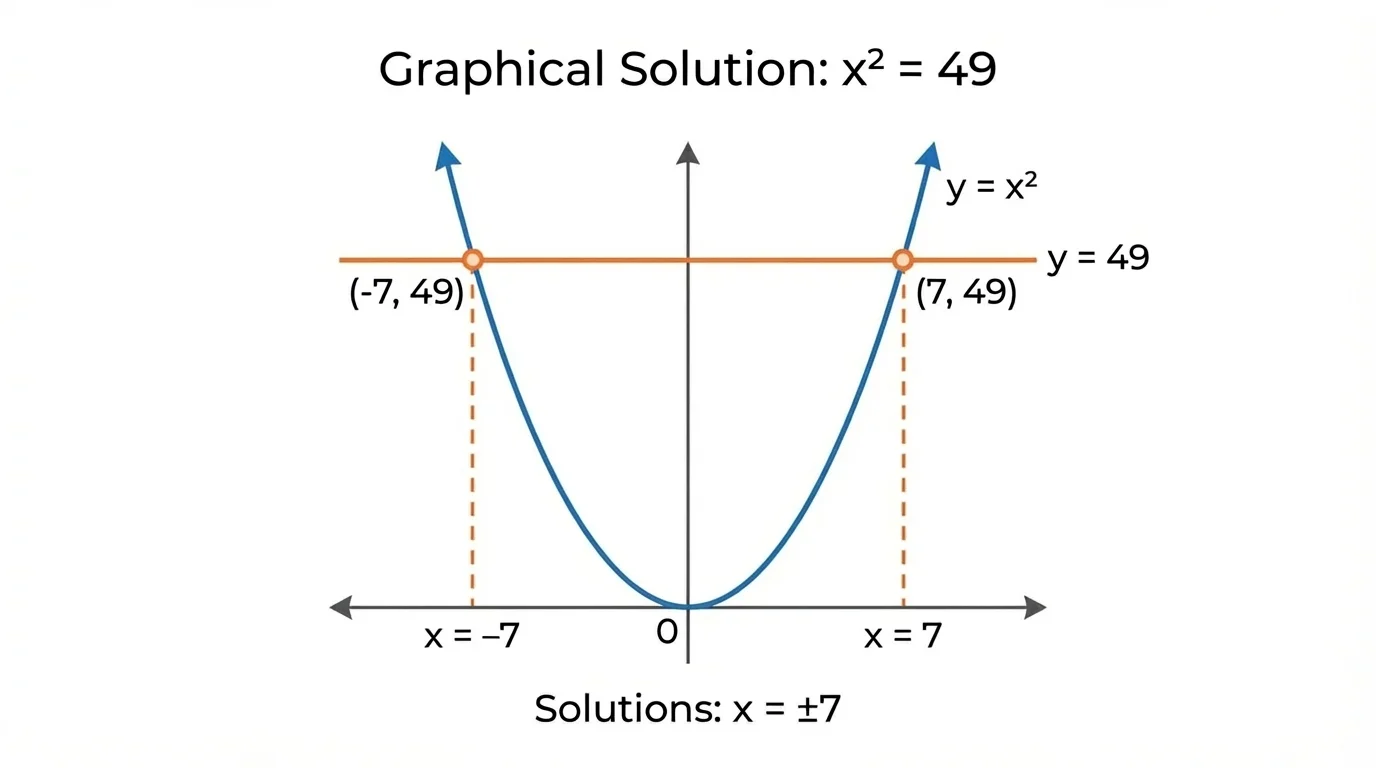
One important warning: when solving equations such as \(x^2 = 49\), the solutions are not just \(7\). Since both \(7^2 = 49\) and \((-7)^2 = 49\), the full solution set is \(x = \pm 7\).
Inspection means recognizing the answer by knowing basic square relationships. This works best when the equation is very simple, especially when a squared variable equals a positive number.
For example, if
\(x^2 = 49\)
then the solutions are
\(x = \pm 7\)
because \(7^2 = 49\) and \((-7)^2 = 49\).
If \(x^2 = 0\), then there is only one solution: \(x = 0\). If \(x^2 = -9\), there are no real solutions, because no real number squared gives a negative value. However, in the complex number system, the solutions are \(x = \pm 3i\).
Worked example 1
Solve \(x^2 = 121\).
Step 1: Recognize the square relationship.
Since \(11^2 = 121\), the solutions are \(11\) and \(-11\).
Step 2: Write both solutions.
\(x = \pm 11\)
The equation has two real solutions: \(11\) and \(-11\).
Inspection is the fastest method, but it only works when the structure is extremely simple and familiar.
When a squared expression is isolated, taking square roots is often the most direct method. The symmetry of quadratic graphs helps explain why there are often two solutions, as [Figure 1] shows: points equally far to the left and right can produce the same squared value.
The key idea is to rewrite the equation so that one side is a single square. Then take the square root of both sides, remembering the \(\pm\) sign.
For example, solve
\[ (x - 3)^2 = 16 \]
Take square roots of both sides:
\[x - 3 = \pm 4\]
Then solve the two resulting equations:
\(x - 3 = 4\) gives \(x = 7\), and \(x - 3 = -4\) gives \(x = -1\).
So the solutions are
\[x = 7 \textrm{ and } x = -1\]
This method also works when the right side is not a perfect square. For instance, if \((x + 2)^2 = 5\), then \(x + 2 = \pm \sqrt{5}\), so \(x = -2 \pm \sqrt{5}\). Exact radical answers are often preferred over decimals unless the problem asks for approximations.
Worked example 2
Solve \(2(x + 1)^2 - 8 = 0\).
Step 1: Isolate the squared expression.
Add \(8\) to both sides: \(2(x + 1)^2 = 8\).
Divide by \(2\): \((x + 1)^2 = 4\).
Step 2: Take square roots.
\(x + 1 = \pm 2\)
Step 3: Solve each equation.
If \(x + 1 = 2\), then \(x = 1\).
If \(x + 1 = -2\), then \(x = -3\).
Therefore, \[x = 1 \textrm{ and } x = -3\]
A very common mistake is forgetting the \(\pm\). If you write only one square root, you may lose half the solutions.
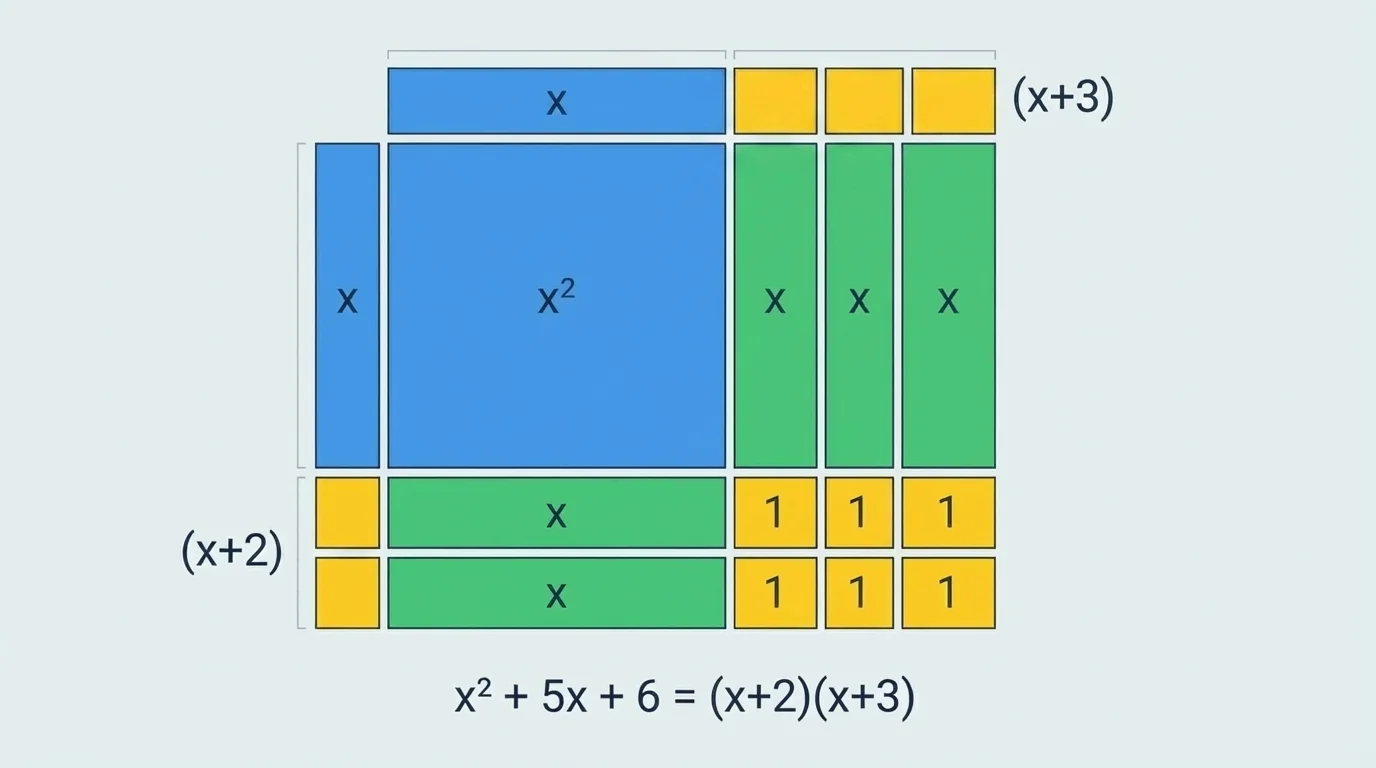
Factoring is powerful when the quadratic can be rewritten as a product equal to zero. In many cases, this is the quickest path, and [Figure 2] illustrates how a trinomial can be reorganized into two linear factors.
Suppose you have
\[x^2 + 5x + 6 = 0\]
Factor the left side:
\[(x + 2)(x + 3) = 0\]
Now apply the zero-product property. If a product is zero, then at least one factor must be zero. So:
\(x + 2 = 0\) or \(x + 3 = 0\)
which gives
\[x = -2 \textrm{ or } x = -3\]
Factoring also works if the equation is not initially equal to zero, but then the first step is to rearrange it. For example, to solve \(x^2 = 7x - 12\), move all terms to one side:
\[x^2 - 7x + 12 = 0\]
Then factor:
\[(x - 3)(x - 4) = 0\]
So the solutions are \(x = 3\) and \(x = 4\).
Worked example 3
Solve \(3x^2 - 12x = 0\).
Step 1: Factor out the greatest common factor.
\[3x(x - 4) = 0\]
Step 2: Use the zero-product property.
Either \(3x = 0\) or \(x - 4 = 0\).
Step 3: Solve each factor equation.
From \(3x = 0\), we get \(x = 0\).
From \(x - 4 = 0\), we get \(x = 4\).
Thus, \[x = 0 \textrm{ and } x = 4\]
Not every quadratic factors nicely over the integers. When factoring becomes awkward or impossible to see, another method is usually better.
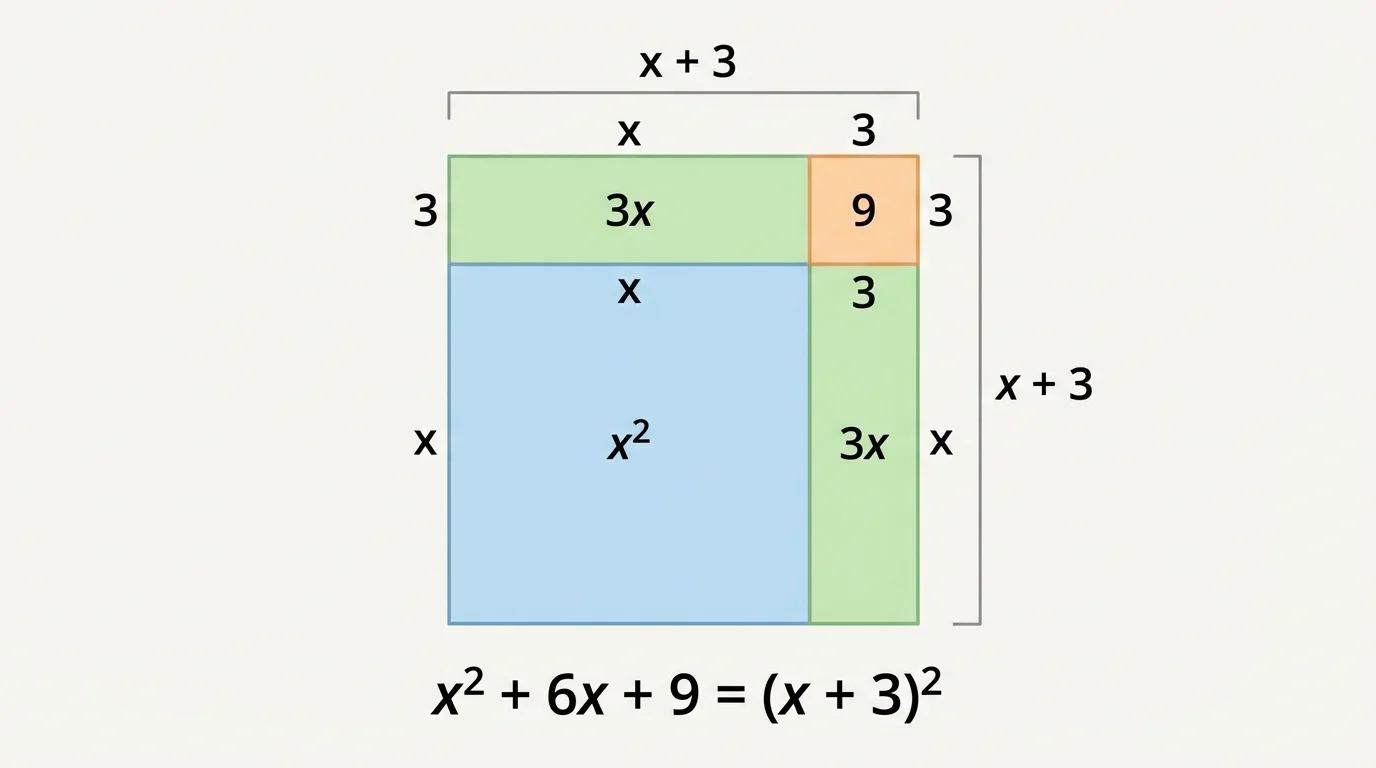
Completing the square turns a quadratic expression into a perfect square trinomial. This method is especially useful when a quadratic does not factor easily, and its geometric logic is easier to see when areas are rearranged into a larger square, as [Figure 3] illustrates.
Start with an equation in the form \(x^2 + bx + c = 0\), or first move terms so that the \(x^2\) and \(x\) terms are on one side. The key number to add is \(\left(\dfrac{b}{2}\right)^2\).
For example, solve
\[x^2 + 6x - 7 = 0\]
Move the constant term to the other side:
\[x^2 + 6x = 7\]
Now take half of \(6\), which is \(3\), and square it: \(3^2 = 9\). Add \(9\) to both sides:
\[x^2 + 6x + 9 = 16\]
The left side is now a perfect square:
\[(x + 3)^2 = 16\]
Take square roots:
\(x + 3 = \pm 4\)
So \(x = 1\) or \(x = -7\).
This method becomes slightly more complicated when the coefficient of \(x^2\) is not \(1\). In that case, first divide the entire equation by the coefficient of \(x^2\).
Worked example 4
Solve \(x^2 + 4x - 1 = 0\) by completing the square.
Step 1: Move the constant term.
\(x^2 + 4x = 1\)
Step 2: Find the completing value.
Half of \(4\) is \(2\), and \(2^2 = 4\).
Add \(4\) to both sides: \(x^2 + 4x + 4 = 5\).
Step 3: Rewrite and solve.
\((x + 2)^2 = 5\)
Take square roots: \(x + 2 = \pm \sqrt{5}\).
So \(x = -2 \pm \sqrt{5}\).
The exact solutions are \[x = -2 \pm \sqrt{5}\]
Completing the square is also the method from which the quadratic formula is derived. That means it is not just a solving trick; it reveals where the formula comes from.
When a quadratic is in standard form \(ax^2 + bx + c = 0\), the quadratic formula gives the solutions directly:
\[x = \frac{-b \pm \sqrt{b^2 - 4ac}}{2a}\]
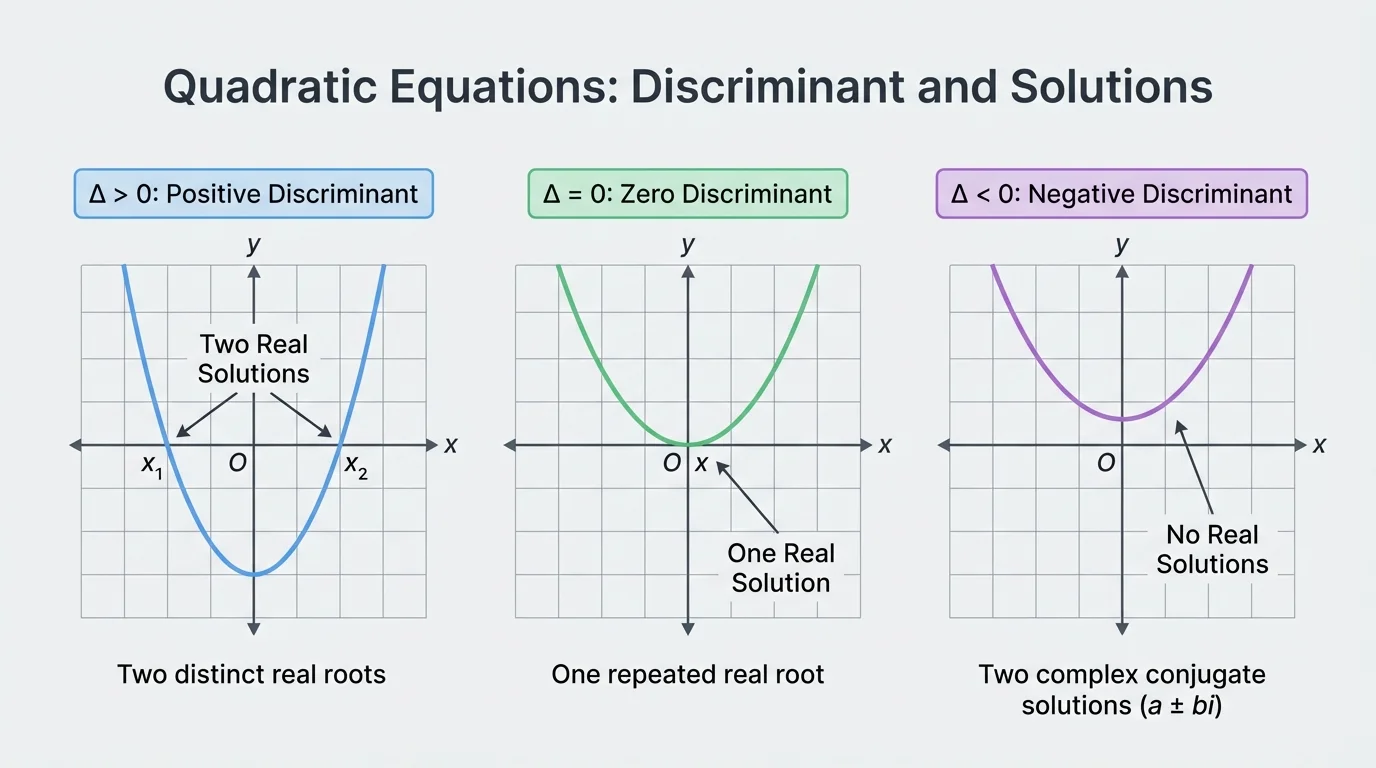
The expression under the square root, \(b^2 - 4ac\), is called the discriminant. It predicts the number and type of solutions, and [Figure 4] connects these cases to how the graph meets the \(x\)-axis.
| Value of \(b^2 - 4ac\) | Type of solutions |
|---|---|
| \(> 0\) | Two distinct real solutions |
| \(= 0\) | One real solution (a repeated root) |
| < 0 | Two complex solutions |
Table 1. How the discriminant determines the number and type of solutions of a quadratic equation.
Let us solve a quadratic that does not factor nicely:
\[2x^2 + 3x - 4 = 0\]
Here \(a = 2\), \(b = 3\), and \(c = -4\). Substitute into the formula:
\[x = \frac{-3 \pm \sqrt{3^2 - 4(2)(-4)}}{2(2)}\]
Simplify inside the radical:
\(3^2 - 4(2)(-4) = 9 + 32 = 41\)
So
\[x = \frac{-3 \pm \sqrt{41}}{4}\]
If the discriminant is negative, the square root involves \(i\). For example, solve
\[x^2 + 2x + 5 = 0\]
Using the quadratic formula with \(a = 1\), \(b = 2\), and \(c = 5\):
\[x = \frac{-2 \pm \sqrt{2^2 - 4(1)(5)}}{2(1)}\]
\(2^2 - 20 = 4 - 20 = -16\), so
\[x = \frac{-2 \pm \sqrt{-16}}{2}\]
Since \(\sqrt{-16} = 4i\), we get
\[x = \frac{-2 \pm 4i}{2} = -1 \pm 2i\]
This is exactly the kind of result students must recognize: a negative discriminant means there are no real solutions, but there are still two complex solutions written in the form \(a \pm bi\).
The quadratic formula can be traced to mathematical work from several cultures, including ancient Babylonian methods and later developments in Islamic and European mathematics. What students use today is the compact form of an idea that took centuries to refine.
Later, when analyzing graphs, you will notice the same pattern from [Figure 4]: if the parabola never crosses the \(x\)-axis, the equation has no real roots, which corresponds to a negative discriminant.
Strong algebra is not just about getting an answer; it is about choosing an efficient path. Different starting forms suggest different methods.
| Equation form | Best first method to try | Example |
|---|---|---|
| \(x^2 = k\) | Inspection or square roots | \(x^2 = 49\) |
| \((x - h)^2 = k\) | Square roots | \((x - 3)^2 = 16\) |
| \(ax^2 + bx + c = 0\) that factors easily | Factoring | \(x^2 + 5x + 6 = 0\) |
| Quadratic not factoring easily, especially with \(a = 1\) | Completing the square | \(x^2 + 4x - 1 = 0\) |
| Any quadratic in standard form | Quadratic formula | \(2x^2 + 3x - 4 = 0\) |
Table 2. A comparison of common equation forms and the most efficient solving methods.
As a quick guide: if the equation already has a square isolated, use square roots. If it factors cleanly, factoring is fast. If neither is true, the quadratic formula always works as long as the equation is in standard form.
Even students who know the methods can lose points through small errors. One of the smartest habits in algebra is to check solutions by substitution.
For example, if you solved \(x^2 + 5x + 6 = 0\) and found \(x = -2\) and \(x = -3\), you can verify:
For \(x = -2\), \((-2)^2 + 5(-2) + 6 = 4 - 10 + 6 = 0\).
For \(x = -3\), \((-3)^2 + 5(-3) + 6 = 9 - 15 + 6 = 0\).
Both work, so both are correct.
Common error patterns
Students often forget to set the equation equal to \(0\) before factoring, forget the \(\pm\) when taking square roots, or make sign mistakes when substituting into the quadratic formula. Another frequent error is treating \(\sqrt{a + b}\) as \(\sqrt{a} + \sqrt{b}\), which is not generally true.
The visual symmetry from [Figure 1] helps explain why missing the \(\pm\) sign is such a serious mistake: a squared value often corresponds to two opposite inputs.
The factor structure from [Figure 2] also helps explain why factoring only works once one side of the equation is \(0\). The zero-product property applies to a product equal to zero, not just any product.
Quadratic equations are not just classroom exercises. They appear whenever a changing quantity depends on a squared term.
In physics, the height of a projectile can often be modeled by a quadratic function. Suppose a ball's height is
\[h(t) = -16t^2 + 48t + 5\]
If you want to know when the ball hits the ground, set the height equal to zero:
\[-16t^2 + 48t + 5 = 0\]
This can then be solved using the quadratic formula. In this setting, a negative time would not make physical sense, so context helps decide which solution is meaningful.
In geometry, quadratics appear in area problems. Suppose a rectangle has length \(x + 4\), width \(x + 1\), and area \(45\). Then
\[(x + 4)(x + 1) = 45\]
Expanding gives \(x^2 + 5x + 4 = 45\), so
\[x^2 + 5x - 41 = 0\]
That equation can be solved by the quadratic formula or completing the square.
Engineers, economists, and computer scientists use quadratic models because they capture situations where change is not constant. A graph that curves instead of staying linear often signals that a quadratic relationship may be present.
Worked example 5
A model rocket's height after \(t\) seconds is \(h = -5t^2 + 20t\). When is the rocket at ground level?
Step 1: Set height equal to zero.
\(-5t^2 + 20t = 0\)
Step 2: Factor.
\(-5t(t - 4) = 0\)
Step 3: Solve.
\(t = 0\) or \(t = 4\)
The rocket is on the ground at launch, \(t = 0\), and lands again at \(t = 4\) seconds.
That example also shows an important modeling idea: sometimes both solutions are mathematically correct, but they represent different moments in the situation.
