An important fact about complex numbers is that a symbol involving \(i\), where \(i^2=-1\), can still behave in a very geometric way. In fact, one simple idea—the conjugate—lets you turn complicated expressions into clean real numbers. That is why conjugates are so important: they connect algebra, geometry, and computation all at once.
A complex number is any number of the form \(a+bi\), where \(a\) and \(b\) are real numbers. The number \(a\) is called the real part, and \(b\) is called the imaginary part. Complex numbers extend the real number system so equations such as \(x^2+1=0\) have solutions.
When students first see complex numbers, division often feels like the hardest part. You cannot leave a complex expression in the denominator if you want the result in standard form. The key tool for fixing that is the conjugate. Conjugates also help us find the modulus of a complex number, which tells us how far that number is from the origin on the complex plane.
Recall that standard form for a complex number is \(a+bi\), where the real and imaginary parts are separated. Also remember that powers of \(i\) repeat: \(i^2=-1\), \(i^3=-i\), and \(i^4=1\).
These ideas are not just symbolic tricks. They are used in electrical engineering, wave motion, and digital communications, where complex numbers model oscillations and phase shifts.
If \(z=a+bi\), then the conjugate of \(z\) is \(a-bi\). In words, you keep the real part the same and change the sign of the imaginary part.
Conjugate: For a complex number \(a+bi\), its conjugate is \(a-bi\).
Modulus: The modulus of \(a+bi\), written \(|a+bi|\) or \(|z|\), is its distance from the origin on the complex plane.
Here are some quick examples. The conjugate of \(3+4i\) is \(3-4i\). The conjugate of \(-2-7i\) is \(-2+7i\). The conjugate of \(5\) is just \(5\), because \(5=5+0i\). The conjugate of \(-6i\) is \(6i\), because \(-6i=0-6i\).
A useful notation is \(\overline{z}\) for the conjugate of \(z\). So if \(z=a+bi\), then \(\overline{z}=a-bi\).
Complex numbers can be plotted on a plane, where the horizontal axis is the real axis and the vertical axis is the imaginary axis. As [Figure 1] shows, on that plane a number \(a+bi\) is represented by the point \((a,b)\), and its conjugate \(a-bi\) is represented by \((a,-b)\).
This geometric view explains why conjugates are so useful. The two numbers \(a+bi\) and \(a-bi\) are reflections of each other across the real axis. They have the same real part, opposite imaginary parts, and the same distance from the origin. That shared distance is the modulus.
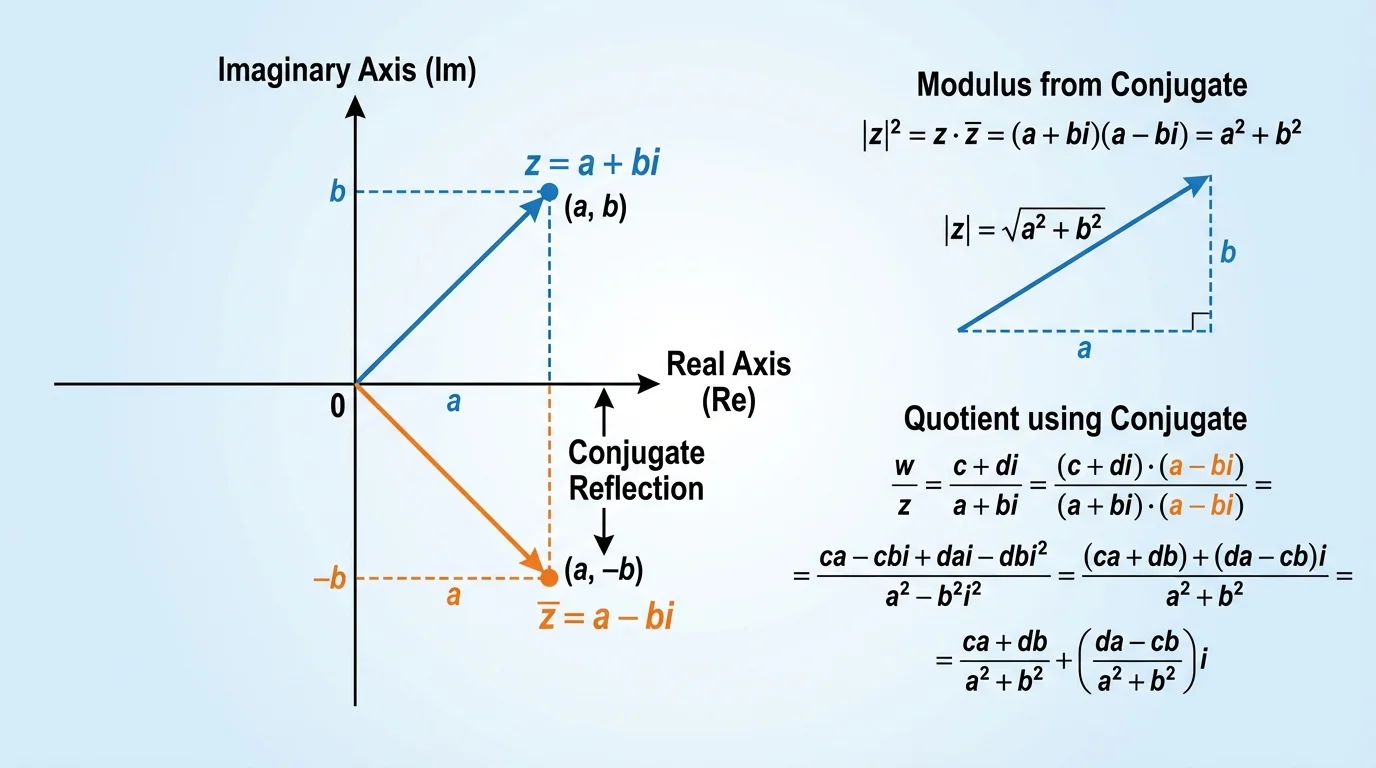
If the imaginary part is positive, the point lies above the real axis. If the imaginary part is negative, the point lies below it. Conjugation flips the point vertically but does not change how far it is from the origin.
Complex numbers were once viewed with suspicion because they seemed "imaginary" in the sense of unreal. Today they are essential in physics, engineering, and computer science.
This reflection idea also hints at an algebraic pattern. When you multiply a complex number by its conjugate, the imaginary parts cancel, leaving a real number.
The most important product involving conjugates is
\[(a+bi)(a-bi)=a^2-b^2i^2\]
Since \(i^2=-1\), this becomes
\[(a+bi)(a-bi)=a^2+b^2\]
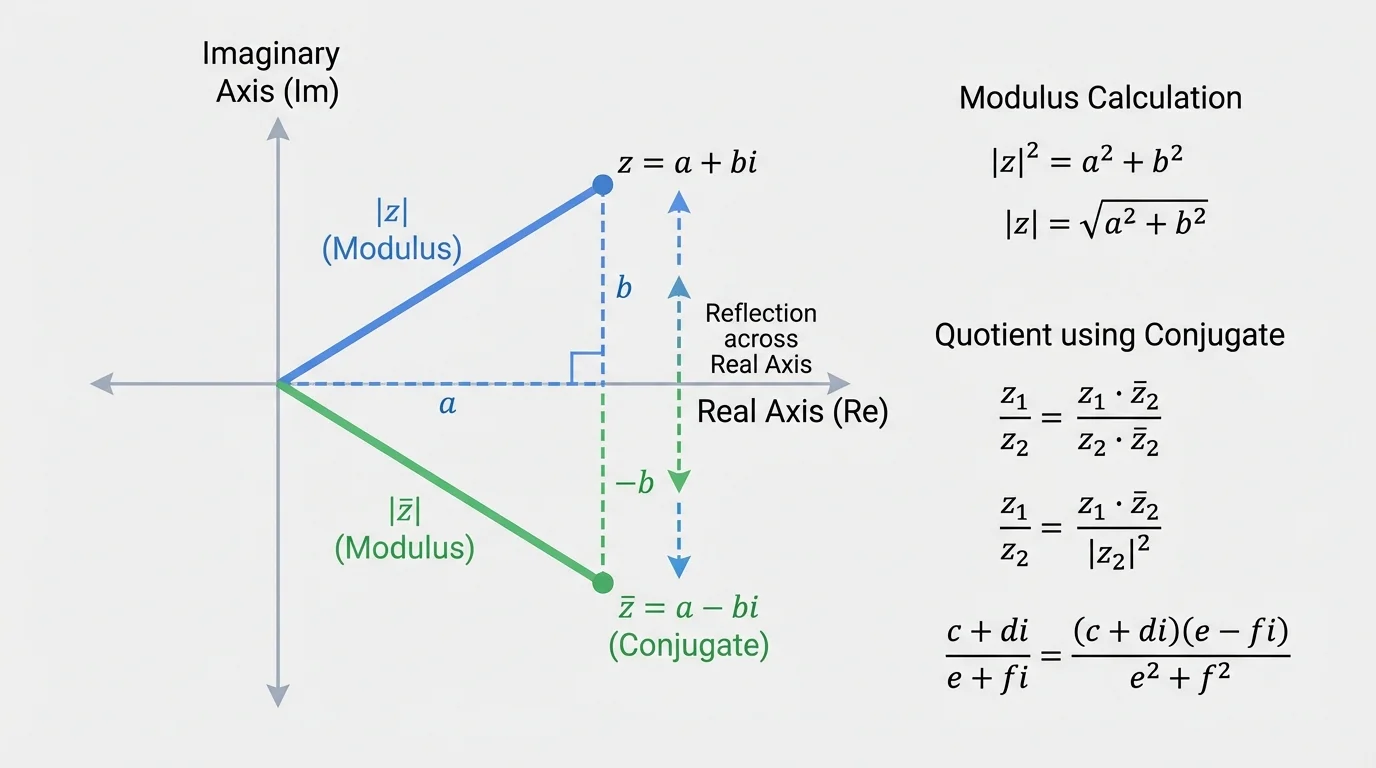
Notice what happened: the answer is a real number, and it is always nonnegative. This is the reason conjugates help with modulus. Geometrically, the modulus is the distance from the origin to the point \((a,b)\), which forms a right triangle, as [Figure 2] illustrates.
By the Pythagorean Theorem, the modulus of \(a+bi\) is
\[|a+bi|=\sqrt{a^2+b^2}\]
There is also a direct connection between modulus and conjugates:
\[|z|^2=z\overline{z}\]
If \(z=a+bi\), then \(z\overline{z}=(a+bi)(a-bi)=a^2+b^2\), so \(|z|=\sqrt{z\overline{z}}\).
This formula works whether \(a\) and \(b\) are positive, negative, or zero. For example, the modulus of \(-3+4i\) is still \(\sqrt{(-3)^2+4^2}=\sqrt{25}=5\).
Why the modulus is never negative
The expression inside the square root is \(a^2+b^2\). Since squares are never negative, \(a^2+b^2\ge 0\). That means \(|z|\) represents a distance, and distances are always nonnegative.
As we saw with the reflected points in [Figure 1], conjugates always have equal moduli because reflection across the real axis does not change distance from the origin.
Suppose you want to divide \(\dfrac{a+bi}{c+di}\), where \(c+di\neq 0\). As [Figure 3] shows, the denominator is complex, so the quotient is not yet in standard form. The standard method is to multiply the numerator and denominator by the conjugate of the denominator, \(c-di\). This process is often called rationalizing the denominator.
Start with
\[\frac{a+bi}{c+di}\]
Multiply numerator and denominator by \(c-di\):
\[\frac{a+bi}{c+di}\cdot\frac{c-di}{c-di}=\frac{(a+bi)(c-di)}{(c+di)(c-di)}\]
The denominator becomes
\[(c+di)(c-di)=c^2+d^2\]
which is real. That is exactly what we wanted.
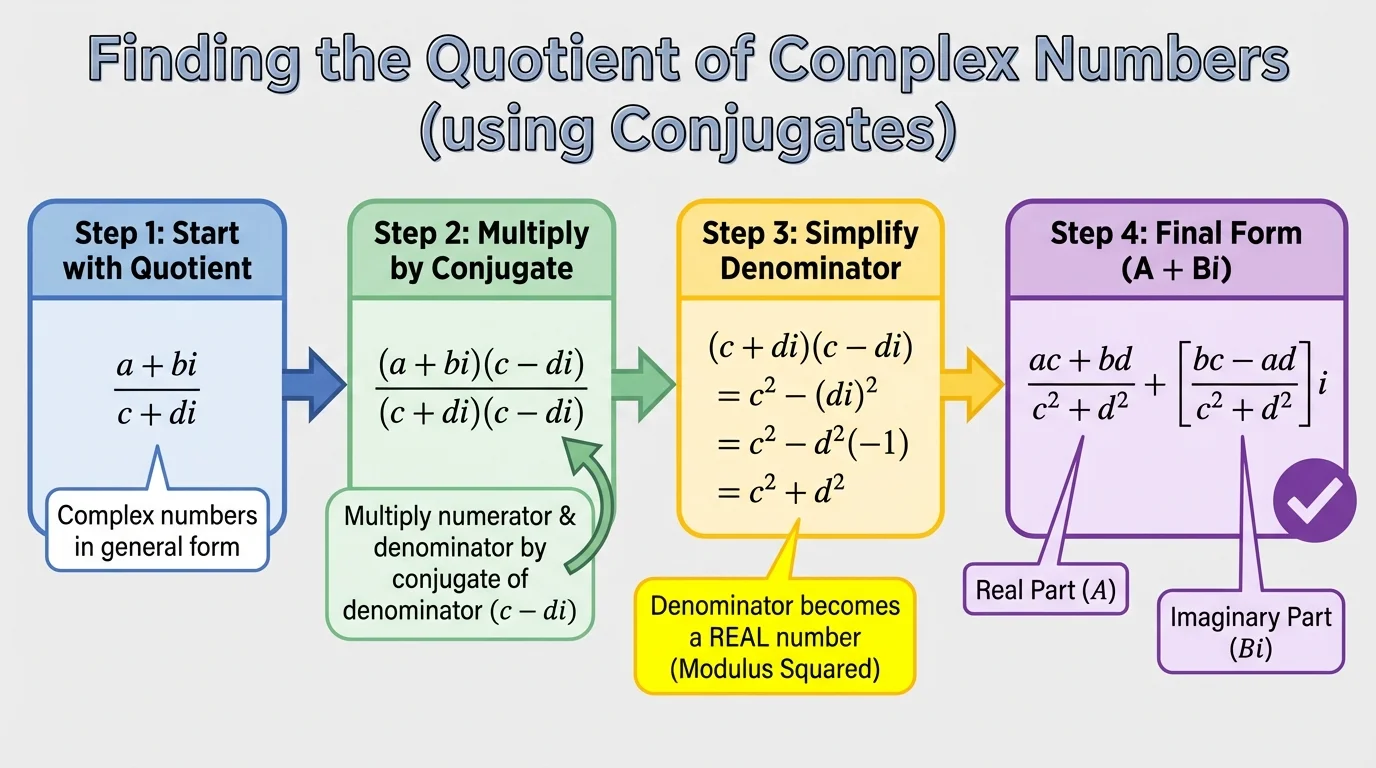
Then you expand the numerator and simplify. The final answer should be written in the form \(x+yi\), where \(x\) and \(y\) are real numbers.
A general formula is useful:
\[\frac{a+bi}{c+di}=\frac{(ac+bd)+(bc-ad)i}{c^2+d^2}\]
This comes from expanding \((a+bi)(c-di)\) and then dividing both real and imaginary parts by \(c^2+d^2\).
The best way to understand conjugates is to use them in actual calculations. The examples below show the full process step by step.
Worked example 1
Find the conjugate and modulus of \(z=5-12i\).
Step 1: Find the conjugate.
Change the sign of the imaginary part: the conjugate of \(5-12i\) is \(5+12i\).
Step 2: Use the modulus formula.
\(|z|=\sqrt{5^2+(-12)^2}=\sqrt{25+144}=\sqrt{169}\).
Step 3: Simplify.
\(|z|=13\).
The conjugate is \(5+12i\), and the modulus is \(13\).
This example is a good reminder that the imaginary part is squared in the modulus formula, so a negative sign disappears after squaring.
Worked example 2
Use conjugates to compute \((3+4i)(3-4i)\), then use the result to find \(|3+4i|\).
Step 1: Multiply the conjugates.
\((3+4i)(3-4i)=3^2-(4i)^2=9-16i^2\).
Step 2: Use \(i^2=-1\).
\(9-16(-1)=9+16=25\).
Step 3: Connect to modulus.
Since \((3+4i)(3-4i)=|3+4i|^2\), we have \(|3+4i|^2=25\).
Step 4: Take the positive square root.
\(|3+4i|=5\).
The product is \(25\), and the modulus is \(5\).
The right-triangle picture in [Figure 2] helps explain why the numbers \(3\), \(4\), and \(5\) appear together here.
Worked example 3
Simplify \(\dfrac{2+3i}{1-4i}\) and write the answer in standard form.
Step 1: Multiply by the conjugate of the denominator.
The conjugate of \(1-4i\) is \(1+4i\), so multiply by \(\dfrac{1+4i}{1+4i}\).
Step 2: Rewrite the fraction.
\(\dfrac{2+3i}{1-4i}\cdot\dfrac{1+4i}{1+4i}=\dfrac{(2+3i)(1+4i)}{(1-4i)(1+4i)}\).
Step 3: Expand the numerator.
\((2+3i)(1+4i)=2+8i+3i+12i^2=2+11i-12=-10+11i\).
Step 4: Expand the denominator.
\((1-4i)(1+4i)=1-(4i)^2=1-16i^2=1+16=17\).
Step 5: Write in standard form.
\(\dfrac{-10+11i}{17}=-\dfrac{10}{17}+\dfrac{11}{17}i\).
The simplified quotient is \(-\dfrac{10}{17}+\dfrac{11}{17}i\).
The flow in [Figure 3] is exactly what happens here: multiply by the conjugate, make the denominator real, then separate the real and imaginary parts.
Worked example 4
Simplify \(\dfrac{7-i}{2+ i}\).
Step 1: Use the conjugate of the denominator.
The conjugate of \(2+i\) is \(2-i\).
Step 2: Multiply numerator and denominator.
\(\dfrac{7-i}{2+i}\cdot\dfrac{2-i}{2-i}=\dfrac{(7-i)(2-i)}{(2+i)(2-i)}\).
Step 3: Expand the numerator.
\((7-i)(2-i)=14-7i-2i+i^2=14-9i-1=13-9i\).
Step 4: Expand the denominator.
\((2+i)(2-i)=4-i^2=4+1=5\).
Step 5: Write the final form.
\(\dfrac{13-9i}{5}=\dfrac{13}{5}-\dfrac{9}{5}i\).
The quotient in standard form is \(\dfrac{13}{5}-\dfrac{9}{5}i\).
Several properties of conjugates are worth remembering because they make longer problems easier.
If \(z=a+bi\) and \(w=c+di\), then
\[\overline{z+w}=\overline{z}+\overline{w}\]
and
\[\overline{zw}=\overline{z}\,\overline{w}\]
Also, if \(w\neq 0\), then
\[\overline{\frac{z}{w}}=\frac{\overline{z}}{\overline{w}}\]
Another important fact is that \(z+\overline{z}\) is always real, while \(z-\overline{z}\) is always purely imaginary.
| Expression | Result | Why it matters |
|---|---|---|
| \(\overline{a+bi}\) | \(a-bi\) | Changes only the sign of the imaginary part |
| \((a+bi)(a-bi)\) | \(a^2+b^2\) | Produces a real number |
| \(|a+bi|\) | \(\sqrt{a^2+b^2}\) | Gives distance from the origin |
| \(\dfrac{a+bi}{c+di}\) | Multiply by \(\dfrac{c-di}{c-di}\) | Makes the denominator real |
Table 1. Core relationships involving conjugates, modulus, and division of complex numbers.
Common mistakes include forgetting to change only the imaginary sign when taking a conjugate, squaring incorrectly, and leaving the final answer for a quotient with \(i\) still in the denominator. Another frequent error is forgetting that \(|z|\) is nonnegative, so if \(|z|^2=25\), then \(|z|=5\), not \(-5\).
"The conjugate is not just a partner number; it is the tool that turns complex expressions into real information."
That idea is why conjugates are used so often: they preserve structure while canceling the imaginary part when multiplied together.
Complex numbers are not only a classroom invention. In electrical engineering, alternating current can be modeled using complex numbers because voltage and current often vary like waves. The modulus represents magnitude, while the angle represents phase. When engineers combine signals or divide one response by another, complex quotients appear naturally.
In physics and digital communication, waves can be represented compactly with complex numbers. The modulus tells how strong the signal is, and conjugates help compute quantities related to energy and power. When a signal is multiplied by its conjugate, the result is real, just as \(z\overline{z}=|z|^2\) predicts.
Why this matters beyond algebra
When scientists study sound waves, radio transmission, or electrical circuits, they often need both size and direction-like information at the same time. Complex numbers package both into one expression, and conjugates help separate the measurable magnitude from the oscillating part.
Even if you do not study engineering right away, these ideas train you to recognize useful structure in algebra. A difficult-looking denominator becomes manageable once you spot its conjugate.
