A video game score, a recipe, a shopping total, and the size of a box all have something in common: each can be described with math using letters and numbers together. When a letter stands for a number, math becomes a tool for describing many situations at once. Then, when the number is known, we can find an exact answer by replacing the letter and simplifying carefully.
In this lesson, you will learn how to evaluate expressions and formulas. That means you will take an expression such as \(3x+5\), use a given value like \(x=4\), and find its value. You will also work with formulas from real life, such as the volume of a cube, \(V=s^3\), and the surface area of a cube, \(A=6s^2\).
Expression is a mathematical phrase made of numbers, variables, and operations. It does not have an equals sign.
Variable is a letter or symbol that stands for a number.
Evaluate means to find the value of an expression when the variable is replaced by a number.
A variable can stand for different numbers in different situations. For example, in \(x+2\), the value depends on what number \(x\) represents. If \(x=3\), then \(x+2=5\). If \(x=10\), then \(x+2=12\).
An expression is not the same as an equation. The expression \(5n-1\) has no equals sign. The equation \(5n-1=19\) does have an equals sign. In this topic, the main goal is to find the value of an expression after replacing the variable with a given number.
When you evaluate, you are answering the question, "What number does this expression equal when the variable has this value?"
Before evaluating expressions, it helps to read them correctly. The expression \(3x\) means \(3\) multiplied by \(x\). The expression \(x+7\) means a number plus \(7\). The expression \(s^3\) means \(s\) multiplied by itself three times: \(s \cdot s \cdot s\).
Here are some common ways to read expressions:
| Expression | How to Read It |
|---|---|
| \(x+9\) | a number plus \(9\) |
| \(12-n\) | \(12\) minus \(n\) |
| \(5m\) | \(5\) times \(m\) |
| \(\dfrac{p}{4}\) | \(p\) divided by \(4\) |
| \(y^2\) | \(y\) squared |
| \(a^3\) | \(a\) cubed |
Table 1. Examples of expressions and how to read them.
Notice that exponents are part of the expression itself. The expression \(y^2\) is very different from \(2y\). The first means \(y \cdot y\), while the second means \(2 \cdot y\).
Remember these arithmetic ideas from earlier grades: multiplication can be shown with \(\times\), a dot, or by writing a number next to a variable such as \(4x\). Also, a fraction bar means division, so \(\dfrac{12}{3}=12 \div 3\).
As [Figure 1] illustrates, words can also describe expressions. For example, "three more than a number" becomes \(n+3\). "Six times a number" becomes \(6n\). "The square of a number" becomes \(x^2\).
Substitute means to replace a variable with the number it stands for. This is the heart of evaluating expressions.
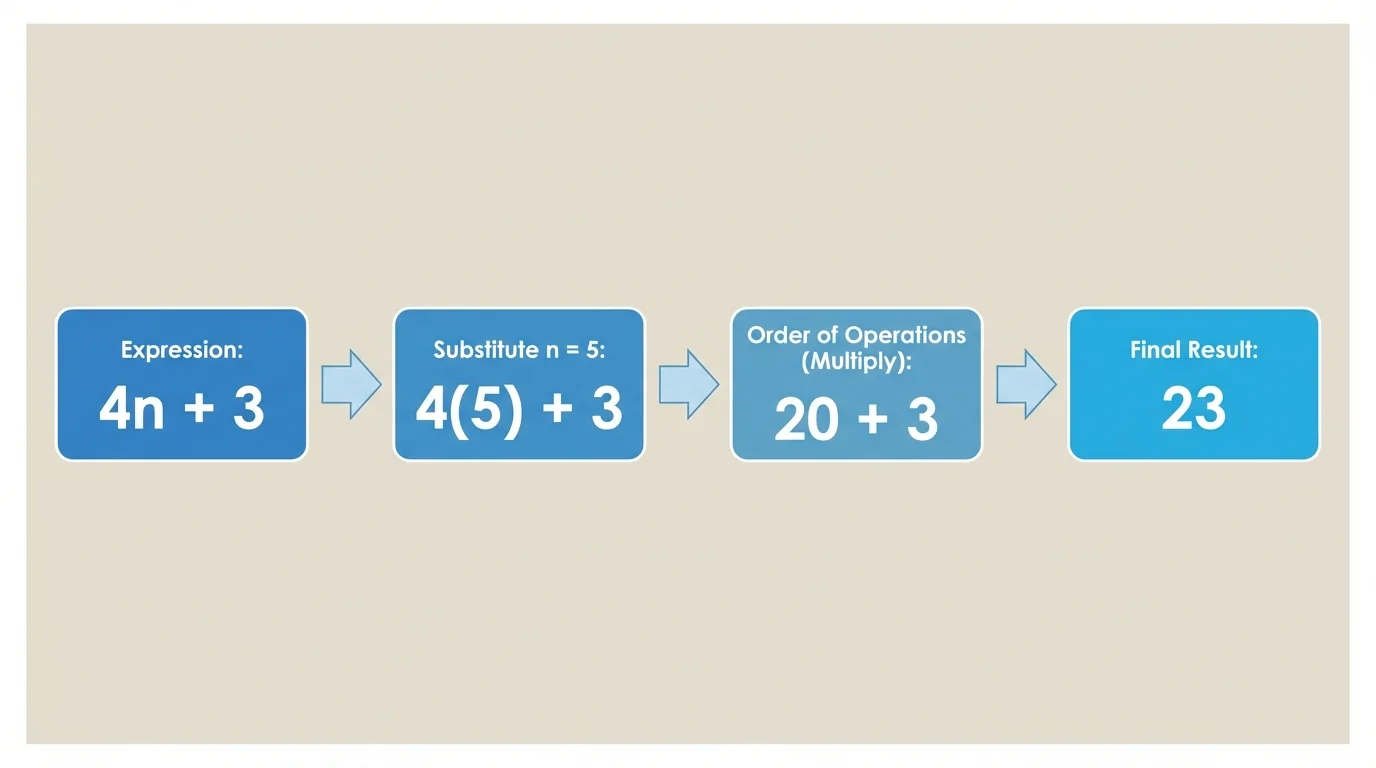
Suppose you want to evaluate \(4n+3\) when \(n=5\). Replace every \(n\) with \(5\). Then simplify: \(4(5)+3=20+3=23\). It is important to replace every occurrence of the variable.
If there is more than one variable, replace each one with its given value. For example, evaluate \(2a+b\) when \(a=3\) and \(b=7\). After substitution, \(2(3)+7=6+7=13\).
Fractions work the same way. If \(s=\dfrac{1}{2}\), then in the expression \(3s\), you replace \(s\) with \(\dfrac{1}{2}\): \(3\cdot \dfrac{1}{2}=\dfrac{3}{2}=1\dfrac{1}{2}\).
Negative numbers also work the same way. If \(x=-4\), then \(x+9=-4+9=5\). The sign of the number matters, so substitute carefully.
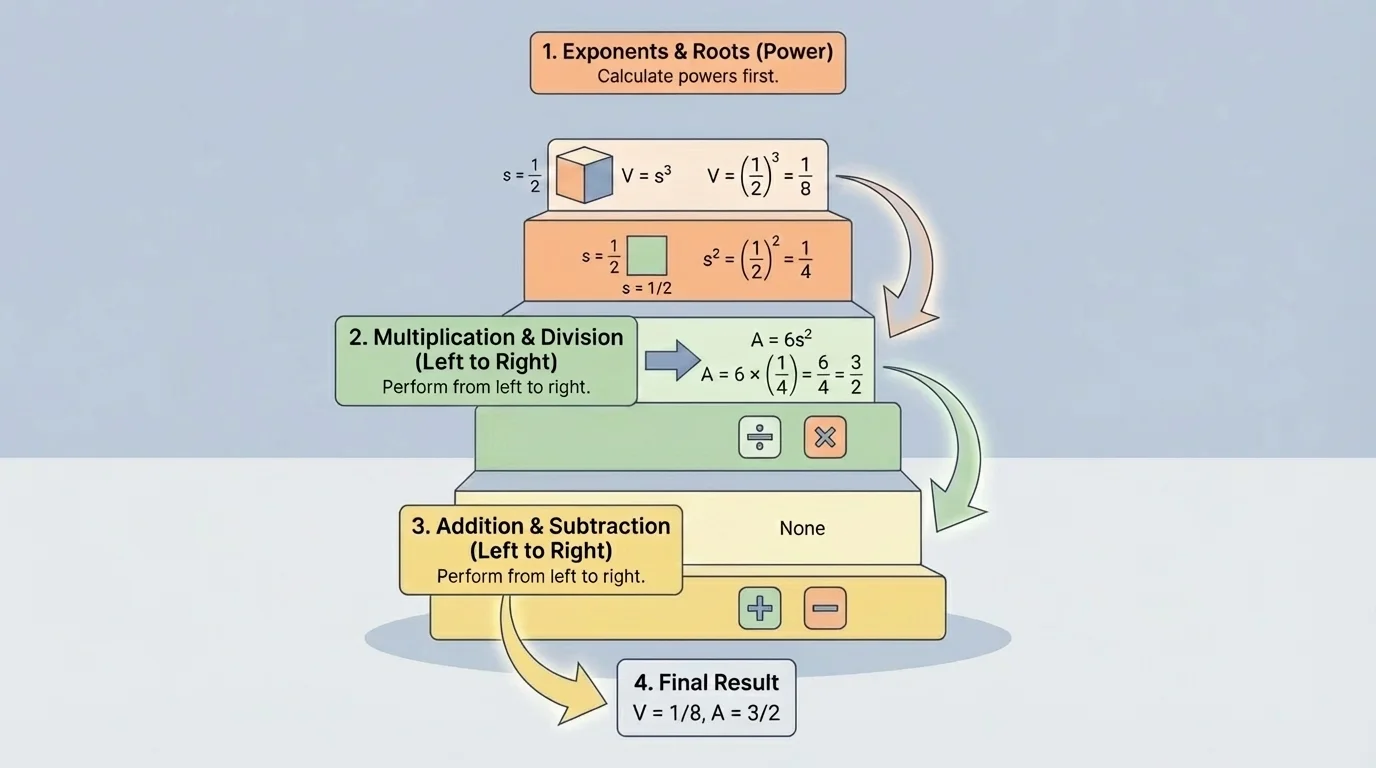
Once numbers have been substituted, you must simplify in the correct order. Math follows a standard pattern, as [Figure 2] illustrates, so that everyone gets the same answer from the same expression.
When there are no parentheses telling you to do something first, use this order:
First: exponents
Second: multiplication and division from left to right
Third: addition and subtraction from left to right
This is called the order of operations. Exponents are especially important in this standard. For example, in \(2+3^2\), you do the exponent first: \(3^2=9\), then \(2+9=11\).
Here is why order matters. Compare these:
For \(2+3^2\), the value is \(2+9=11\).
For \((2+3)^2\), the value is \(5^2=25\).
The numbers are the same, but the placement of operations changes the answer. When there are no parentheses, the usual order must be followed exactly.
Why exponents come before multiplication and addition
An exponent tells how many times a factor is used. In \(4^2\), the \(2\) means \(4 \cdot 4\). That repeated multiplication is part of building the number itself, so it must be done before combining it with other operations.
Later in the lesson, when you evaluate formulas such as \(s^3\) and \(6s^2\), the same rule still applies. The exponent is found before multiplying by any number outside it.
Worked example 1
Evaluate \(3x+5\) when \(x=4\).
Step 1: Substitute the value.
Replace \(x\) with \(4\): \(3(4)+5\).
Step 2: Multiply.
\(3 \cdot 4=12\), so the expression becomes \(12+5\).
Step 3: Add.
\(12+5=17\).
The value of the expression is \(17\).
This example shows a common pattern: substitute first, then simplify using the correct order.
Worked example 2
Evaluate \(2n^2-1\) when \(n=3\).
Step 1: Substitute the value.
\(2(3)^2-1\).
Step 2: Evaluate the exponent.
\((3)^2=9\), so the expression becomes \(2(9)-1\).
Step 3: Multiply.
\(2 \cdot 9=18\).
Step 4: Subtract.
\(18-1=17\).
The value of the expression is \(17\).
Notice that the exponent is done before multiplication. If you multiply first, you get the wrong answer.
Worked example 3
Evaluate \(5a+b\) when \(a=2\) and \(b=9\).
Step 1: Substitute each variable.
\(5(2)+9\).
Step 2: Multiply.
\(5 \cdot 2=10\).
Step 3: Add.
\(10+9=19\).
The value of the expression is \(19\).
Expressions can have more than one variable, so careful substitution matters.
Worked example 4
Evaluate \(6s^2\) when \(s=\dfrac{1}{2}\).
Step 1: Substitute the fraction.
\(6\left(\dfrac{1}{2}\right)^2\)
Step 2: Evaluate the exponent.
\(\left(\dfrac{1}{2}\right)^2=\dfrac{1}{4}\).
Step 3: Multiply.
\(6 \cdot \dfrac{1}{4}=\dfrac{6}{4}=\dfrac{3}{2}\)
The value of the expression is \(\dfrac{3}{2}\).
Fractions can feel tricky, but the process stays the same: substitute, evaluate exponents, then multiply or divide, then add or subtract.
As [Figure 3] shows, a formula is a rule written with variables that shows a relationship between quantities. Formulas help describe real things such as distance, area, cost, and volume. A cube is a great example because its side length determines both volume and surface area.
When you use a formula, you evaluate an expression in context. That means your answer should match the meaning of the situation, not just the arithmetic.
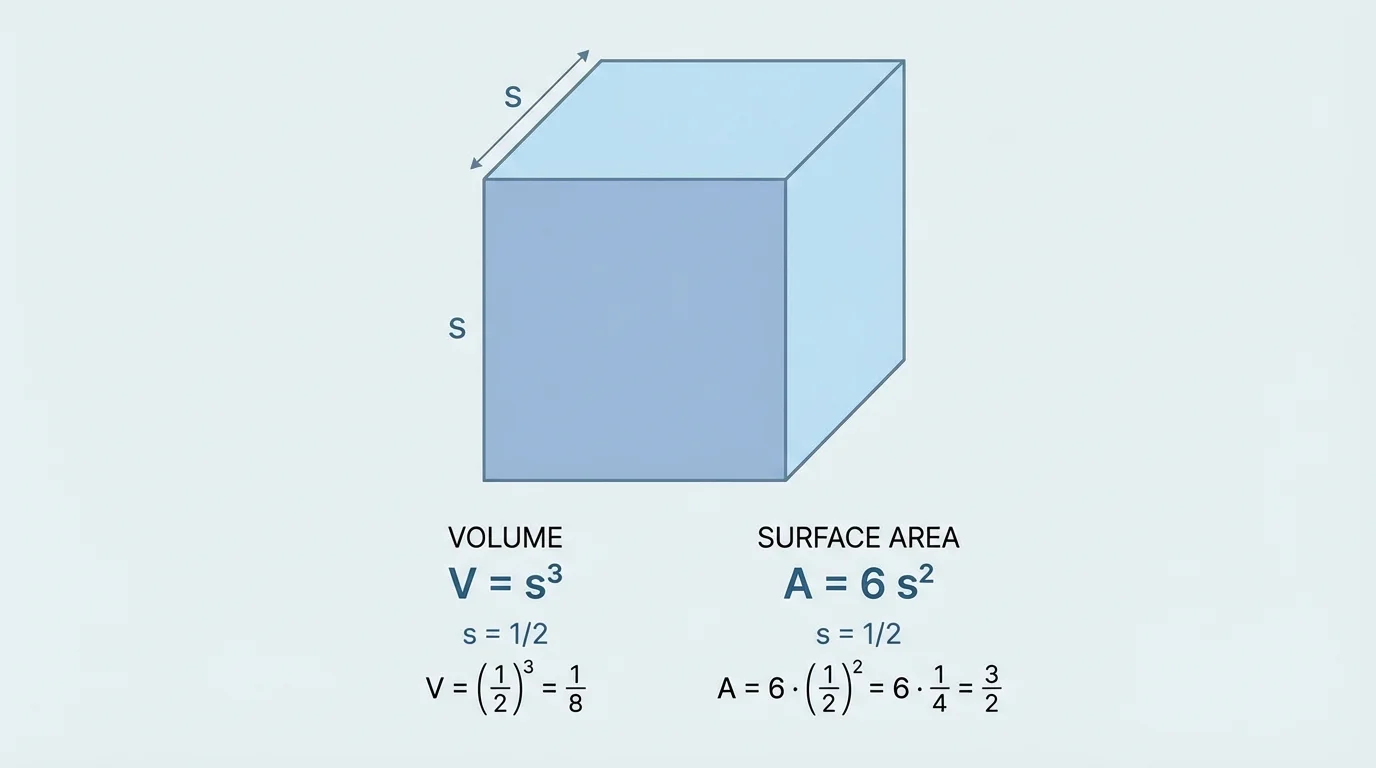
For a cube with side length \(s\), the formulas are:
Volume: \(V=s^3\)
Surface area: \(A=6s^2\)
The volume tells how much space is inside the cube. The surface area tells the total area of all \(6\) faces on the outside.
Worked example 5
Find the volume and surface area of a cube when \(s=\dfrac{1}{2}\).
Step 1: Use the volume formula.
Substitute \(s=\dfrac{1}{2}\) into \(V=s^3\): \(V=\left(\dfrac{1}{2}\right)^3\).
Step 2: Evaluate the exponent.
\(\left(\dfrac{1}{2}\right)^3=\dfrac{1}{8}\).
Step 3: Use the surface area formula.
Substitute into \(A=6s^2\): \(A=6\left(\dfrac{1}{2}\right)^2\).
Step 4: Evaluate the exponent and multiply.
\(\left(\dfrac{1}{2}\right)^2=\dfrac{1}{4}\), so \(A=6 \cdot \dfrac{1}{4}=\dfrac{6}{4}=\dfrac{3}{2}\).
The cube has volume \(\dfrac{1}{8}\) and surface area \(\dfrac{3}{2}\).
This result makes sense. A side length of \(\dfrac{1}{2}\) is small, so the cube's volume should be less than \(1\). Also, surface area is larger than volume here because it adds the areas of all \(6\) outer faces.
Here are more real-world formulas and expressions:
| Situation | Formula or Expression | Meaning |
|---|---|---|
| Perimeter of a square | \(P=4s\) | Add the \(4\) equal sides |
| Area of a rectangle | \(A=lw\) | Multiply length and width |
| Total cost of notebooks | \(3n\) | If one notebook costs $3, then \(n\) notebooks cost \(3n\) |
| Distance traveled | \(d=rt\) | Distance equals rate times time |
Table 2. Examples of formulas and expressions used in everyday situations.
Worked example 6
A scooter travels at \(12\) miles per hour for \(3\) hours. Use \(d=rt\) to find the distance.
Step 1: Substitute the values.
\(d=(12)(3)\)
Step 2: Multiply.
\(12 \cdot 3=36\)
The distance is \(36\).
The same idea appears in shopping. If each ticket costs $8 and you buy \(t\) tickets, the total cost is \(8t\). If \(t=5\), then the cost is \(8 \cdot 5=40\), so the total is $40.
The word cubed for \(s^3\) comes from geometry. A cube has length, width, and height, so multiplying the same side length three times matches the three dimensions of the solid.
Looking back at the cube, each face is a square with area \(s^2\), and there are \(6\) faces, which is why the surface area formula is \(6s^2\).
One common mistake is forgetting to substitute everywhere. In \(2x+x\), if \(x=4\), then the expression becomes \(2(4)+4\), not just \(2(4)+x\).
Another mistake is confusing \(3x^2\) with \((3x)^2\). If \(x=2\), then:
\(3x^2=3(2^2)=3(4)=12\)
But \((3x)^2=(3 \cdot 2)^2=6^2=36\)
These expressions are not equal.
A third mistake is ignoring the order of operations. In \(2+5^2\), some students add first and get \(7^2=49\), but that is incorrect because the exponent comes first. The correct value is \(2+25=27\).
When fractions are involved, students sometimes square only the numerator or only the denominator. Remember that \(\left(\dfrac{1}{2}\right)^2=\dfrac{1^2}{2^2}=\dfrac{1}{4}\).
Math is not only about getting an answer. It is also about asking whether the answer makes sense. If a side length is small, then a volume or area based on that side length should also be small. If a ticket costs $8, buying \(5\) tickets should cost more than $8, not less.
You can estimate to check your work. For example, if \(s=\dfrac{1}{2}\), then \(s^3\) should be smaller than \(\dfrac{1}{2}\), and it is: \(\dfrac{1}{8}\). Also, \(6s^2\) should be \(6\) times a small number, and \(6 \cdot \dfrac{1}{4}=\dfrac{3}{2}\), which fits that idea.
Checking for reasonableness is especially useful when using formulas in real-life situations, because the numbers should match the story behind them.
Evaluating expressions combines arithmetic and algebra. The variable tells you that a number is missing or can change. Substitution replaces the variable with a known number. Then order of operations tells you exactly how to simplify the result.
Formulas are powerful because one expression can describe many situations. Once you know the value of the variable, you can use the same formula to find an exact answer. That is true for a cube, a rectangle, a trip, or a shopping total.
