Have you ever felt like one version of you is at school, another at home, and another with your friends? 🤔 That feeling is not "being fake." It is usually a sign that your roles and the expectations around you are changing—especially in middle school. Understanding these changes can help you understand yourself much better.
A role is the part you play in a certain situation. You already have many roles: student, friend, child, teammate, maybe club member or babysitter. Each role comes with expectations—what people think you should do.
Expectations are ideas or rules about how someone is supposed to act. Some expectations are said out loud ("Turn in your homework on time"), and some are quiet or hidden ("Don't embarrass your friends"). You also have your own expectations for yourself, like "I want to be kind" or "I want to get good grades."
All of these roles and expectations together shape your self-understanding—what you believe about who you are, what you are good at, and what matters to you. One person can sit in the middle of many different roles at the same time, each with its own set of expectations.
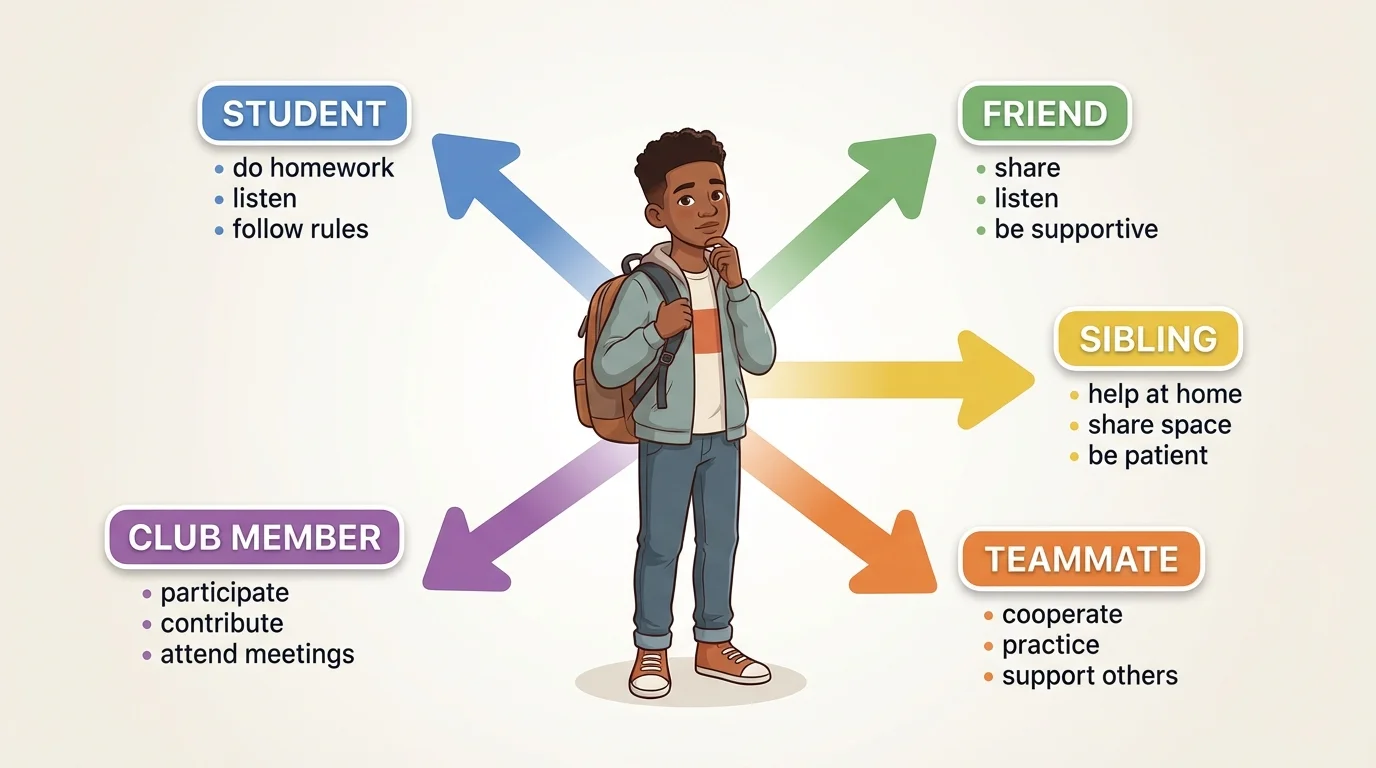
As shown in [Figure 1], you can picture yourself in the middle while different roles and their expectations surround you. When you were younger, your roles were simpler: maybe just "kid" and "student." Now, starting in middle school, your life adds more layers, which makes your self-understanding more complex—and sometimes more confusing. 😅
Roles, Expectations, and Self-Understanding
Because roles and expectations come from different people and places (school, family, friends, social media), they can pull on your self-understanding in different directions. Learning to notice these pulls is a big part of growing up.
Middle school is a time when your roles start to change quickly. That is one big reason it can feel exciting and stressful at the same time. 🎢
Some new or changing roles in middle school include:
Each time a role changes, the expectations change too. For example:
At home, your family might shift from "You are the little kid we help" to "You are old enough to help us too." That might mean more chores, watching a younger sibling, or managing your own schedule.
These changes can make you start to ask yourself questions like, "Am I responsible now?" or "Am I the kind of person who can handle this?" That is your self-understanding growing and updating.
Why New Roles Feel Uncomfortable at First
When you step into a new role, your brain does not yet have a clear picture of "me doing this." At first, you might feel awkward, nervous, or unsure. As you get more practice and feedback, your brain starts to connect that role to your identity. The uncomfortable feeling is often just a sign that your self-understanding has not caught up with your new role yet.
Over time, you may start saying things like "I am a science person," "I am a leader," or "I am good with kids." Those are identity statements that grew from trying new roles, noticing what fit you, and hearing others' reactions.
Not all expectations come from the same place. Some come from the outside, and some come from the inside.
An external expectation is what someone else (a teacher, coach, parent, or friend) wants or thinks you should do. An internal expectation is what you want or expect from yourself.
| Type of expectation | Who sets it? | Example in middle school |
|---|---|---|
| External | Others (teachers, family, friends, society) | Your teacher expects you to read for 20 minutes every night. |
| Internal | You | You expect yourself to be honest, even when it is hard. |
Table 1. Comparison of external and internal expectations.
Sometimes, external and internal expectations match. For example, your parents expect you to work hard in school, and you also want good grades. When that happens, it often feels motivating and clear.
Other times, they clash. Maybe:
When expectations clash, you might feel pressure, stress, or guilt. This can make your self-understanding feel shaky: "Am I a good friend if I don't answer?" "Am I a good student if I miss practice to study?"
Many students your age already feel pressure from both school and friends at the same time, and researchers have found that learning to name and balance expectations helps reduce stress.
Learning to notice who is setting each expectation, and whether you agree with it, is a powerful self-awareness skill.
As your roles and expectations change, your self-understanding changes along with them. This does not happen all at once. It is more like a cycle that repeats.
Here is a common pattern:
Over time, this pattern helps you discover your strengths, values, and interests:
As roles shift, you might discover new parts of yourself:
This is how changing roles and expectations help you build a more complete picture of who you are.
"We do not grow absolutely, chronologically. We grow sometimes in one dimension, and not in another; unevenly."
— Anaïs Nin
Your self-understanding might grow faster in one area (like friendships) while still catching up in another (like handling school responsibilities). That is normal.
Sometimes, your different roles ask you to do things that do not fit together. This is called role conflict. It often brings strong feelings—stress, frustration, or even anger.
Here are some examples of role conflict:
When roles conflict, your self-understanding might feel torn: "Which role shows who I really am?" To make this easier, you can follow a few simple steps, which are organized in [Figure 2].
One helpful way to handle role conflicts is to move through four steps:
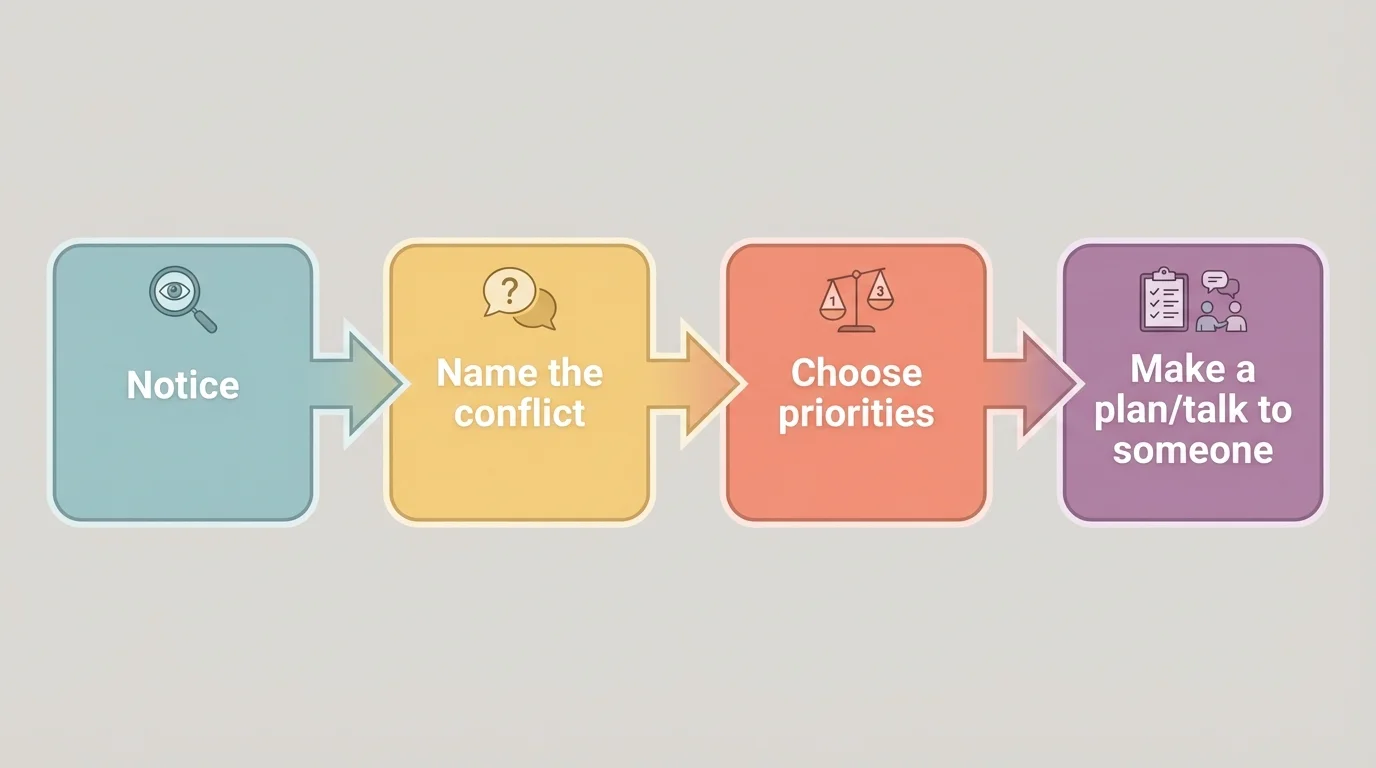
These steps do not magically fix everything, but they help you use your growing self-understanding instead of just reacting. Later, when you think about a time you used these steps, you might say, "I am someone who can make careful choices," or "I am learning to stand up for what matters to me," which adds to your identity.
Example: Balancing Homework and Friendship
Read how one student used the four steps to handle a role conflict.
Step 1: Notice
Mia realizes she feels tight in her chest every time her group chat blows up during homework time.
Step 2: Name the conflict
She thinks, "As a student, I want to finish my math, but as a friend, I feel like I have to answer right away so I do not look rude."
Step 3: Choose priorities
Mia decides that, for the next hour, her priority is to understand her homework because doing well in school matters a lot to her future.
Step 4: Make a plan or talk
She sends one message: "I need to go focus on homework, I'll be back later," then puts her phone in another room until she is done.
Afterward, Mia notices she feels proud and thinks, "I am able to set boundaries." Her self-understanding has grown stronger and clearer.
Steps like the ones shown in [Figure 2] help you respond in a way that matches your values instead of just following pressure.
Your self-understanding can be kind and realistic—or harsh and unfair. You have some control over which one it becomes. 🌱
Here are some tools to build a healthy, balanced view of yourself:
1. Ask yourself reflection questions.
After a day or week, you might ask:
These questions help you notice how your roles affect your feelings and choices.
2. Keep a simple journal or notes.
You do not need long paragraphs. You could write quick bullets like:
Writing things down makes patterns easier to see: you might discover "I often help people" or "I like solving hard problems."
3. Check your inner voice.
Your inner critic is the voice in your head that might say things like "You always fail" or "Everyone is better than you." That voice is usually not accurate. When you notice it, ask:
Answering kindly helps your self-understanding become more fair and less negative.
4. Ask for helpful feedback.
You can ask a teacher, family member, or coach questions like:
This gives you more accurate information about your strengths and areas to grow, instead of just guessing.
5. Use a growth mindset.
A growth mindset is the belief that your abilities can improve with effort, good strategies, and help from others. Instead of thinking "I am bad at this," you think "I am learning this."
When roles change and expectations increase, using a growth mindset helps you say, "I am still figuring out who I am, and that is okay."
These short stories show how changing roles and expectations can affect self-understanding in different ways. 📚
Story 1: Jordan the "Quiet Kid" Becomes a Presenter
Jordan always thought, "I am just quiet. I am not a leader." In 6th grade, his science teacher asks him to present part of a group project. At first, this new role feels scary. The external expectation: "Speak in front of the class."
Jordan practices at home and gets feedback from a sibling. On presentation day, he is nervous but does it. The class listens, and the teacher says, "You explained that really clearly."
Jordan updates his self-understanding from "I am just quiet" to "I am quiet, and I can speak up when I practice." He sees a new possibility for himself.
Story 2: Lila the "Perfect Student" Learns Balance
Lila feels like her role is to be "the perfect student." Her internal expectation is "I must get everything right," and her parents' external expectation is "Do your best and be responsible." She assumes that means never making mistakes.
When math gets harder, Lila gets one low quiz grade and thinks, "Maybe I am not smart." She feels her identity cracking. After talking with her teacher, she hears, "One quiz does not decide who you are. It just shows what you have not learned yet."
Lila starts to see herself not as "perfect or a failure," but as "a hard worker who sometimes needs help." Her self-understanding becomes more realistic and kinder.
Story 3: Carlos Between Family and Friends
Carlos's family expects him to speak their home language at home and follow certain traditions. His friends speak mostly English and sometimes make jokes Carlos finds uncomfortable. Carlos feels role conflict between family member and friend.
After feeling confused for a while, Carlos uses the four steps from [Figure 2]. He notices how tense he feels when friends make jokes about his culture, names the conflict, and decides his value of respect is more important than fitting in.
He calmly tells his friends, "Those jokes bother me. Please stop." Some friends apologize and stop the jokes. Carlos's self-understanding grows stronger: "I am someone who respects my culture and can speak up for myself."
Self-understanding is not just about feelings—it also affects how you plan, decide, and connect with others.
When you know your roles, expectations, and values, you can:
Over time, this helps you become more authentic—your actions match the kind of person you want to be, no matter which role you are in. 🌟
