What is something you really want to do better this month—maybe read a longer story, kick a soccer ball harder, or remember to raise your hand in class? 🌟 Today you learn how to choose one simple goal that fits you and helps you grow.
You are the only you in the whole world. 🎉 You have your own favorite games, foods, books, and people. You also have your own things that feel a little tricky.
Some kids love drawing and can sketch for a long time. Some kids love running and feel fast and strong. Some kids love talking to friends, and others feel more quiet and shy.
There are also things that might feel hard right now. Maybe it is reading big words, tying your shoes, sharing toys, or remembering to listen the first time.
Your self-awareness is the way you notice what you like, what is hard for you, and how you feel. When you pay attention to yourself like this, it is easier to choose a goal that truly fits you.
A goal is something you plan to do and work toward.
Here are some examples:
A goal is different from a wish. A wish is like, "I wish I could fly like a bird." 🐦 A goal is like, "I will practice jumping rope for 10 minutes after school." A goal is something you can really practice with your body, your brain, or your words.
Goal is a clear thing you want to do or get better at, and you are ready to work on it. It is not just a dream. It is a plan.
Goals help you grow little by little. When you choose a good goal and stick with it, you start to feel proud and strong inside.
Before you pick a goal, it helps to know two things about yourself:
Look at these questions. You can think about them quietly:
Feelings are like tiny helpers. They give you clues. When you feel proud, it might mean, "This is something I care about!" When you feel frustrated, it might mean, "This is something I want to grow in."
Interests and Areas for Growth
Your interests are things you like and want to do more. Your areas for growth are things that feel tricky but can get easier with practice. A strong goal often connects something you like with something you want to improve.
For example, maybe you love soccer, but you get upset when your team loses. Your interest is soccer. Your area for growth is staying calm and kind when things do not go your way.
Now you are ready to make a "just right" goal—one that is not too big and not too tiny. As you learn about this, remember the idea shown in [Figure 1], where a child has many ideas but chooses just one clear goal to focus on.
Here are three things that make a goal "just right" for second grade:
Here are some strong, simple goals:
Here are some goals that are too big or too fuzzy:
You can fix a fuzzy goal by making it clearer. For example, change "I will be nicer" into "I will give one compliment to a classmate each day."
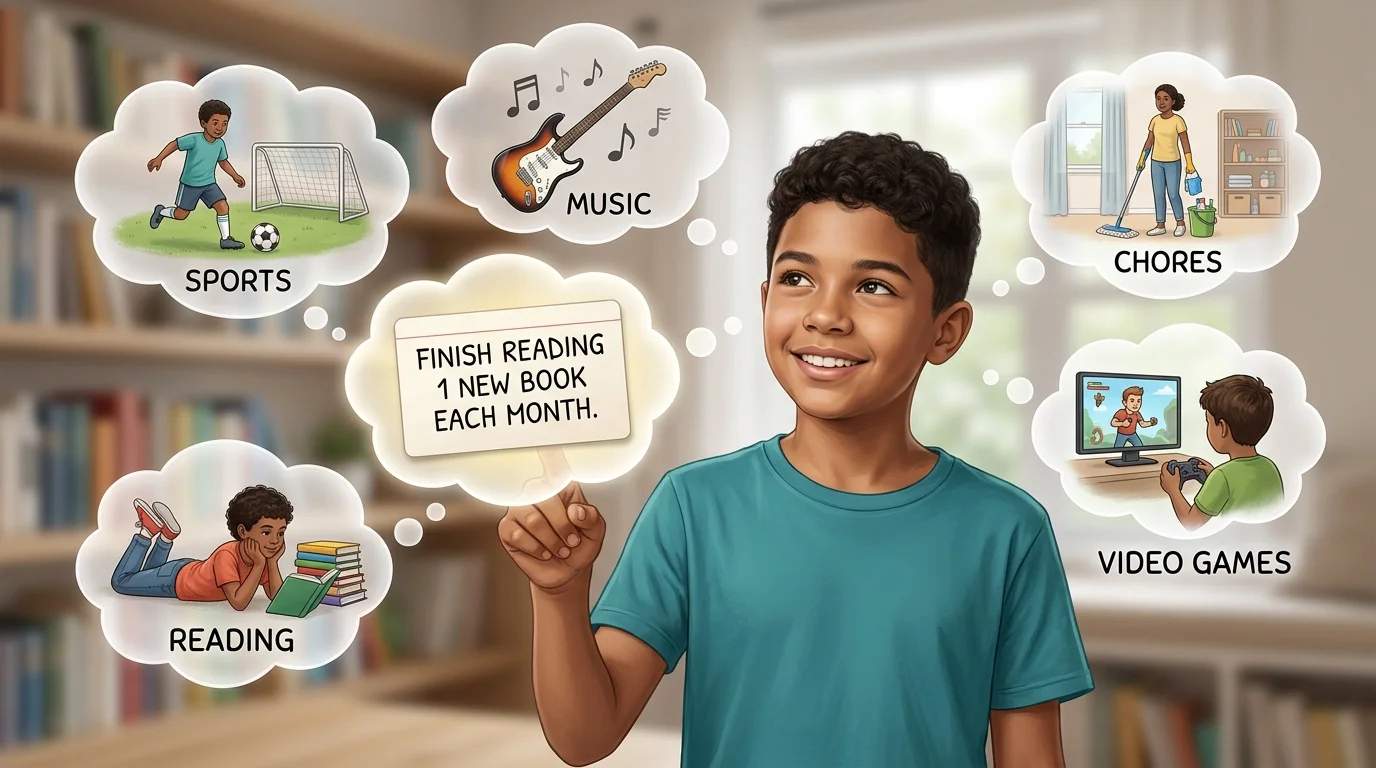
Notice that in the picture, the child has many ideas but picks one short sentence as a goal. This shows how choosing one simple goal makes it easier to remember and to practice.
Goals become easier when you break them into small steps, like little stairs you can climb. Think of your goal at the top and your steps as rungs on a ladder, like the picture in [Figure 2].
For example, imagine your goal is: "I will finish my math homework before dinner on school days." 🍎
You might use these steps:
Now your brain knows exactly what to do first, second, and third.
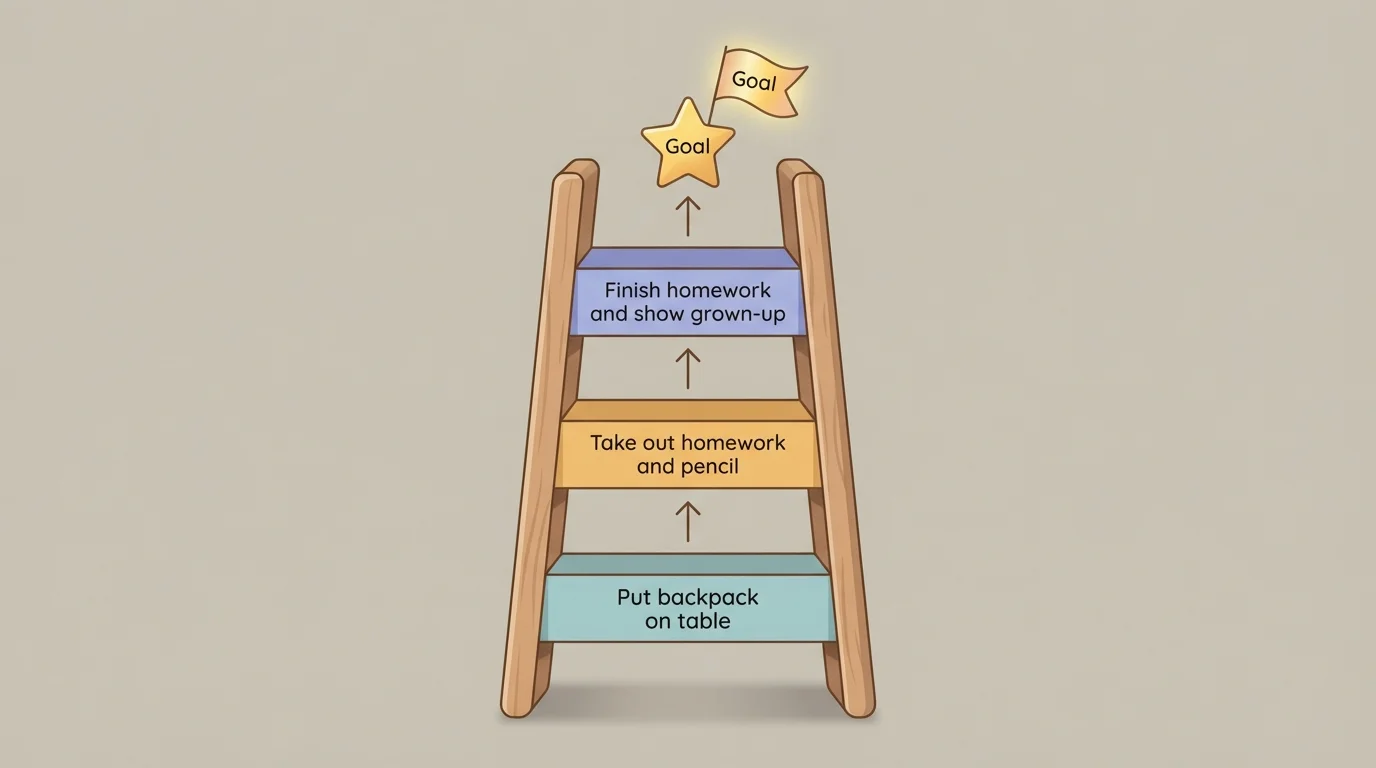
The ladder picture shows how each small action brings you closer to your goal at the top. You do not jump to the top at once—you climb one step at a time.
Example: Goal and Steps for a Reading Interest
Imagine you love stories but get tired when the book is long.
Step 1: Choose your goal.
Your goal might be: "I will read one chapter book page each night before bed this week."
Step 2: Break it into steps.
Steps could be:
Step 3: Notice how it feels.
You can check in: Do you feel proud? Calm? Sleepy in a good way? That feeling helps you know this is a good goal for you.
You can make steps for friendship goals too. For a goal like "I will play with someone new this week," the steps might be:
Sometimes you try a goal and it feels great. Sometimes it feels too hard or too easy. That is okay! Part of self-reflection is checking in with yourself and making changes when you need to.
Here are helpful questions to ask yourself:
If your goal was too big, you can make it smaller. For example:
It is important to be kind to yourself. 🌈 Goals are for learning, not for being perfect. Even grown-ups change their goals when they learn new things about themselves.
"Every small step counts."
— A simple rule for personal growth
When you remember that every step counts, the ladder in [Figure 2] makes even more sense—each step is worth celebrating.
Every person has their own mix of interests and areas for growth. Your goal might be "I will speak louder so others can hear me," while your friend's goal might be "I will listen without interrupting." Both goals are important, even though they are different.
Here are kind ways to treat other people's goals:
This is part of personal growth and good interpersonal skills—you grow on the inside and help others grow too.
When you respect each person's goal, your classroom, home, or team can feel safe and strong. Everyone gets a chance to work on what matters most to them.
Some athletes, artists, and scientists started with very tiny goals, like practicing for 5 minutes a day, and kept going until they became very skilled.
Remember how the child in [Figure 1] chose one goal from many ideas? You can do the same. Pick one interest or one area for growth, make a small, clear goal, and climb your steps one by one. Your goal can help you become more of who you already are inside. 🌟
