Have you ever felt proud after fixing something you got wrong before? That proud feeling is your brain saying, "I learned!" 🌟 Today we will learn how mistakes, effort, and feedback work together to help you grow.
Mia took a spelling test. When she got her paper back, she saw red circles on some words. She felt a little sad. She thought, "I made mistakes." Her teacher said, "These circles are not to make you feel bad. They are to show you where you can grow."
The teacher sat with Mia and showed her the words she missed. That was feedback. Mia listened, asked questions, and went home to practice those words. The next week, she had another spelling test. This time, she got more words correct. Mia smiled and thought, "My mistakes and my hard work helped me get better!" 😄
Mistake means something you did that was not quite right. It might be a wrong answer, a missed step, or a choice that did not work out well.
A mistake is not a "bad you." It is just a "not-right-yet" action. Everyone, even adults, makes mistakes every day. When you write a word wrong, spill juice, or forget to raise your hand, that is a mistake.
There are two ways to react to a mistake:
The second way helps your brain grow stronger. Your brain is like a muscle. When you fix a mistake, your brain gets a tiny workout. 💡
Effort is the energy you use when you try your best, even when something is hard. Effort looks like:
When you put in effort, you might feel tired or frustrated, but that is okay. It means you are working. With enough effort, things that were hard can start to feel easier. That is how you improve.
Think of a soccer player. At first, they might miss the goal many times. After lots of practice (effort), they start to kick straighter and stronger. The same thing happens with reading, math, and being kind to others. ⚽
Feedback is information someone gives you to help you know what went well and what you can do better next time.
People who can give you feedback include:
Feedback can look or sound like:
Feedback is not meant to hurt your feelings. It is like a flashlight that helps you see where to go next. 🔦
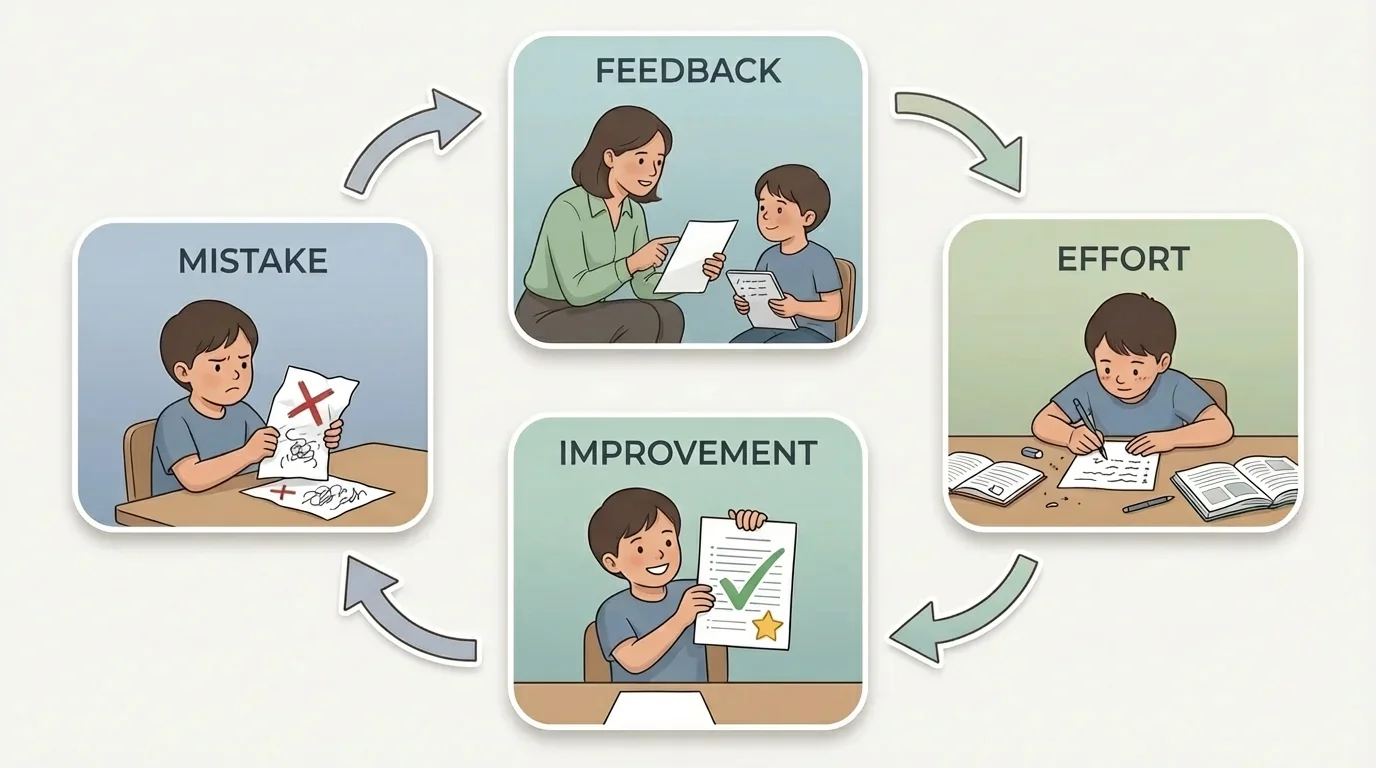
When you get feedback, you can follow a simple process, like going around a little circle, as in [Figure 1]. This helps you move from mistake, to effort, to improvement.
Step 1: Listen or look carefully
When someone gives you feedback, stop and pay attention. Look at your paper. Listen to their words. Try not to talk over them.
Step 2: Stay calm
You might feel annoyed, sad, or embarrassed. You can take a deep breath. Count slowly to 3 in your head. You can think, "This is to help me." 🧘
Step 3: Ask questions
If you do not understand the feedback, you can say:
Step 4: Make a small plan
Decide one or two things to improve. For example:
Step 5: Try again with effort
Now use your plan. Work slowly and carefully. This is where effort and feedback work together. You are not just doing it again; you are doing it smarter.
Step 6: Notice what got better
After you try again, look at your work. What is neater? What is clearer? What is more correct? Smile at your progress. 🎉
When we talk about mistakes and feedback, feelings are very important. This is part of self-awareness, which means noticing what is happening inside you.
After a mistake, you might feel:
All these feelings are normal. What matters is what you do next. Here are some helpful choices:
When you can name your feeling, like "I feel frustrated," it becomes easier to calm down and listen to feedback.
Feedback is part of working with other people. The way you talk and listen can make feedback helpful and kind.
When someone gives you feedback:
When you give feedback to others:
This makes your classroom or team a safe place where everyone can learn and grow together.
Growth means you can do something better now than you could before. Growth happens when you keep going around the "mistake–feedback–effort–improvement" circle.
You can notice your growth by:
For example, maybe at the start of the year you could only read very short books. Now you can read longer stories. That is growth! Or maybe you used to forget to share toys, but now you remember more often. That is growth in kindness.
How Mistakes, Effort, and Feedback Work Together
In many parts of your day, you move from a mistake, to feedback, to effort, and then to improvement. Seeing this pattern can help you feel proud instead of upset when you make mistakes.
Example 1: Reading Time
You are reading a book and say a word the wrong way. Your teacher gently says the word for you. That is feedback. You listen and repeat the word slowly. That is effort. The next time you see the word, you read it correctly. That is improvement.
Example 2: Math Problem
You solve a problem and get an answer. The teacher checks it and says, "Check your counting again." That is feedback. You count more carefully and see that you skipped a number before. You fix it. That is effort. Now you know to count slowly next time, and you make fewer counting mistakes. That is improvement.
Example 3: Playing a Sport
You are learning to shoot a basketball. At first, the ball does not reach the hoop. Your coach says, "Bend your knees and aim a little higher." That is feedback. You practice bending your knees and aiming. That is effort. After many tries, you finally make the basket. That is improvement. 🏀
Example 4: Helping at Home
You wash the dishes and your parent says, "The plates are still a little soapy. Rinse them longer." That is feedback. You rinse them again, making sure the soap is gone. That is effort. Next time you wash dishes, you remember to rinse well, and your parent says, "Nice job!" That is improvement.
Example 5: Being a Good Friend
You talk while your friend is sharing something important, and they look hurt. Later, they say, "I felt sad when you didn't listen." That is feedback. You say, "I'm sorry," and next time you listen quietly when they talk. That is effort. Over time, you become a better listener and friend. That is improvement in how you treat others. ❤️
All these examples show the same pattern: you make a mistake, you get feedback, you use effort, and you grow. When you notice this pattern in your own life, you can feel proud of how you are changing and becoming your best self.
Many famous scientists, artists, and athletes kept trying after hundreds of mistakes; they used feedback from others and from their own experiments to finally create amazing inventions, paintings, and records.
You are still growing and learning every day. When you remember that mistakes are chances to learn, feedback is help, and effort is your power, you can keep improving at school, at home, and with friends.
