Have you ever said something in anger and then thought, "Why did I do that?" later? 🤯 Maybe you snapped at a friend, slammed a door, or sent a mean text, even though a few minutes before you didn't plan to do any of that. Those "what was I thinking?" moments are often caused by something called emotional triggers.
Understanding emotional triggers is an important part of self-management and emotional regulation. When you learn how your triggers work, you can make better choices, stay in control of your reactions, and build stronger relationships with friends, family, and teachers. 💡
Everyone experiences emotions like happiness, anger, sadness, fear, and excitement. Emotions send messages about what is happening around you and what matters to you.
Emotions are strong feelings, such as joy, anger, fear, or sadness, that you experience in your body and mind.
Emotional triggers are specific situations, words, actions, or memories that quickly cause a strong emotional reaction inside you.
Judgment is your ability to think about what is right, safe, and fair before you act or decide.
An emotional trigger is like a button inside you that, when pressed, sets off a big feeling very quickly. The same event might be a trigger for one person but not for another, as shown in [Figure 1].
For example:
Emotional triggers work quickly in your brain. They send a fast signal to the "alarm" part of your brain, which focuses on protecting you, and this can take over from the calmer, thinking part of your brain.
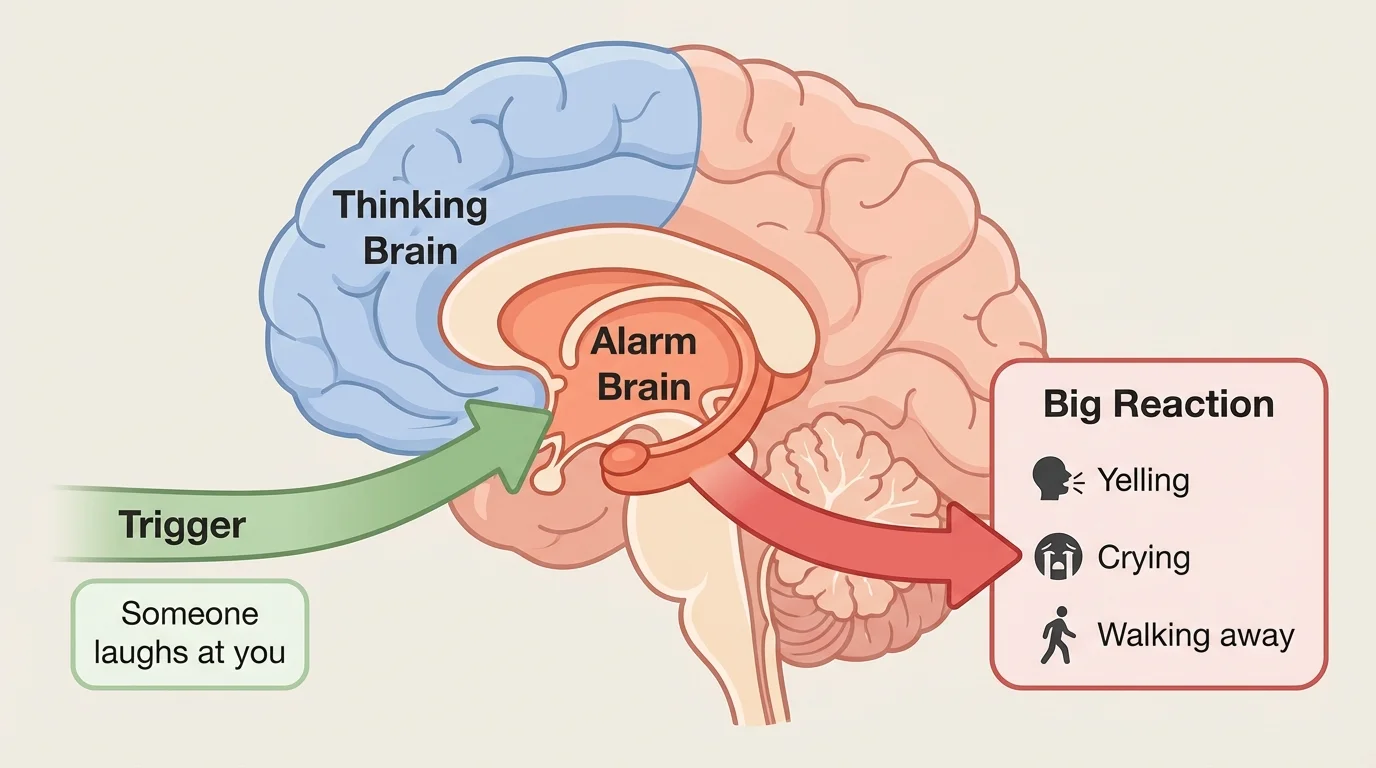
When the alarm part is in charge, your body might:
None of this means you are "bad" or "overdramatic." It just means your brain and body are reacting to something that feels important or unsafe, even if it is not actually dangerous.
Even though triggers are personal, many students your age share some of the same ones. Recognizing these can help you notice your own patterns. 😊
| Common Trigger | What It Might Feel Like | Possible First Reaction |
|---|---|---|
| Feeling left out | Lonely, hurt, jealous | Ignoring people, rude comments, quitting a group |
| Being embarrassed in public | Hot face, shame, wanting to hide | Joking too loudly, blaming others, leaving suddenly |
| Being criticized | Angry, worthless, defensive | Arguing, talking back, shutting down |
| Losing or failing at something | Frustrated, afraid, disappointed | Blaming teammates, quitting, saying "I don't care" |
| Unfair treatment | Anger, confusion, resentment | Yelling, complaining, refusing to follow directions |
| Online comments or posts | Jealous, rejected, ashamed | Mean messages, deleting people, silent treatment |
Feeling left out. Friends hang out without you, or there is a group project and you are not picked. This can trigger the thought, "Nobody likes me," even if that is not true.
Embarrassment. You trip in the hallway, mispronounce a word when reading, or get an answer wrong while others are watching. This can trigger shame or anger.
Criticism or correction. A teacher corrects your work, or a coach points out a mistake. Some students can accept this calmly, but for others it triggers the feeling "I'm not good enough."
Losing or failing. You try hard on a test, game, or competition, but it does not go how you hoped. This can trigger frustration or hopelessness.
Unfairness. Your sibling gets more screen time, or a classmate breaks a rule but you get in trouble. Unfairness is a huge trigger for many people.
Online and social media. Seeing photos of friends hanging out without you, reading a negative comment, or being left on "seen" can trigger jealousy, humiliation, or anger.
When your emotions are very strong, it becomes harder for your "thinking brain" to do its job. Good judgment means you can think about consequences and choose what is safest, kindest, and most helpful.
Emotional triggers can interfere with judgment in several ways:
1. All-or-nothing thinking. After a trigger, you might think in extremes, like "Everyone hates me" or "I always mess up." These thoughts are usually not accurate, but they feel true in the moment. They make it hard to see middle-ground solutions such as "Some people are upset with me right now, but we can fix it."
2. Mind-reading. You might believe you know exactly what others are thinking, even without proof: "She rolled her eyes, so she thinks I'm stupid." This can lead you to react to something that is not real.
3. Making small problems huge. A small mistake or misunderstanding becomes a giant disaster in your mind. Maybe a friend forgets to text back and you decide the entire friendship is over. This can push you to make choices you later regret, like sending angry messages.
4. Impulsive choices. When your alarm brain is running the show, you act fast instead of thinking first. Examples:
Later, when you calm down, your thinking brain "comes back," and you can see what you should have done. This can feel confusing or embarrassing, but it is a normal human experience.
Thinking Brain vs. Alarm Brain
Your "thinking brain" helps you plan, remember rules, and stay respectful. Your "alarm brain" focuses on safety and reacts quickly to danger. Emotional triggers can make the alarm brain get loud and push the thinking brain into the background. The goal is not to silence your alarm brain, but to give your thinking brain time to catch up.
Later, when you practice skills for calming down and waiting before reacting, you are training your thinking brain to stay more involved, just like we saw with the brain parts in [Figure 1].
Relationships with friends, family, and teachers are built on trust, respect, and communication. Emotional triggers can shake these things if we are not careful. 💬
Here are some ways triggers can interfere with relationships:
1. Misunderstandings. You might misunderstand someone's words or actions because you feel triggered. For example, a friend jokes, "Wow, nice move," after you miss a shot in a game. If you feel sensitive, you might hear it as mean teasing instead of light joking, and you snap back harshly.
2. Hurtful words. When you are triggered, you might say things like, "I never liked you anyway," or "You're so annoying." These words can stick in someone's memory, even if you say sorry later.
3. Avoiding people. If a certain person often triggers you, you might start avoiding them: not answering messages, changing seats, or skipping activities. This can slowly weaken friendships.
4. Disrespecting boundaries. When you are very upset, you might ignore others' boundaries—like following them when they ask for space, or reading someone's messages without permission—because you are desperate to fix or control the situation.
5. Losing trust. If triggers often lead to yelling, lying, or breaking promises, people may start to trust you less. Trust can be rebuilt, but it takes time and effort.
On the other hand, learning to manage triggers can actually strengthen relationships. When you calm yourself, listen, and speak honestly, you show others that you are responsible and respectful, even when things are hard. That makes relationships safer and closer. ❤️
The first step to managing emotional triggers is self-awareness—paying attention to what is happening inside you. You can think of it like turning on an inner flashlight to see your own thoughts and feelings more clearly.
Here are three kinds of clues that can help you notice when a trigger is happening:
1. Body clues.
2. Thought clues.
3. Behavior clues.
The Emotional Thermometer
Imagine your feelings as a thermometer from 1 to 10. At 1–3, you feel calm or just a little annoyed. At 4–6, you feel more upset, but can still think a bit. At 7–10, you feel very angry, terrified, or hurt, and it is hard to think at all. If you notice your "temperature" going up, you can use strategies to cool down before you reach 9 or 10.
When you think back to times you felt out of control, you can ask yourself:
The answers to these questions help you discover your personal triggers and early warning signs.
Even if you cannot control what triggers you, you can learn to control how you respond. There is a path from trigger → big feeling → pause → better choice → healthier result.
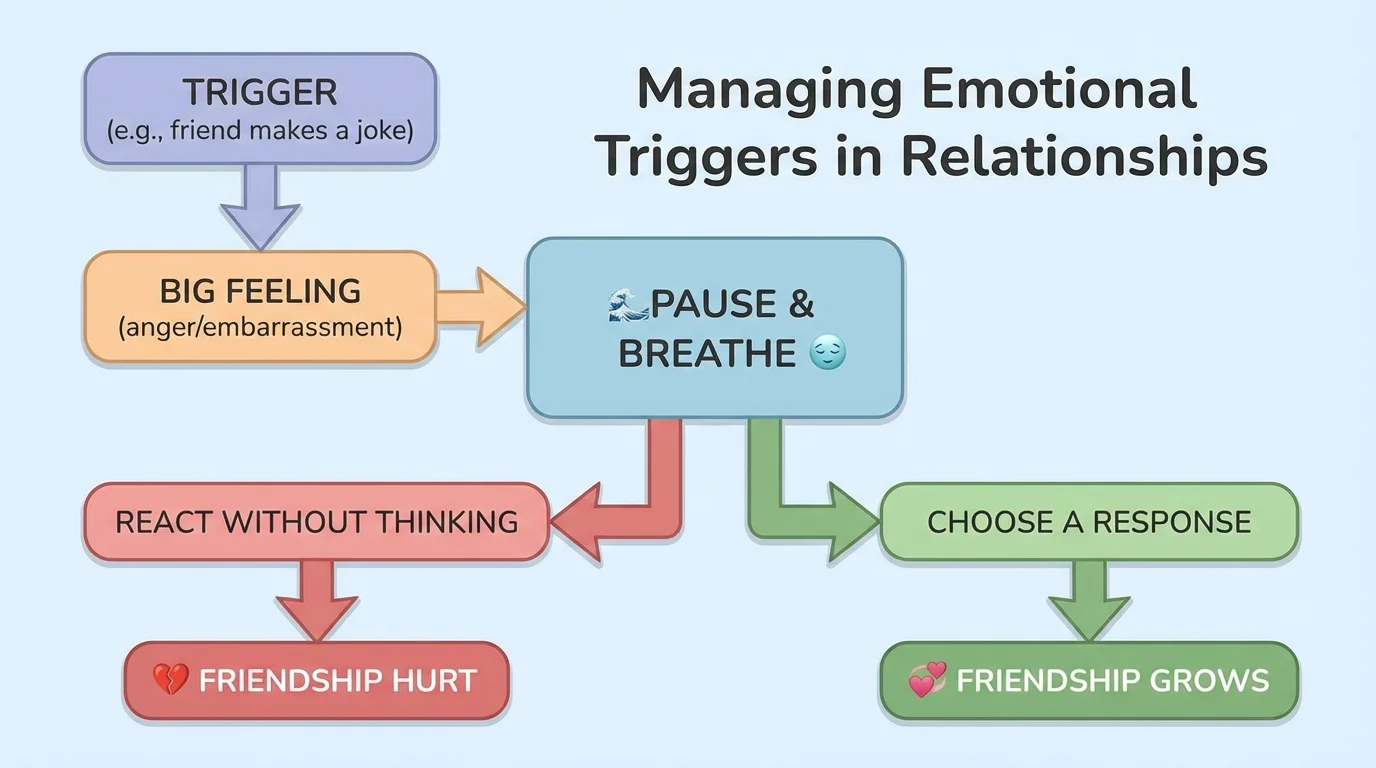
Here are some tools for emotional regulation and resilience, as shown in [Figure 2]:
1. Pause and breathe. 🧘♂️
2. Name the feeling.
Quietly say to yourself, "I feel angry," "I feel hurt," or "I feel embarrassed." Naming a feeling can make it feel a little smaller and easier to handle.
3. Talk to yourself in a helpful way. This is called positive self-talk.
4. Take a short break.
5. Problem-solving steps.
6. Use your support team.
Trusted adults and friends can help you think clearly when you feel overwhelmed. You can say, "I'm really upset. Can I talk to you?"
Case Study: A Text Message Trigger
Situation: You see that your close friend started a group chat without you. You feel a big rush of anger and hurt.
Step 1: Notice the trigger and body clues.
You realize, "Seeing this chat is my trigger." Your heart is racing and your face feels hot.
Step 2: Pause and breathe.
You put your phone down and take 5 slow breaths. You remind yourself not to type anything yet.
Step 3: Name the feeling and use positive self-talk.
You think, "I feel left out and jealous. I don't know the full story yet," instead of "They obviously hate me."
Step 4: Choose a response.
Instead of sending a rude message to the group, you decide to text your friend privately: "Hey, I noticed a new group chat. I felt a little left out. Can you tell me what it's for?"
Outcome: Your friend explains that the chat is for a school project you are not in, and they forgot to tell you. You still feel a bit hurt, but the friendship stays strong.
This example follows the same path you saw in [Figure 2]: trigger → big feeling → pause → thoughtful choice → healthier result.
No one handles triggers perfectly all the time. Sometimes you will say or do something that hurts someone. The good news is that you can repair relationships and even make them stronger. 🌱
1. Take responsibility.
2. Give a real apology.
3. Explain your feelings without blaming.
Use "I" statements instead of "You" attacks:
4. Listen to the other person.
Let them share their side without interrupting. You might find out that their intention was different from what you thought. Remember how triggers affect your ability to see things clearly, just like with the alarm brain in [Figure 1].
5. Make a plan for next time.
Talk together about how to handle similar situations in the future:
Repairing relationships does not erase what happened, but it shows maturity, builds trust, and helps both people learn.
Sometimes emotional triggers feel so strong that your usual strategies—breathing, positive self-talk, short breaks—do not seem to work. You might feel like you are always at an 8, 9, or 10 on your emotional thermometer.
Signs you might need extra help include:
When that happens, it is important to reach out to trusted adults, such as:
You can say something like, "I've been getting really angry and I don't know how to control it," or "My feelings feel too big and I need help." Reaching out is a sign of strength and resilience, not weakness. 🛡️
Some adults also work with therapists or counselors to learn about their own emotional triggers. Even grown-ups keep practicing these skills throughout their lives.
Over time, as you practice noticing triggers, calming your body, and choosing healthier responses, you will build powerful self-management skills that help you at school, at home, and in every relationship you have.
