Explain how interests and strengths connect to learning choices.
Explain How Interests and Strengths Connect to Learning Choices
Describe what interests are and give examples from everyday life.
Describe what strengths are and notice different kinds of strengths in yourself and others.
Explain how interests and strengths can work together or be different.
Tell how your own interests and strengths can guide what and how you choose to learn.
Show respect for other people's different interests and strengths.
Have you ever wondered why some school projects feel fun and easy, while others feel slow and hard? The answer is often hiding in what you enjoy and what you are already good at—your interests and your strengths.
What Makes You, YOU?
Every person in your class is a little different. You may all be the same age and learn in the same room, but you do not all like the same things, and you are not all good at the exact same skills. That is what makes a classroom interesting and full of possibilities.
Two important parts of who you are are your interests and your strengths. When you understand these, you can make smarter choices about how you learn, what you practice, and how you help others. That is called self-awareness—noticing what is going on inside you.
What Are Interests?
Your interests are the things you enjoy and feel curious about. When you are interested in something, you feel like, "I want to know more about this!" or "I want to do this again!"
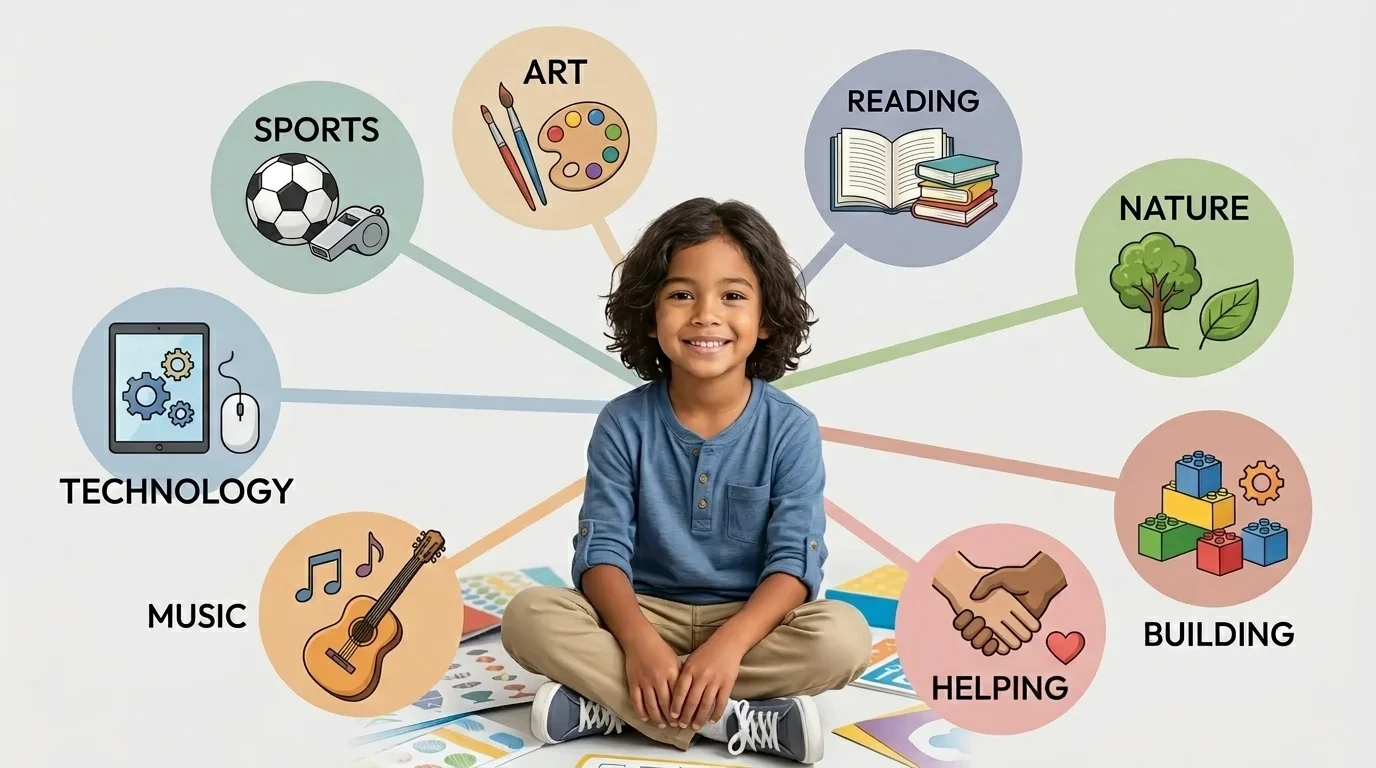
There are many kinds of interests, as shown in [Figure 1], such as sports, art, and nature.
Here are some examples of interests you might have:
Playing a sport like soccer or basketball
Drawing, painting, or coloring pictures
Reading stories about animals or adventures
Building with blocks or bricks
Taking care of pets or learning about wild animals
Listening to music or playing an instrument
Helping younger kids or friends when they are sad
Using computers or tablets and exploring new apps
When you like doing something, you often choose it again and again. You might talk about it a lot, or you might feel excited when you get time to do it. That is a sign that it is an interest for you.
Figure 1: A child in the center with bubbles around them labeled "Sports", "Art", "Reading", "Nature", "Building", "Helping", "Music", and "Technology", each with a small simple icon.
Interests can also show up in school subjects:
You might like science because you enjoy doing experiments and asking "Why?"
You might like math because you enjoy solving puzzles and problems with numbers like \(3 + 4\) or \(7 - 2\).
You might like writers' workshop because you enjoy making up stories.
You might like social studies because you are curious about people in other places.
Interests can change as you grow. Something you did not like last year may become interesting this year. Trying new things gives you a chance to discover new interests. 🎉
Interests and Strengths are two important parts of who you are. Interests are what you enjoy and feel curious about. Strengths are what you can do well right now, or what comes more easily to you than other things.
Even though these words are connected, they are not the same. Next, you will learn about strengths.
What Are Strengths?
Your strengths are the things you can do well. A strength might feel easier for you than it feels for other people. You may learn it quickly, or you may have practiced it a lot so that now you are good at it.
Here are different kinds of strengths you might have:
Learning strengths
Remembering facts from books or videos
Understanding stories and being able to retell them
Solving number problems like \(25 + 10\) in your head
Noticing patterns, such as \(2, 4, 6, 8\) or red–blue–red–blue
People strengths
Making new friends easily
Listening carefully when others talk
Helping classmates work out a problem or argument
Being kind and cheering people up
Body and movement strengths
Running fast in PE
Having good balance on a beam or while skating
Throwing and catching balls well
Dancing or learning new movements quickly
Creativity strengths
Thinking of many ideas for a project
Drawing detailed pictures
Making up stories, comics, or plays
Building new designs with blocks or recycled materials
You might notice that some strengths are easy to see, like running fast, and some are quieter, like being a careful listener. All kinds of strengths are important.
A strength does not have to be something "perfect." You can call it a strength if you are already doing it pretty well, or if you have grown a lot at it. You can have more than one strength, and they can be in very different areas.
How Interests and Strengths Work Together
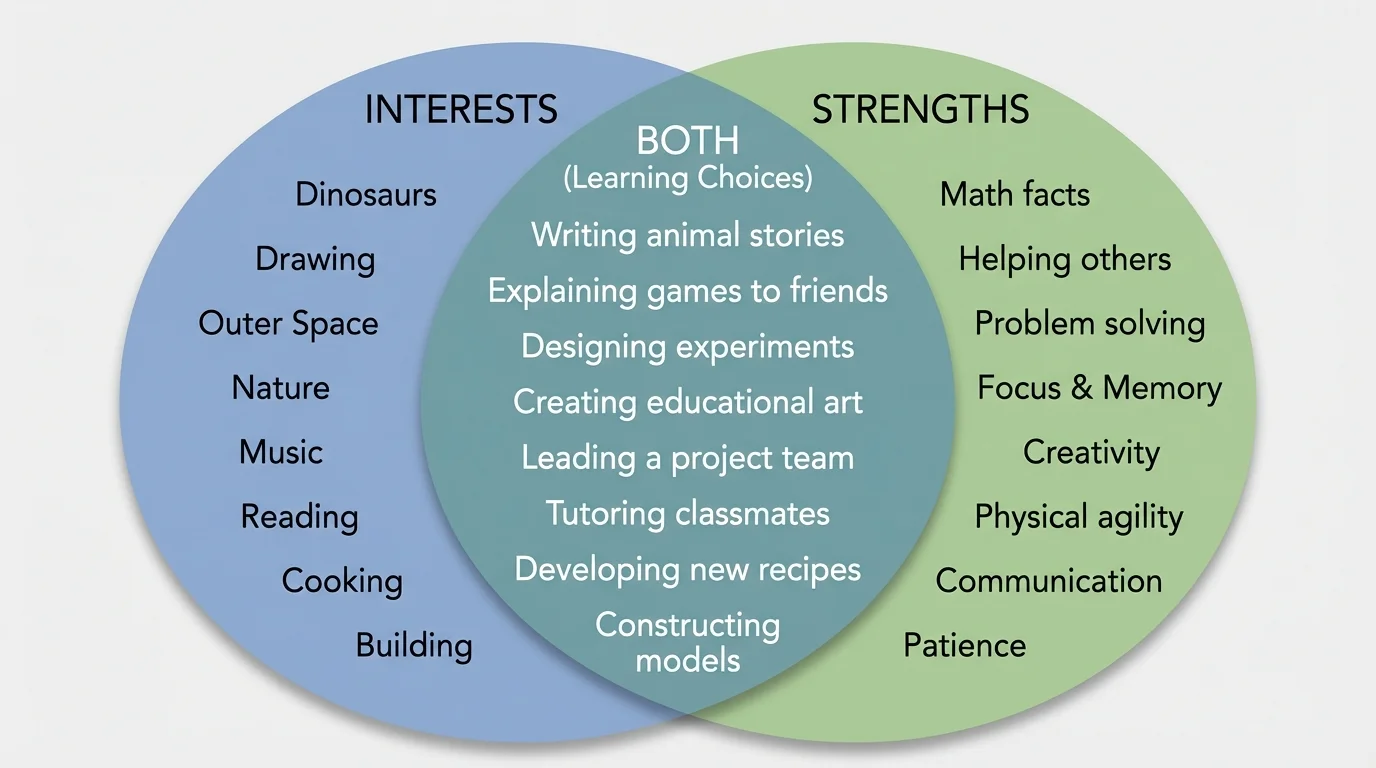
You can picture this, like in [Figure 2], as two circles that sometimes overlap. One circle is your interests. The other circle is your strengths. In the middle, where they overlap, are things you both like and do well.
Interests and strengths are like two friends that often like to be together. You may be interested in something because you are good at it, or you may become good at something because you are interested and practice a lot.
Figure 2: A simple two-circle Venn diagram. Left circle labeled "Interests" with examples like "Dinosaurs", "Drawing". Right circle labeled "Strengths" with examples like "Math facts", "Helping others". Overlapping middle labeled "Both" with examples like "Writing animal stories" and "Explaining games to friends".
Here are three different places something can fit in the circles:
Interest only (in the "Interests" circle): You like it, but you are not very good at it yet.
Strength only (in the "Strengths" circle): You are good at it, but you do not enjoy it very much.
Both (in the middle): You enjoy it and you can do it well.
Here are some stories to show how this looks:
Interest without strength (yet): Maya loves the idea of playing guitar. She watches videos of musicians and tries to copy them. Right now, she makes mistakes and cannot play songs smoothly. Guitar is an interest, but not a strength yet. If she keeps practicing, it might move into the middle of the circles.
Strength without interest: Jordan is quick at doing multiplication like \(6 \times 4\) and \(7 \times 3\). He gets the answers right, such as \(6 \times 4 = 24\), but he thinks math is "boring." Multiplication is a strength for him, but it is not a big interest.
Both interest and strength: Li likes drawing and also draws very detailed animals that classmates admire. Drawing is in the overlap—it is both an interest and a strength.
Sometimes a teacher or friend might see a strength in you before you see it yourself. When someone says, "You explain games really clearly," they might be noticing a strength in communication. Over time, you can learn to notice these things too, just like you noticed the circles in [Figure 2].
Choosing What and How to Learn
Knowing your interests and strengths can help you make choices about learning. This is part of using your executive functioning skills—planning, making decisions, and staying organized in your mind.
There are two big questions to think about:
What do I want or need to learn?
How can I learn it in a way that fits my interests and strengths?
1. Choosing what to learn
Sometimes you get to choose your topic. For example:
During a research project, you might choose animals, planets, or famous people.
In writers' workshop, you might choose what kind of story to write.
At home, you might choose a new hobby.
Here is how interests can guide your choice:
If you love animals, you might choose to learn about sharks, dogs, or butterflies.
If you enjoy space and science, you might choose the moon, stars, or rockets. 🚀
If you like history and people, you might choose a leader, an inventor, or someone who helped others.
When you pick a topic that matches your interests, you usually feel more excited to read, write, and talk about it. Even if the work is hard, your curiosity helps you keep going.
2. Choosing how to learn
Even when the teacher chooses the subject (for example, everyone must learn multiplication or everyone must read a certain story), you can still use your strengths and interests to choose how you work:
If you are strong at drawing, you might draw pictures to help you remember a story or a science idea.
If you are strong at talking and explaining, you might learn by talking with a partner and asking questions.
If you are strong at moving your body, you might learn by using motions, hand signals, or movement games (like jumping on number facts such as \(4 + 4\) or \(5 + 3\)).
If you are strong at organizing, you might make neat charts or lists to help you study.
Interests can help with how you learn too:
If you love sports, you might solve math problems that use scores and time, like \(10 - 3\) points in a game.
If you love stories, you might turn a science lesson into a story about a water droplet traveling through clouds and rain.
If you love music, you might make up a song to remember facts.
Using your interests and strengths in these ways can make learning feel more fun and less scary. It can also help you stay motivated when something is challenging.
Using Interests and Strengths as Learning Tools
When you connect schoolwork to what you like and what you do well, your brain pays more attention and remembers better. You feel more confident, and you are more willing to keep trying, even if you make mistakes. This is how interests and strengths become tools for learning, not just facts about you.
Thinking this way helps you grow and also helps your teacher understand you better.
Growing New Strengths From Interests
Sometimes you are not strong at something yet, but you are very interested. That interest can pull you forward and help you practice. Over time, the thing that was only in the "Interests" circle in [Figure 2] can move into the middle, where it is both an interest and a strength.
For example:
Alex loves reading about space but finds long words hard. He keeps reading short books about planets and rockets, and he asks for help with tricky words. Little by little, his reading gets stronger. His interest in space gives him energy to practice reading.
Sara enjoys being in the school play but is shy about speaking loudly. She practices her lines at home and with a friend. After a while, she becomes stronger at speaking in front of people.
Diego thinks coding games look fun on the computer, but he does not understand them yet. He starts with very simple coding puzzles and keeps trying. Because he is interested, he wants to solve more levels and his skills grow.
Each of these children is using interest to grow a new strength. This is part of having a growth mindset—believing that you can get better at things with effort and practice.
It is also possible for a strength to turn into an interest. Maybe you find out you are good at drawing maps in social studies, and that makes you start to like maps more.
Many people who become very good at something, like musicians, athletes, or scientists, started out just being curious and interested. Their interest helped them practice again and again.
When you notice this happening in yourself, you can feel proud of your hard work, not just your talent.
Respecting Other People's Interests and Strengths
Not everyone in your class will share your interests and strengths—and that is a good thing! A team, a group project, or a class works better when people bring different skills and ideas.
Here is how differences can help a group project:
One person likes writing and is strong at spelling and sentences.
Another person likes drawing and is strong at making clear pictures.
A third person likes talking and is strong at presenting in front of the class.
A fourth person likes planning and is strong at keeping track of time and materials.
If everyone had the same interests and strengths, the project might be missing something. But with different strengths, each person can do a part that fits them well. This can make the whole group's work better.
Respecting others means:
Listening when they talk about what they like.
Not making fun of interests that are different from yours.
Noticing and saying kind things about other people's strengths ("You are really good at explaining directions!").
Letting people use their strengths in group work.
When you respect others' interests and strengths, they are more likely to respect yours too. This helps everyone feel safe and valued in the classroom.
Simple Steps to Notice Your Own Interests and Strengths
Sometimes it is hard to see your own interests and strengths clearly. Your brain is busy, and you might not stop to think about them. Paying attention on purpose is part of self-awareness and helps you make better learning choices.
Here are some simple steps you can think through:
Notice what feels fun or exciting.
Ask yourself: "What do I look forward to at school?" "What do I like doing at home when I have free time?"
These answers show your interests.
Notice what feels easier or what you have improved at.
Ask yourself: "What do I finish quickly?" "What do others say I am good at?"
These answers show your strengths.
Look for the overlap.
Think back to the two circles in [Figure 2] and imagine your own circles.
What is in the middle for you—something you enjoy and can do well?
Use what you find to make learning choices.
When you can choose a topic, pick one that fits your interests.
When you cannot choose the topic, use your strengths to decide how you will work (drawing, talking, organizing, moving).
Plan to grow.
Choose one interest you are not strong at yet.
Think: "What is one small way I can practice this?"
These steps do not have to take a long time. You can think through them in your head at the start of a lesson, or when a teacher gives you a new project. Over time, you get better at noticing yourself and choosing what helps you learn best.
"What you love and what you're good at can guide you toward how you learn and who you become."
— Anonymous teacher
As you keep learning about your own interests and strengths, remember: they are not locked in place. They can grow, change, and help you make choices every day.
Interests are things you enjoy and feel curious about, like sports, stories, or animals.
Strengths are things you can do well right now, such as solving number problems, drawing, or helping friends.
Interests and strengths can be different, but they often work together; sometimes an interest becomes a strength after practice.
Using your interests and strengths helps you choose what to learn and how to learn in ways that fit you.
Respecting other people's different interests and strengths makes groups and classrooms stronger and more friendly.
Noticing your own interests and strengths is part of self-awareness and helps you plan and make good learning choices.