Have you ever noticed that you might feel confident during art but nervous during math, or relaxed in group work but stressed on tests? 🤔 You are the same person, but you feel and act differently in each kind of school task. This is because your strengths, challenges, and the supports you use can change depending on what you are doing.
At school, you have many jobs: listening, thinking, talking, writing, sharing, and helping. Sometimes these jobs feel easy and fun. Other times they feel hard or confusing. None of this means you are "good" or "bad" at school. It simply shows that you are a full, growing person with different sides.
Your brain uses executive functioning skills to help you plan, stay focused, manage time, and control your actions. Your heart and feelings help you use interpersonal skills, such as being kind, listening, and working with others. Learning to notice how you use these skills in different school responsibilities is a big part of self-awareness.
Every day, you handle different responsibilities at school. These are tasks that you are expected to do. There are many kinds, and they connect like a big web, as shown in [Figure 1].
Here are some common school responsibilities:
Each responsibility uses your brain and your feelings in slightly different ways. For example, tests may use more memory and focus, while group projects use more talking and teamwork.
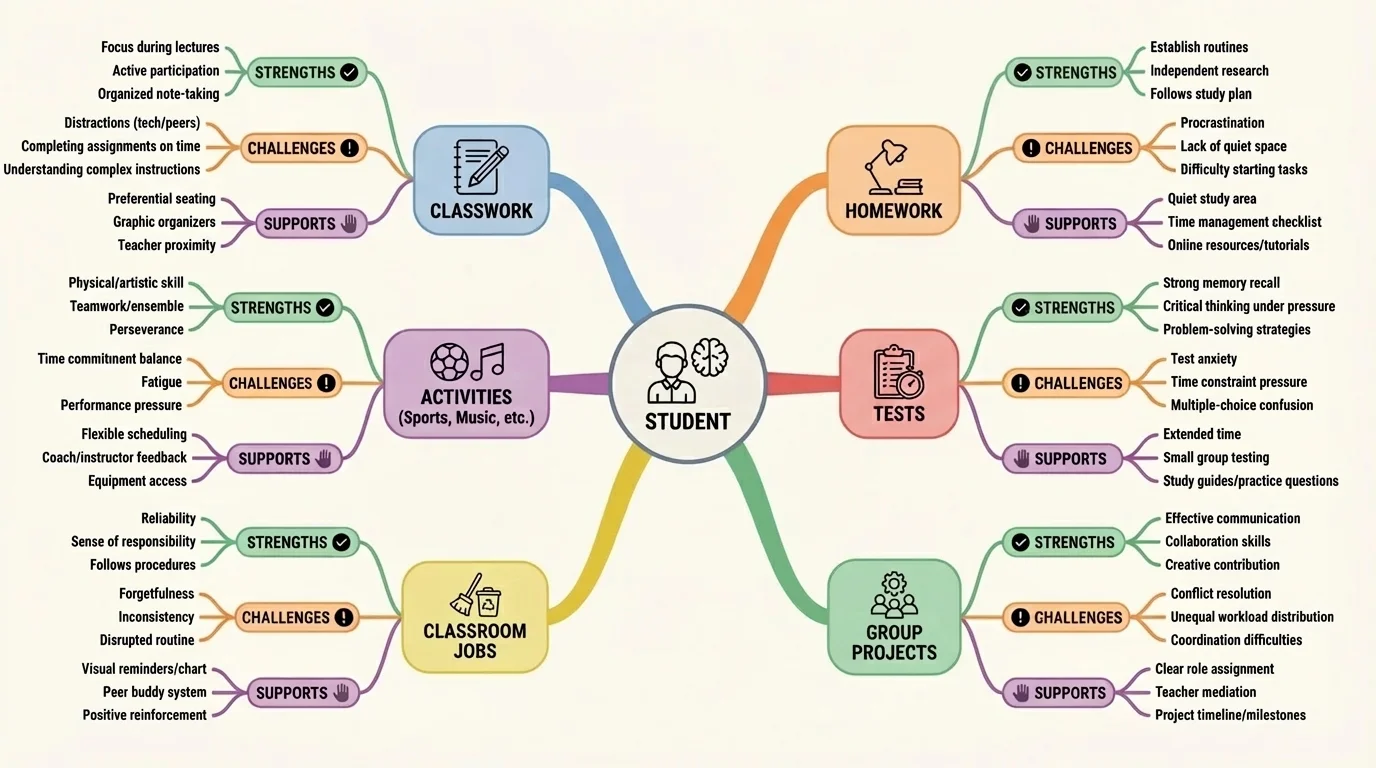
Your strengths are the things you do well or feel confident about. Strengths are not only about grades. They can be about how you think, how you treat people, or how you handle your time.
Strengths, challenges, supports are three key ideas:
Here are some strength examples in different school responsibilities:
Strengths can be about how you do things, not just what you do. For example, maybe math is sometimes hard, but a strength you have is that you keep trying and do not give up. That is a powerful strength for any responsibility. 💡
Challenges are the parts that feel hard right now. Everyone—kids and adults—has challenges. Having challenges does not mean you are not smart. It just shows where you might need more time, practice, or support.
Some examples of challenges across responsibilities are:
Many challenges are connected to self-awareness and self-control. For example, noticing, "I always rush on tests," is the first step to changing that habit. Once you can name a challenge, you are already beginning to manage it.
Challenges as chances to grow
Each challenge can become a chance to grow. When something is hard, your brain is working to build new connections. This is part of a growth mindset, which means believing you can improve with effort, practice, and good help.
It is important to remember that a challenge in one responsibility does not mean a challenge in every responsibility. You might struggle to remember homework but be amazing at class discussions. 🌱
Supports are anything that helps you do your responsibilities better. Supports are not "cheating." They are fair ways to help everyone learn and succeed.
We can think of supports in three groups:
These are people who help you with school responsibilities:
These are objects or technology that make responsibilities easier:
These are ways of working that help you do your best:
The supports you need might be different for homework than for tests, or different for group projects than for sports. That is normal.
Now that we understand responsibilities, strengths, challenges, and supports, we can start to compare them. Comparing means looking at two or more things side by side to see what is the same and what is different. We can organize this information in a chart, like the one shown in [Figure 2].
The table below shows how one imaginary student, Maya, might describe her strengths, challenges, and supports in three responsibilities.
| Responsibility | Strengths | Challenges | Supports |
|---|---|---|---|
| Classwork | Listens well; asks questions | Gets distracted by noise | Sits near front; uses earplugs |
| Homework | Works carefully | Forgets to bring it home | Packs bag right after school; checklist by door |
| Group projects | Kind to others; shares ideas | Feels shy presenting | Practices at home; stands near a friend |
Table 1. Example comparison of strengths, challenges, and supports across responsibilities.
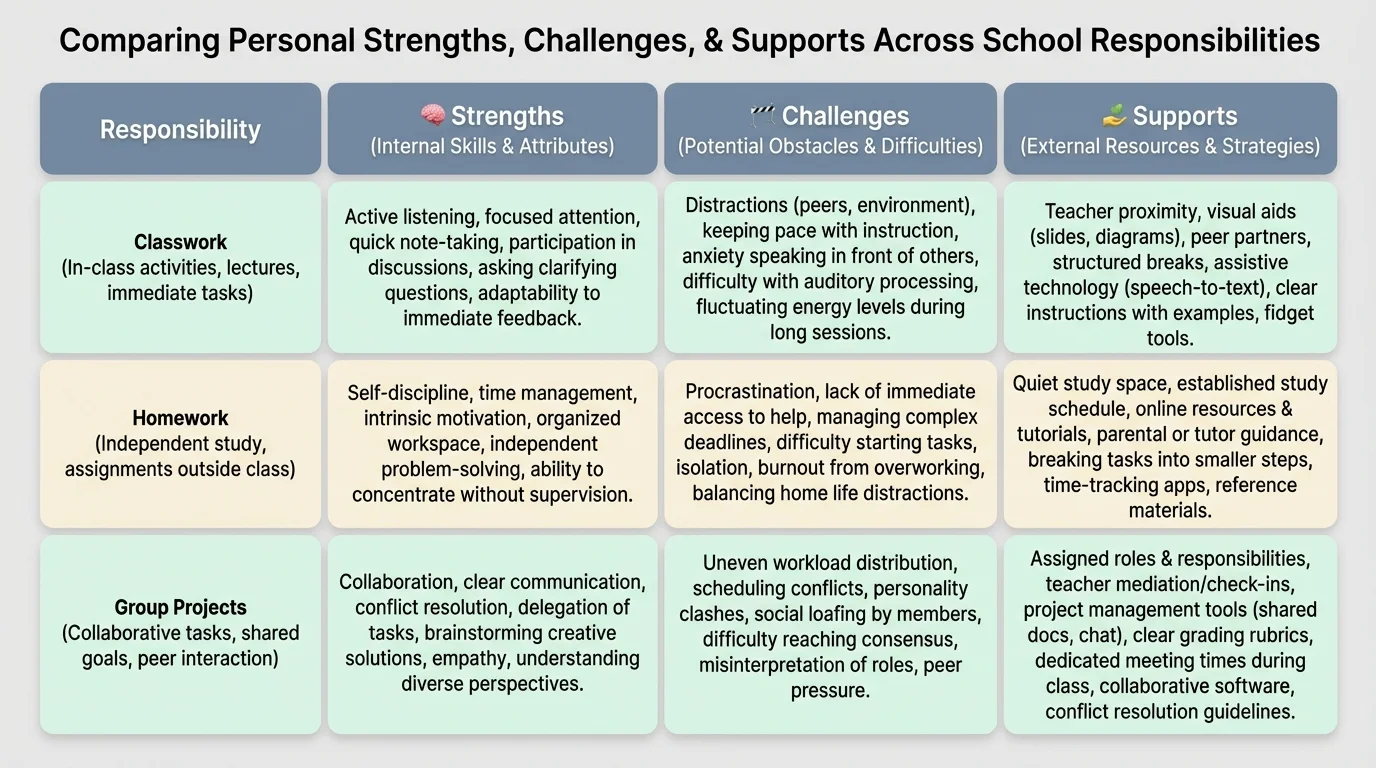
When you look at Maya's chart and at the chart in [Figure 2], you can notice patterns:
Comparing like this helps you see where your individuality shows up. You might be very social in group projects but quiet in tests. You might be bold in sports but nervous in class discussions. All of these are parts of who you are.
Self-awareness means paying attention to your own thoughts, feelings, and actions. It is like holding up a gentle mirror to yourself. Instead of judging yourself as "good" or "bad," you notice what is happening and how you can grow.
You build self-awareness by asking thoughtful questions, such as:
Over time, you can notice changes:
These changes show personal growth. Growth does not always mean "perfect." It means moving forward, learning from mistakes, and trying again. 🎉
Some adults still use planners, reminders, and checklists every day, just like students, because everyone needs supports—even after school is over.
When you practice self-awareness, it also helps your relationships. You can tell friends or teachers, "I'm good at explaining ideas, but I get really nervous talking in front of the whole class. Could I start by sharing in a small group?" That is using self-awareness and self-advocacy together.
Let us look at a few short stories to see how different students' strengths, challenges, and supports compare across responsibilities.
Case Study 1: Jordan
Jordan loves science and group work.
Step 1: Jordan's strengths
In classwork, Jordan is great at hands-on activities and explaining ideas out loud. In group projects, Jordan is a strong leader who keeps the group on task and makes sure everyone has a job.
Step 2: Jordan's challenges
Jordan rushes through written work and sometimes forgets to show steps in math. On tests, Jordan sometimes answers quickly without fully reading the question.
Step 3: Jordan's supports
Jordan's teacher reminds the class to underline key words in test questions and to check their work. Jordan also pauses after each problem to ask, "Did I show all my thinking?"
Across responsibilities, Jordan shows strong speaking and leadership strengths, but needs supports for slowing down and checking.
Think about how Jordan's pattern might be similar or different from yours. Maybe you are the opposite: careful on tests but quiet in groups.
Case Study 2: Lina
Lina is quiet but very thoughtful.
Step 1: Lina's strengths
For homework, Lina is very organized. She writes all assignments in her planner, finishes them early, and keeps her papers neat. On tests, she reads slowly and carefully and rarely makes careless mistakes.
Step 2: Lina's challenges
In group projects, Lina feels nervous and sometimes lets others make all the decisions. In class discussions, she often has ideas but worries they are not good enough to share.
Step 3: Lina's supports
Lina's teacher sometimes gives her a "sentence starter" like, "I agree with you because…" to help her join in. A friend in her group invites her to share at least one idea each time.
Lina's comparison shows strong planning skills and careful work, but challenges with speaking up. Her supports focus on building confidence and giving her safe ways to share.
You might notice that both Jordan and Lina have strengths and challenges, but in different places. That is individuality in action.
Case Study 3: Mateo
Mateo is energetic and creative.
Step 1: Mateo's strengths
In activities like sports and art club, Mateo has lots of energy and great ideas. In group projects, he keeps people laughing and helps make the project fun.
Step 2: Mateo's challenges
During classwork, Mateo sometimes talks off-topic and distracts others. For homework, he sometimes forgets to start until very late. On tests, sitting still for a long time is hard.
Step 3: Mateo's supports
Mateo uses a timer to work for short times, like 10 minutes, and then takes a quick stretch break. He keeps a sticky note on his desk that says, "Is this the right time to talk?" His coach also reminds him that focusing in class helps him do better in sports, too.
Mateo's comparison shows strong creativity and energy, with challenges in self-control and time management. His supports help him use his energy in a positive way.
Once you start to notice your own patterns, you can use that information to make school life better.
Here are some ways to use what you know:
As you learn more about your strengths, challenges, and supports across all your school responsibilities, you are not just becoming a better student. You are also becoming a stronger, more aware person who understands how you work, how you feel, and how to keep growing. 🌟
